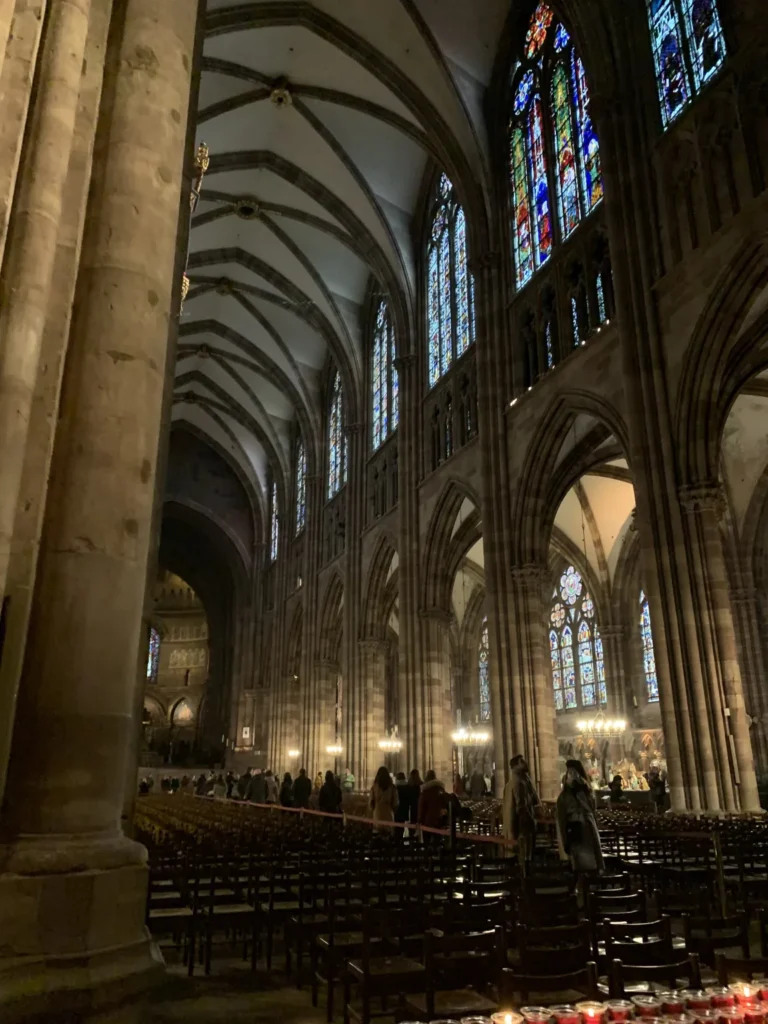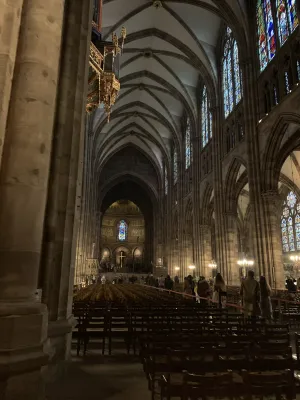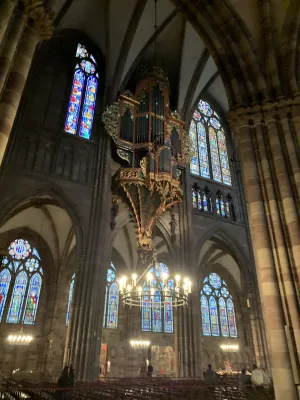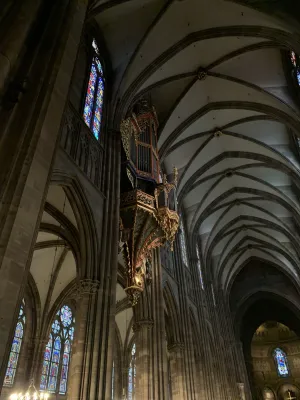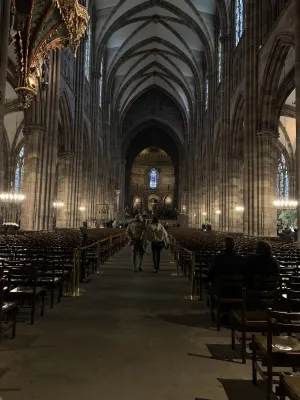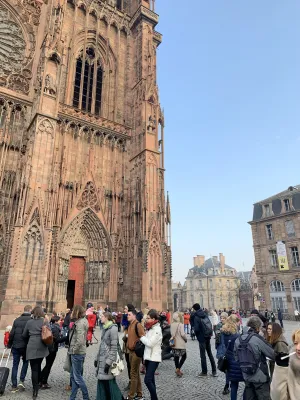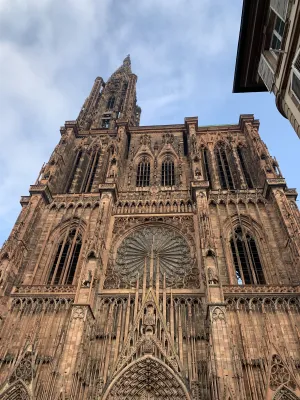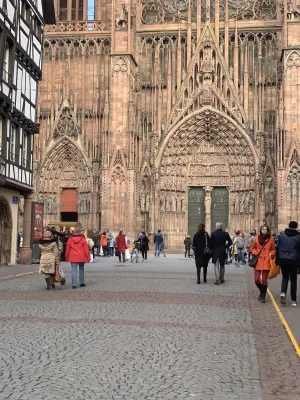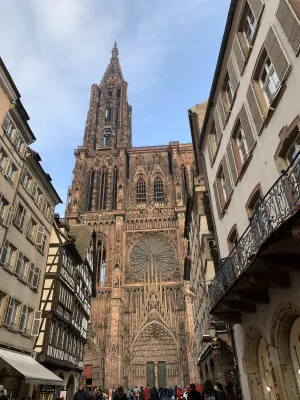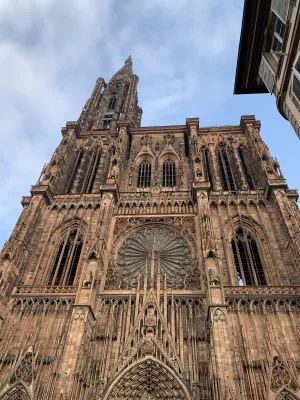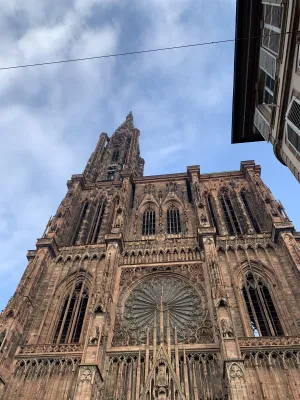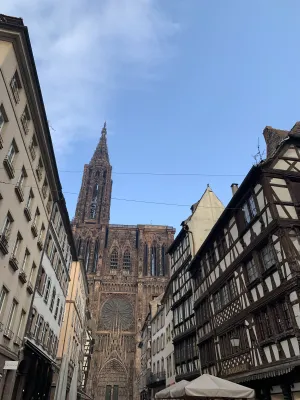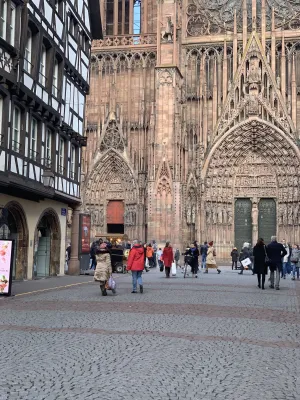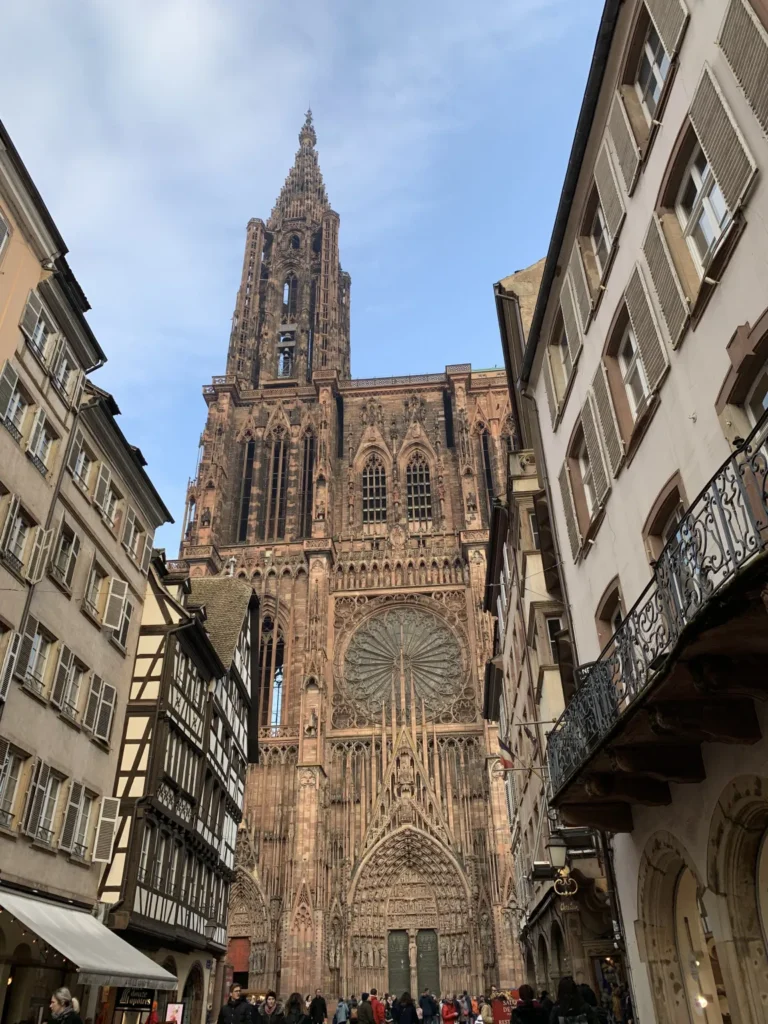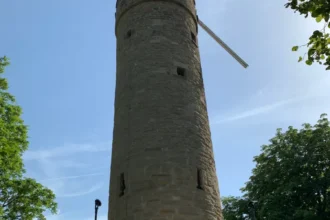

Strasbourg Cathedral is an undeniable masterpiece of Gothic architecture and a landmark of historical and artistic significance. A monument built on layers of history. Construction of the original Romanesque cathedral began in 1015, but today only the crypt and the floor plan remain. The iconic Gothic tower of today’s cathedral was completed in 1439. Victor Hugo once described it as “a marvel of colossality and delicacy,” an impression reinforced by the elaborate and ornate details of the façade. With its 142-meter-high tower, the cathedral was the tallest building in Christendom until the 19th century. Notre-Dame de Strasbourg Cathedral (French: Cathédrale Notre-Dame de Strasbourg), commonly known as Strasbourg Cathedral, is a Roman Catholic building in Strasbourg, Alsace. It is one of the most important church buildings in European architectural history and is one of the largest sandstone buildings in the world. This Romanesque-Gothic basilica is an example of a harmonious fusion of German and French cultural influences. The cathedral was built between 1176 and 1439 from pink sandstone from the Vosges mountains, replacing earlier buildings that had been destroyed by fire in 1007 and 1015. Construction progressed from northeast to southwest, initially in the Romanesque style before transitioning to the Gothic style. The cathedral’s 142-meter-high north tower was the tallest building in the world from 1647 to 1874. Renowned architects such as Erwin von Steinbach and Ulrich Ensinger were involved in its design. Despite war damage in 1870 and 1944 and the iconoclastic unrest of the Reformation, the interior and decorations of the cathedral have been preserved. The maintenance of the cathedral has been managed since at least 1281 by the Œuvre Notre-Dame, which also runs the Maison de l’Œuvre museum. A lasting symbol of Alsace. The cathedral’s striking asymmetrical shape—its south tower was never completed—remains a landmark of Alsace. Visible from the German banks of the Rhine, as well as from the Vosges and Black Forest mountains, its presence is unmistakable. On clear days, the cathedral’s tower can even be seen from the Turmberg in Karlsruhe and the Trifelsblick hut near Gleisweiler, which are about 50 and 55 miles away, respectively. Among the most famous sights inside the cathedral are the astronomical clock and the “Pillar of Angels.” Other notable features include the pulpit, the baptismal font, the swallow’s nest organ, the stained glass windows, and the tapestries depicting the life of the Virgin Mary – each of which is a testament to Western art. Both Catholic and various Reformation preachers have served in the cathedral, which remains the seat of the Archdiocese of Strasbourg. Origins: From pagan temple to early Christian church. The hill on which the cathedral stands was once the site of a Roman temple dedicated to Hercules and Mars, and possibly even an older Druidic sanctuary. In the 4th century, a Christian wooden shrine stood on this site. In 510, King Clovis I commissioned the construction of a stone church, which was later enlarged under Bishop Arbogast and Dagobert in 675 and rebuilt in the Carolingian style around 775, before being destroyed by fire in 873. These early buildings have largely been lost, and their exact location is unknown. Romanesque and early Gothic phase. In 1007, the rebuilt church was struck by lightning, prompting Bishop Werner to commission the construction of a large three-nave basilica in 1015, which was repeatedly damaged by fires until 1176. Archaeological finds from 2012, including a massive lime kiln probably used for the construction, provide insights into its past. In 1190, a new phase of construction began in the late Romanesque style. The crypt was extended to the west, and the apses, choir, and transept were built on the foundations of the previous building, which led to certain irregularities, such as the pillars in the middle of the transept, which were necessary for the vaults. High Gothic splendor. Around 1245, work began on the nave in the High Gothic style, which is characterized by elaborate triforia. By 1275, the new nave was completed, and in 1277, under the direction of Erwin von Steinbach, the foundation stone for the west facade of the cathedral was laid, which was continued by Erwin’s son Johannes after Erwin’s death in 1318. The west facade, which was originally planned with two towers, underwent changes in design and execution over time. By 1383, Michael von Freiburg had connected the towers with a bell tower, creating a uniform facade block reminiscent of the vertical structure of Notre-Dame de Paris. From 1399, under the direction of Ulrich Ensinger and later Johannes Hültz, the octagonal upper floors of the north tower were added, which were crowned with an openwork spire in 1439 and reached a height of 142 meters. Although plans existed to complete the south tower, these were never implemented. Later developments and restoration. Between 1495 and 1505, the richly decorated Laurentius portal on the northern transept was built by Jakob von Landshut. In 1835, a lightning rod was installed, disturbing the tomb of Erwin von Steinbach. Gustave Klotz led the restoration after the artillery damage of the Franco-Prussian War in 1870, replacing the central tower with a larger one by 1875 and decorating the choir with neo-Byzantine frescoes by Eduard von Steinle. Despite heavy bombing during World War II, the stained glass windows, which had been safely stored elsewhere, and the richly decorated west facade remained intact, preserving the cathedral’s splendor. Strasbourg Cathedral is not only an outstanding example of Gothic architecture, but also a living chronicle of cultural and historical change, from Roman times to medieval innovations to modern restoration work. Its elegance, historical significance, and artistic splendor continue to fascinate visitors from all over the world.