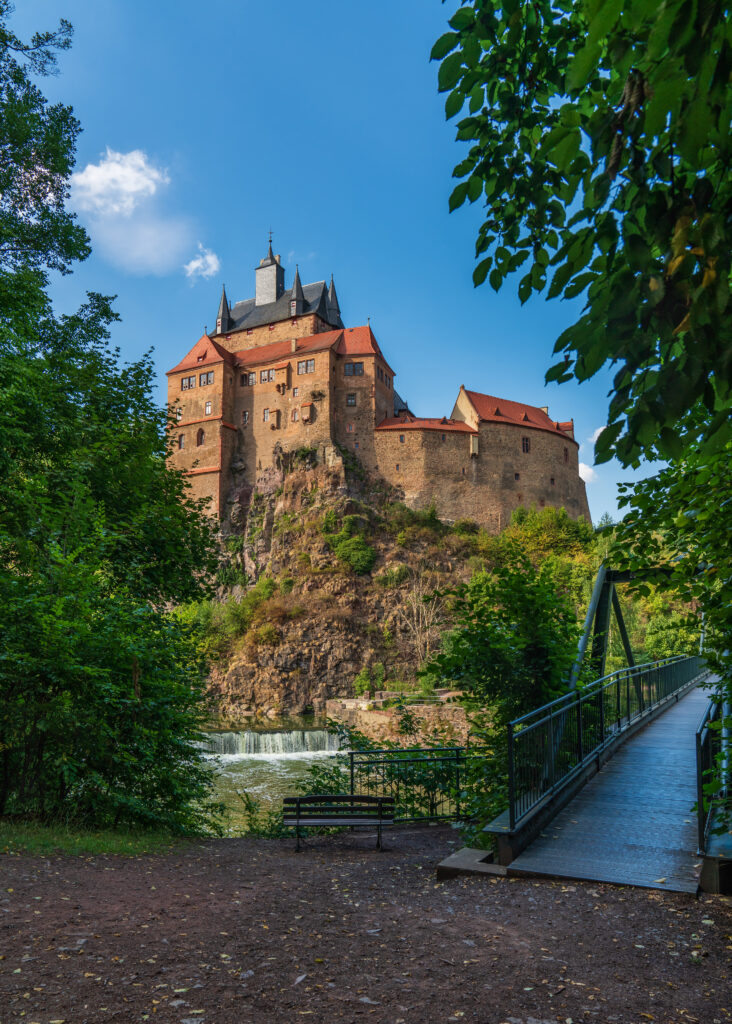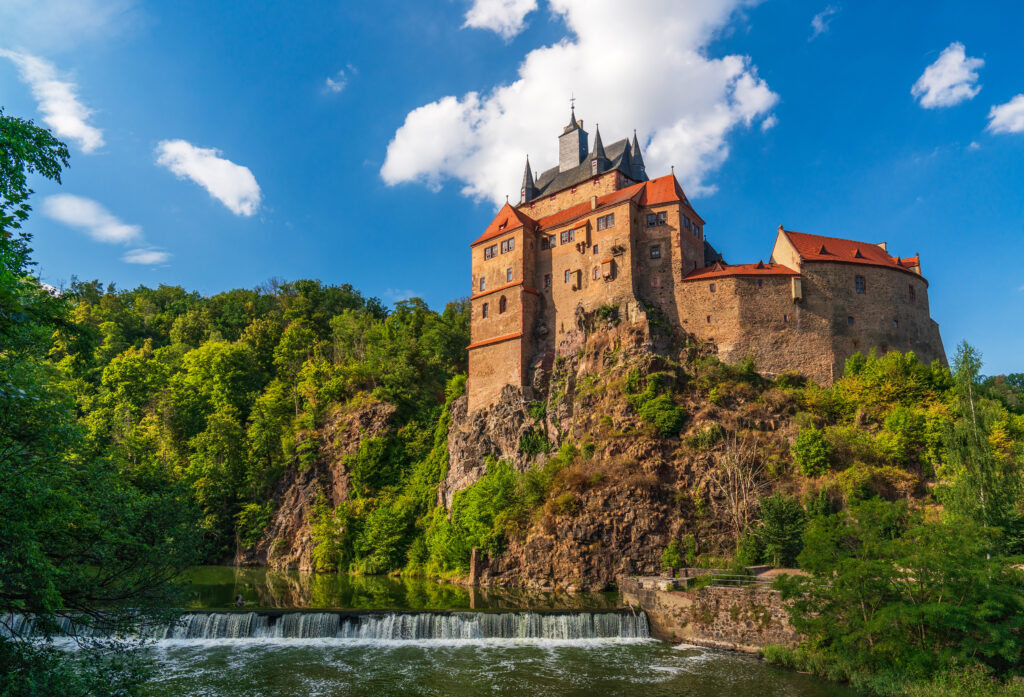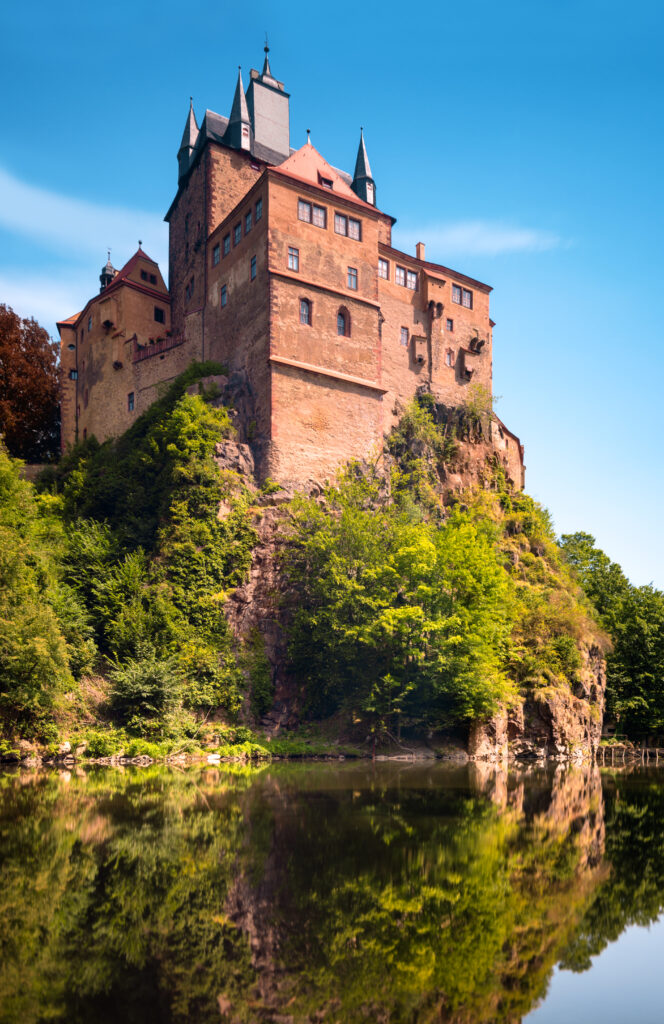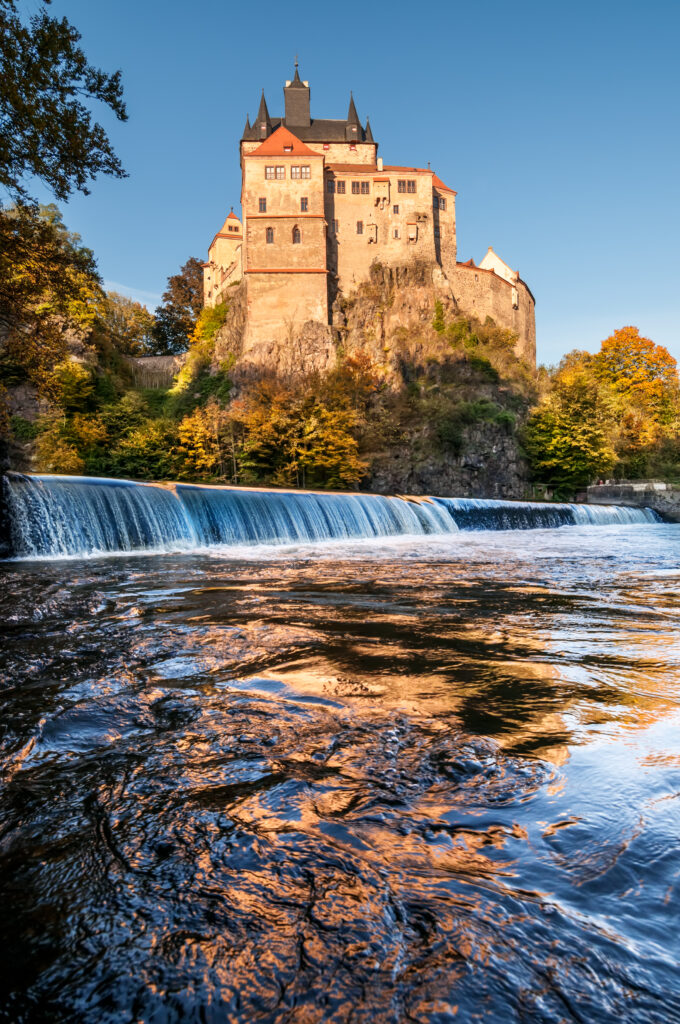

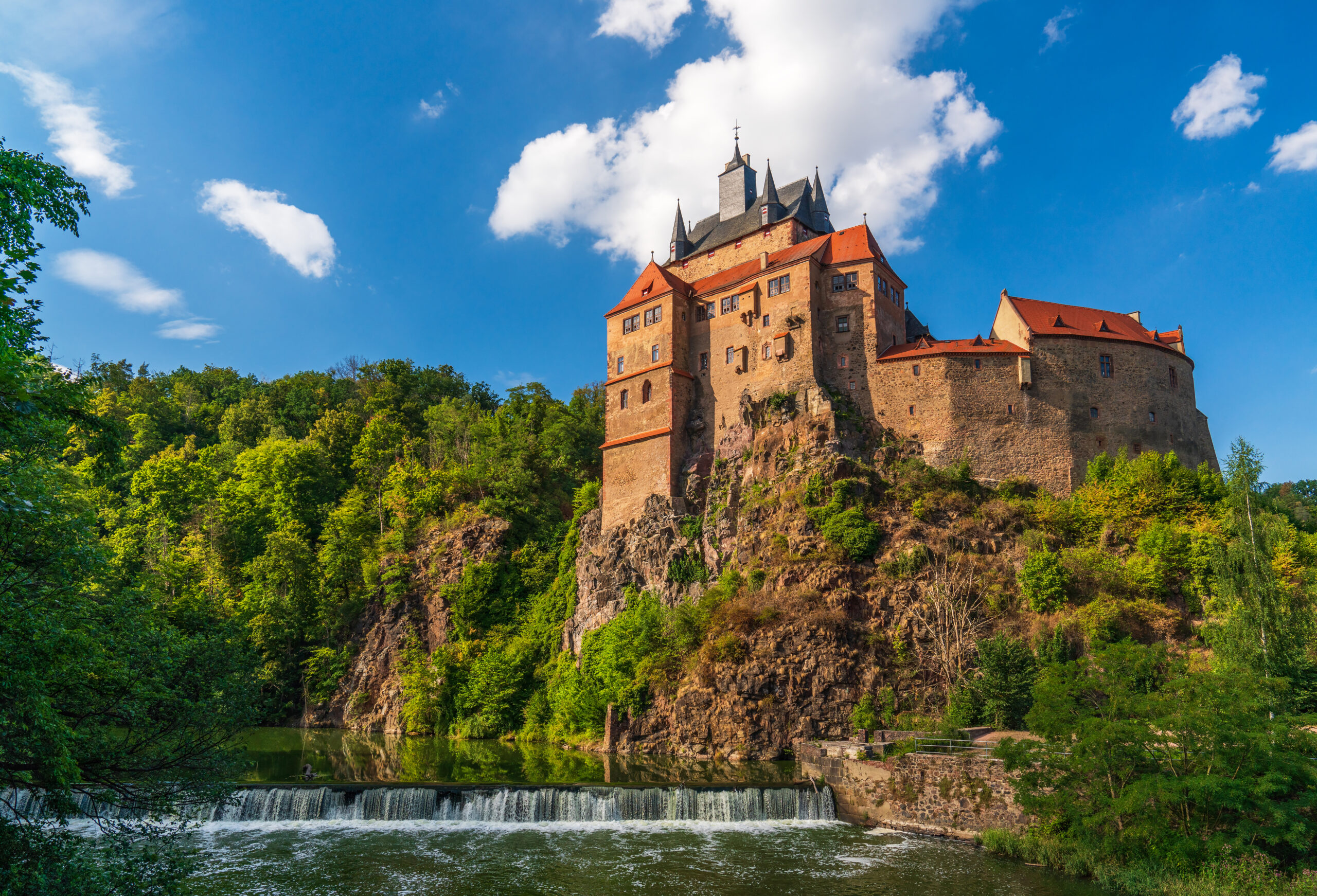
Perched on a rocky outcrop above the Zschopau River, Kriebstein Castle captivates all who see it with its imposing silhouette. This medieval fortress, nestled in the quiet village of Kriebstein near Waldheim in Saxony, dates back to the 14th century. Kriebstein is rich in history, myths, and legends and remains a lasting testament to Gothic architectural splendor and historical intrigue.
An architectural marvel – The unique structure of Kriebstein Castle is an example of the typology of a castle built on a rocky outcrop. The fortress, which is only accessible via a deep artificial moat, encompasses the monumental residential tower, which rises to a height of 45 meters and has a base area of 22 by 12 meters. Built around 1399, the tower, with its late medieval turrets and distinctive ridge turret, forms the basis for the castle’s emblematic silhouette. Surrounding this citadel are the gatehouse, the curtain wall, the service wing, the kitchen house, and the chapel wing, all of which contribute to the oval layout of the complex.
The Beerwalde legacy – The castle’s historic past began with the Beerwalde family, who made it their center of power. Before Kriebstein, the Beerwalde family lived in a tower castle surrounded by a moat called “Waal,” the remains of which can still be seen today. When Dietrich von Beerwalde promised to build “Krywensteyn” (according to some historical records) in 1384, the foundation stone was laid for today’s Kriebstein, which is largely a uniform construction based on his design. The most important elements from this period include the residential tower, the chapel, and the curtain wall, while little remains of his father’s earlier fortress.
Renovations by Schleinitz – Under Hugold III von Schleinitz, the castle underwent extensive reconstruction in the mid-15th century. Schleinitz commissioned Arnold von Westfalen, the architect of Albrechtsburg Castle in Meissen, to carry out extensive renovation work. This included the addition of a new service wing with a ballroom and a well room, as well as alterations to the rear palace and the kitchen building. These alterations contributed to the castle’s present form, while retaining its Gothic character.
After the death of Hugold von Schleinitz in 1490, the castle changed hands frequently, but remained largely unchanged in terms of its structure until the 17th century. Under the new prominent Schönberg family, further extensions were made, such as the addition of further floors to existing buildings and the construction of a staircase between the tower and the gatehouse.
The Arnim era – In 1825, Karl Hans von Arnim-Planitz acquired the castle, initiating another significant phase of redesign under the direction of court architect Karl Moritz Haenel. Between 1866 and 1868, the castle underwent extensive neo-Gothic renovation. Although these changes were carried out with great care, they somewhat obscured the medieval character of the fortress. Notable alterations included the demolition of the original wooden kitchen building, which was replaced by a more stable structure, and changes to the interior layout. Despite these changes, the Arnims ensured that the splendor of Kriebstein was preserved. By 1930, parts of Kriebstein Castle had been opened to the public. The Arnim family’s commitment to maintaining and restoring the castle without state funding earned it the reputation as “Saxony’s most beautiful knight’s castle.”
The transition after the war – After World War II, the castle was confiscated by the state and used for various purposes, including as a residence and forestry administration office. It was not until August 1949 that Kriebstein was reopened as a museum. A fascinating discovery was made in 1986 when a treasure hidden in the residential tower was found, which belonged to Heinrich Graf von Lehndorff-Steinort, who had sought refuge in Kriebstein from the advancing Red Army. Since January 1, 1993, Kriebstein Castle has been owned by the Free State of Saxony and is administered by the Saxon State Office for Castles, Palaces, and Gardens. In 2010, an agreement was reached between the state and the Lehndorff heirs to return 423 cultural assets previously stored in the castle.
Legends and folklore – No description of Kriebstein would be complete without mentioning its rich myths and legends. One of these stories tells of a tragic love affair between a young noblewoman and a minstrel. The forbidden love blossomed within the castle walls, but cruel fate separated the two. Their spirits are said to haunt the castle grounds, their love immortal despite the passing of centuries. Another fascinating myth concerns the “ghost knight,” a ghostly figure who is believed to have been one of the castle’s first lords. According to legend, he wanders the halls, protecting the fortress from all threats and ensuring that Kriebstein’s historic past remains untainted.
Kriebstein Castle is a monument to Saxony’s rich history, embodying stories of grandeur, architectural mastery, and human resilience. With its striking Gothic elements and dramatic location, it continues to attract visitors who want to travel back in time and uncover its secrets. Whether you are fascinated by its medieval architecture or enthralled by the legends that surround its stone walls, Kriebstein remains a beacon of historical and cultural significance in the heart of Saxony.