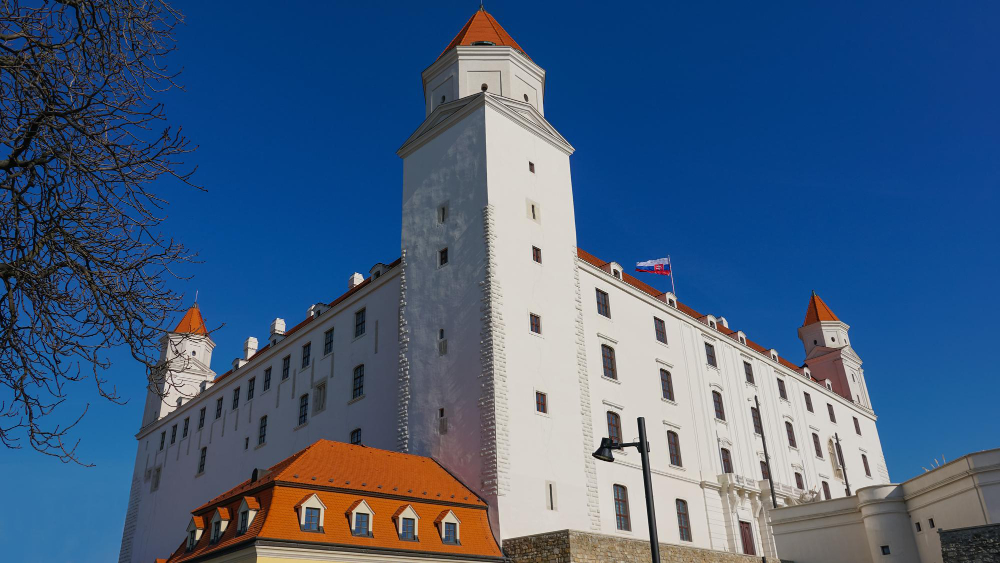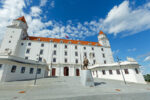

Bratislava Castle stands majestically atop a hill overlooking the Danube and is one of Slovakia’s most famous landmarks. Its imposing presence has inspired countless stories—mysterious legends and historical chronicles that tell of a steadfast structure marked by both triumph and tragedy. From its humble beginnings as a fortress to its current role as a cultural symbol, Bratislava Castle has witnessed centuries of human ambition, conflict, and legacy. Let’s step behind the castle’s imposing facade and discover the fascinating stories that breathe life into its stones.
Origins in Antiquity – Long before Bratislava Castle received its iconic crown of four corner towers, the site where it stands was already a hub of human life. Archaeological findings suggest that Celtic tribes first settled the area in the 1st century BCE, drawn by its strategic location overlooking important trade routes along the Danube. These early inhabitants built a fortress on the hill, likely to defend themselves against rival tribes and protect their burgeoning trade. During the Roman era, this strategic site became part of the Roman Empire’s border, known as the Limes Romanus. The soldiers stationed in the area were tasked with protecting the empire’s border against Germanic incursions. Although these ancient fortifications no longer survive, they marked the beginning of Bratislava’s significance as a site of political and military importance—a legacy carried on by the castle itself.
The Medieval Transformation – The first true form of Bratislava Castle emerged in the Middle Ages. Around the 9th century, the hill, once frequented by Celts and Romans, became home to a Slavic settlement. After the region was incorporated into the Great Moravian Empire, the site gained in importance. During this period, fortified structures took shape, offering protection against marauding enemies in the face of growing external threats. Bratislava rapidly developed into a center for regional administration and religious ceremonies. At the beginning of the 10th century, when the area came under Hungarian rule, the castle was converted into a full-fledged stone fortress. The emerging Kingdom of Hungary used Bratislava Castle not only as a military fortress but also as a symbol of power in the northern part of its territory. Over the years, kings and rulers expanded the complex, adding massive walls and towers that cemented its reputation as a virtually impregnable bastion.
Coronation Glory and the Queen’s Legacy – In the 16th century, Bratislava Castle achieved its greatest fame as the coronation site for Hungarian monarchs. This era began after the Ottoman Empire conquered Buda in 1541, forcing a shift in Hungary’s administrative and ceremonial functions. Bratislava was chosen as the new center of power due to its proximity to Vienna and its easily defensible location on the Danube. A symbolic moment in the castle’s history occurred in 1563, when Emperor Maximilian II was crowned King of Hungary in St. Martin’s Cathedral—a church located directly below the castle. Coronations such as this cemented Bratislava’s reputation as a place where history was made. After ascending the throne, rulers often graced the castle’s halls with lavish banquets and council meetings. A legend associated with the castle tells of Queen Maria Theresa of Austria, perhaps its most famous royal resident. Known for her intelligence, her steadfastness, and her reforms, Maria Theresa left a deep mark on the castle’s history. She had the building extensively renovated and transformed it into a magnificent Baroque palace with elegant interiors befitting an empress. Folklore tells that Maria Theresa once wandered through the castle’s halls late at night to find solace in moments of solitude. Her ghostly figure, clad in royal robes, is said to still occasionally roam the halls, forever linked to the splendor she helped create.
Destruction and Reconstruction – While the royal splendor of Bratislava Castle reached its peak in the 16th and 17th centuries, the late 18th century brought its darkest hour. In 1811, a devastating fire ravaged the castle, reducing much of it to smoldering ruins. Accounts of the cause of the fire vary; some blame careless soldiers stationed there, while others point to structural flaws. Regardless, the destruction was so severe that the castle remained abandoned for nearly two centuries. It stood as a grim reminder of the transience of grandeur and was visited only by those who gazed upon its charred silhouette and pondered in wonder what had once been. And yet the story of Bratislava Castle did not end in ashes. In the mid-20th century, the Slovak government launched a monumental project to restore the castle to its former glory. Architects and historians meticulously examined old blueprints and surviving structures to recreate the castle’s original splendor. By the 1960s, the rebuilt Bratislava Castle stood proudly once more, reflecting the Baroque splendor that had flourished under the reign of Maria Theresa.
Legends and Ghost Stories – No medieval castle would be complete without its ghost stories and whispered legends, and Bratislava Castle is no exception. One of the oldest tales revolves around a woman named Lucia. According to legend, Lucia was a servant in the castle during the Middle Ages and fell hopelessly in love with a young knight. Her affection, however, went unrequited, and the knight rejected her advances in favor of a wealthy noblewoman. Furious and heartbroken, Lucia cursed the castle and swore that its halls would echo with misery. According to local lore, her spirit still roams the grounds, and her screams mingle with the wind on stormy nights. A more heroic legend surrounds the story of the golden horse hidden beneath the castle. In turbulent times, rulers are said to have buried an ornate statue made of pure gold to protect it from invaders. Treasure hunters have tirelessly searched for this mythical relic, yet to this day, no traces of the golden horse have been discovered. Its alleged existence remains an enticing mystery that inspires visitors to imagine what treasures might lie beneath their feet.
Modern Symbolism and Cultural Role – Today, Bratislava Castle stands as a testament to Slovakia’s resilience and cultural heritage. Its gleaming white facade is visible from miles away and symbolizes both the continuity of history and the country’s modern identity. The castle now houses the Slovak National Museum and invites visitors to explore exhibitions that delve deeply into the region’s rich diversity in the fields of art, archaeology, and politics. The panoramic view from Castle Hill offers breathtaking vistas of Bratislava’s Old Town, the meandering Danube, and on clear days, even as far as the Austrian border. Every year, thousands flock to Bratislava Castle to experience its historic charm up close. As you stroll through its halls and gardens, you can feel the weight of the centuries gently bearing down on the present. Whether you’re exploring the magnificent halls once frequented by monarchs or learning about the ancient settlers who inhabited the hill—there is a tangible connection to the past that is both humbling and inspiring.
A Living Monument – Bratislava Castle is not just a stone structure—it is a living monument to human ingenuity, resilience, and the stories that shape us. Its evolution from a Celtic fortress to a medieval center of power and from a royal residence to a modern cultural center makes it an irreplaceable jewel in the crown of Slovak history. Visitors who make their way to its gates encounter not just a building; they enter a realm where legends and reality coexist.
As the setting sun bathes the walls in golden hues, it is easy to imagine the whispers of ancient rulers, the laughter at banquets, and the tragic cries of Lucia’s broken heart—all mingling with the evening breeze. Bratislava Castle is a lasting reminder that every stone tells a story, and when these stories are woven together, they form the timeless soul of a nation.