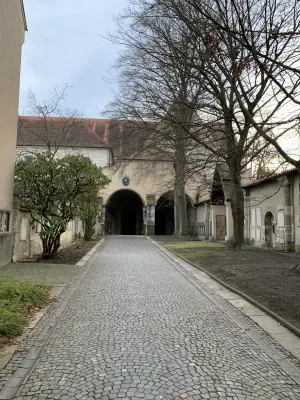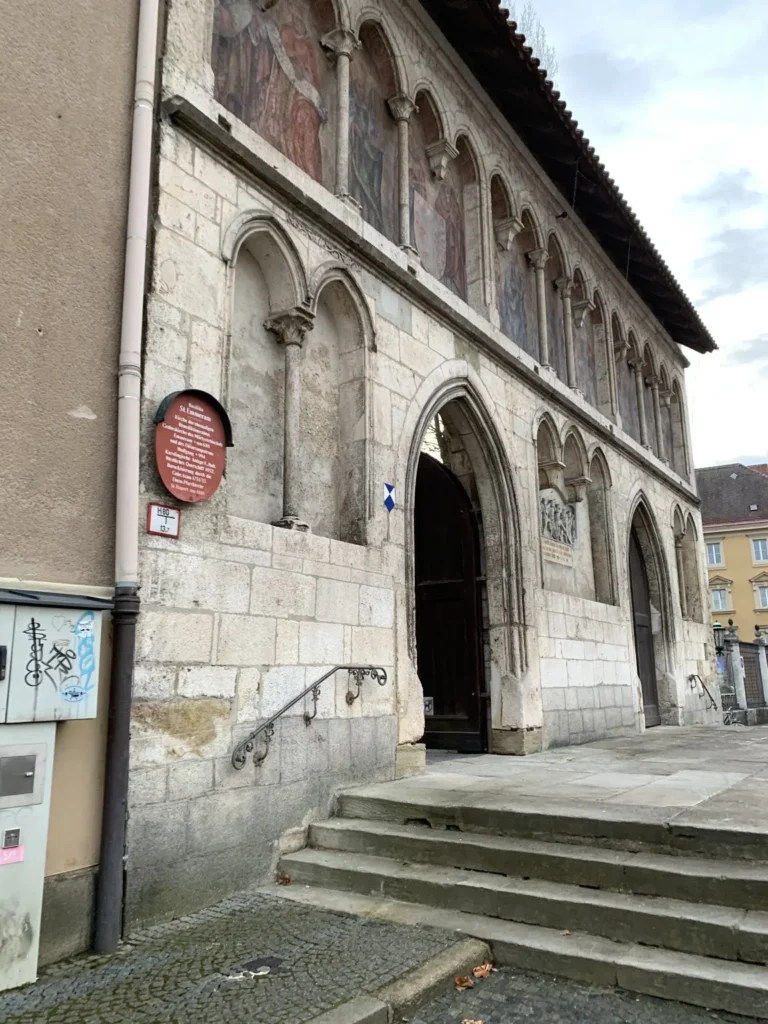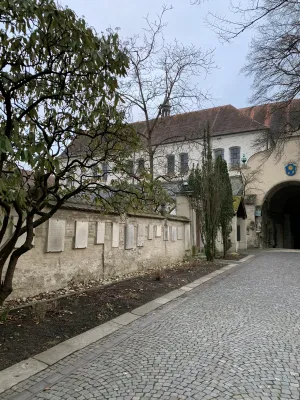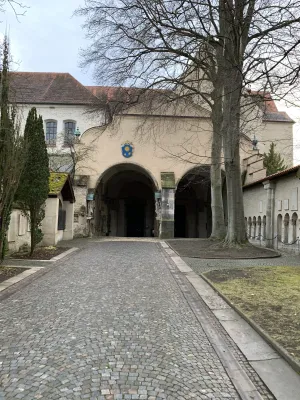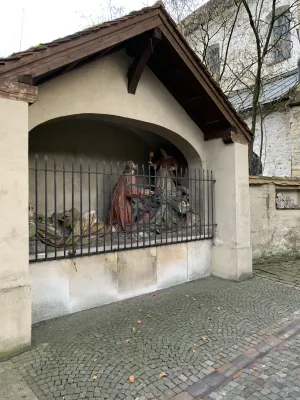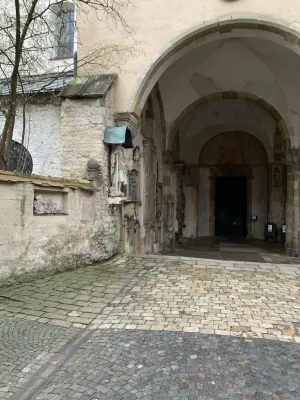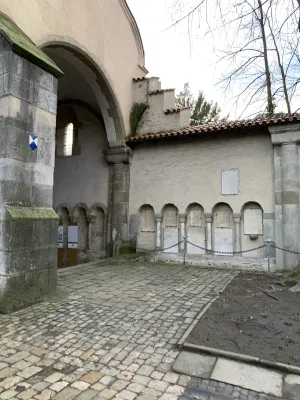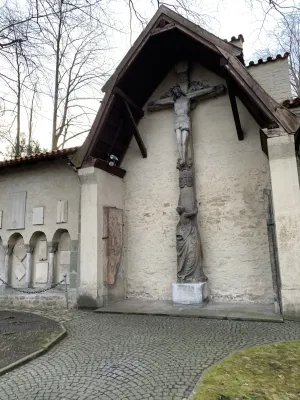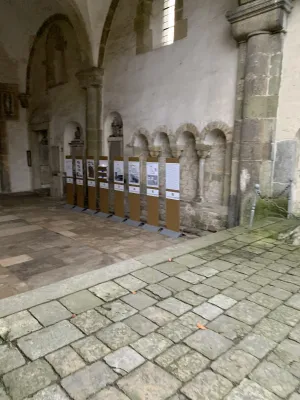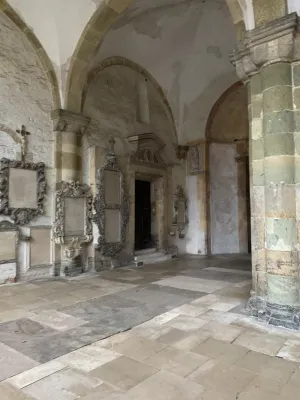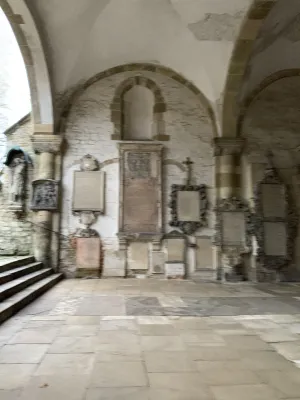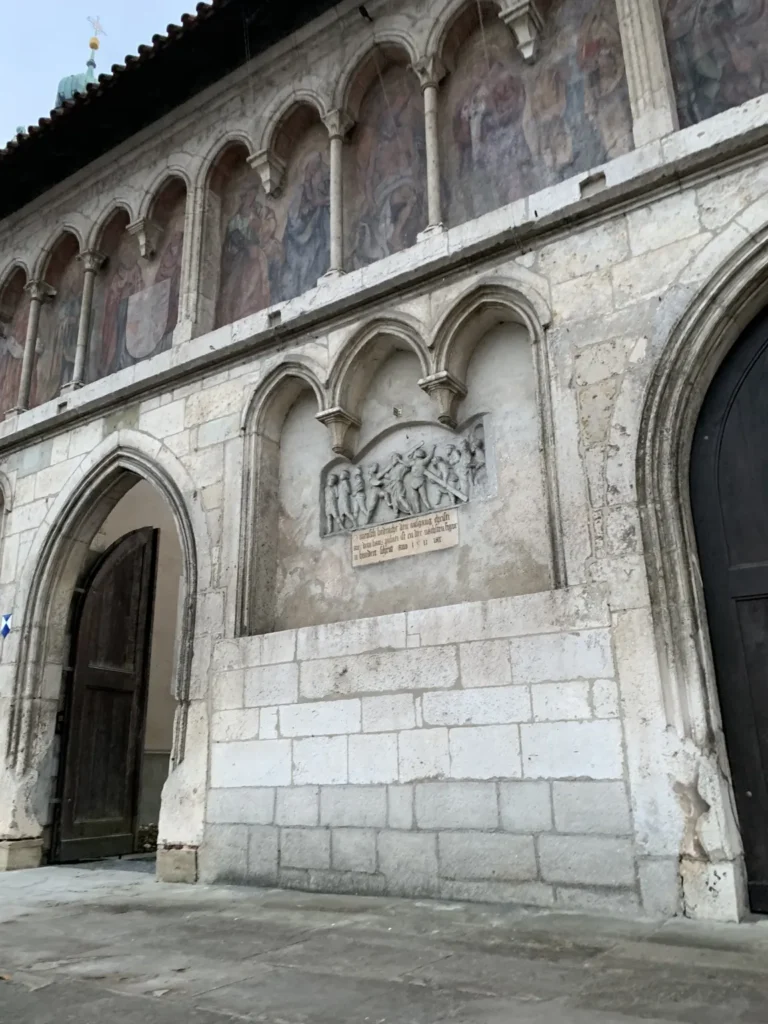

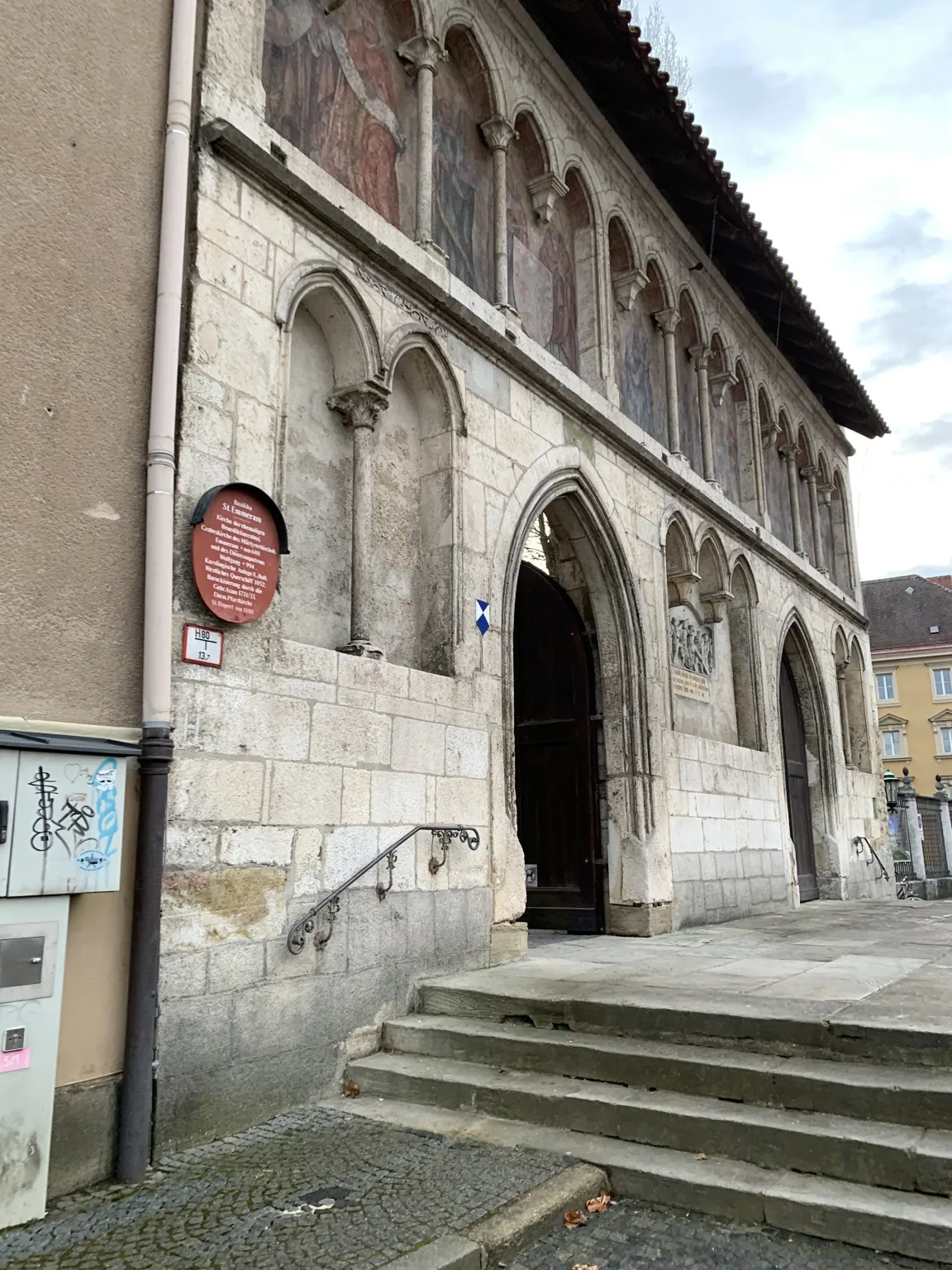
During my visit to the Danube metropolis of Regensburg, I discovered the portal to St. Emmeram’s Basilica while strolling through the old town. St. Emmeram’s Basilica was the church of the former Benedictine abbey and the burial church of the martyr bishop Emmeram around 680 and the diocesan patron saint Wolfgang around 994. To reach St. Emmeram’s Basilica, I entered an imposing Gothic portal, which was located on the site of the early medieval entrance to the Carolingian royal palace from the 9th century. I walked through the portal and arrived at the entrance with a vestibule leading to St. Emmeram’s Basilica. This entrance with a vestibule was once a throne room from the Carolingian period. The hall belonged to the royal palace built by Arnulf of Carinthia, and the double niches at the entrance to St. Emmeram’s Basilica in particular originate from the throne room. The St. Emmeram parish courtyard was once St. Michael’s Chapel, which was consecrated in 982 by Bishop Wolfgang, later St. Wolfgang. The chapel dates back to the Carolingian period. It was a two-story hall building, the floor of which was much lower than the current terrain and whose floors could be reached via the attached tower. This type of construction was known as an aula regia. The lower chapel with its barrel vault served as a crypt, while the upper church, which could be accessed from the upper floor of the palace tower via the west gallery, belonged to the ruler. St. Michael’s Gate Chapel was only accessible from the private rooms of the royal families. In 996, Abbot Ramwold gave the Chapel of St. Michael to Burgrave Pabo I as a family burial place. It became the burial place of the first burgrave. After the Pabonen family died out, the remains were reburied in the basilica and the burgrave’s crypt was dissolved. A fire in 1166 destroyed large parts of the St. Emmeram monastery complex. As a result, Abbot Peringer was only able to have St. Michael’s Chapel rebuilt in the Romanesque style 20 years later. He commissioned an eastern round apse with a blindwork of ashlars. After completion, the church was consecrated in 1189 by Bishop Konrad in honor of the Holy Trinity, the Archangel Michael, and all angels. The copperplate engraving “Heiliger Marterberg” (Holy Martyr’s Hill) by Andreas Geyer is the only source of information about the chapel’s appearance in the High Middle Ages. It shows a high nave with a narrow west tower near the portal wall. From the 13th century onwards, St. Michael’s Chapel became the cemetery chapel for the parish cemetery laid out north of St. Emmeram and St. Rupert. The underground ossuary, which is 8.5 meters deep and has a barrel vault, also dates from this period. A staircase led down from the cemetery on its south side to a gallery from which the bones were thrown into the depths. Adjacent to the 8-meter-long ossuary on the east side was a small room with a transverse barrel vault. In 1727, the Romanesque building was in need of renovation and simply outdated. Therefore, the parish vicar of St. Rupert, Benedictine Father Josef Floßmann, advocated for a renovation. The chapel was given Baroque features by the brothers Cosmas and Damian Asam, and the structure of the previous building was destroyed. The west tower was demolished and the apse was built over with a square tower. The nave was extended and the secular upper floor was removed to vault the space. Unfortunately, from the end of the 19th century, St. Michael’s Chapel was no longer considered worth seeing, so demolition began in 1892 to build the St. Emmeram parish house with a rectory and sacristan’s house in the neo-Gothic style. The ossuary of St. Michael’s was preserved as a relic in the basement. The Basilica of St. Emmeram has something mystical about it; its portal and vestibule with sculptures alone are impressive. Also worth seeing is the legendary Heinrich’s Chair made of dolomite rock in the Wolfgang Crypt in the west niche of St. Emmeram. I was completely captivated by the basilica and its vestibule, and I was fascinated by this historic place, which exuded an air of mystery. In St. Emmeram’s Basilica, 1,200 years of religious, artistic, and cultural history come together to create an impressive experience.