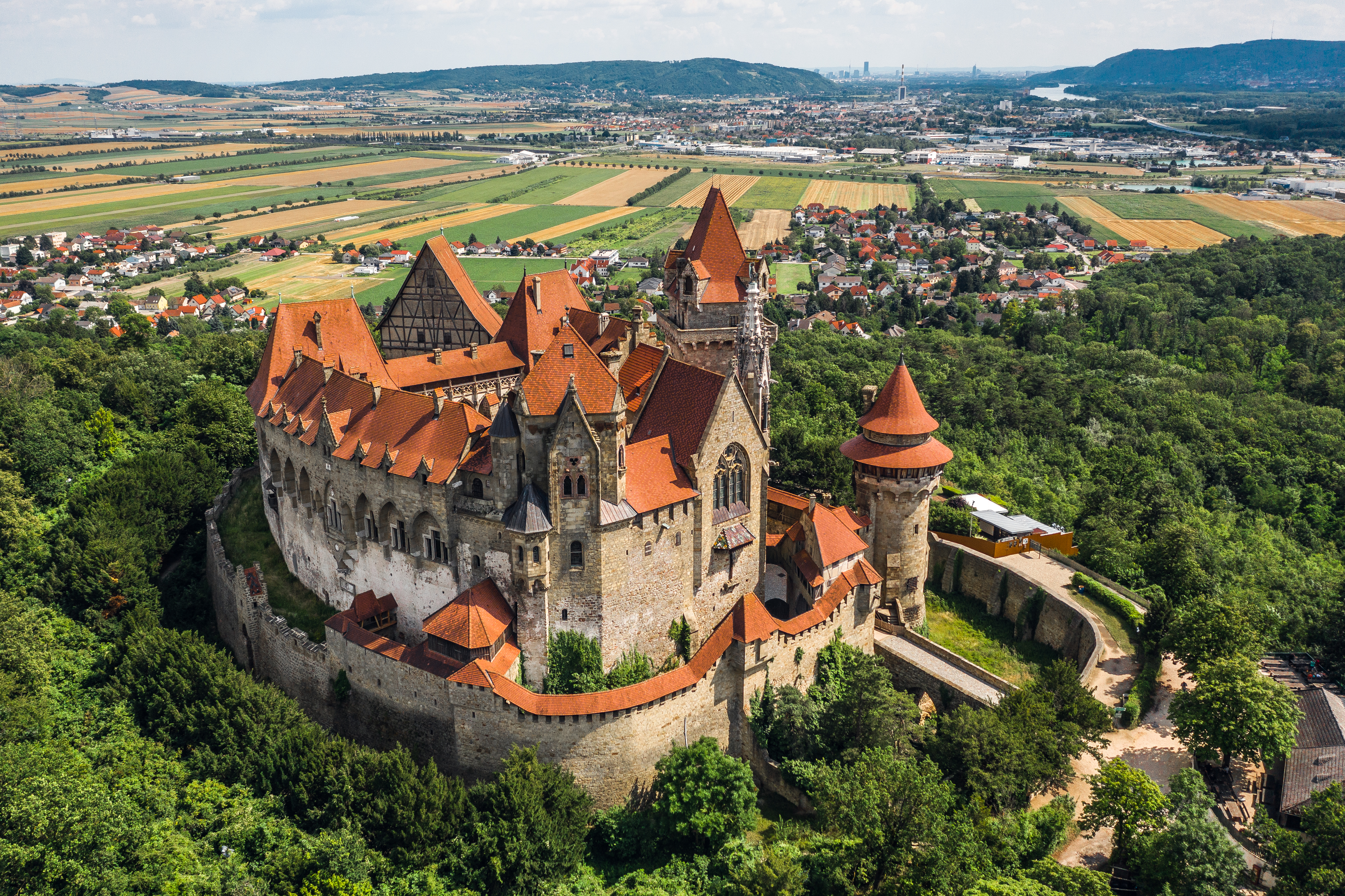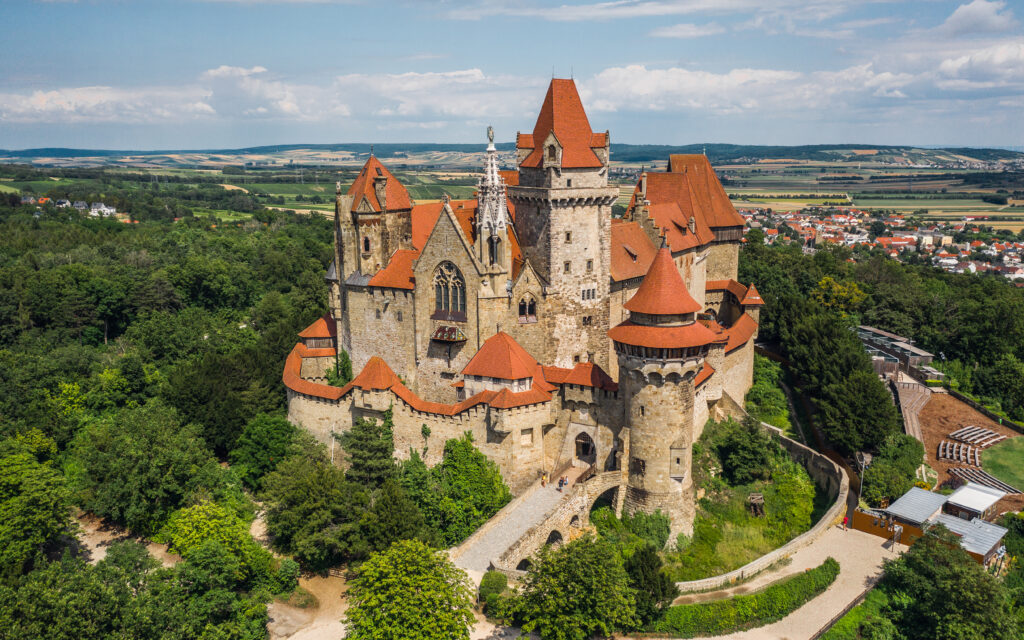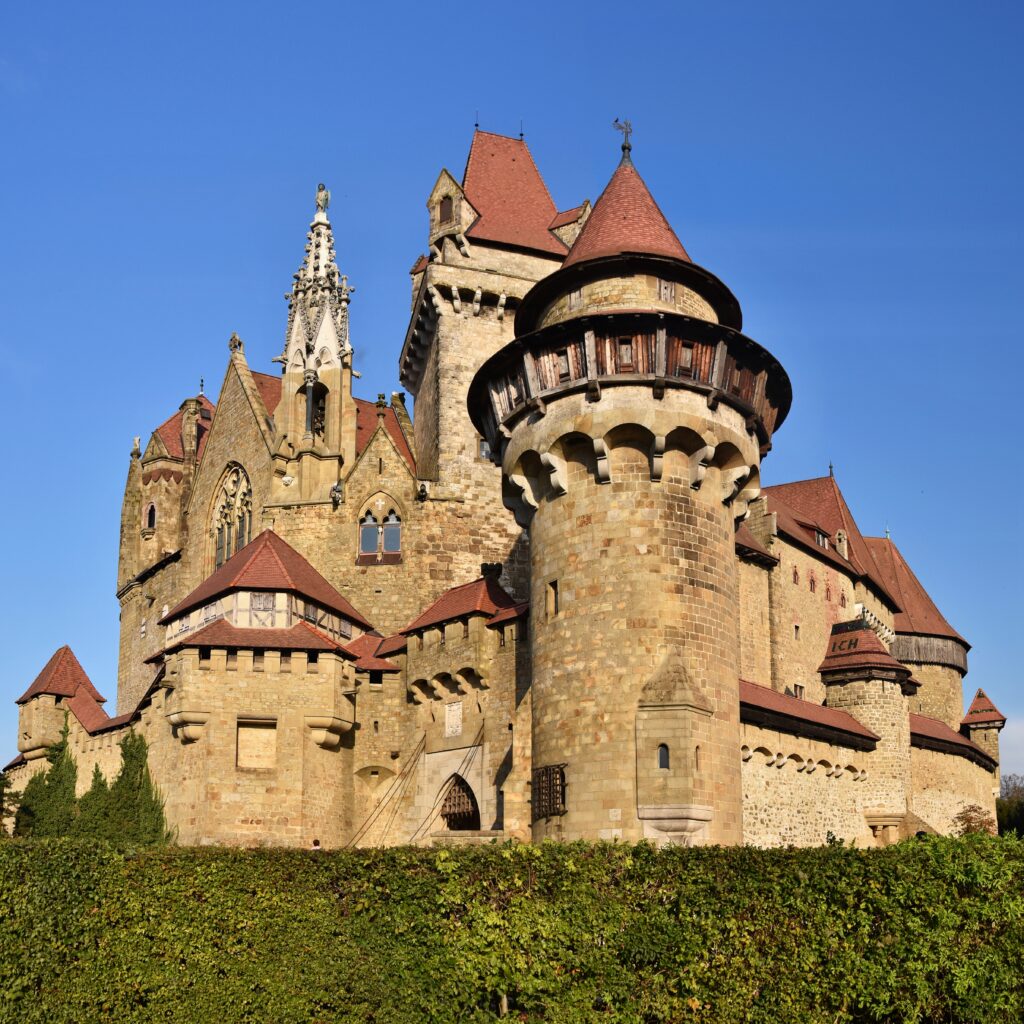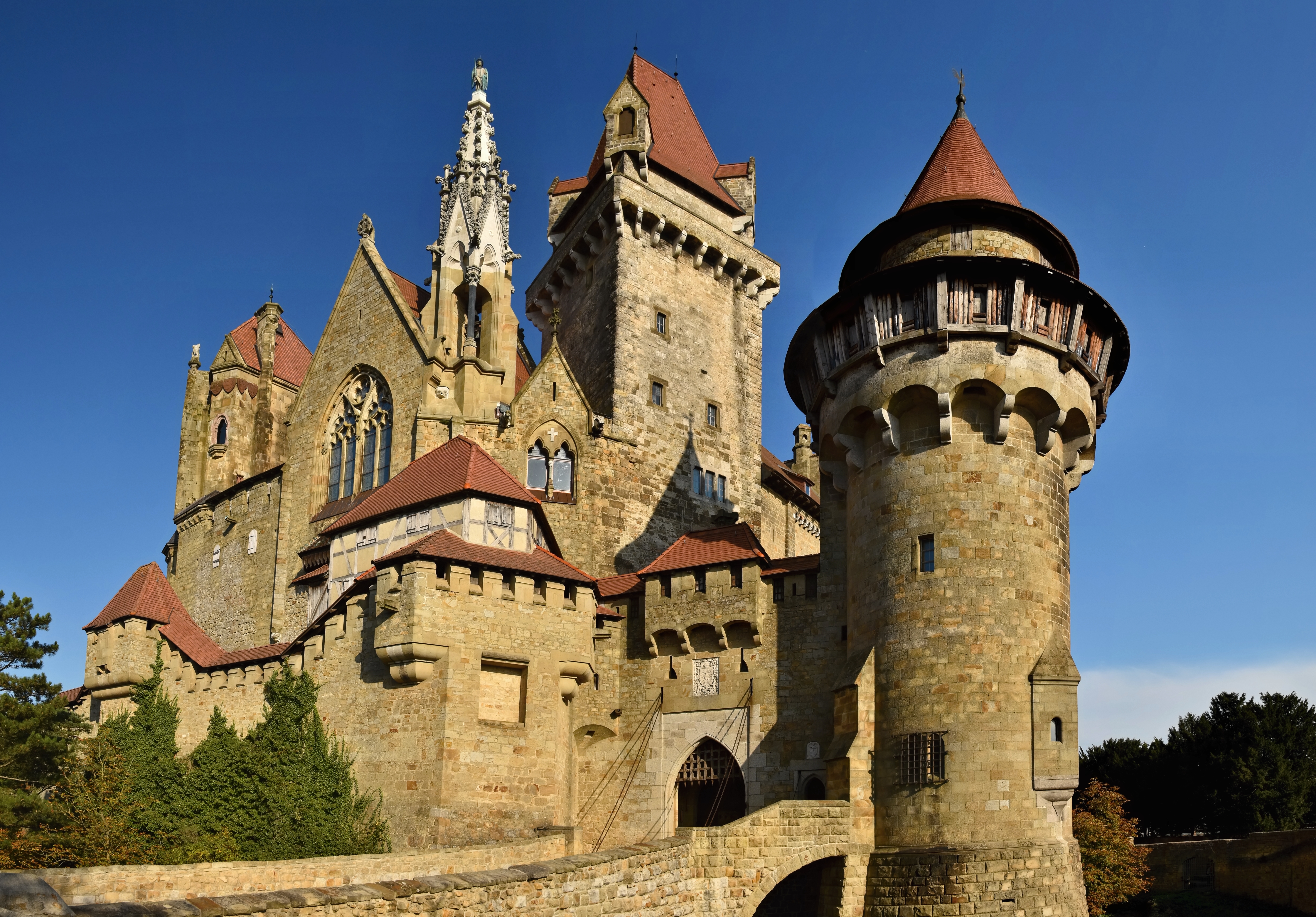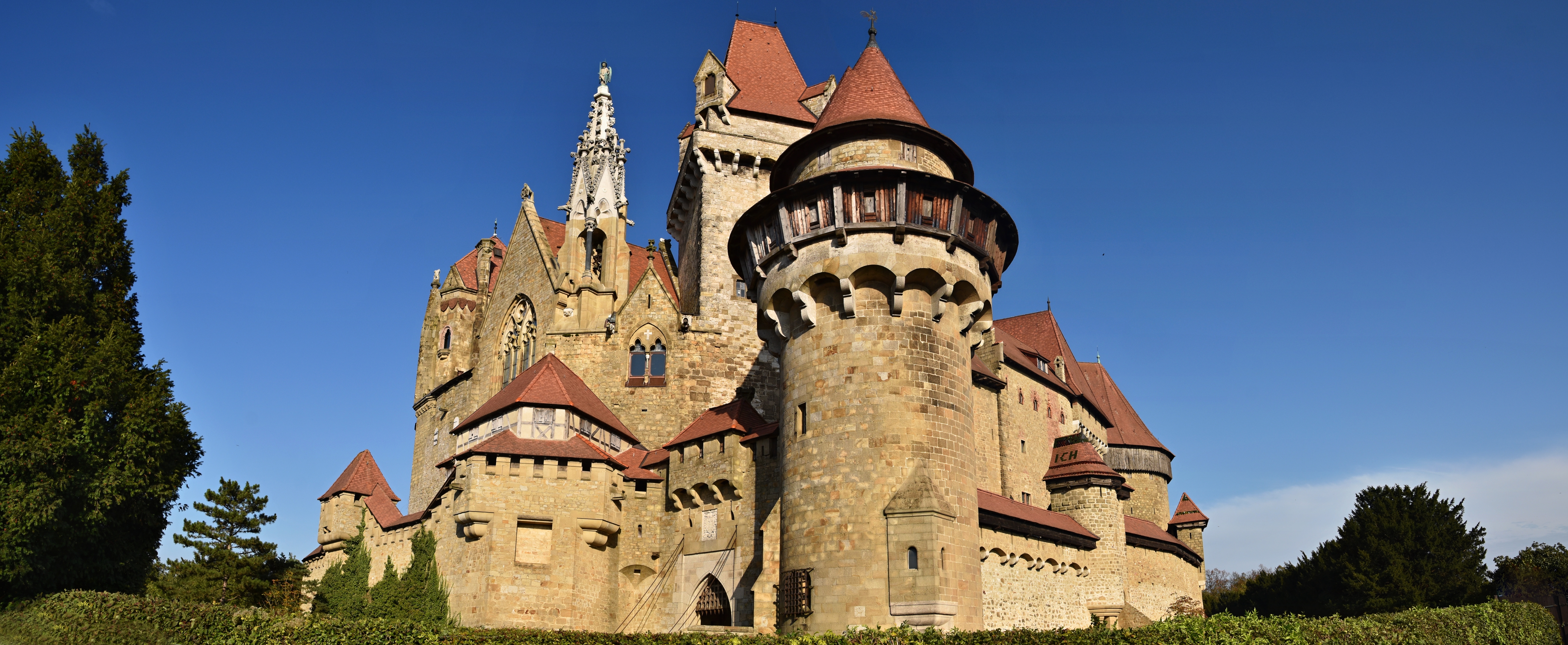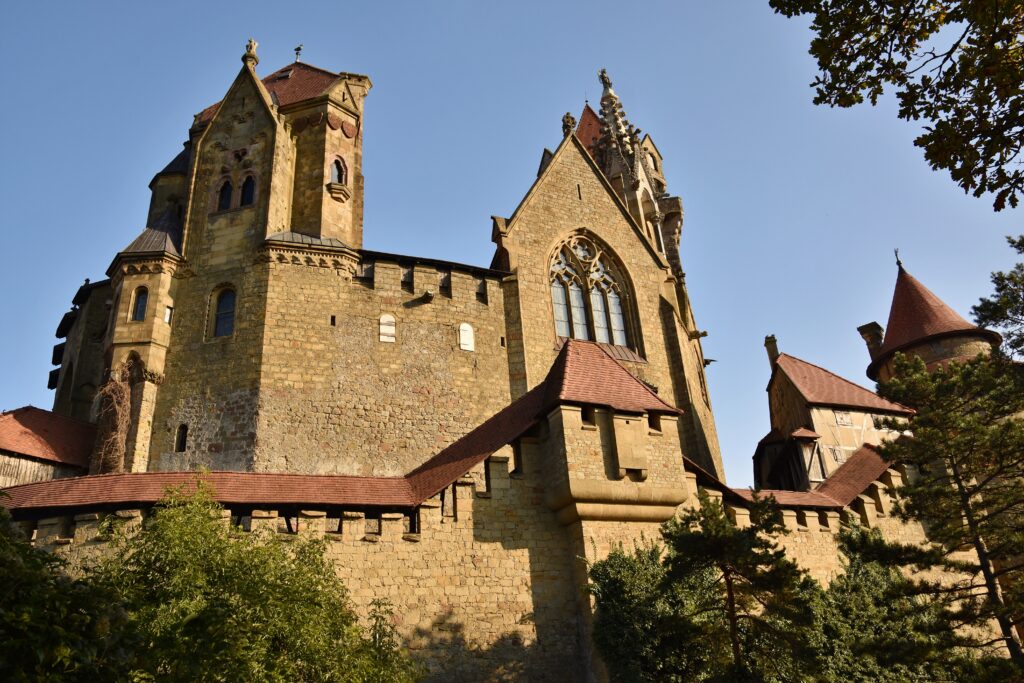

Nestled in the picturesque town of Leobendorf in Lower Austria, Kreuzenstein Castle stands as a testament to history’s resilience and the enduring allure of medieval architecture. Originally constructed during the 12th century, this castle’s story is one of transformation, destruction, and revival. Its intriguing past, full of legendary figures and dramatic events, continues to captivate visitors from around the world.
A Journey Through Time – Kreuzenstein Castle’s roots trace back to the 12th century when it was erected by the noble Formbacher family. By marriage, the castle later passed into the possession of the Counts of Wasserburg. With time, it found its way into the hands of the Habsburg dynasty through the notable Ottokar II of Bohemia in 1278. This marked the beginning of a long association with one of Europe’s most influential royal houses. In July 1527, Kreuzenstein became a grim chapter in religious history. The Anabaptist preacher Balthasar Hubmaier was imprisoned and interrogated within its walls. Refusing to recant his teachings, he faced execution, burned at the stake in Vienna on March 10, 1528. This event exemplified the tumultuous religious fervor of the era.
Destruction and Abandonment – The Thirty Years’ War (1618-1648) brought widespread chaos to Europe, and Kreuzenstein Castle was no exception. Unyielding to numerous sieges, the castle finally succumbed in 1645 during the war’s endgame. Swedish forces under Field Marshal Lennart Torstensson occupied much of Lower Austria, including the castle, sans combat. On April 5, 1645, Colonel Lukas Spicker surrendered the fortress due to insufficient defenses. As the Swedish troops withdrew in September 1645, Torstensson ordered the demolition of Kreuzenstein. Explosions designed to obliterate strategic points left the once-mighty stronghold in ruins. Over the ensuing centuries, local farmers scavenged these remains for building materials, reducing Kreuzenstein to a mere shadow of its former glory.
A Visionary Revival – The dying embers of Kreuzenstein Castle found new life under the stewardship of Count Johann Nepomuk Wilczek in the late 19th century. Acquiring the ruins in the 18th century, the Wilczek family had amassed considerable wealth through coal mining in Silesia. Johann Nepomuk, an esteemed polar explorer, embarked on an ambitious project: to resurrect Kreuzenstein as a museum showcasing his extensive art collections. Starting in 1874, reconstruction efforts spanned over three decades, culminating in the castle’s grand reopening on June 6, 1906. Architect Carl Gangolf Kayser spearheaded the initial phases until his death in 1895, followed by Humbert Walcher von Molthein and artist Egon Rheinberger. These visionaries meticulously integrated remnants of the medieval structure with materials sourced from across Europe, fashioning a “Romanesque-Gothic model castle.” Among the most notable salvaged pieces was the Kaschauer Gang, an elegance-spanning arcade dating back to approximately 1450. Originally part of the St. Elizabeth Cathedral in Košice (Kaschau), Slovakia, it found new purpose spanning Kreuzenstein’s courtyard. Additionally, a spiral staircase from the Renaissance Castle of Göllersdorf and one of the oldest existing medieval stone slingshots from Fortress Hohensalzburg were incorporated into the design.
Famed Turbulence and Resilience – Kreuzenstein’s rebirth faced its own trials. In 1915, a bolt of lightning ignited a fire that partially destroyed the archive and library wing. World War II also left its mark; the castle sustained significant damage during 1945 clashes between the German Wehrmacht and the Red Army, resulting in looted artifacts. Many of Count Wilczek’s manuscripts now reside in the Austrian National Library. Despite these setbacks, the Wilczek family retained ownership and continued restoration, ensuring the castle’s historical integrity. Today, Kreuzenstein Castle is a beloved tourist destination just north of Vienna. It hosts events and has even served as a filming location for productions like Netflix’s “The Witcher” and Disney+’s “Shardlake.”
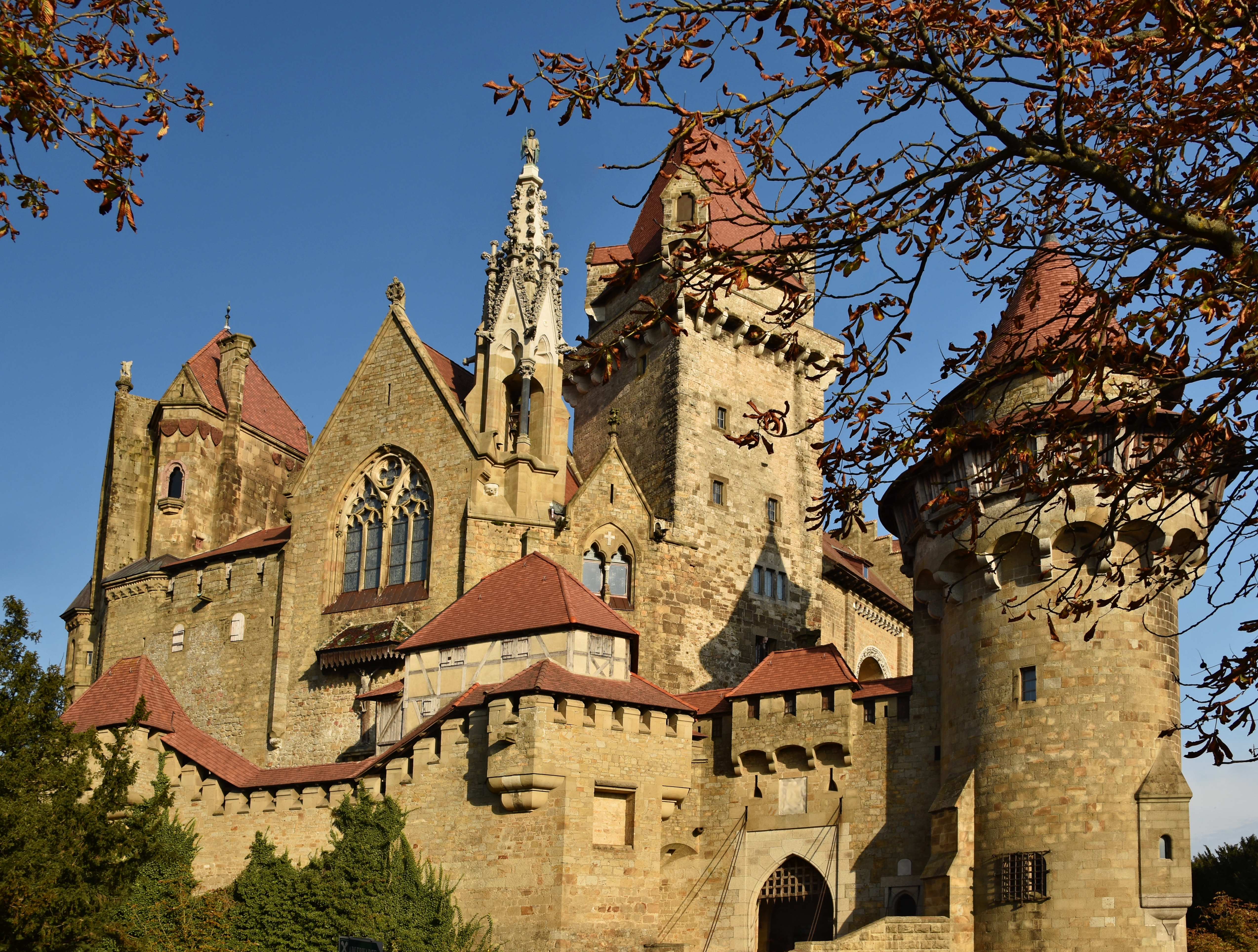
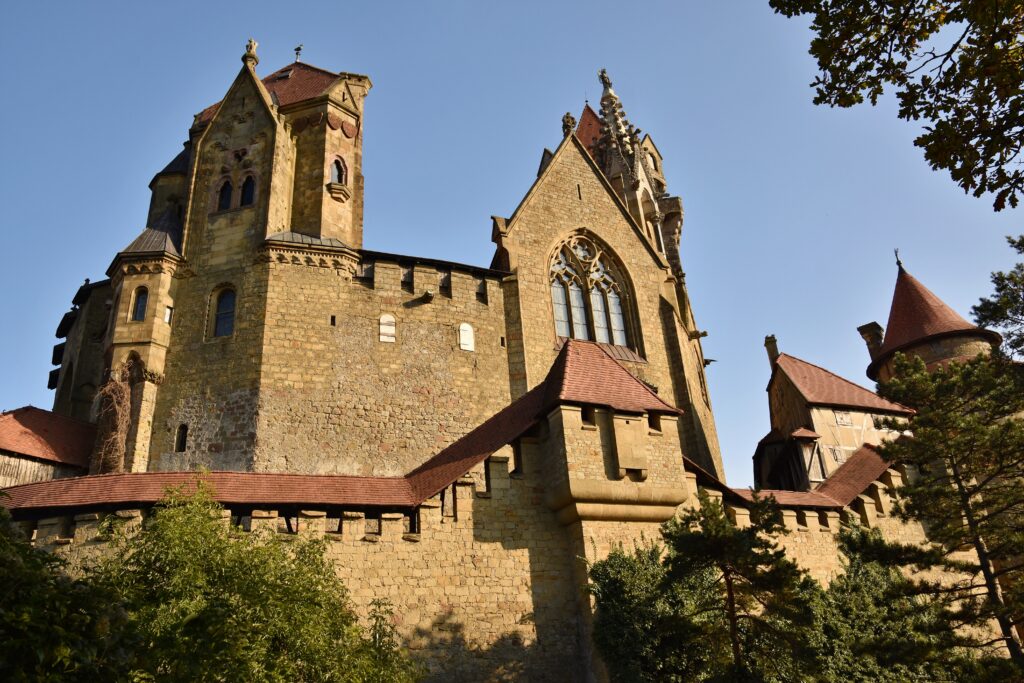
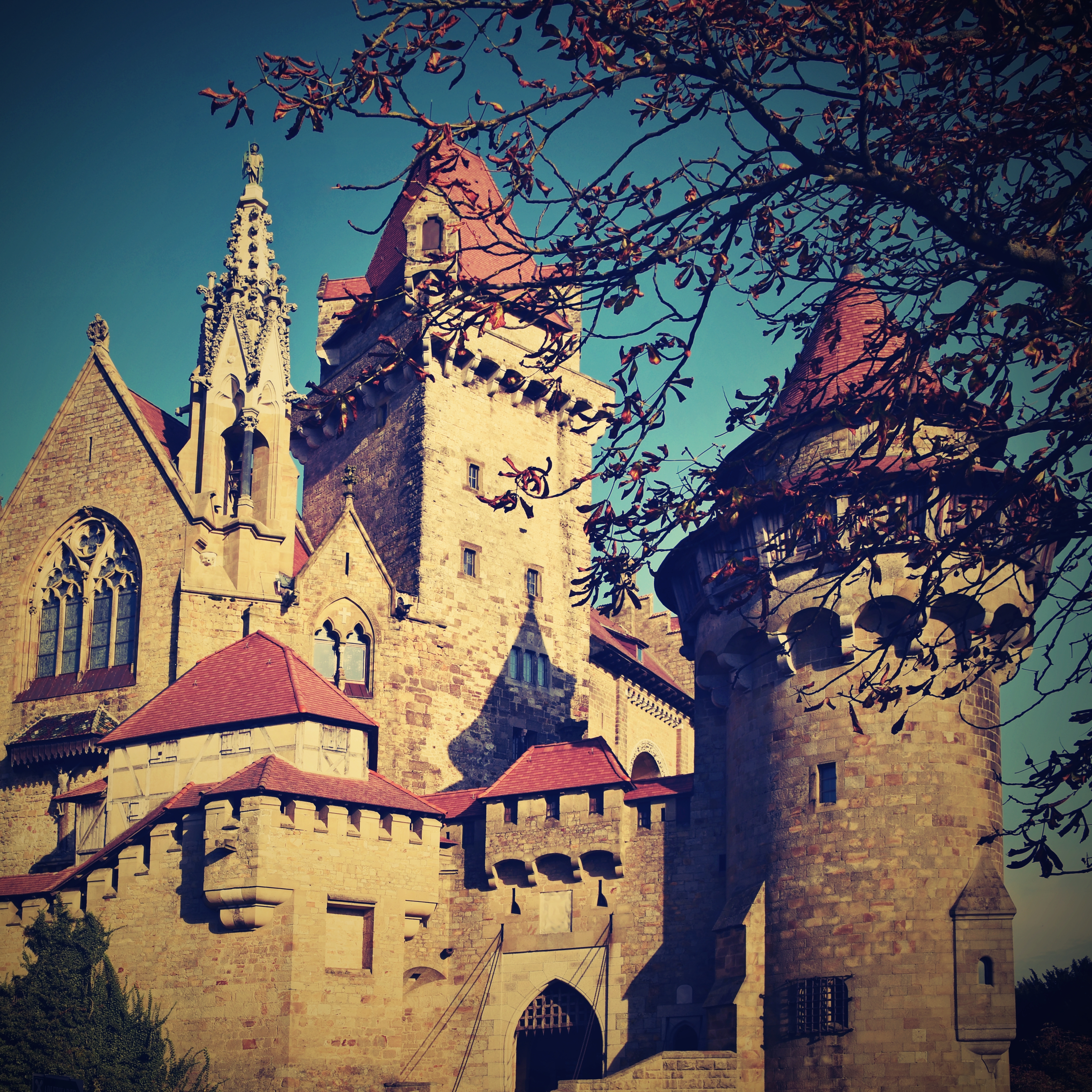
Architectural Marvel – Kreuzenstein Castle’s structural beauty is underscored by its eclectic blend of medieval and 19th-century elements. Ringed by a robust wall, the castle features varied-height towers, residential quarters, a moat, and defensive walls. Steeped in history, it showcases refined stonework, contrasting the reused medieval materials discernible upon close inspection. The narrow West Front, replete with a polygonal northwest tower and the chapel’s gabled facade, houses intricate tracery windows. Beneath this lies a crucifix dating to circa 1520, flanked by a polygonal bell tower adorned with crockets and pinnacles. Atop this tower perches a bronzed figure of St. Michael, augmented in the 19th century with wings, sword, and shield. Entry to the fortress is achieved by crossing a lofty arched bridge and drawbridge leading to the gatehouse, outfitted with a machicolated projection. Adjacent lies the zwinger—a typifying defensive courtyard.
A Living Legacy – The present-day Kreuzenstein Castle thrives as a storied museum and heritage site. Visitors immerse themselves in a rich tapestry of art and armor, tracing the legacy of the Wilczek family. Though the annual classical serenade held in the courtyard ceased per the current lord’s wishes, the castle remains vibrant with activity, including public raptor demonstrations by Adlerwarte Kreuzenstein and medieval-themed experiences at the Burg Tavern.
Thus, Kreuzenstein Castle continues to enchant, offering a window into Europe’s profound historical labyrinth. As tourists traverse its storied halls, they echo the footsteps of nobles, warriors, and visionaries, all united by the enduring magic of Kreuzenstein.