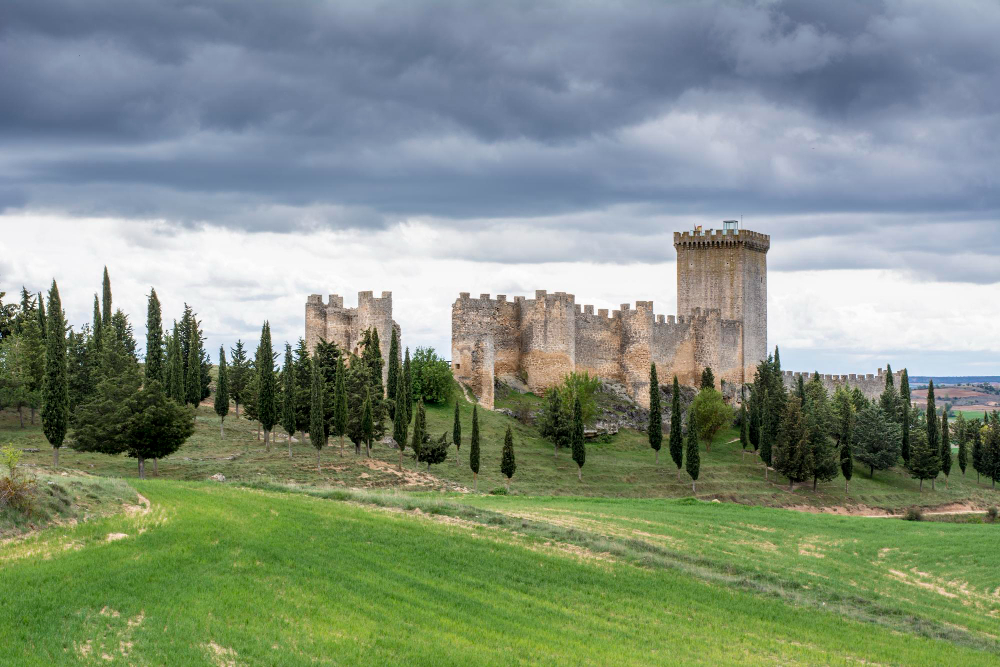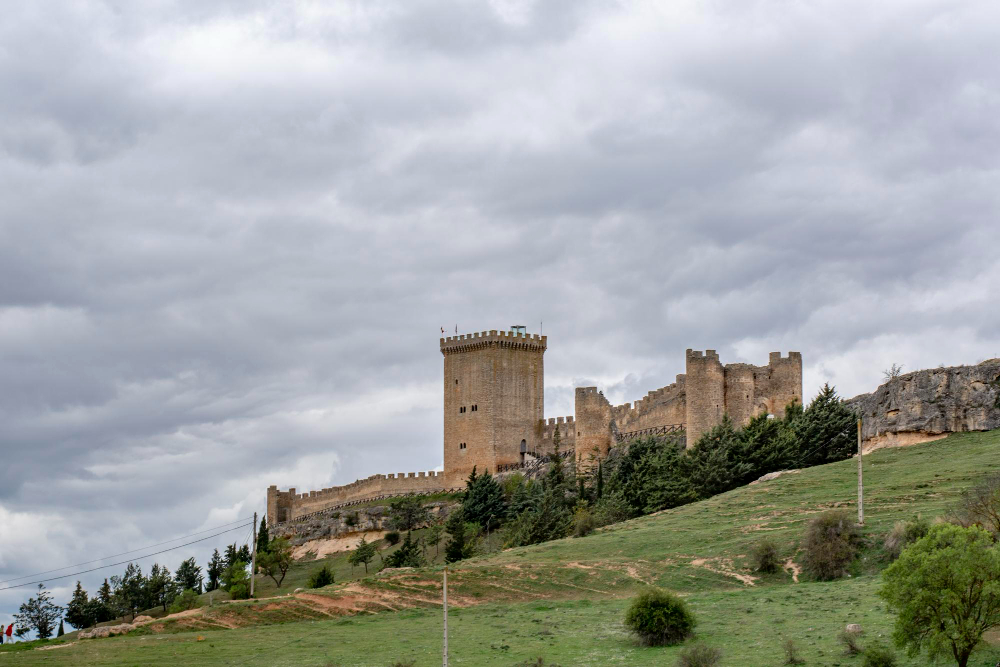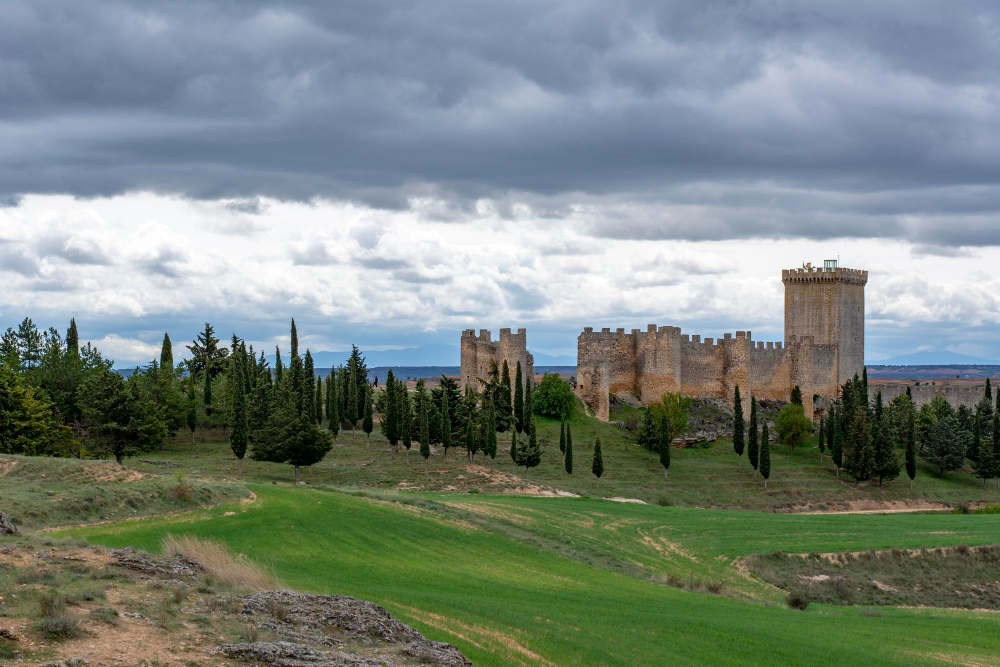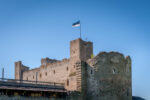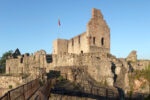

High above the small Castilian village of Peñaranda de Duero stands a fortress which, even from a distance, appears as a stone landmark of the landscape. Peñaranda de Duero Castle, in the province of Burgos, is one of the most impressive surviving fortifications in northern Spain. Its massive walls, imposing keep and sweeping views over the Duero Valley bear witness to an era when this region was not merely a rural area, but a borderland between political and religious power blocs. The complex visible today encompasses several centuries of history. According to widely accepted historical accounts, its origins date back to the 10th century. However, the castle’s appearance, which makes such a lasting impression on visitors today, was primarily shaped by extensive alterations carried out in the 15th century. These were undertaken by the powerful family of the Counts of Miranda del Castañar, who transformed Peñaranda de Duero into a prestigious seat of power. As such, the castle is at once a military structure, a symbol of aristocratic power and a key to the history of Castile.
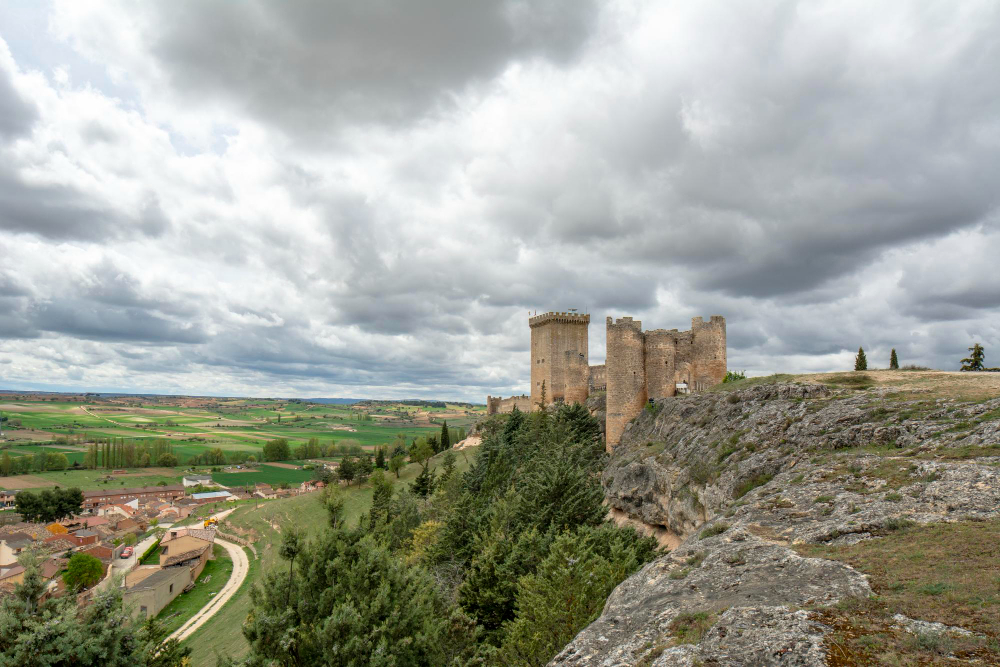
A fortress on the former border – In the 10th century, the region that is now northern Spain was characterised by conflicts, shifting borders and fortified settlements. The Christian Kingdom of Castile gradually extended its influence southwards, whilst Al-Andalus, the Muslim-ruled part of the Iberian Peninsula, continued to be a significant political and military power. Between these two spheres of influence lay zones over which control was frequently contested. During this period, castles served a far greater purpose than merely a defensive one. They functioned as observation posts, places of refuge, administrative centres and visible symbols of territorial claims. Peñaranda de Duero’s location on a hilltop was particularly well-suited to this purpose: from here, it was possible to monitor the paths and valleys that wound through the landscape along the River Duero. The name of the town itself refers to its geographical location. In Spanish, ‘Peña’ means rock or rocky outcrop, whilst ‘Duero’ refers to the great river that flows through central and north-western Spain as far as Portugal. It is therefore no coincidence that the castle stands above the town: it utilises the natural elevation as a strategic advantage and incorporates the terrain into its defences. However, the image of a border castle under constant siege should not be exaggerated. Medieval reality did not consist solely of open battles. Border regions were also trading zones, areas of shifting alliances and places where political influences overlapped. Nevertheless, the ability to defend itself was crucial – and it is precisely this function that can still be seen in the castle’s architecture today.
From early fortification to a noble residence – The castle’s origins date back to the Middle Ages, but the complex underwent several alterations over time. The work carried out in the 15th century was particularly significant. At that time, Peñaranda de Duero belonged to the Counts of Miranda del Castañar, an influential noble family in the Kingdom of Castile. These alterations took place at a time when castles were increasingly required to fulfil two roles. On the one hand, they remained fortified strongholds in a society characterised by dynastic conflicts and rival noble interests. On the other hand, they were intended to symbolise the status, wealth and political significance of their owners. A castle was not merely a place of protection, but also a stage for exercising power. In Peñaranda de Duero, this dual role is particularly evident. The complex still retains the austere character of a defensive castle: high walls, battlements, towers and an entrance that is difficult to control. At the same time, the fortress was renovated in a style befitting the standards of a high-ranking noble house. The castle was not merely intended to deter attackers. It was intended to make it clear who ruled over the town and the surrounding region. The developments of the 15th century also form part of the broader context of Castilian history. The Crown sought to expand its influence over powerful families, whilst the nobility sought to secure their own estates and privileges. Castles such as that of Peñaranda de Duero were therefore part of a dense network of power, property and loyalty.
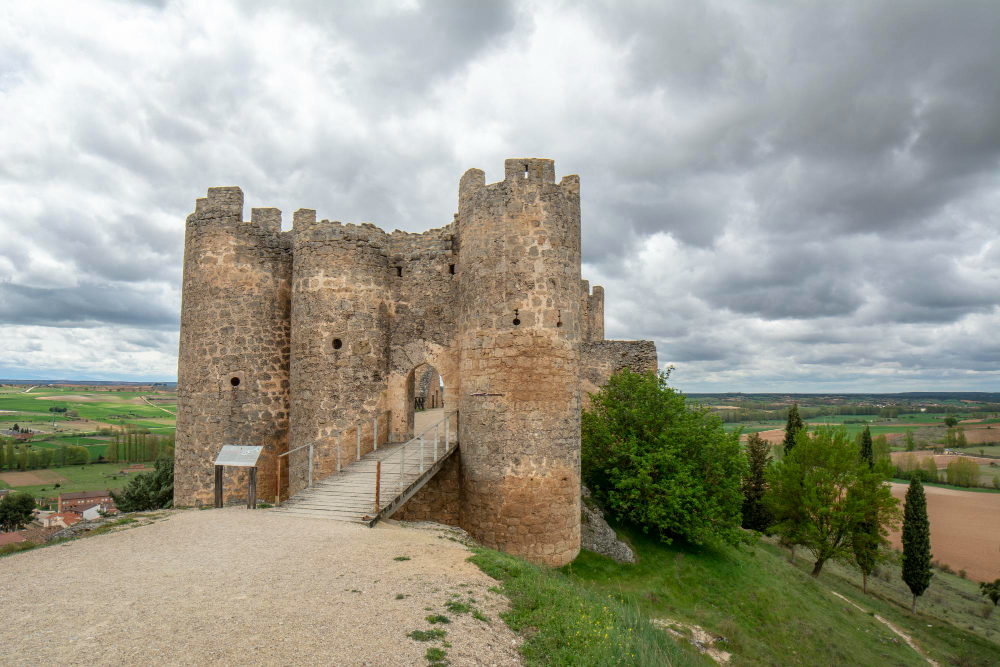
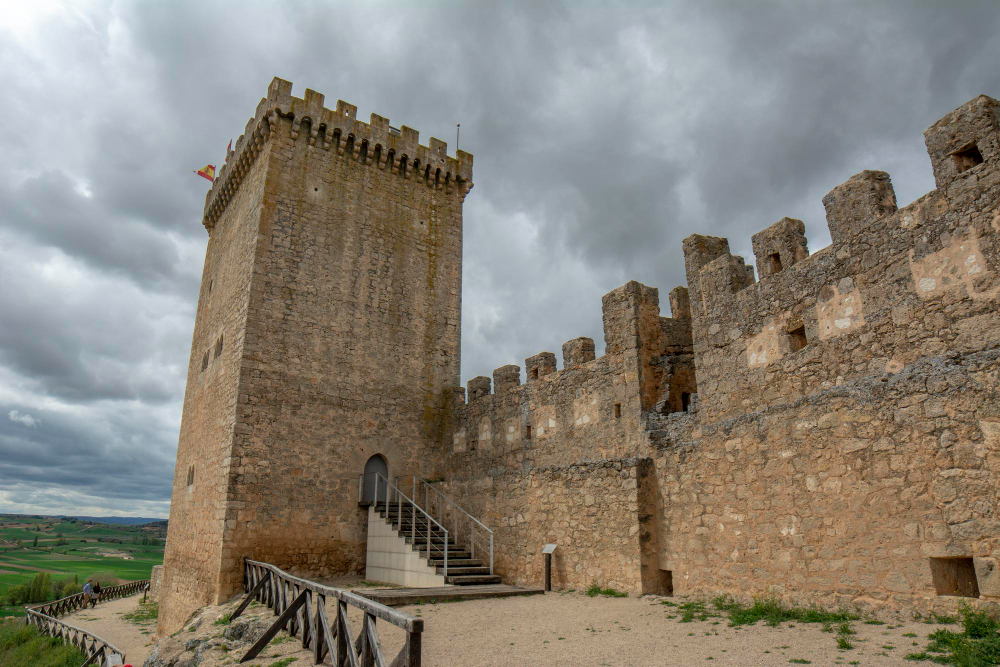
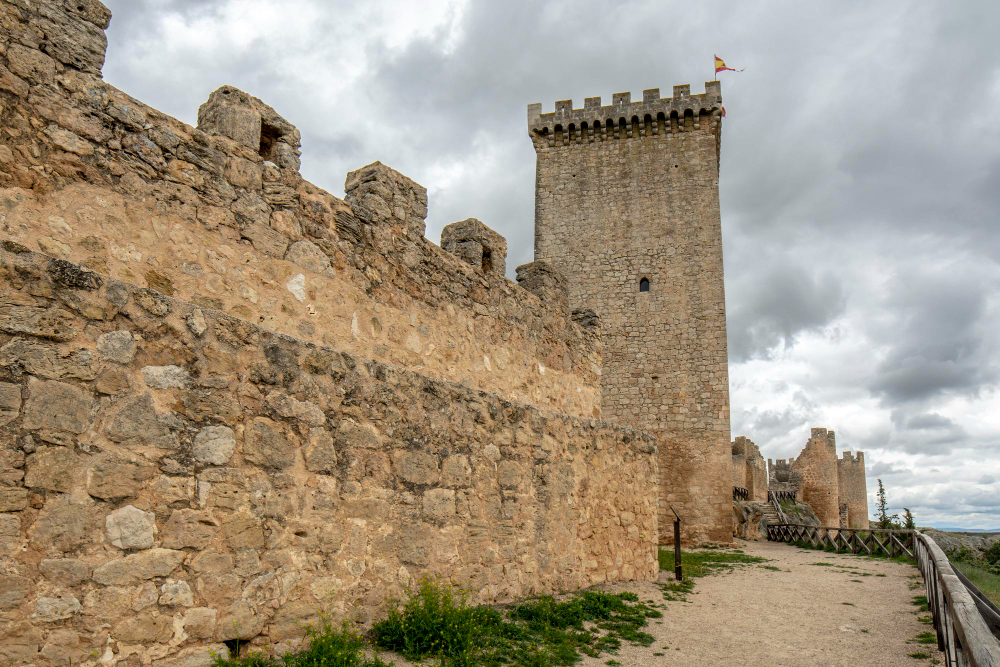
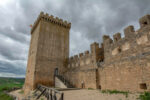
The keep as the centrepiece of the complex – The most striking feature of the castle is its tall, four-storey keep. This central tower dominates the complex and remains the most important landmark of Peñaranda de Duero to this day. The keep – often referred to in Spanish as the torre del homenaje – was the strongest and most symbolically significant part of many medieval castles. It served a variety of purposes. From a military perspective, it could act as a last refuge should the outer defences be breached. At the same time, the tower’s height provided an excellent vantage point over the surrounding area. Anyone standing on its roof terrace could spot movements in the valley and along the access routes at an early stage. The architecture also emphasises this defensive character. The castle features battlements – the jagged crenellations at the top of the walls – behind which defenders could take cover. In addition, there is a gallery with machicolations: these are projecting defensive structures whose openings allowed the area directly at the foot of the walls to be monitored and defended. To this day, such architectural features convey an impression of just how carefully medieval fortifications were prepared for potential attacks. The tower has a roof terrace and is flanked by further square towers. Two of these frame the castle’s pointed-arch entrance. This ogival arch is a typical design feature of the Gothic style and points to the architectural forms that played a role in the later alterations to the complex. The walls are constructed from carefully dressed stone blocks. This solid construction lends the castle its impressive sense of unity. At the same time, the keep features decorative wooden beams that visually break up the austere stonework. It is precisely this contrast between the robust masonry and the exposed wooden elements that gives the building its distinctive character.
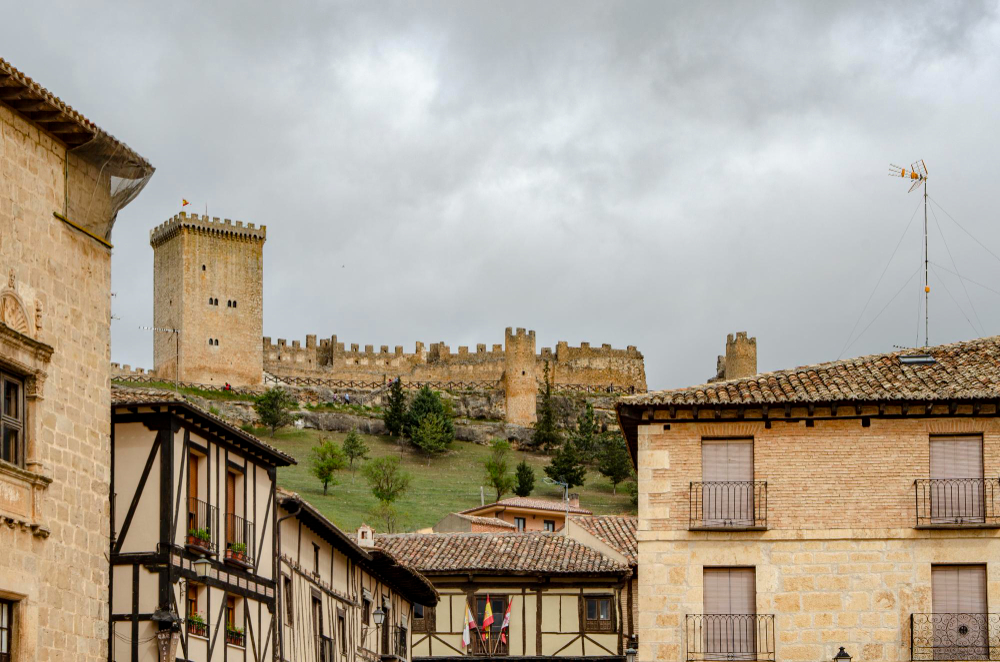
Walls, Gates and the Lost Defensive Ring – The castle did not once stand alone. It formed the starting point of a defensive system that enclosed the town of Peñaranda de Duero. Only a part of this medieval town wall survives today: the crenellated arch of Las Monjas, the ‘Nuns’ Gate’. This remnant is of great significance because it serves as a reminder that protection was not limited to the castle alone. The population, the houses, granaries, workshops and religious buildings within the town were also intended to be secured by walls and controlled access points. A fortified town was a complex system: the castle dominated the high ground, whilst gates and walls structured daily life in the settlement below. The Las Monjas Gate thus possesses not only architectural but also historical value. It marks the connection between the castle as the seat of power and the town as the living space of its inhabitants. Anyone walking through Peñaranda de Duero today can still experience this relationship spatially: the fortress towers above the streets and rooftops of the town, as if it had never completely lost its medieval supervisory function.
Between history and legend – Like many old castles, Peñaranda de Duero is shrouded in an atmosphere that blends historical facts with local imagination. Such places lend themselves to legends: of hidden passageways, secret treasures, besieged towers or noble families whose stories are said to have been preserved within the masonry. When it comes to specific, spectacular legends about the castle, however, visitors should take care to distinguish between folklore and documented history. Medieval fortresses in particular are often embellished over the centuries with tales whose origins are difficult to verify. The castle’s actual history, however, is fascinating enough even without these fictional secrets. Perhaps the strongest ‘legend’ of the place lies in its visible endurance. The castle has weathered political upheavals, changes in military technology and centuries during which many comparable structures fell into disrepair or were demolished. Its walls are a reminder of the era of the Castilian border fortresses, its Gothic forms reflect the ambitions of the late medieval nobility, and its location highlights the central role that geography played in history.
A monument in a historic wine-growing region – Peñaranda de Duero lies in the Ribera del Duero region, an area now known worldwide primarily for its wines. Yet the cultural landscape of the Duero consists of more than just vineyards and wineries. It is also a landscape brimming with medieval towns, churches, palaces, bridges and castles. The castle is therefore part of a wider cultural context. In Peñaranda de Duero itself, other historic buildings complement the picture of a Castilian town with a remarkably well-preserved past. These include the Plaza Mayor, the Collegiate Church of Santa Ana and the Palace of the Zúñiga y Avellaneda family. The castle crowns this ensemble and gives the town its distinctive silhouette. For travellers, the building is more than just a photo opportunity. The path up leads through a town whose layout is still shaped by the Middle Ages. Once at the top, it becomes clear why this location was chosen: the view stretches far across the plain, over fields, paths and the Duero countryside. What appears picturesque today was once a military advantage.
A Preserved Past – Peñaranda de Duero Castle is an example of how history can remain visible through architecture. It tells not of a single event, but of several eras: of the precarious border situation of the 10th century, of the political power of Castilian noble families in the 15th century, and of the later transformation of former defensive structures into historical monuments. Its keep, battlements, machicolations and gatehouses make it one of the most striking fortresses in the province of Burgos. At the same time, the remaining arch known as Las Monjas serves as a reminder that the castle and the village once formed a joint defence system. Anyone visiting Peñaranda de Duero therefore encounters not a romantic setting devoid of context, but a place where the history of Castile can be physically traced. The castle still stands above the village – no longer as a military outpost on a contested border, but as an impressive testament to an era whose traces have been preserved in stone.