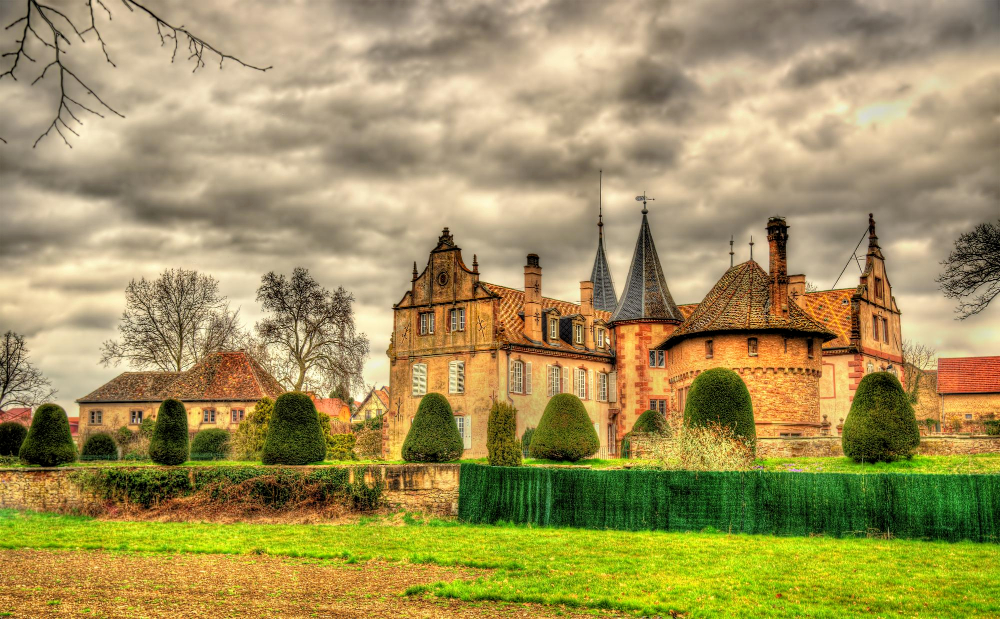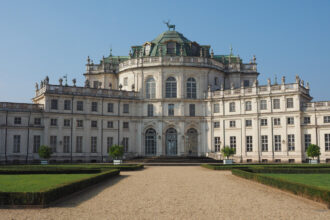

In the heart of the Alsatian countryside, some 15 kilometres west of Strasbourg, stands Château d’Osthoffen – a building that not only captivates with its architectural beauty, but also tells a story spanning centuries. Since 11 September 1963, the château has been partially listed as a historic monument and is considered one of the most significant historic sites in the Bas-Rhin department. Yet behind its walls and towers lies far more than just a building – here, Roman roots, medieval fortifications, Renaissance aesthetics and traces of revolutionary destruction come together.
A Roman Prehistory – The origins of the castle date back to the time of the Roman conquest around 50 BC. At that time, the area was part of a defensive system built around the Roman camp on Scharrach Hill, some five kilometres west of the present-day castle. A watchtower was built on the eastern edge of this camp, which was later expanded into the Château d’Osthoffen. The castle’s name derives from the tower’s location: ‘Ost’ refers to its eastern position, whilst ‘Hoffen’ denotes a courtyard or camp. The counterpart to this complex was the village of Westhoffen, which lay to the west of the main Roman camp and was also built on the remains of a fortification. Originally, the village and Osthoffen Castle were not close to one another. The village was situated about two kilometres east of the castle in a small valley near a spring. Archaeological finds such as pottery shards point to early settlement. It was only after periods of warfare and destruction that the village population sought shelter and settled near the castle walls – a shift that took place over the course of the first millennium.
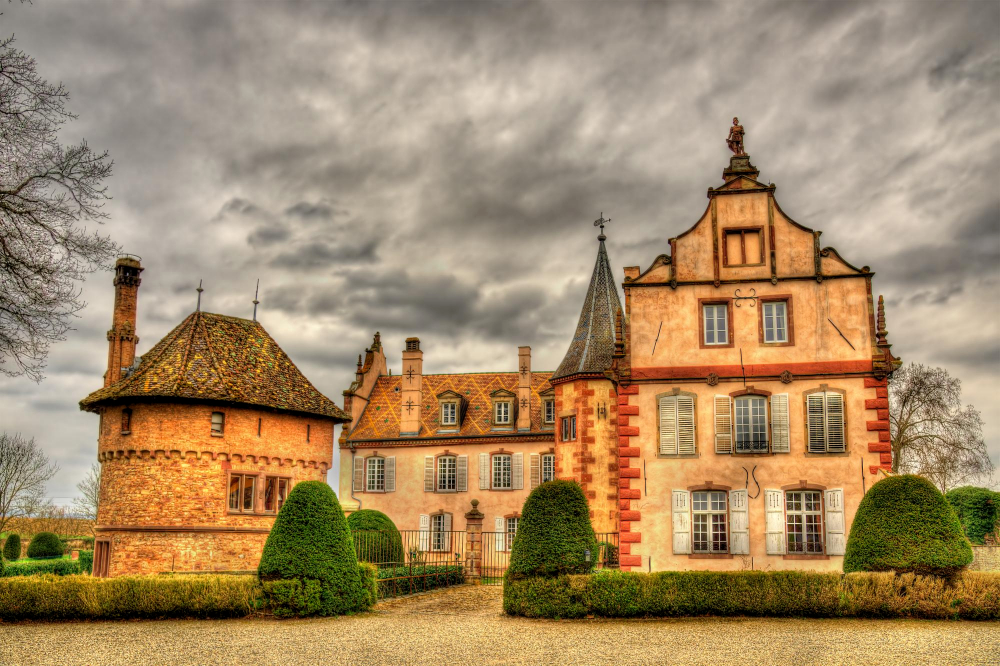
Medieval fortress and Renaissance splendour – In the 12th century, a medieval castle was built on the foundations of the former Roman camp. However, its moats were never filled with water; it was not a classic moated castle. For over three centuries, the complex served as a defensive structure until a severe attack by the Bishop of Strasbourg in the early 15th century reduced the castle to rubble and ashes. The destruction was so extensive that the castle remained unused for a whole century. It was not until the end of the 15th century that the castle experienced a rebirth. The master builder Jost von Seebach took it over and redesigned it. However, its military function increasingly took a back seat. Instead, agricultural and religious aspects took centre stage at the castle. It became part of the territory of the great Marmoutier Abbey, which extended as far as Lorraine. Over time, the castle was visually enhanced: two Renaissance gables in the Rhenish style were added, whilst the core of the defensive structure – such as walls and towers – remained intact. Another historical episode occurred during the Thirty Years’ War. The castle briefly became a military hub once more when troops under the command of General Turenne took up quarters here – shortly before the Battle of Enzheim.
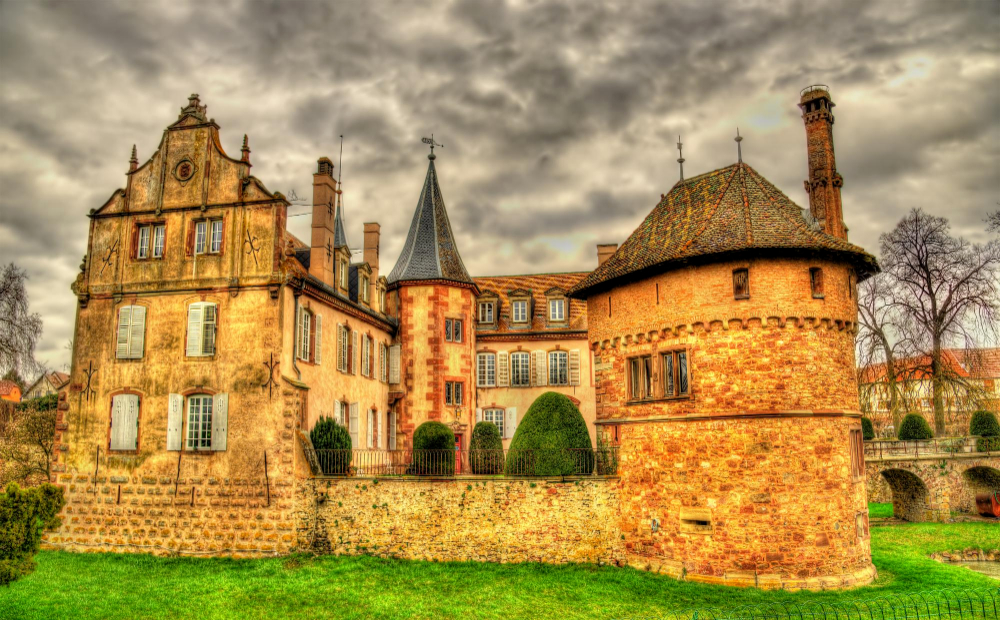
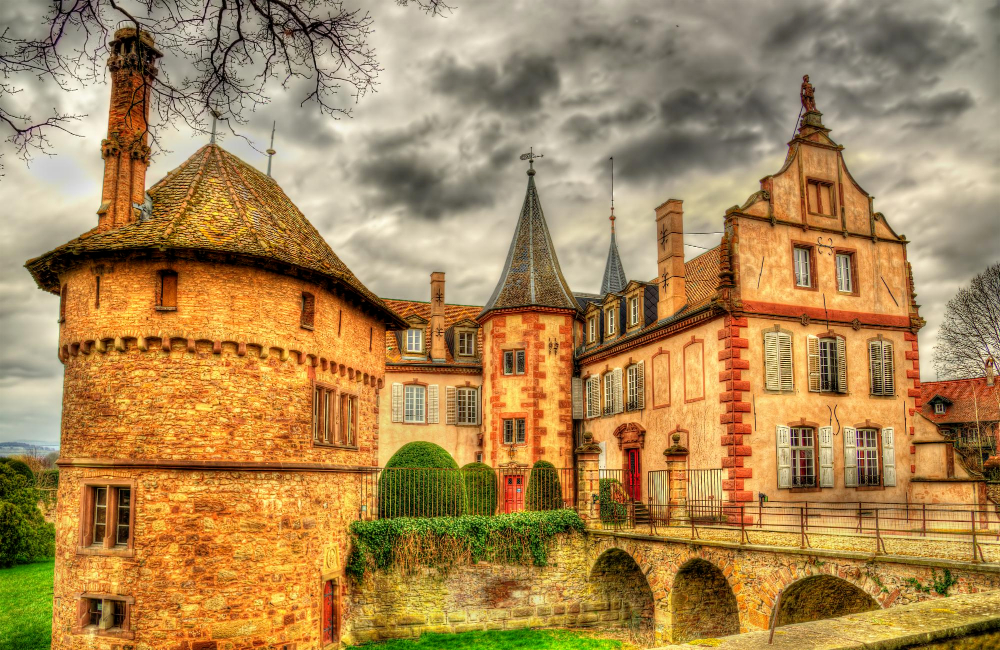
The renovation during the Age of Enlightenment and the French Revolution – The 18th century brought changes to both the architecture and the political landscape. Under the family of Baron Zuckmantel, who served as Louis XV’s ambassador in Venice, the castle was renovated. The walls enclosing the inner courtyard were demolished, and new French-style windows gave the complex a contemporary appearance. However, the French Revolution took a heavy toll on the building. A law compelled the owners of border castles along the Rhine to demolish all defensive and fortified towers. At Château d’Osthoffen, too, the two towers and the stair tower had to be removed – a painful loss for the castle’s owners, the Zuckmantel sisters. Shocked by the excesses of the Revolution, they leased the estate to their cousin Vietinghoff and withdrew. Over the course of the 19th century, the château changed hands several times. After various sales, it eventually came into the possession of General and Viscount François Grouvel, who was married to a woman from Alsace. Under their son, Jules Grouvel, extensive renovation work and technical modernisation were carried out at the château: the destroyed round tower was rebuilt in 1866 based on old records, a stone bridge replaced the previous wooden one, and the interior was fitted out with new wooden features and modern furniture.
War, destruction and reconstruction in the 20th century – The two world wars of the 20th century brought dramatic upheavals for the Château d’Osthoffen. During the Second World War, the château was looted, the family archives were lost in a fire, and the owners faced enormous challenges. François Grouvel, who opposed the recognition of German claims to Alsace, had to accept the loss of his properties, which were either sold to Germany or destroyed. The liberation of Alsace brought further damage, this time caused by Allied troops. The owners had to literally clean the castle’s interiors, which had been soiled by looting and the ravages of war, using fire hoses. In the years following the war, the arduous task of reconstruction began. The château was gradually brought up to modern standards – including the installation of running water and telephone lines. Despite its turbulent history, the Château d’Osthoffen remains to this day a cultural heritage site maintained by the Grouvel family.
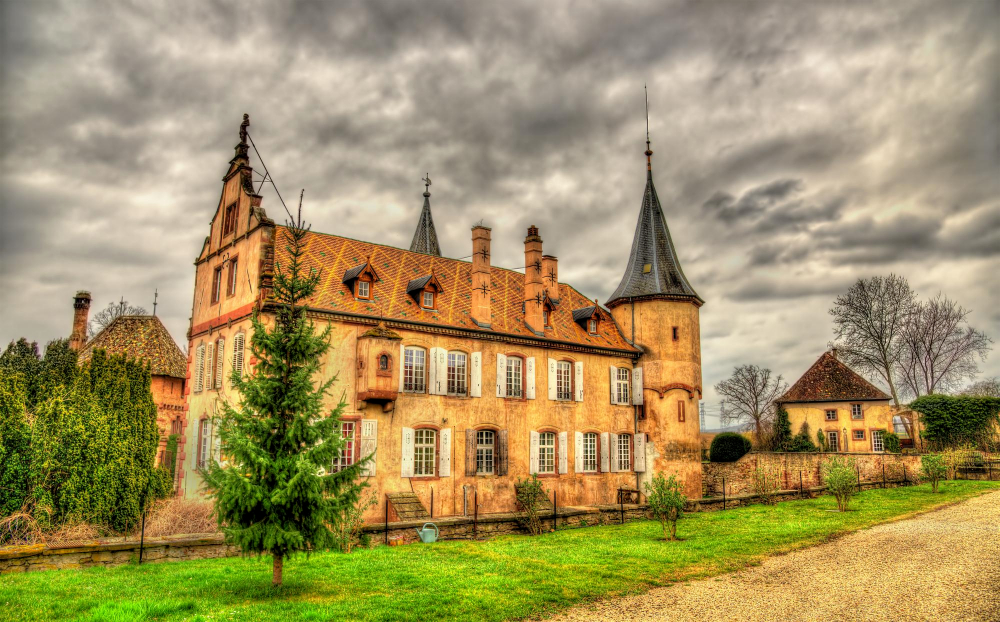
Impressive architecture – The Château d’Osthoffen consists of two wings arranged at right angles to one another, connected by a 15th-century polygonal stair tower and a round corner tower, which is considered the oldest part of the castle. Originally, the building had three storeys, but the top one was demolished during the Renaissance. Today, the building comprises a ground floor, an upper floor and a mansard roof crowned by magnificent gables. The central castle tower, which was destroyed during the French Revolution, was rebuilt in the mid-19th century by Jules Grouvel. Also worth seeing is a 15th-century statue on the east gable of the castle. It depicts Saint Quirinus as a Roman general – a symbolic relic that underscores the castle’s connection to Marmoutier Abbey.
A castle steeped in history – The Château d’Osthoffen is more than just a historic building – it is a mirror of European history. From Roman guard posts to medieval fortifications, a Renaissance palace and destruction during the Revolution, right through to the modern era, it has left its mark on every period. Even today, it retains its unique character, nestled in the picturesque landscape of Alsace. A visit is well worth it not only for history buffs, but also for anyone wishing to experience the legends of a truly extraordinary place.