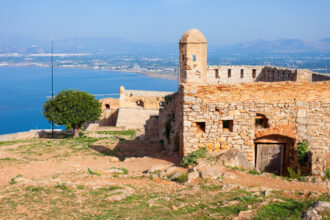

In the heart of the historic Pokuttya region, in what is now western Ukraine, stand the ruins of Chernelytsia Castle – “Chernelytskyi zamok” in Ukrainian, “Zamek w Czernelicy” in Polish. What today appears to be a silent stone relic was, in the 17th century, a significant military outpost of the Polish-Lithuanian Commonwealth. The complex epitomises an era in which the border regions along the Dniester were shaped by wars, changing rulers, Ottoman campaigns and the power claims of the nobility. The castle is not a medieval knight’s castle in the romantic sense. It was built for the age of firearms: with thick walls, embrasures and acute-angled bastions. At the same time, its coats of arms, inscriptions and construction phases tell the story of the families who sought to make their political influence visible here. The history of Chernelytsia is thus not only a history of military architecture, but also a reflection of the complex past of Eastern Central Europe.
A fortress on the eastern periphery of the state – Chernelytsia is situated in Pokutia, a historic region between the Carpathians and the Dniester. In the 17th century, the area belonged to the Polish–Lithuanian Commonwealth, one of the largest states in Europe. Yet this size did not automatically guarantee security. The south-eastern borderlands were repeatedly the scene of armed conflicts: with the Ottoman Empire, the Crimean Khanate, Moldavian troops, and in the clashes of the time with Cossack units and regional rulers. Its location near the Dniester gave the castle strategic importance. The river was not only a natural geographical boundary but also a vital transport and supply route. Whoever controlled the fords, paths and ridges in the surrounding area could monitor military movements and secure supplies. Chernelytsia was situated on the eastern edge of what was then the Polish-Lithuanian dominion, on the right bank of the Dniester, and was thus one of the most exposed fortifications in this border region. The complex covered an area of approximately two hectares. Its walls reached a height of up to six metres in places and were around two and a half metres thick. This massive construction method was crucial for the time: the thin, high walls of earlier castles were becoming increasingly vulnerable to artillery. The fortifications at Chernelytsia therefore followed the bastion-style principle that had been spreading throughout Europe since the 16th century.
Two construction phases and a noble family history – The castle was not built in a single phase. The older, lower sections of the perimeter walls are dated to the period between 1622 and 1636. Their construction was commissioned by Jadwiga Bełżecka. She was a daughter of the Grand Hetman of the Crown, Jerzy Jazłowiecki, and the widow of Captain Andrzej Bełżecki. These family connections alone demonstrate that the castle was built in an environment where military functions and aristocratic ownership were closely intertwined. The early structures were evidently modelled on Jazłowiec Castle, a major fortress in the region. This connection was no coincidence: the Jazłowiecki family had long been one of the most influential magnate families in south-eastern Poland-Lithuania. Their castles were not merely residences, but fortified centres of local rule. The later parts of the complex were constructed in a different style. These include, in particular, the upper sections of the walls and the gate tower. The building was completed in 1659 by Michał Jerzy Czartoryski, a member of the influential Czartoryski princely family. He held high office and was, amongst other things, Voivode of Bracław. The castle came into his possession through his marriage to Eufrozyna Stanisławska. The architectural history of Tschernelyzja is therefore also a history of inheritances and marriages. In 17th-century aristocratic society, estates and fortifications were frequently transferred through marriage. Castles were far more than mere properties: they represented income, regional influence, military security and symbolic prestige.
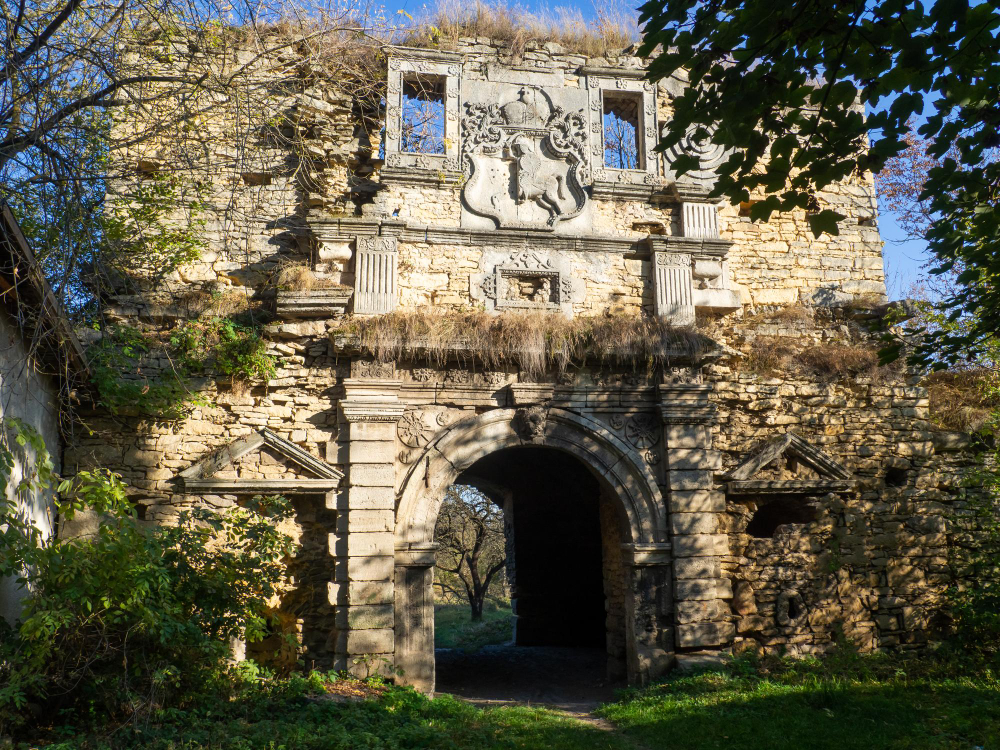
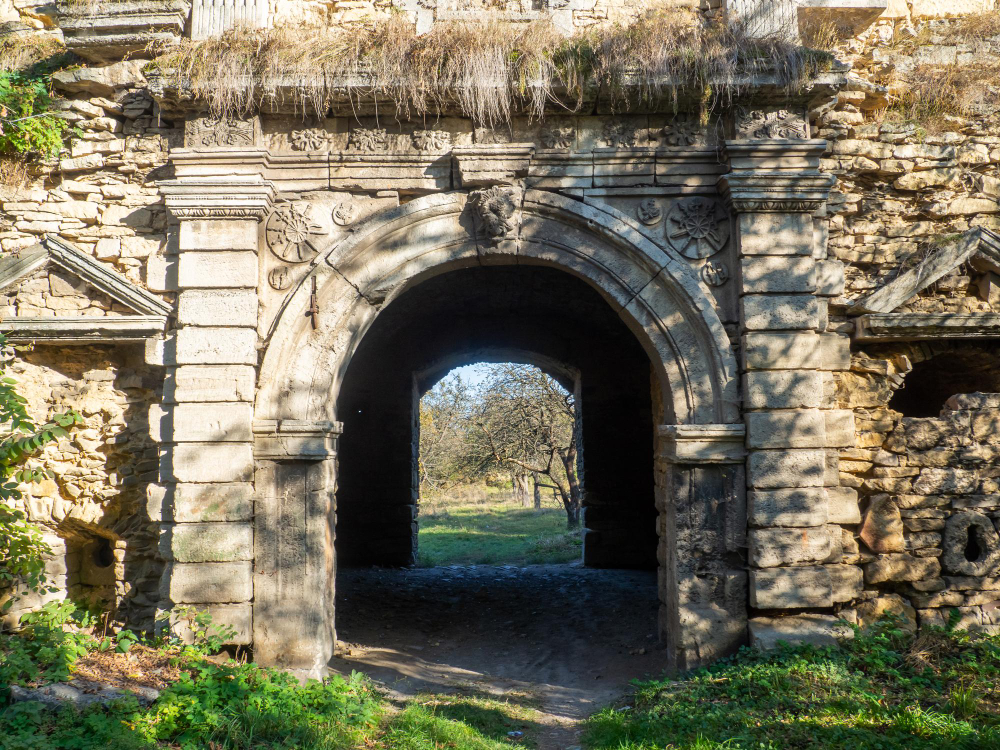
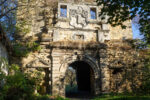
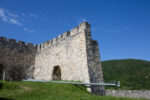
Bastions, embrasures and stone coats of arms – Architecturally, Tschernelyzja Castle is classified as an early modern bastion fortification. At its four corners stood acute-angled bastions. Such projecting defensive structures enabled the defenders to secure the flanks of the walls and to engage attackers with fire from multiple directions. The design was a response to changing military technology: cannons and firearms had fundamentally altered the requirements for fortifications. The walls feature embrasures designed for firearms. These made it clear that the complex was not intended merely for ceremonial purposes. The castle was designed as a militarily functional shelter capable of accommodating people, supplies and equipment in the event of an emergency. Its walls formed a rigid boundary between the fortified interior and an insecure environment. The gate is particularly telling, as it combines defence with self-representation. On the front is the “Pogoń”, the coat of arms of the Grand Duchy of Lithuania. This motif – an armed horseman – refers to the Lithuanian component of the Polish–Lithuanian Union. Its presence demonstrates that, despite its location in present-day Ukraine, Tschernelyzja was part of a larger political confederation whose elites combined Polish, Lithuanian and Ruthenian traditions. On the western side of the gate is the “Piława” coat of arms, which was associated with the Potocki family and other noble lineages. Above this, or in the immediate vicinity, is an inscription bearing the letters ‘E.S.X.C.W.B.’. This is interpreted as a reference to Eufrozyna Stanisławska, Princess Czartoryska, who was either the wife of or a member of the circle of patrons responsible for the castle’s construction. In the 17th century, such initials served as a visible sign of ownership, social status and dynastic claim. Anyone passing through the gate was entering not only a military complex but also the domain of a powerful family.
War against the Ottomans and Tatars – The castle was completed during a particularly turbulent period. In the decades following 1659, the region was repeatedly caught up in the aftermath of the wars between Poland–Lithuania and the Ottoman Empire. In 1672, and again in 1676, Chernelytsia sustained damage as a result of the Ottoman campaigns. It was not only regular Ottoman troops who were involved in the battles and raids of that era; Tatar units and forces from the Moldavian region also played a part in the border conflicts. The year 1672 marked a major turning point for Poland–Lithuania. In the war against the Ottoman Empire, the important fortress of Kamianets-Podilskyi was lost, and the kingdom was forced to make significant concessions in the Treaty of Buchach. Although Chernelytsia was not one of the state’s very largest fortresses, it was situated in an area whose military significance suddenly became even more apparent. In the 1680s, the castle regained its importance. During King Jan III Sobieski’s so-called Moldavian campaigns, it served as a depot for food and fodder. This function was crucial to the conduct of the war. Armies could only operate for as long as they had access to grain, fodder, weapons, ammunition and means of transport. A castle such as Chernelytsia was therefore not merely a place for soldiers behind walls, but part of a logistical network. According to historical accounts, King Jan III Sobieski himself stopped at Chernelytsia on several occasions. Sobieski was one of the most famous rulers of Poland–Lithuania and became particularly renowned for his role in the relief of Vienna in 1683. His visits underscore the castle’s role within the kingdom’s south-eastern military strategy. From here, a route into the Moldavian border regions was just as conceivable as securing the kingdom’s own supply lines along the Dniester region.
From military stronghold to ruin – As the political landscape changed, the castle gradually lost its former function. At the turn of the 18th to the 19th century, it was owned by the Tsensky family. Although the great wars of the 17th century were long past, the complex had long since ceased to be the centre of active border defence. The partitions of Poland–Lithuania at the end of the 18th century had fundamentally altered the political landscape. Pokutia came under Habsburg rule, and the old magnate fortresses no longer held the same military significance. At the end of the 19th century, there were apparently plans to rebuild the castle. The then owner, Samuel Mosberg, wanted to carry out work on the complex in 1892. However, the authorities of the Horodenka district prohibited any structural alterations and threatened penalties in the event of non-compliance. This ban suggests that the ruin was already recognised as a historic building worthy of protection – even though there was no heritage conservation in the modern sense at that time. Following the Soviet annexation of Eastern Galicia and Volhynia in 1939, the castle’s former use came to a definitive end. It remained as a ruin, but without the function that had once given it its significance. It is precisely this that gives it its special significance today: The walls do not represent a single national space of remembrance, but rather the layered history of a region that was under Polish-Lithuanian, Habsburg, Soviet and Ukrainian rule.
A monument to European border history – Chernelytsia Castle is less well known than Kamianets-Podilskyi, Khotyn or the great castles of Galicia. Nevertheless, it possesses exceptional historical value. Its bastions bear witness to its adaptation to the age of gunpowder. The coats of arms on the gate recall the political order of the Polish-Lithuanian noble republic. The war damage it bears points to the long-standing conflict between Poland-Lithuania and the Ottoman Empire. And its ruins demonstrate just how closely architecture, power and memory are intertwined. Anyone looking at Chernelytsia does not see a fully restored setting, but an authentic fragment of the past. It is precisely the preserved walls, bastions and coats of arms that reveal that this remote castle once stood at a crucial historical crossroads: between Central Europe, the Black Sea region and the political worlds of Eastern Europe.