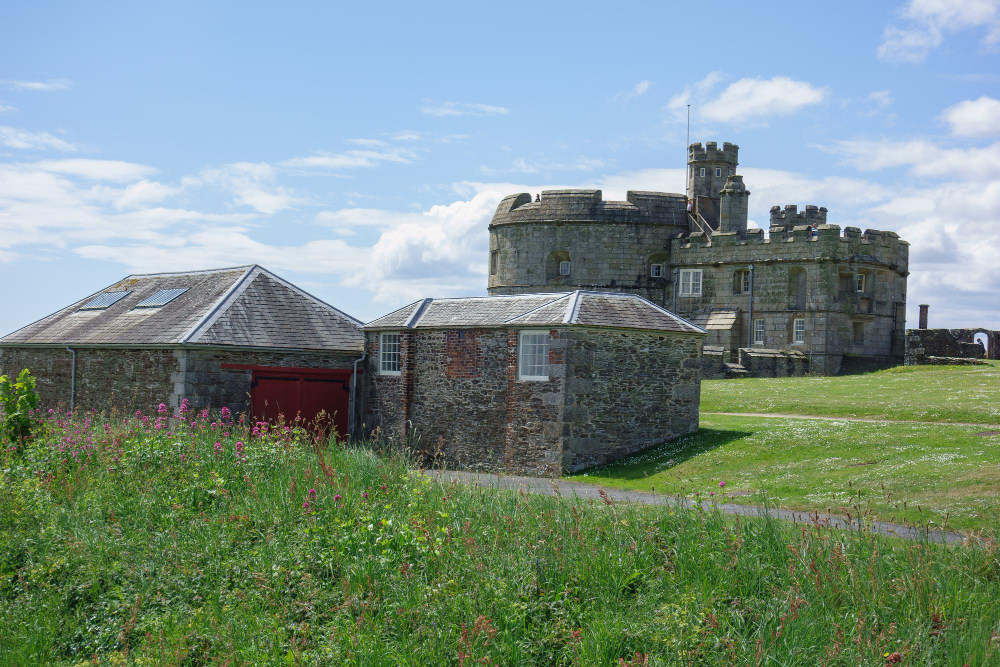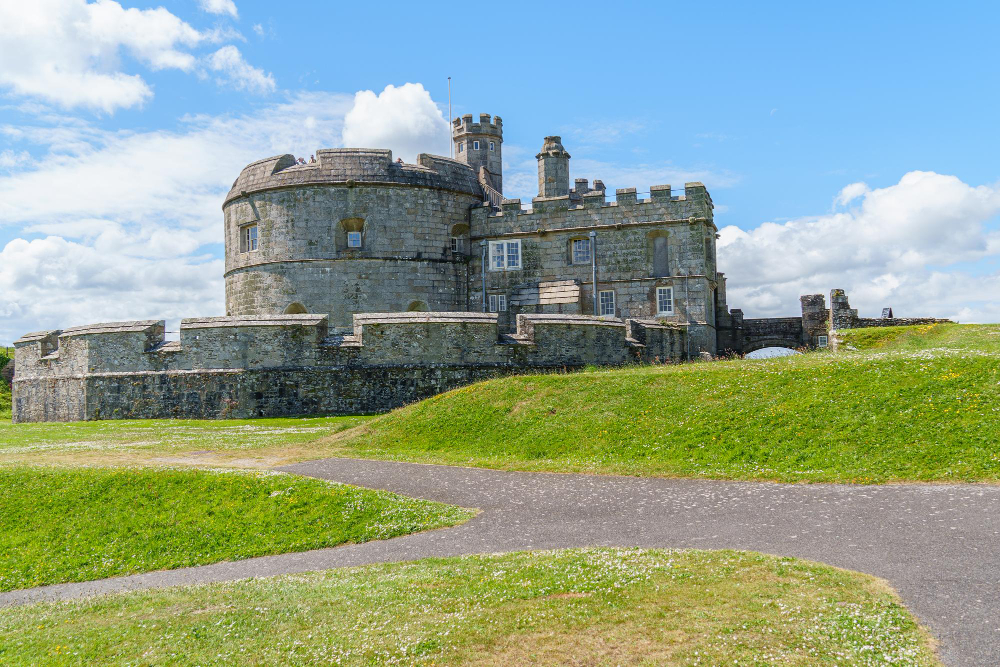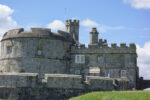

Pendennis Castle stands high above the mouth of the River Fal near Falmouth – one of England’s most impressive coastal fortresses. From the headland, the castle overlooks the Carrick Roads, a deep, natural harbour that has been of great importance for centuries to merchant ships, navies and those seeking refuge. Together with St Mawes Castle on the opposite side of the estuary, Pendennis Castle formed a military defence system designed to control access from the sea. However, the complex is far more than just a structure dating from the time of Henry VIII. It tells the story of religious conflicts, the fear of invasion, the English Civil War, the development of modern coastal artillery and the military significance of Cornwall right up to the 20th century. Today, Pendennis Castle is managed by English Heritage and is one of the region’s best-known historical attractions.
A castle born of fear of invasion – Pendennis Castle was built during one of the most tense periods in English history. In the 1530s, King Henry VIII had broken away from the Roman Catholic Church, rejected the Pope’s ecclesiastical authority in England and initiated the English Reformation. This political and religious separation left England vulnerable on the international stage: France and Spain, both major Catholic powers, were regarded as potential adversaries. Henry VIII responded with a large-scale programme to strengthen coastal defences. Between 1539 and 1547, numerous so-called ‘Device Forts’ were built at strategically important points along the English coast, named after the royal defence orders, the ‘Devices’. Pendennis Castle was part of this system, which stretched from the east coast to the south-west. The location was carefully chosen. The Carrick Roads, the widely branching stretch of water between Falmouth and the River Fal, offered ships an exceptionally safe anchorage. Whoever controlled the entrance could monitor access to one of Europe’s finest natural harbours. At the same time, the bay was a potential landing point for enemy fleets. Pendennis Castle on the western side and St Mawes Castle on the eastern shore were intended to work together to prevent enemy warships from entering the sheltered waters.
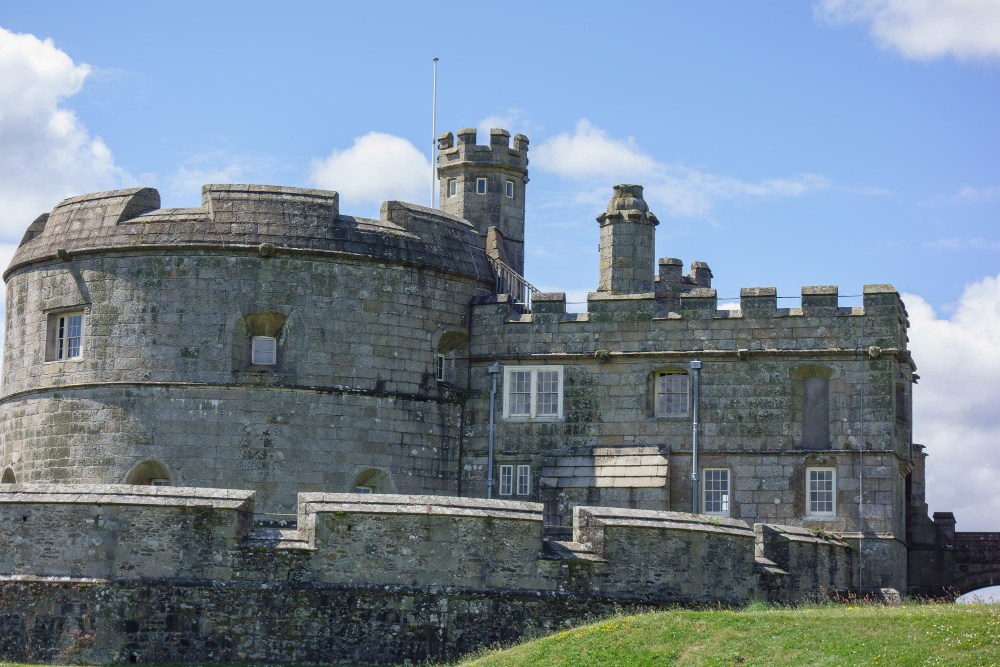
The original structure: round tower, walls and cannons – The first fortress was comparatively compact. At its centre stood a massive, round gun tower, surrounded by a low ring wall, or curtain wall. The tower had been built to accommodate the artillery of the time: its thick walls offered protection against shelling, whilst the cannons could be aimed through embrasures at ships in the fairway. The round shape was no coincidence. In the 16th century, fortresses increasingly adapted to the growing importance of cannons. Tall medieval walls and narrow towers proved vulnerable to artillery. Lower, sturdier structures and wide gun emplacements were better suited to repelling attacks. Pendennis Castle was therefore not a romantic knight’s castle in the traditional sense, but a modern military installation of its time. Its purpose was not to accommodate large armies for extended periods or to serve as a seat of power. It was an instrument of coastal defence: a fortified gun emplacement from which access to the harbour could be controlled. Moreover, the castle was placed under permanent administration at an early stage. The first governor appointed by Henry VIII was John Killingrew from Arwenack near Falmouth. His family shaped regional history for generations. The governorship remained closely associated with the Killingrews for a long time; they wielded considerable influence in Cornwall.
A refuge for the Queen and the heir to the throne – Pendennis Castle faced its greatest historical test more than a century after its foundation – during the English Civil War. In the 1640s, the supporters of King Charles I, the Royalists, fought against Parliament. Cornwall had long been regarded as a Royalist stronghold. However, as parliamentary forces brought ever larger parts of the country under their control in the course of the war, the royalist strongholds in the south-west became increasingly isolated. Pendennis Castle took on particular significance during this period. Following the collapse of royalist positions in other parts of England, high-ranking members of the royal family sought temporary refuge in Cornwall. Queen Henrietta Maria, the wife of Charles I, and her son, the Prince of Wales – the future King Charles II – stayed in the region before fleeing to France. The fortress was thus not only a military stronghold but also, for a short time, a place of royal refuge during a period of national crisis. When parliamentary troops reached the south-west in 1646, Pendennis Castle remained one of the last Royalist strongholds. Under the command of John Arundell of Trerice, then around 70 years old, the garrison refused to surrender. Arundell, an experienced and staunch Royalist, later became known as ‘John for the King’ because of his resistance.
The Siege of 1646: 155 Days of Resistance – The siege of Pendennis Castle began in the spring of 1646 and lasted until 17 August of the same year. For around five months, the castle was besieged by Parliamentarian troops. The attack came from both land and sea, effectively cutting the fortress off from supplies. The complex was not home to soldiers alone. In total, around 1,000 men, women and children were sheltering in Pendennis Castle. For a fortress of this size, this placed an enormous strain on resources. Food, fuel and medical supplies were running low. The siege was therefore, above all, a struggle against hunger, disease and exhaustion. The defenders held out for an unusually long time. Pendennis Castle became the last significant Royalist stronghold in the south-west of England and was among the last of the King’s castles to surrender at all. Comparable last bastions of the Royalists were Raglan Castle in Wales and Harlech Castle. In the end, it was not a successful assault that forced the garrison to surrender, but the catastrophic supply situation. After 155 days, Arundell surrendered honourably. The terms of the surrender spared the defenders from a massacre or the complete destruction of the fortress. The long siege nevertheless remained deeply embedded in Cornwall’s historical memory: Pendennis Castle stands to this day as a symbol of Royalist perseverance.
Conversion into a modern coastal fortress – After the Civil War, Pendennis Castle by no means lost its importance. On the contrary: as cannons, warships and military tactics evolved, the fortress was repeatedly rebuilt. Whilst the original Tudor castle was preserved, it was surrounded by new defences in the centuries that followed. Particularly in the 18th and 19th centuries, more powerful batteries, barracks, powder magazines and additional gun emplacements were constructed. The threat no longer came solely from traditional European rivals; in the 19th century, it stemmed primarily from fears of a possible attack by France. England modernised numerous coastal fortifications to keep pace with the growing range and destructive power of artillery. The complex took on a significantly more intricate appearance. Where once there had been mainly a round tower and a low wall, extensive military areas with ditches, bastions, shelters and gun platforms were created. As a result, Pendennis Castle became a vivid example of how military architecture evolved over the centuries. Even remote areas of the headland were used for military purposes. Below the castle lies Crab Quay, a favourable spot for potential landings. A battery was built there by the turn of the 18th century at the latest, as evidenced by maps from the early 18th century. Further military installations were added later. Along the coast, concrete foundations serve as reminders of searchlight emplacements that were used to monitor the sea area.
Little Dennis Blockhouse and lost defences – The Little Dennis Blockhouse was also one of the early fortifications. It was built in the 1540s to complement Pendennis Castle and was strategically situated overlooking the River Fal and the open sea. The D-shaped structure was intended to provide additional protection and secure a further section of the coast with artillery. This blockhouse no longer exists today. It was demolished in 1654, just a few years after the end of the Civil War. Its disappearance shows that fortresses were never static: military requirements changed, and older structures were replaced, demolished or integrated into new defence concepts. Pendennis Castle in particular illustrates this development. The fortress is not a structure from a single era, but a military history book made of stone, earth and concrete. A Tudor tower, Civil War emplacements, Victorian artillery installations and 20th-century defensive remains all stand within the same landscape.
A fortress overlooking Europe’s history – Today, Pendennis Castle is above all a place of remembrance and education. Visitors can explore Henry VIII’s original gun turret, walk along the later ramparts and enjoy the view across Falmouth Bay and the Carrick Roads. The view immediately explains why this site was of military importance for centuries: from the headland, one can survey the strait through which ships enter the sheltered harbour. The castle links local history with the major conflicts of Europe. Its foundation reflects the religious tensions of the Reformation period. Its most famous siege forms part of the history of the English Civil War. Its later extensions reflect the rivalries between the major European powers and the technological changes in warfare. Pendennis Castle is therefore not merely a tourist attraction in Cornwall. It is an exceptionally well-preserved testament to how England defended its coasts for almost five centuries – and how a single fortress could become a stage for national history.