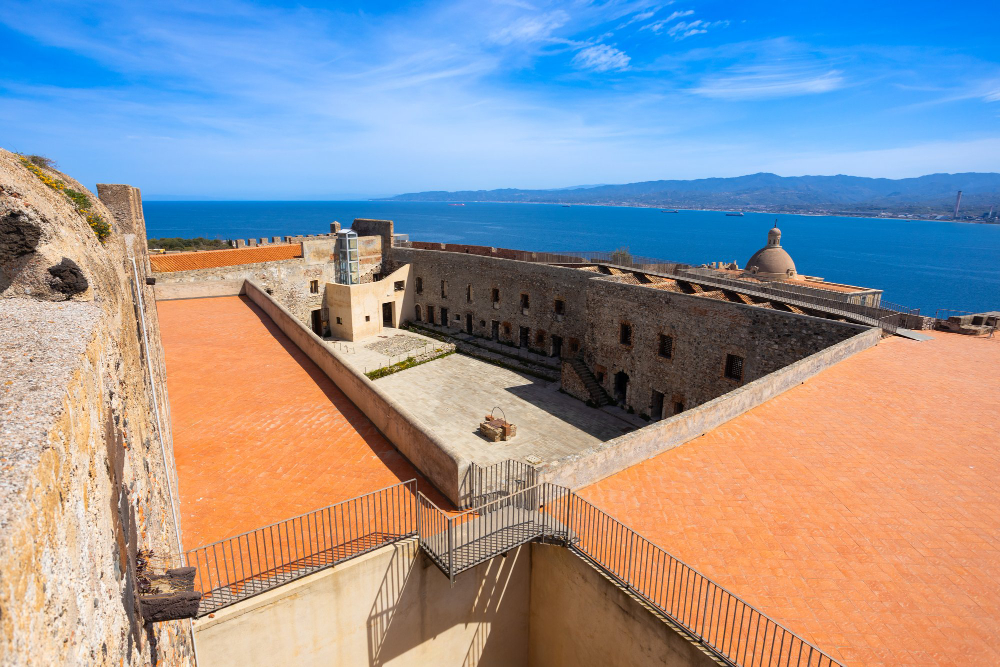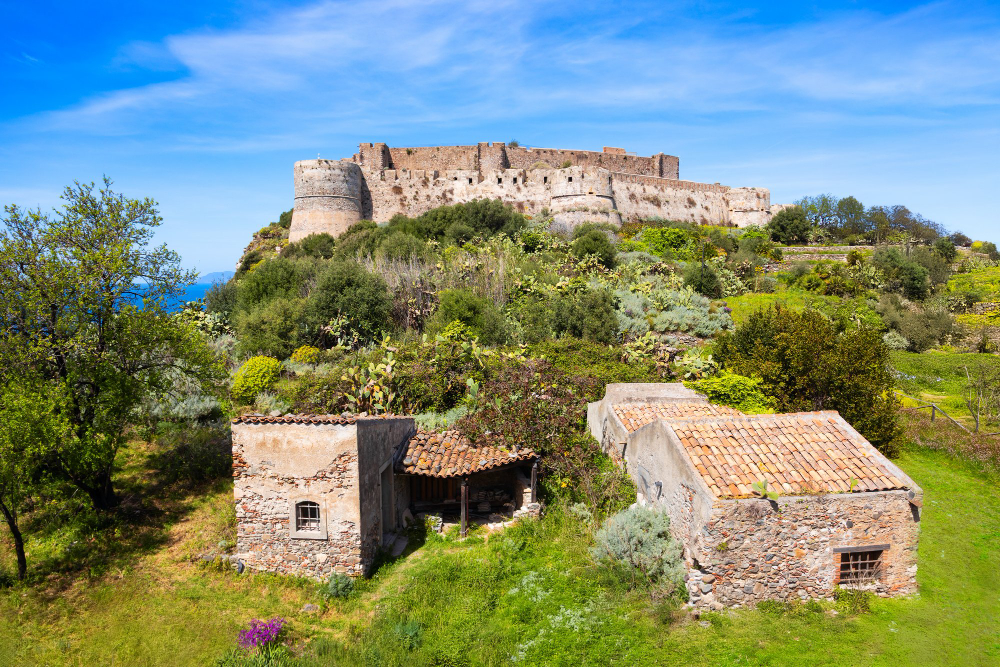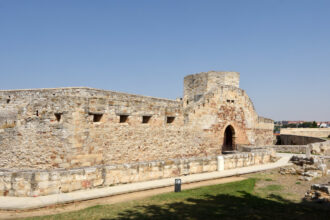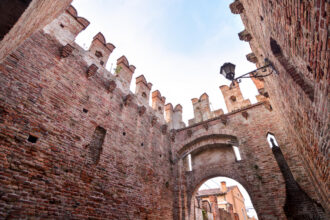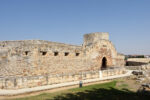

Towering high above the north-eastern coast of Sicily, the Castello di Milazzo stands like a stone history book. Anyone entering this imposing complex does not merely gaze upon walls, bastions and towers: they are walking through more than 6,000 years of settlement, military and cultural history. From the earliest prehistoric fortifications, through Greek, Roman and Byzantine periods, to Norman lords, Spanish military engineers and the Risorgimento – hardly any other place on the island condenses so many eras into such a small space. The structure, often simply referred to as the ‘Castle of Milazzo’, is in truth far more than just a castle. It is a fortified town, or rather a citadel, within whose walls churches, monastic complexes, administrative buildings and residential houses once stood. Its unique location on a hill above the town and the harbour explains why the complex remained of such great importance for millennia.
A strategic rock between Sicily and the Aeolian Islands – Milazzo lies on a narrow headland on the north coast of Sicily. From here, the view stretches across the Gulf of Patti to the Aeolian Islands. At the same time, the town commands a natural harbour which has been of great importance since ancient times for trade, supplies and military operations. The fortress dominates not only the present-day town area but also the approaches from the sea. On the north-western side, the rock drops away steeply, forming a natural defence. The more easily accessible south-eastern side, by contrast, had to be secured with ever-new rings of walls, moats and bastions. It was precisely this combination of topography and harbour location that made Milazzo a coveted stronghold for the powers that ruled over Sicily. The history of the site begins long before the great empires of the Mediterranean region. Archaeological evidence suggests that the hill was already fortified as early as 4000 BC, during the Neolithic period. This makes the area one of the oldest continuously used fortified sites in Sicily. However, the earliest structures should not be confused with the stone walls visible today: they were part of a prehistoric settlement landscape, the remains of which were repeatedly built over in the course of millennia.
From the Acropolis to the Roman Castrum – In the 8th or 7th century BC, Greek settlers reshaped the strategic hilltop. They used the site as an acropolis – that is, as the fortified, elevated centre of a settlement. An acropolis was not merely a military refuge; it could also fulfil religious, political and communal functions. As the balance of power shifted, so too did the function of the fortification. The Romans, and later the Byzantines, transformed the site into a castrum, a militarily organised stronghold. This development reflects Sicily’s central role in the Mediterranean: the island lay on the routes between Italy, North Africa, the eastern Mediterranean and the Iberian world. Whoever controlled the coastal towns could monitor trade, supply fleets and detect enemy movements at an early stage. Ancient coins have also been discovered within the fortress grounds, including specimens associated with the Mamertines. This group, which had its origins in Campanian mercenaries, played a significant role in north-eastern Sicily during the 3rd century BC. Such finds provide valuable insights into the region’s historical significance, but they do not allow for a complete reconstruction of all events that took place within the present-day complex. Particular caution is required when dealing with a fortress that has been remodelled several times over the course of millennia: not every visible section of wall can be unequivocally attributed to a single period.
The Normans, the Staufers and the rise to a medieval castle – The striking medieval centre of the complex was built under the Normans, who conquered Sicily in the 11th century. The Normans built castles and administrative centres at many strategic points across the island. In Milazzo, they created a fortified core which formed the basis for later development. The oldest and, today, most striking part is the so-called Torre Saracena, the ‘Saracen Tower’. Despite its name, it is attributed to the Normans. The name refers more to historical memories and linguistic traditions than to a confirmed builder from the Muslim period. The tower has been altered several times over the centuries, as have almost all parts of the citadel. Under the Staufers, particularly during the reign of Frederick II of Hohenstaufen in the 13th century, the castle was significantly expanded. The Staufers consolidated their power through a dense network of royal castles; for them, architecture was also an expression of administration, control and the claim to sovereignty. Around the Norman core, walls were erected featuring projecting, square towers. This style of construction met the requirements of medieval defence, long before artillery was to fundamentally transform the art of fortification. During this period, Milazzo was not merely a military outpost. The town also held political significance. It is recorded that in 1295 the Sicilian Parliament convened in the castle. This event took place during a period of great tension following the Sicilian Vespers and amidst the conflict over the Sicilian crown. The complex thus became the stage for a story that extended far beyond the town’s boundaries.
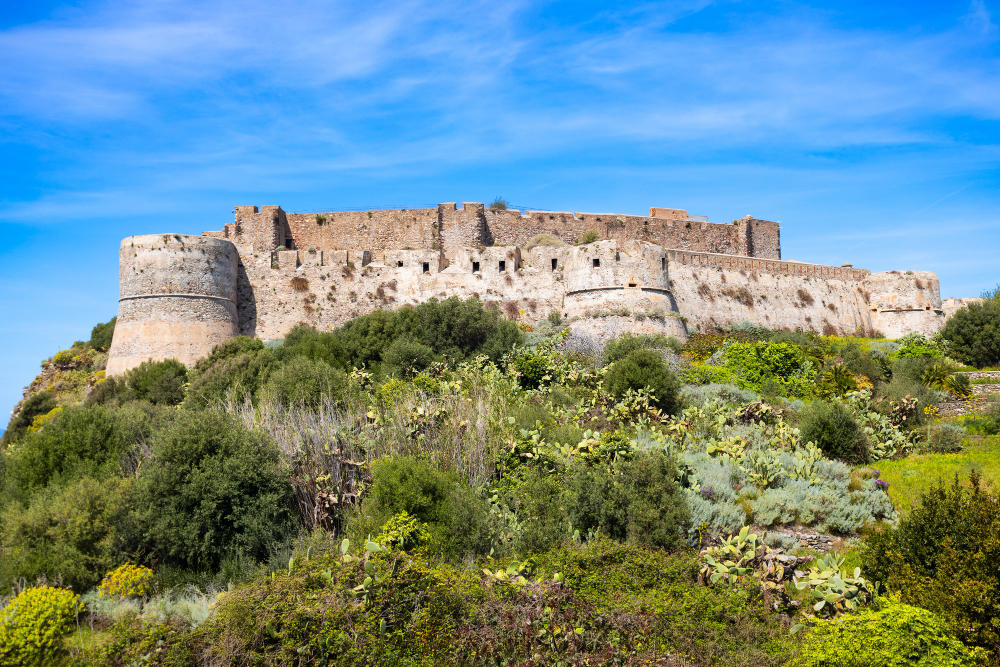
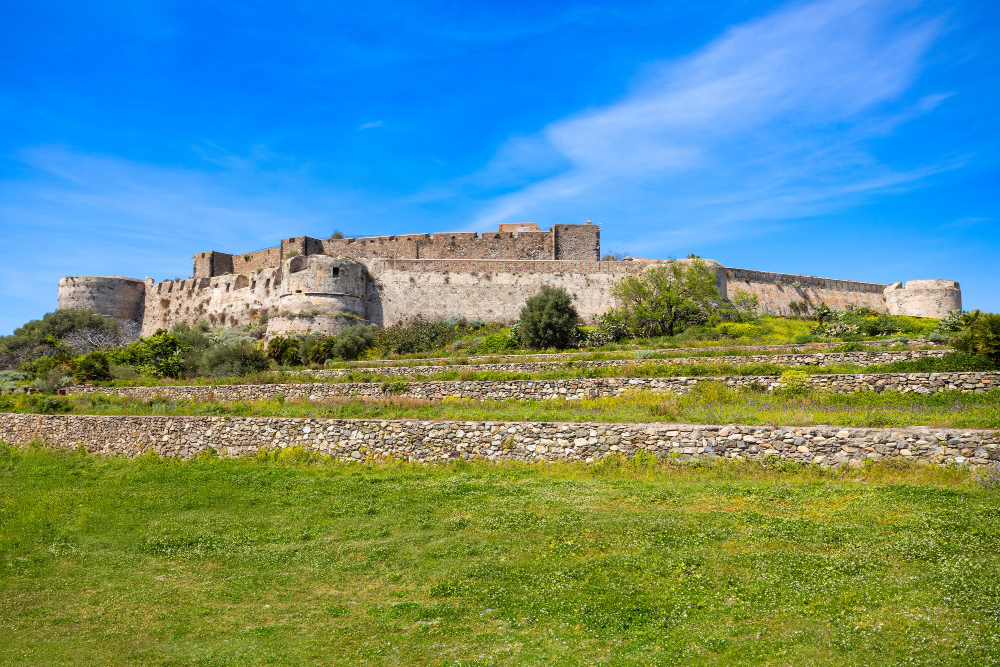
The response to cannons: Aragonese and Spanish fortification rings – With the spread of heavy firearms, the classic medieval castle lost its security. High, comparatively narrow walls and angular towers were far more vulnerable to cannon fire than the later, lower and more massive bastions. In Milazzo, the rulers responded with a comprehensive reconstruction. Between 1496 and 1508, under Aragonese rule, a new ring of walls was constructed, known as the Cinta Aragonese. Six semicircular bastions enclosed the older medieval core. The architect Baldiri Meteli is associated with this phase of construction. The complex thus visibly expanded beyond the boundaries of the earlier castle. In the 16th century, the expansion continued. Between 1525 and 1540, the Spanish erected an additional, more extensive ring of fortifications. This enclosed not only the older walls but also the settlement that had since developed within the fortress grounds. The castle was finally transformed into a citadel. Among the military engineers involved were Pietro Antonio Tomasello and Antonio Ferramolino. Later alterations and designs are attributed to Tibúrcio Spannocchi, Camillo Camilliani and Pietro Novelli, amongst others. The Spanish fortifications exemplify the principles of early modern military architecture: massive earthworks and masonry, projecting bastions for flanking fire, and staggered defence zones. Of particular importance are the Bastione di Santa Maria and the Bastione delle Isole. The Bastione di Santa Maria is situated to the south and protects the main entrance. Its name recalls a church dedicated to the Virgin Mary, which was partially demolished to make way for the military complex. The Bastione delle Isole at the eastern end has an arrow-like shape and was designed by Antonio Ferramolino. This area also features counter-mining defences: underground measures intended to detect, disrupt or combat enemy tunnels. In the 17th century, further outer works were added, including ravelins. These defensive structures, positioned in front of the main walls, were intended to halt attackers and protect the more vulnerable sections of the fortress. The architecture of Milazzo thus also tells the story of a race between offensive and defensive technology.
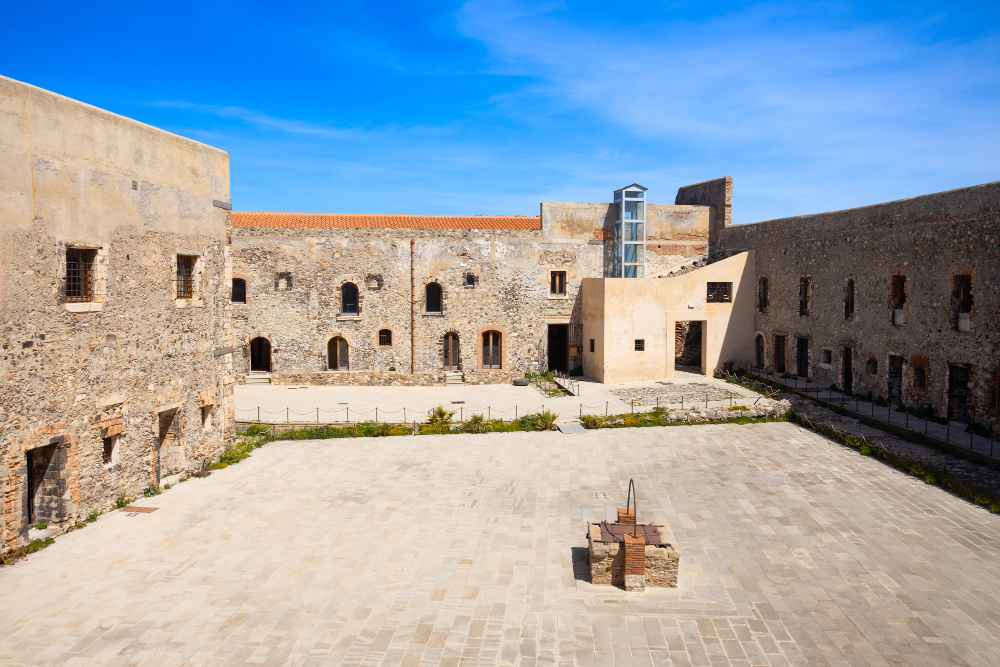
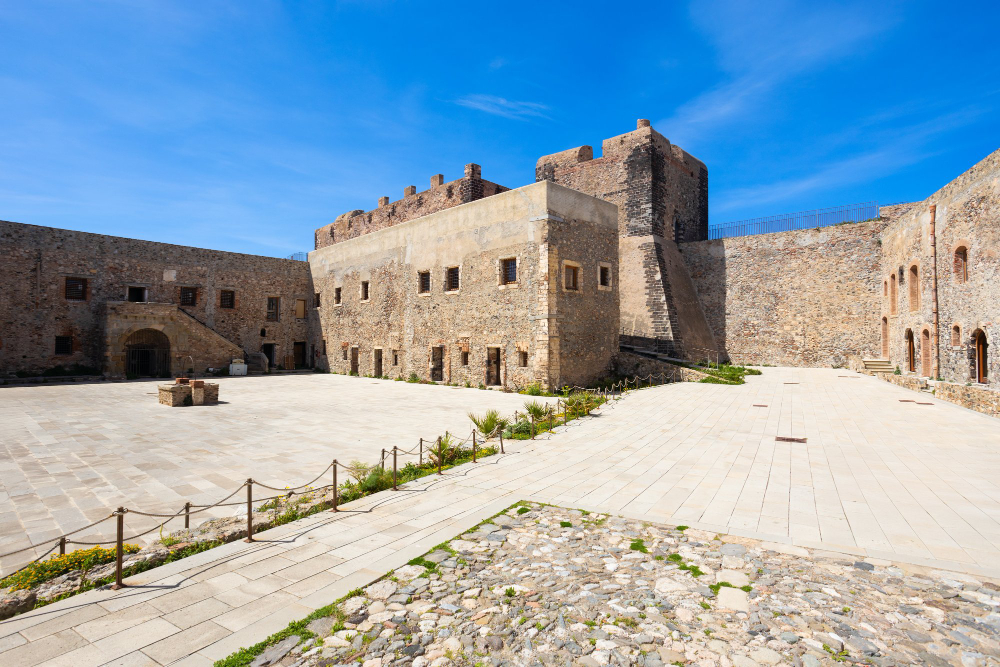
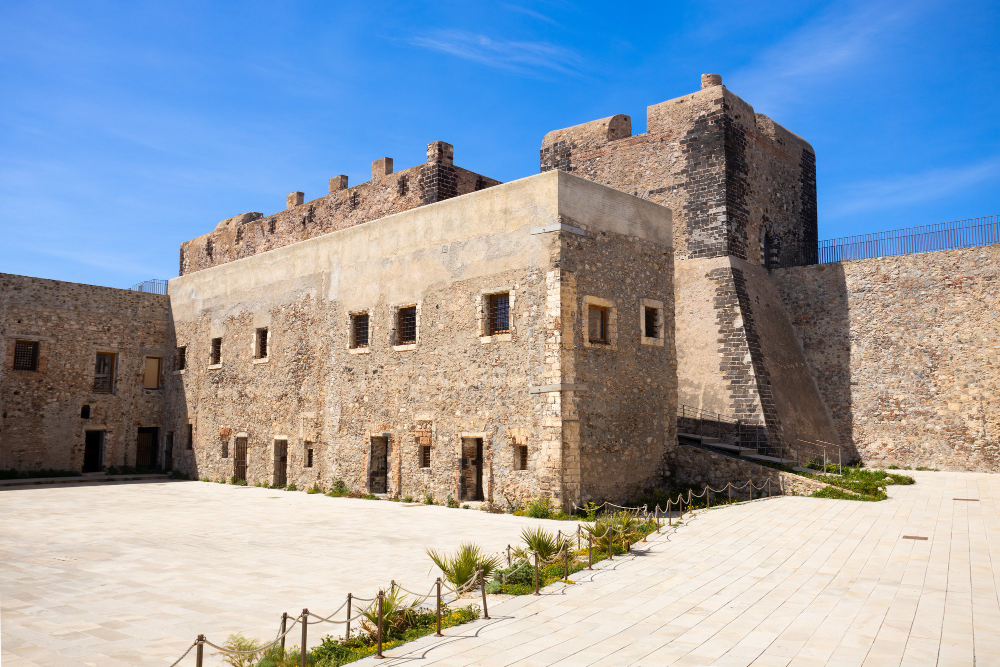
A city behind walls: cathedral, monastery and administration – The Castello di Milazzo was never merely a garrison. Within its walls, an urban space developed, featuring religious and civil buildings. A barrel-vaulted passageway leads into an inner courtyard area where the remains of this former town can be seen. Of particular significance is the Old Cathedral, the construction of which began in 1607. A Benedictine monastery was also built during the same period. Alongside these stand the ruins of the Palazzo dei Giurati, an administrative building for the jurors or municipal officials. The traces of the older Church of Santa Maria, in turn, serve as a reminder of how often priorities shifted within a military complex: religious buildings, living quarters and administrative facilities were repeatedly forced to take a back seat to new defensive requirements. This blend of fortress and town defines the site’s unique character. Visitors see not only embrasures and battlements, but also the remnants of everyday life that took place behind the ramparts.
The Bourbons, Garibaldi and the years as a prison – In the 18th century, Milazzo first came under Habsburg control before the Bourbons took over. Under their rule, the citadel remained a site of military significance until the events of the Italian Risorgimento reshaped the political map of Sicily. In 1860, Milazzo was captured as part of Giuseppe Garibaldi’s campaign in Sicily. The Battle of Milazzo was one of the decisive engagements of the so-called Expedition of the Thousand and contributed to the defeat of Bourbon rule on the island. The fortress thus once again found itself at the centre of a historic upheaval. However, it subsequently lost its military role gradually. From 1880, the complex was converted into a prison. This use entailed structural alterations that did not always benefit the historic fabric. Following the closure of the prison in 1959, the Castello remained neglected for a considerable period. It was only through extensive restoration work carried out between 1991 and 2002, and again from 2008 to 2010, that key areas were preserved and the site made more accessible once more. Today, the Castello di Milazzo is open to visitors and ranks among the most impressive historic sites on Sicily’s northern coast. Those who pass through its gates do not encounter a static past. Rather, the walls reveal how each era has translated its own fears, technical capabilities and claims to power into stone – from the prehistoric hilltop to the early modern bastion, from the medieval tower to the traces of a modern prison.