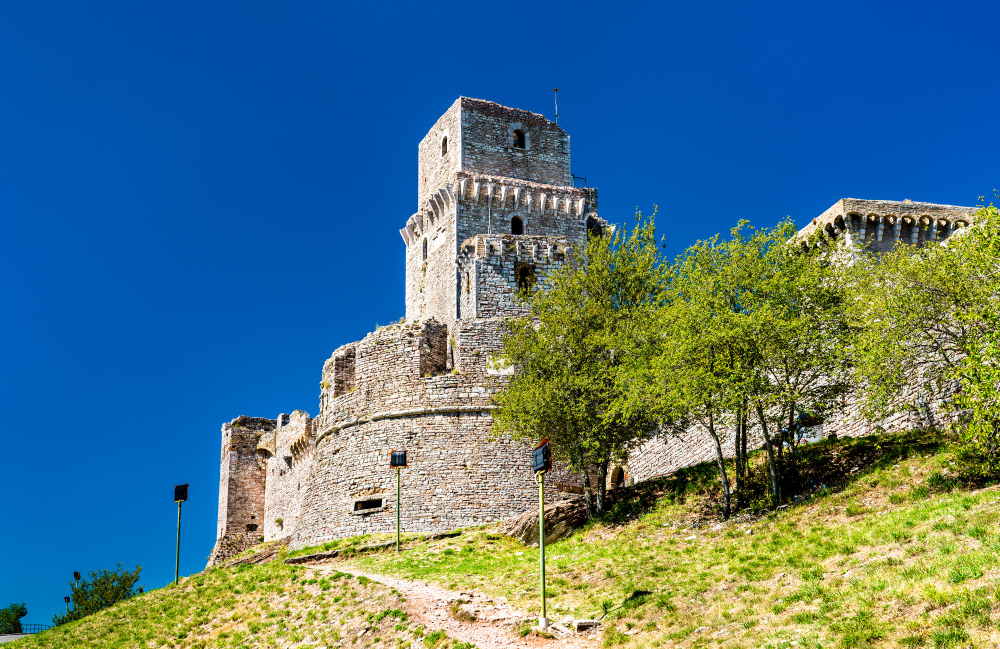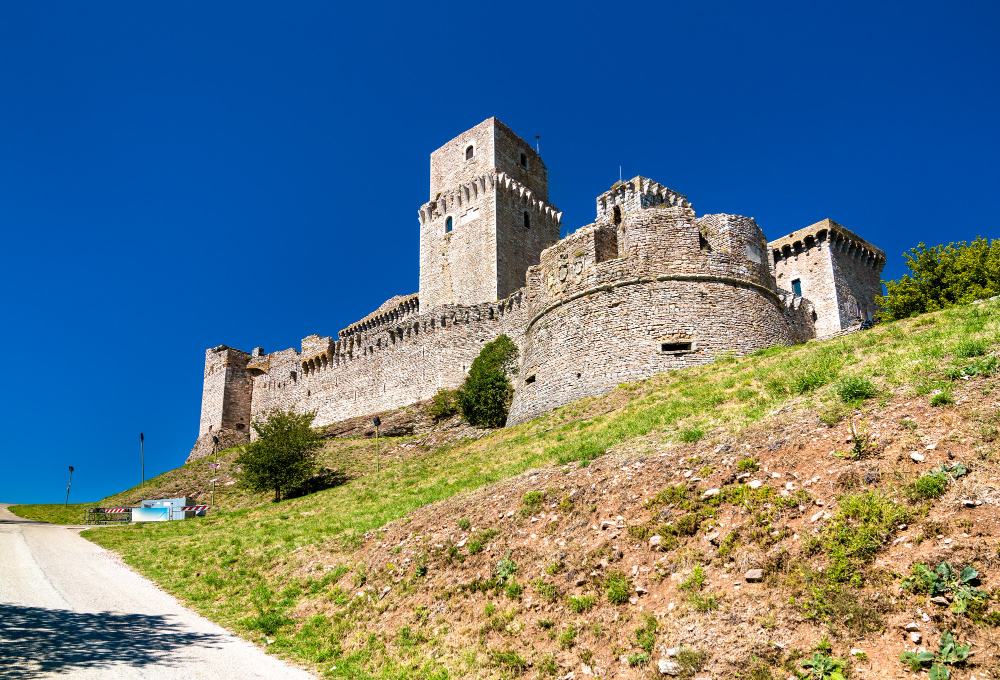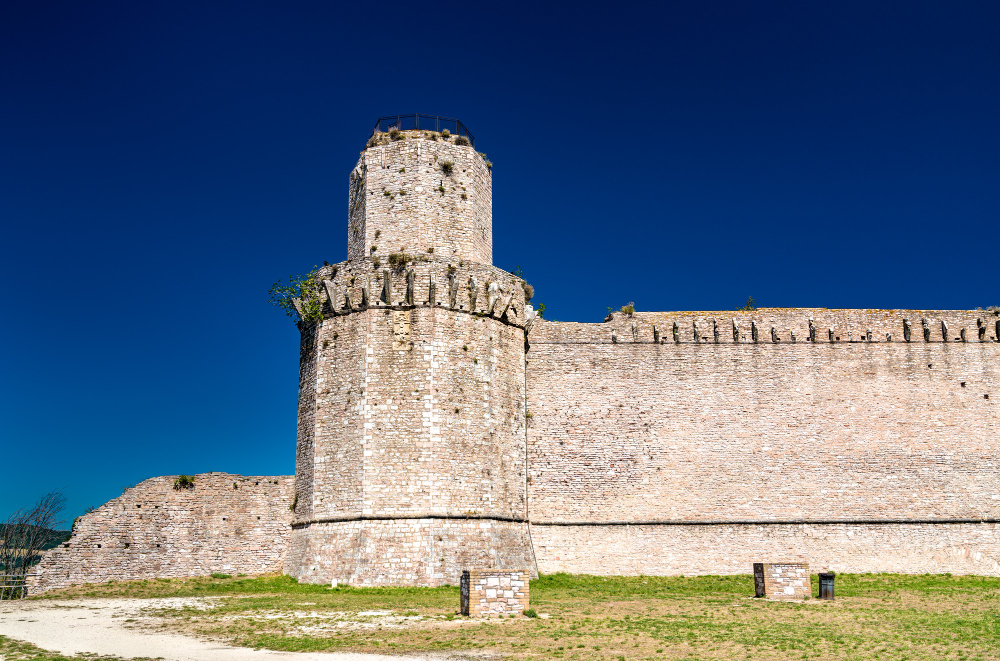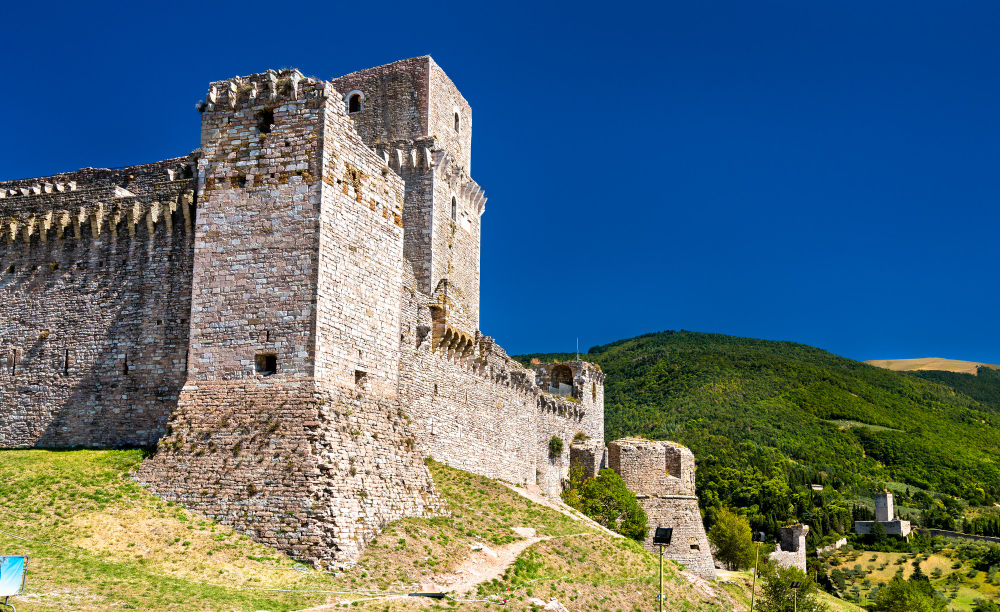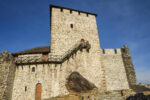

Towering high above the medieval streets of Assisi stands the Rocca Maggiore, a mighty fortress on Monte Asio. Whilst Assisi is known worldwide primarily as the birthplace of St Francis and as a centre of Franciscan spirituality, the fortress tells of another side to the town’s history: of emperors and popes, urban conflicts, sieges and the evolution of military technology. Anyone who climbs up to the Rocca Maggiore not only looks out over the rooftops of Assisi to the Umbrian plain – they also enter a place where political power was concentrated for centuries. The complex is the larger of the two fortifications overlooking Assisi. Opposite it, on a lower hill, lies the smaller Rocca Minore, often referred to as Rocchicciola. Together, the two castles formed a strategic system for controlling the town and its surroundings. The Rocca Maggiore was by far the more important military and political stronghold.
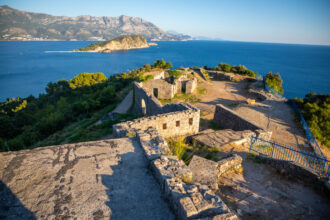
A location of strategic importance – The castle’s location was carefully chosen. Assisi stretches along the western slopes of Monte Subasio, above the vast Valle Umbra. From the Rocca Maggiore, one can overlook the plain towards Perugia, Spello and Foligno. At a time when control over roads, trade routes and lines of sight determined power, this elevated position was of inestimable value. The rocky terrain made an artificially raised mound – as was common with many castles in medieval Europe – superfluous. The natural topography took on a large part of the defensive function. Steep slopes made access difficult for attackers, whilst the castle garrison could spot movements on the plain at an early stage. The first confirmed mention of the Rocca Maggiore dates from the year 1173. However, its present appearance should not be mistaken for the result of a single construction phase. Rather, the castle is the result of destruction, alterations and extensions spanning several centuries. Its walls bear traces of changing rule and evolving military requirements.
Frederick II: Childhood memory or political legend? – The name of Emperor Frederick II is particularly closely associated with the Rocca Maggiore. The future Holy Roman Emperor, King of Sicily and one of the most fascinating rulers of the Middle Ages was born in Jesi in 1194. His mother, Constance of Sicily, and his father, Henry VI of the House of Staufen, were closely involved in the power struggles of the High Middle Ages in Italy. It is said that Frederick lived in Assisi for a time as a child and had connections with the castle. In popular accounts, the Rocca Maggiore is therefore often described as the place of his childhood. What is historically certain, above all, is the significance of Assisi within the Staufer sphere of influence; individual details regarding Frederick’s stay, however, must be treated with caution. It is precisely in the case of famous figures that narratives emerge over the centuries which blend local memory, tradition and verifiable history. It is undisputed, however, that the castle was built and used during an era in which Italy’s major political conflicts also had an impact on smaller towns. Imperial interests, papal claims and the desire of urban elites for autonomy repeatedly clashed in Umbria.
Destruction and a New Beginning under Papal Rule – The medieval history of Assisi was characterised by tensions between different political factions. Like many towns in central Italy, Assisi was embroiled in the conflicts between the Guelphs, who were traditionally closer to the Papacy, and the Ghibellines, who supported imperial interests. In this context, fortresses were not merely military structures; they were visible symbols of dominion over a town. The early castle was severely damaged or destroyed following political unrest and changes in power. A decisive new phase of construction began in the 14th century. The papal legate, Cardinal Gil Álvarez Carrillo de Albornoz, played a central role in this. Albornoz had been sent to Italy by Pope Innocent VI to restore papal rule in the territories of the Papal States. At that time, the popes were still resident in Avignon; many towns in central Italy had largely withdrawn from Rome’s direct control during this period. Albornoz did not rely solely on diplomacy. He had castles renovated or newly built at strategically important locations in order to permanently secure the return and enforcement of papal authority. The Rocca Maggiore in Assisi forms part of this broader context. It was part of a policy that closely linked administration and military presence. However, the work dragged on for a long time. The complex was expanded over generations and adapted to new requirements. It was not until 1538 that the fortress was completed in its essential form – at a time when the classic medieval castle was already being fundamentally challenged by firearms and artillery.
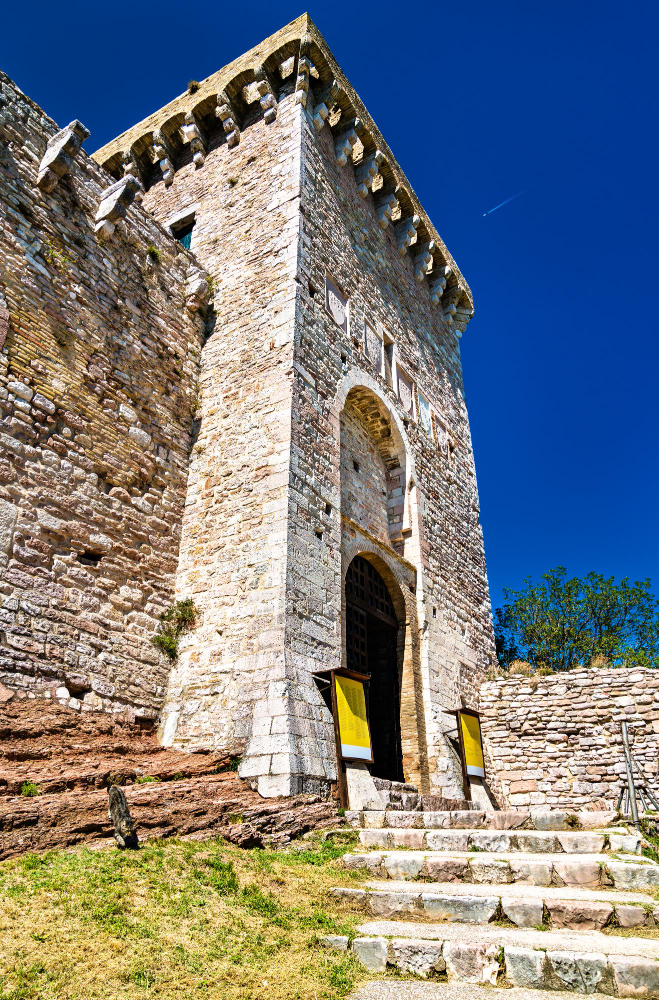
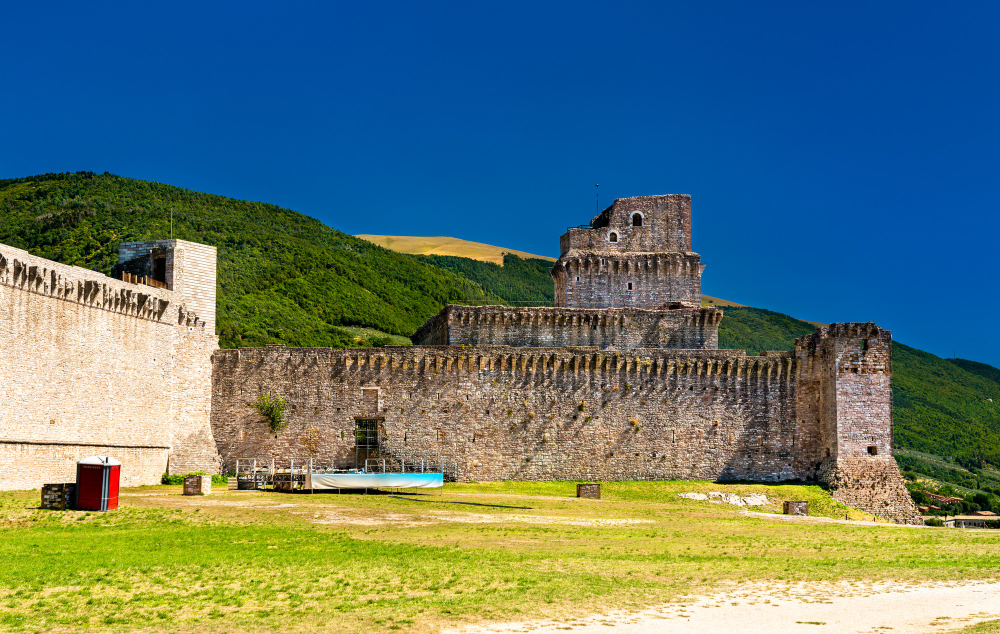
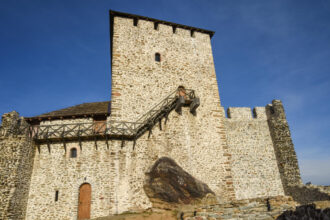
Walls, towers and the mighty keep – The Rocca Maggiore still looks impressive today, although it has suffered damage and losses over time. Its external appearance is characterised by thick walls and several towers. Square corner towers reinforce the defensive lines; battlements and projecting defensive features, often referred to in German as ‘Pechnasen’, bear witness to medieval combat tactics. Through such openings and projections, defenders could engage attackers right at the foot of the walls. Particularly striking is the large donjon, that is, the keep or main tower of the complex. Together with parts of the surrounding walls, it is one of the castle’s older components. Such a tower served not only for observation and defence. In an emergency, it also provided a place of refuge and stood as a symbol of the lord’s power. Inside, the comparatively small courtyard is striking. Unlike in stately residences, the Rocca Maggiore was not designed with spacious living quarters as its primary focus, but rather with defensive capability. Nevertheless, the castle also contained rooms that served purposes beyond purely military ones. On the first floor of the palas is a large hall, the décor of which reflects the complex’s significance as a seat of power. A fortress could, after all, serve simultaneously as a garrison, an administrative centre and a stage for political representation.
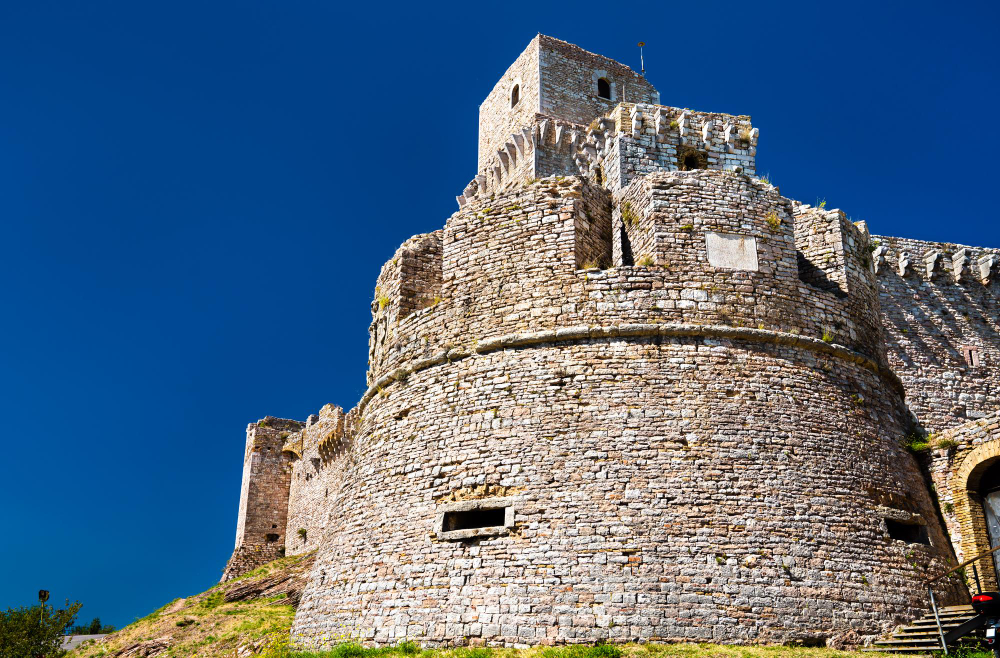
The polygonal tower and adaptation to new weapons – In the 15th century, the castle underwent a major extension: Giacomo Piccinino had a twelve-sided tower built to the west of the main complex, which was connected to the castle via a battlement walk. Piccinino was a condottiero – a military leader who, in Renaissance Italy, fought for various clients using mercenary troops. His family belonged to one of the most famous condottiero dynasties of the 15th century. The polygonal tower demonstrates that fortress architecture had to adapt to the new military reality. With the increasing prevalence of firearms and cannons, tall, narrow walls lost their former security. Round or polygonal structures were better at deflecting projectiles than straight wall surfaces and offered more advantageous positions for defence. The last major extension in 1538 followed this development even more clearly. A round bastion capable of housing artillery was built at the entrance. This transformed the Rocca Maggiore into a transitional form between a medieval hilltop castle and an early modern artillery fortress. Although the large Renaissance fortifications were often lower, wider and designed more specifically to withstand cannon fire, it became clear in Assisi too that the era of knightly castles was drawing to a close.
Damage, Decay and Restoration – The history of the Rocca Maggiore is not only a history of expansion, but also one of decay. The effects of war, political upheavals and centuries of neglect have left their mark. Parts of the corner towers, battlements and defences were damaged or collapsed. It is precisely these scars that reveal that the complex is not merely a romantic backdrop devoid of history, but a structure that has weathered real conflicts. With growing interest in heritage conservation and cultural tourism, the castle increasingly became the focus of restoration work. Safeguarding such a complex is a challenging task: the historic fabric must be preserved, whilst at the same time the walls, towers and paths must remain accessible and safe for visitors. Restoration work cannot undo the passage of centuries, but it helps to protect the structures that remain and make them understandable.
More than just a vantage point – Today, the Rocca Maggiore is one of Assisi’s most impressive sights. The climb up offers a shift in perspective: below lie the town’s churches, squares and stone houses; in the distance, the Umbrian countryside opens up. Yet the fortress is far more than just a vantage point overlooking the famous pilgrimage site. It tells the story of an Assisi that was not only a spiritual centre but also a contested municipality. It recalls the rule of the Staufers, the reconquest of central Italy by the Papal States, the condottieri and the transition from the sword to the cannon. It is precisely this contrast that gives it its appeal: below the castle, Assisi stands for Francis of Assisi, the ideal of poverty and peace – whilst above the town rises a structure shaped by power, protection and violence. The Rocca Maggiore thus demonstrates just how multifaceted history can be. Assisi is not merely the town of a saint. It is also a town whose fate was shaped over the centuries by a interplay of spiritual influence, political self-assertion and military control.