
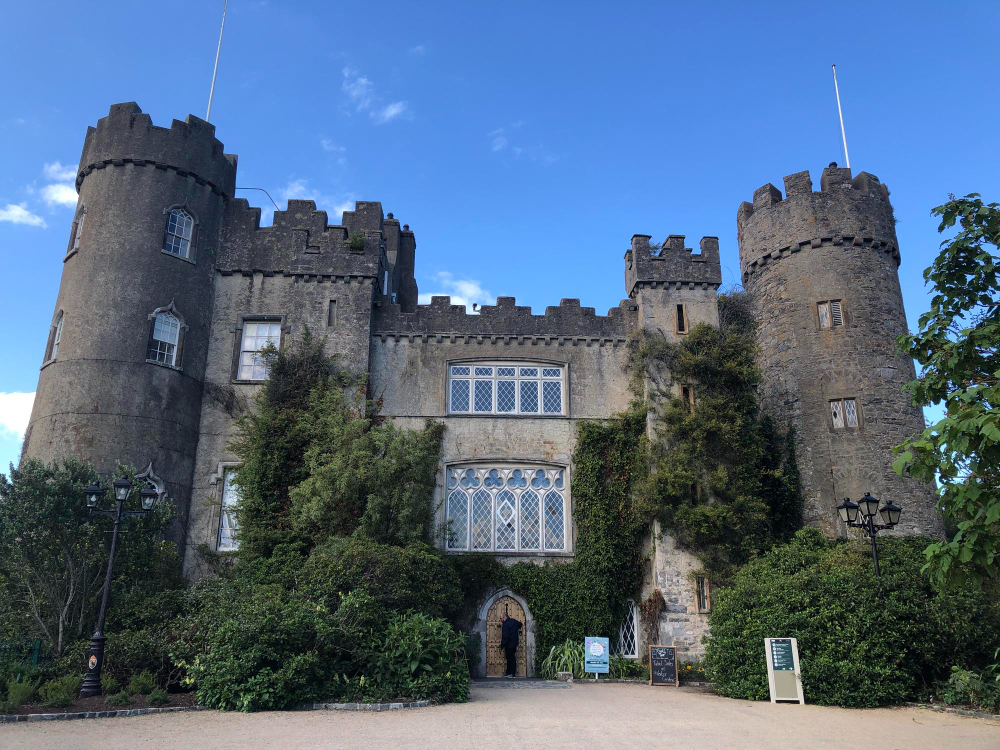
Just a few kilometres north of Dublin, hidden behind ancient trees and extensive grounds, stands one of Ireland’s most impressive historic sites: Malahide Castle. The castle, situated in the present-day coastal town of Malahide in County Fingal, is far more than just a photogenic day-trip destination. Its walls tell tales of Norman conquest, English rule, religious conflicts, civil war and the gradual transition from an aristocratic family seat to public ownership. For almost eight centuries, Malahide Castle was linked to a single family: the Talbots. From 1185 to 1976, members of this family lived on the estate – with a brief interruption during Oliver Cromwell’s rule in the 17th century. Hardly any other place in Ireland brings together so many layers of the country’s history in such a small space.
A Norman knight is granted land by the sea – The history of Malahide Castle begins in the decades following the Anglo-Norman invasion of Ireland. Richard Talbot, a knight who had accompanied King Henry II of England to Ireland, was granted the lands and harbour of Malahide in 1185. This grant was part of a broader strategy by the English Crown: control over the newly conquered territory was to be secured in the long term through loyal Norman families. The land was strategically well-situated. Malahide was located on a sheltered bay north of what was then Dublin, with access to the Irish Sea and a location that was significant both economically and militarily. The Talbots probably initially built a fortified residence there. Parts of the present-day structure date back to the 12th century, although the castle’s appearance has changed repeatedly over the centuries. Malahide Castle was never merely a medieval fortress. It gradually developed into a residence for the landed gentry. Although fortified walls, towers and a large great hall are reminders of the turbulent times of the Middle Ages, later generations increasingly adapted the complex to suit the needs of a stately home. The castle was significantly extended, particularly under King Edward IV in the 15th century. However, the striking towers that characterise the complex today date largely from the 18th century: they were added in 1765 and gave the building its now familiar, romantic-Gothic profile.
Almost 800 Years of Talbot Rule – The exceptional significance of Malahide Castle lies above all in the longevity of its family history. The Talbots held the estate for over 791 years. This continuity was by no means a given, as Ireland was shaken during this period by repeated wars, uprisings, expropriations and political upheavals. The family weathered the shifting balance of power between the English Crown, the Irish nobility and, later, the British administration. They lived through the Reformation, the conflicts between Catholics and Protestants, the wars of the 17th century and the reorganisation of Ireland following the defeat of the Catholic King James II by William of Orange. It is noteworthy that, despite their long-standing ties to the English-influenced upper classes, the Talbots remained Catholic until 1774. As a result, they lived for a long time under the shadow of the so-called Penal Laws. These laws severely restricted the rights of Catholics and other non-Anglican groups. Property rights, political participation, education and religious practice were affected to varying degrees. The fact that the family was nevertheless able to retain its estate points to their influence, their adaptability and the complex reality of Irish social history, which can never be fully categorised into simple dichotomies of ‘English’ and ‘Irish’.
Cromwell, Expropriation and Return – The greatest turning point for the Talbots came in the 17th century. Following the reconquest of Ireland by Oliver Cromwell’s troops, Malahide Castle was seized from the family. The estate passed to Miles Corbet, a supporter of Cromwell and a political official of the Commonwealth. For many Catholic landowners, the Cromwell era meant dispossession, expulsion or the loss of their political standing. Malahide was part of this wider trend. Yet the Talbots were to return: following the Restoration of the monarchy in 1660 and the return of King Charles II, Corbet was executed. Malahide Castle subsequently reverted to its original owners. This episode lasted just over a decade, yet it illustrates how precarious even the holdings of long-established families could be. Whilst the castle survived, its history was henceforth inextricably linked to the major political conflicts of the British-Irish Isles.
The Tale of the 14 Talbots – Numerous stories still surround Malahide Castle to this day. The best known relates to the Battle of the Boyne in 1690, one of the decisive military moments in Irish history. Near the River Boyne, the armies of the Catholic King James II and the Protestant William III fought each other. William’s victory had far-reaching consequences: Protestant dominance in Ireland was consolidated, whilst the Catholic elite continued to lose influence. Malahide is associated with the dramatic legend that 14 members of the Talbot family had breakfast in the Knights’ Hall on the morning of the battle and were all dead by evening. The story is an integral part of the local oral tradition and is frequently mentioned in connection with guided tours of the castle. It conveys the tragedy of that era, when families were torn apart by political loyalties, religious divisions and military conflicts. Historically, however, such tales should be treated with caution. They reflect a culture of remembrance in which actual events, family history and later embellishments can become intertwined. This is precisely why they are so interesting: legends such as these show how a place lives on not only through documents and architecture, but also through stories passed down through the generations.
Ghost stories between the Knights’ Hall and the portrait gallery – Like many of Ireland’s ancient castles, Malahide also has a reputation as a place of the supernatural. Visitors and travel accounts have long mentioned several alleged ghostly figures, including the so-called ‘Puck’, who is described as a small court jester or servant. According to a widespread tale, he is said to have been in love with the daughter of a Talbot lord and, following a tragic end, to wander the grounds. A ghost known as Lady Maud Plunkett is also frequently associated with the castle. She is said to wander through the rooms dressed in white and to appear particularly near the portrait collection. Such stories cannot be substantiated as historical facts. However, they form part of Malahide Castle’s cultural aura and demonstrate how strongly historical sites are shaped by folklore, tourism and local tradition. The castle itself provides the perfect backdrop for such legends: dark wood panelling, period furniture, family portraits and rooms whose functions have changed over the centuries. The Great Hall, in particular, still conveys a sense of medieval grandeur to this day. At the same time, Malahide is not an unchanged relic from the 12th century, but a building that has been continuously remodelled, furnished and adapted to the changing lifestyles of its inhabitants.
An airship base during the First World War – A lesser-known but remarkable episode took place during the First World War. In 1918, a take-off and landing site for airships was established on the grounds of Malahide Castle. The airships were linked to the British airship base on Anglesey in Wales and were used in operations against German U-boats in the Irish Sea. The submarine threat was of great strategic importance to the British Isles. Merchant ships and military transports had to be protected, and sea routes monitored. Airships were able to observe large areas from the air and were therefore of interest for anti-submarine warfare. After the war ended, however, plans to permanently station airships at Malahide were not pursued. The fact that a medieval family seat temporarily became part of modern wartime logistics illustrates the transformation of the site. Malahide Castle was not merely a backdrop to the past, but remained involved in the political and technical developments of its time throughout the 20th century.
The Boswell Papers: A Literary Discovery – In the 1920s, the castle also came to the forefront of literary history. Private papers belonging to James Boswell were discovered on the estate. Boswell, an 18th-century Scottish writer, is best known as the biographer of Samuel Johnson. His writings are regarded as important sources for the intellectual and social life of his era. The manuscripts came into the possession of the American collector Ralph Heyward Isham via a descendant of Lord Talbot of Malahide. The discovery and subsequent preservation of the papers were significant for research, as Boswell’s diaries and correspondence offer an unusually personal insight into the 18th century. Malahide Castle thus also became a place where family archives, cultural history and an international passion for collecting intersected.
Sale to the Irish State – The Talbot era came to an end in the 1970s. The 7th Baron Talbot of Malahide died in 1973. His sister, Rose Talbot, inherited the castle and estate, but faced considerable financial burdens, particularly due to inheritance tax. In 1975 and in the period that followed, the estate was sold to the Irish State; in 1976, this brought to an end the Talbot family’s direct connection with Malahide Castle, which had lasted for almost eight centuries. The transfer was not without controversy. In order to meet financial obligations, large parts of the furnishings had to be sold off beforehand. Furniture, works of art and other items of furnishings left the castle. The sales sparked public criticism, as many people feared that a significant part of Ireland’s cultural heritage was being torn apart. However, some of the items were secured by government bodies and private collectors. Today, Malahide Castle is one of the best-known historic attractions in the Greater Dublin area. It is situated within Malahide Demesne Regional Park, the remaining part of the former estate. The grounds, covering approximately 1.1 square kilometres, feature not only the castle but also walking trails, gardens and open green spaces. The site thus combines heritage conservation, local recreation and educational tourism. Malahide Castle is not a silent monument. Its history spans from Norman knights through Cromwell’s confiscations and the Battle of the Boyne to the World Wars and modern cultural tourism. Those who walk through its rooms encounter not a single past, but many: the history of a family, of a country, and the ongoing question of how historical sites should be preserved, narrated and utilised.