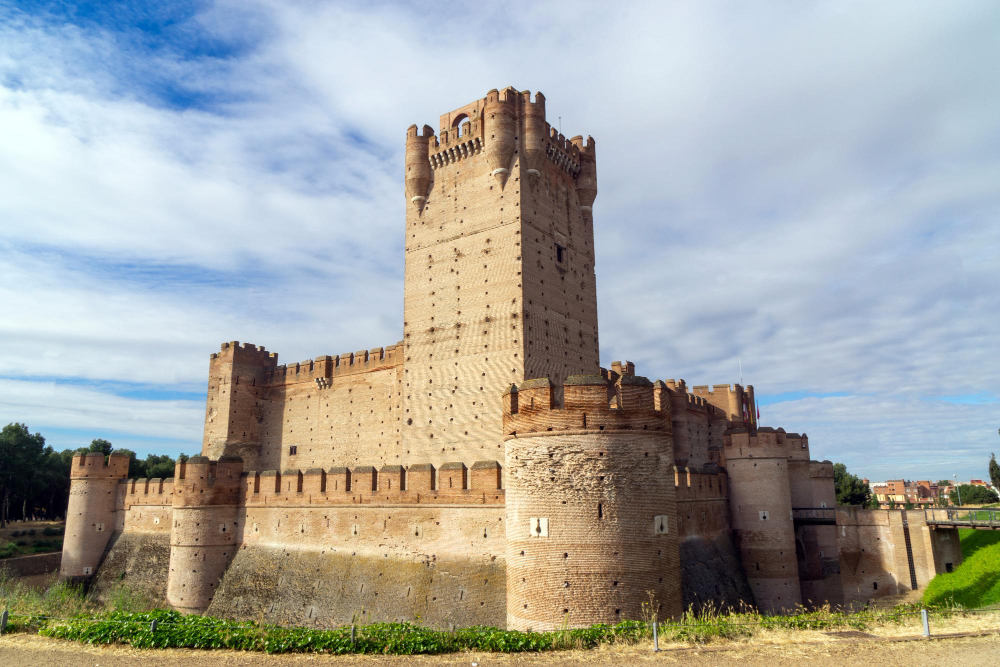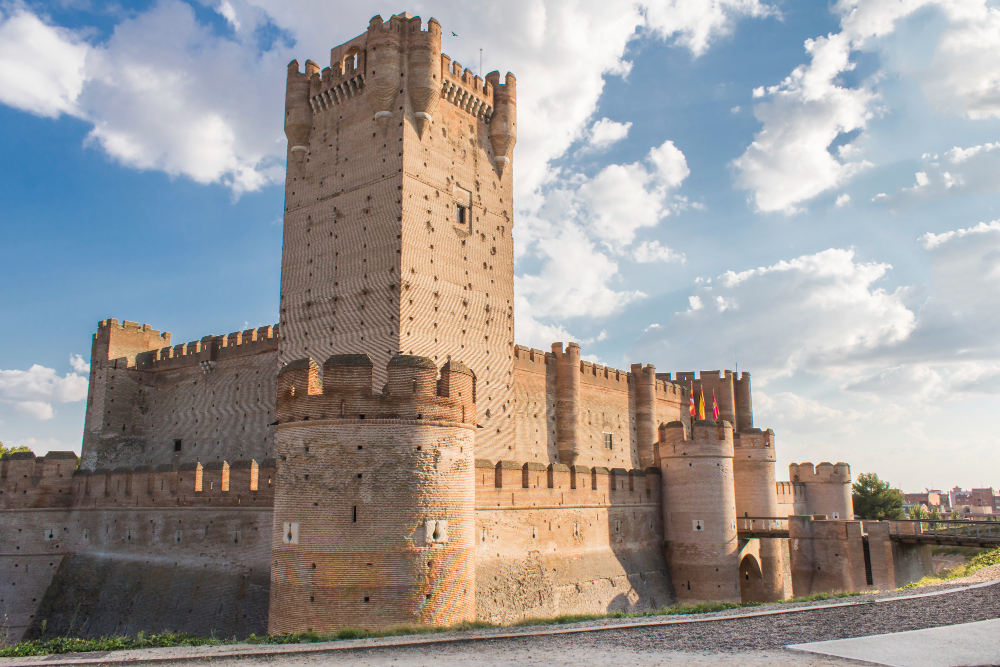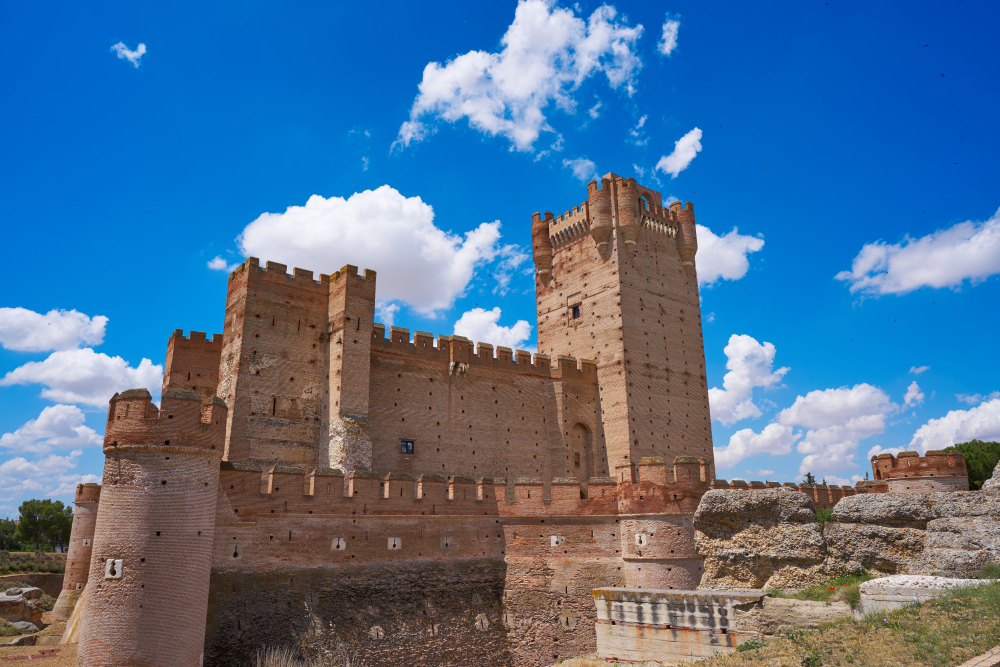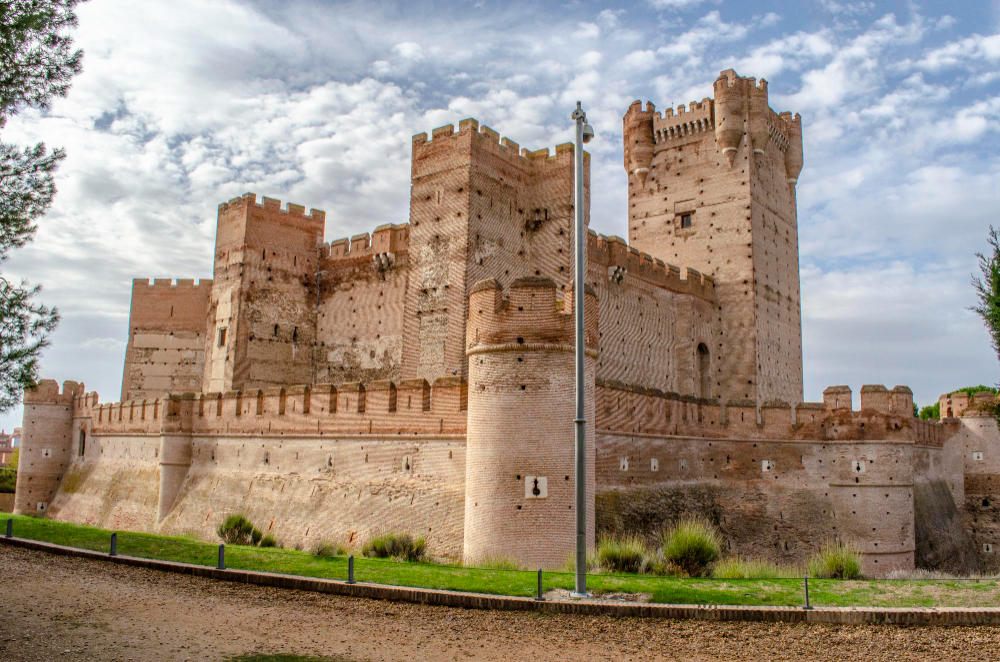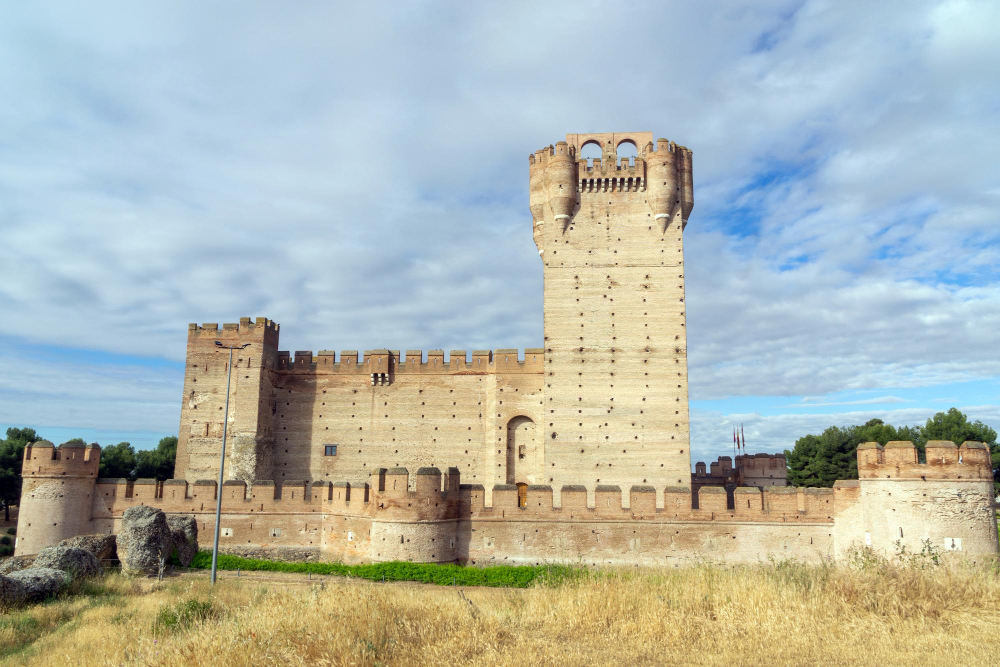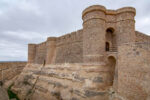

High above the Castilian town of Medina del Campo stands a castle whose red-brick walls are visible from a great distance: the Castillo de La Mota. The complex is one of Spain’s most impressive fortresses – not only because of its 44-metre-high main tower, but also because of its extraordinarily eventful past. Kings resided here, political conflicts were settled here, and prominent prisoners were held here. And it was here that the Italian power-hungry politician Cesare Borgia managed a spectacular escape. The Castillo de La Mota is thus far more than just a photogenic medieval structure. It tells the story of the emergence of the Kingdom of Castile, of dynastic struggles, of Isabella the Catholic, and of the tensions between monarchical power and urban resistance. Since 1904, the fortress has been a listed building and is recognised as a Bien de Interés Cultural.
A castle on the ‘hill’: the origins of La Mota – The castle’s name refers directly to its location. In Spanish, ‘La Mota’ roughly means ‘hill’ or ‘elevation’. It was on this strategically favourable hill that the settlement of Medina del Campo was founded between around 1070 and 1080. At that time, the region lay in an area characterised by conflicts between Christian kingdoms and Muslim territories on the Iberian Peninsula. Fortifications were probably erected quite early on following the settlement of the hill. However, the oldest parts of the main castle that can be identified today date back to the 13th century. Remains of this early structure are found mainly in the south-western section. The castle’s current appearance, which impresses visitors with its mighty walls, towers and a wide defensive ring, is, however, primarily the result of alterations carried out in the 15th century. The location was no coincidence: from the hilltop, Medina del Campo could be controlled, whilst potential attackers could be spotted at an early stage. The castle was thus a military stronghold, but also a visible symbol of royal rule over a town that gained great importance in the late Middle Ages through trade and fairs.
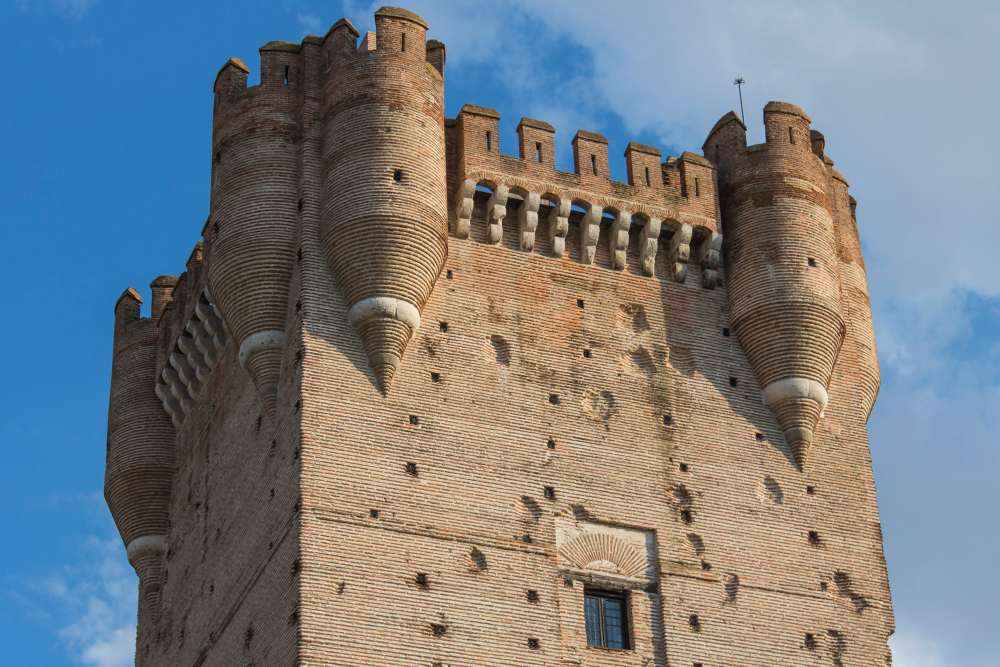
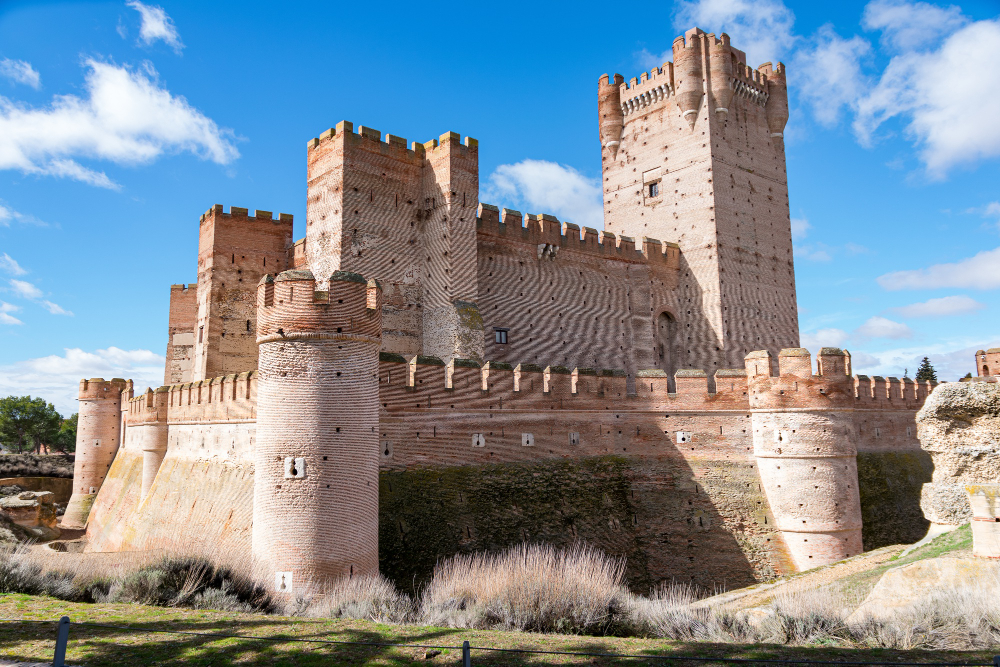
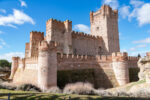
Red brick, Mudejar forms and a 44-metre tower – Architecturally, Castillo de La Mota differs from many castles in Central Europe, which are primarily associated with grey natural stone. The fortress consists mainly of light reddish brick, a building material commonly used in Castile. Natural stone was used primarily in areas subject to particular wear and tear or for representative features: for example, in embrasures, coat-of-arms stones and individual architectural details. A distinctive feature is the evidence of medieval construction methods on the outer walls. The regularly spaced openings are not signs of damage, but remnants of what is known as ‘scaffolding timber’: during construction, beams were threaded through these holes to support scaffolding and working platforms. Particularly impressive is the barbican, a large outer curtain wall that encircles the main castle. From the bottom of the moat, it reaches a height of almost 20 metres. Attackers therefore first had to cross the moat and were then subjected to fire from the embrasures of the outer fortifications. Added to this was an inner curtain wall, from which defenders could operate with bows or, later, with firearms. The layout of the complex is trapezium-shaped. At its centre lies a large inner courtyard, flanked by four towers. This area once housed residential and service rooms. Towering above it all is the mighty Torre del Homenaje – the main tower, which served as a defensive structure, a vantage point and a symbol of power. At 44 metres, it is considered one of the tallest castle towers in Castile. Access today is via a fixed wooden bridge. Originally, there was a drawbridge here. The gate itself lies between two towers; above it, a coat of arms commemorates the Catholic Monarchs, Isabella I of Castile and Ferdinand II of Aragon. Inside, there is also the Chapel of Santa María del Castillo.
Power struggles in the 15th century: between Castile and Aragon – In the late Middle Ages, La Mota was repeatedly the scene of dynastic disputes. In 1390, King John I of Castile bestowed Medina del Campo and the castle upon his ten-year-old son Ferdinand. He later became King Ferdinand I of Aragon. Upon his death, the reign passed to his son John of Aragon, who, according to historical records, was himself born in Medina del Campo at the end of the 14th century. However, the connection between the Castilian and Aragonese ruling families did not lead to stability. In the first half of the 15th century, protracted conflicts arose between John II of Castile and his cousins, the so-called Infantes of Aragon. Control over Medina del Campo was at times divided: whilst the Aragonese held the castle hill, the town itself remained under Castilian influence. John of Aragon had the fortress extended during this period. However, in 1445, he and his allies were defeated by Castilian troops at the Battle of Olmedo. Medina del Campo and Castillo de La Mota were definitively returned to the Castilian Crown. The castle remained politically significant under Henry IV as well. Around 1460, the king had the main tower built or substantially extended. A few years later, Henry gifted the fortress to the influential Archbishop of Toledo, Alfonso Carrillo. However, in 1465, Carrillo turned against the king and supported the rebellion in which Henry’s half-brother, Alfonso of Castile, was to be proclaimed anti-king. Following the death of the young Alfonso in 1468, the uprising quickly collapsed. The castle changed hands several times in the years that followed – a testament to its value as a key military and political stronghold.
Isabella the Catholic and the conversion into a modern fortress – The death of Henry IV in 1474 marked the beginning of the Castilian War of Succession. In 1475, Castillo de La Mota passed from the ownership of the Fonseca family to Isabella of Castile and her husband Ferdinand of Aragon, who later became known as the Catholic Monarchs. Under their rule, between 1480 and 1483, the complex acquired its most defining defensive structures. The barbican was extended, as were further outer fortifications. Interconnected corridors and rooms serving a defensive purpose were constructed beneath the curtain wall. The castle was now prepared for the demands of an era in which siege engines and artillery were playing an increasingly significant role. For Isabella, La Mota was not merely a military structure. It was one of her favourite residences, and the royal family stayed in Medina del Campo on numerous occasions. At times, the royal archives were also kept in the castle. The fortress thus combined several functions: residence, administrative centre, treasury of the realm and military stronghold.
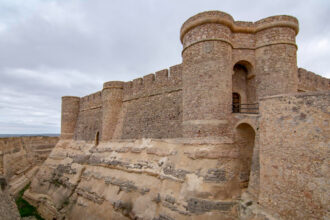
Cesare Borgia: Imprisonment and Escape from the Tower – One of the castle’s most famous episodes is the imprisonment of Cesare Borgia. The scion of Italian nobility, son of Pope Alexander VI, had become a feared figure in the power struggles of Italy. Following his father’s death, however, Borgia lost his political protection. In 1504, under pressure from Ferdinand II of Aragon, he was arrested in Naples and transferred to Spain. Initially, Borgia was imprisoned in the Castillo de Chinchilla de Montearagón. In 1505, he was taken to La Mota. The fortress was considered particularly secure, yet in October 1506 the prisoner managed to escape. It is said that he escaped from the tower with the aid of a silk cord. The escape attempt was risky and underlines just how much the castle was used at that time as a state prison for high-ranking political prisoners. Hernando Pizarro, brother of the conquistador Francisco Pizarro, was also imprisoned here. He spent more than two decades at La Mota, from 1540 to 1561. His long imprisonment shows that the complex continued to play a central role in the Spanish Crown’s apparatus of power during the 16th century.
The Comuneros Revolt and subsequent military use – During the Comuneros Revolt of 1520 to 1522, Medina del Campo once again found itself at the centre of a conflict. The rebels rose up against King Charles I – later Emperor Charles V – and against the growing influence of royal central authority. The town and the fortress were the scene of fierce fighting, but the Comuneros failed to capture Castillo de La Mota. The visible damage to the main tower serves as a reminder of the complex’s military history. Impact marks can still be seen on its façade, which are thought to be the result of the siege and artillery fire. Later, the castle served, amongst other things, as a military base and an artillery depot. From the 17th century onwards, a gradual state of disrepair set in. Although individual parts were repaired, the complex lost its former military significance. In 1649, the damaged bridge was rebuilt. A survey carried out in 1774 already noted considerable damage; parts of the moat had eroded, which compromised the castle’s stability.
Preservation, Restoration and Remembrance – It was not until the early 20th century that public interest in preserving the structure grew. In 1904, the Castillo de La Mota was granted the status of a protected national cultural heritage site. Shortly afterwards, the first restoration works began. Between 1913 and 1916, destroyed battlements and parapets were reconstructed based on surviving examples. Towers and defensive turrets were also repaired later on. During the Franco dictatorship, the castle was handed over to the Falange and served as the headquarters of the Sección Femenina, the regime’s women’s organisation. Further alterations took place during this period; the inner courtyard was redesigned in the Mudejar style based on historical models. These restorations have helped shape the castle’s current appearance, but are also part of a complex political history of memory. Modern archaeological and architectural investigations have documented the site in greater detail. Of particular importance was the mapping of the underground passages, chambers and defensive structures, which had long remained largely unknown. Today, the Castillo de La Mota stands as one of Castile’s most significant monuments, embodying nearly a thousand years of history. Its walls tell not only of sieges and kings, but also of trade, rule, captivity and change. Anyone crossing the wooden bridge into the castle therefore enters not merely a monument – but a place where the history of Spain is condensed into brick, stone and the shadows of the towers.