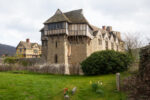

Set amidst the rolling countryside of Shropshire, near the small English village of Stokesay, stands a structure that at first glance resembles a medieval castle: towers, a moat, defensive walls and an imposing gatehouse characterise the scene. Yet Stokesay Castle was never intended to be an impregnable fortress. Rather, it is one of the most extraordinary surviving examples of a fortified manor house in medieval England – built by a wealthy merchant who sought to combine security, social prestige and economic success. Today, the site is managed by English Heritage; it is a Grade I listed building and designated as a ‘Scheduled Monument’, placing it under special protection. Its history spans from the heyday of the English wool trade through the Civil War to the debates surrounding modern heritage conservation. Stokesay Castle is therefore not only an attractive destination for a day out, but also a rare testament to how wealth and power were displayed in the Middle Ages.
A wool merchant builds himself a castle – The name Stokesay reflects the village’s long history. It is believed to be derived from the Anglo-Saxon term “stoches”, meaning ‘livestock farm’, as well as from the name of the Say family, who had owned the land since the 12th century. In 1281, Laurence of Ludlow acquired the estate. Laurence did not belong to the old landed gentry, but was a merchant – albeit an exceptionally successful one. He traded in wool from the Welsh Marches, the border region between England and Wales. At that time, wool was one of England’s most important export commodities; it supplied the textile centres in Flanders and other parts of Europe. Laurence maintained business connections in Shrewsbury and London, travelled extensively and apparently wielded considerable political influence. According to sources, he supported the Crown on matters of trade policy and even lent money to high-ranking nobles. The purchase of Stokesay was therefore more than just a property investment for him. On the one hand, the estate was intended to generate income: arable land, meadows, woodland, a mill and dovecotes provided a regular income. On the other hand, it was intended to become a prestigious residence. Laurence needed a house that would visibly display his economic standing – without giving the impression that he wished to compete militarily with the powerful border barons. Construction work probably began around 1285. By the early 1290s, Laurence was already able to move into the complex. In 1291, he received a so-called “licence to crenellate” from King Edward I – that is, royal permission to fit out his house with battlements and fortifications. Such licences were not only practical but also symbolically significant: they confirmed social recognition and transformed a manor house, externally at least, into a ‘castle’. Laurence was not, however, to enjoy his building for long. In November 1294, he drowned off the south coast of England. His son William presumably completed the outstanding work. The Ludlow family remained the owners until the end of the 15th century; later, Stokesay passed to the Vernon family through marriage.
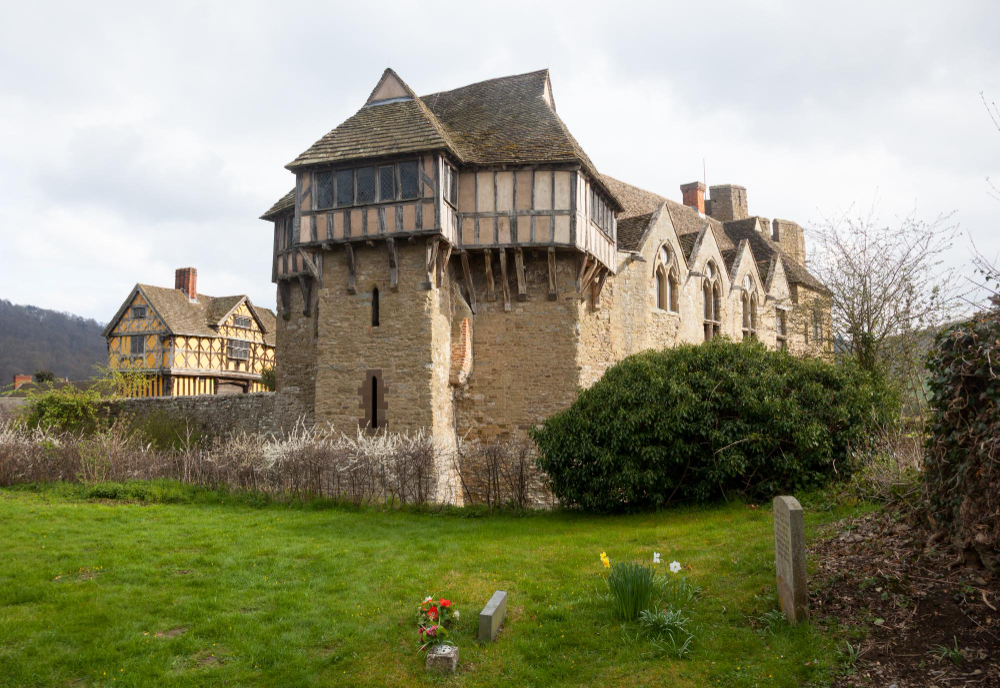
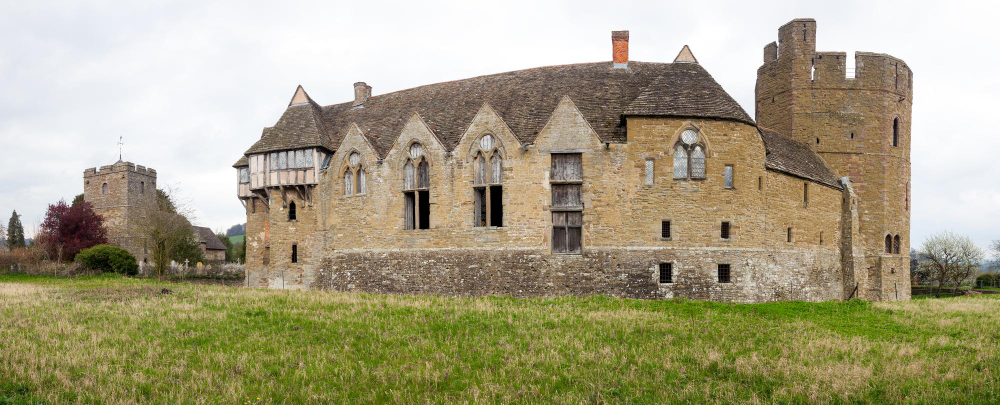
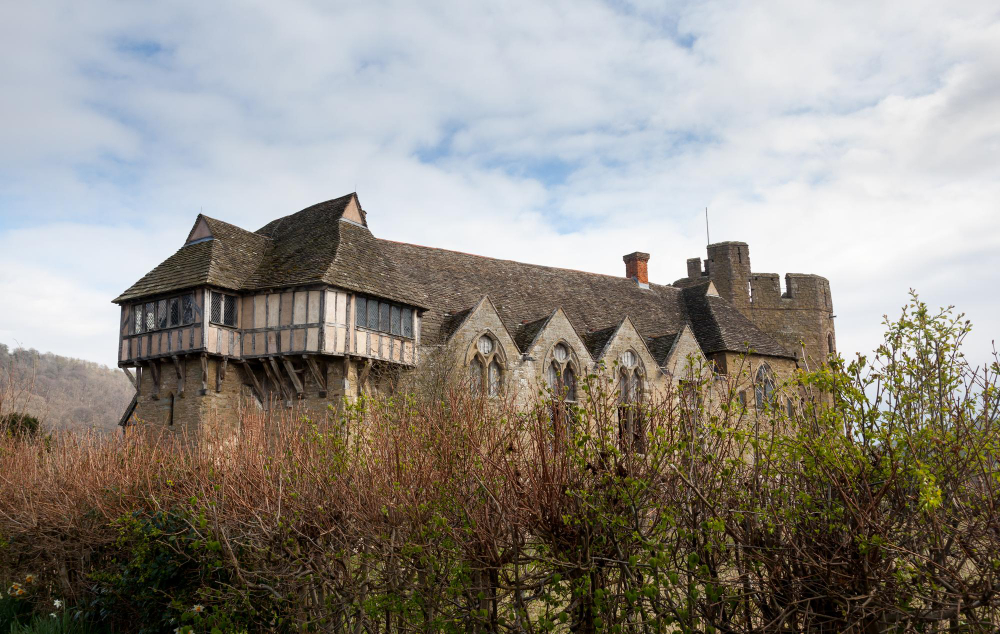
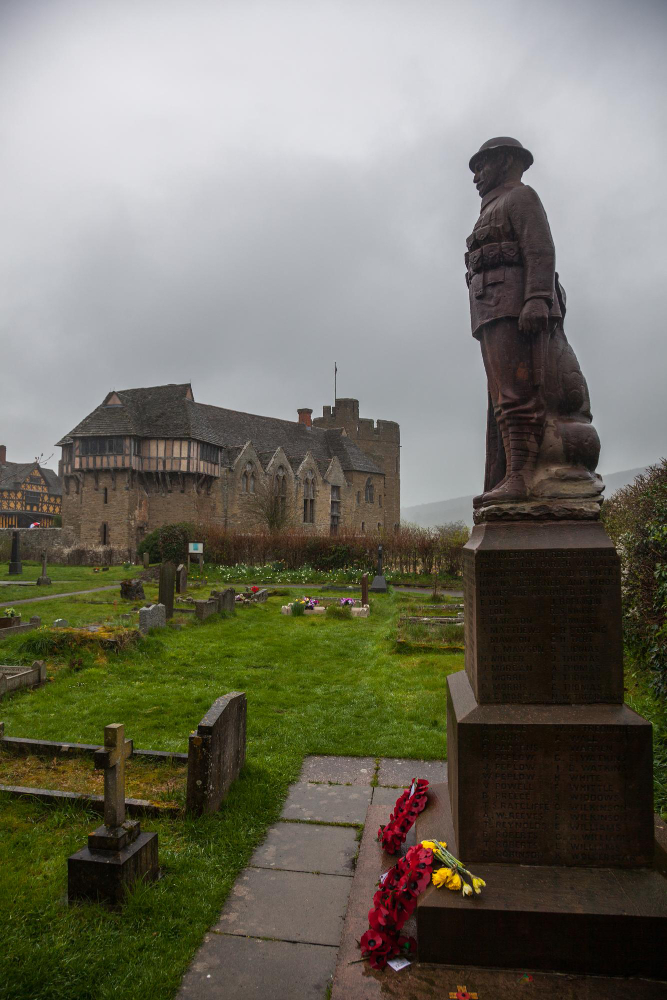
A castle never intended as a fortress – Stokesay Castle owes its impact to the interplay of domestic comfort and magnificent defensive capabilities. The complex is situated on gently sloping ground in the valley of the River Onny. A moat once surrounded the inner courtyard; however, it is not entirely clear whether it was permanently filled with water. Access was via a causeway leading to the gatehouse. Inside, the main medieval buildings still stand close together: the great hall, the so-called ‘Solar Block’, which served as private living quarters, and a north and a south tower. It is precisely this largely preserved complex that makes Stokesay so significant. The most imposing part of the complex is the south tower. It features an unusual, irregular pentagonal ground plan and thick walls. Staircases and small recesses for toilets are set into the masonry. However, the tower was not ideally suited to serious defence: its construction even required buttresses to stabilise the walls. The large windows in the hall also show that comfort took precedence over military resilience. This is precisely the key to understanding Stokesay. The building was intended to look strong, but not necessarily to be strong. As visitors approached, they would see the tall south tower, which might have been reflected in the water of the moat or a pond. Its design was reminiscent of the stately gatehouses that Edward I had built in his Welsh castles, such as Caernarfon or Denbigh. Laurence of Ludlow thus adopted the architectural style of the royal buildings – adapted to the needs of a wealthy merchant. The great hall was the public heart of the house. It was here that meals were eaten, business was conducted, guests were received and festivities were held. Measuring approximately 16.6 metres in length and 9.4 metres in width, it features a remarkable 13th-century roof structure. Large wooden arches support the structure without the usual vertical mullions. This roof is regarded as a rare remnant of medieval carpentry. The adjoining Solar wing was the family’s more private area. On the upper floor was the Solar, a living and retreat area for the master of the house. However, the wooden panelling visible today and the richly decorated fireplace date predominantly from the 17th century. Among the striking details are small openings through which one could observe the hall – an architectural symbol of the social distance between the lords of the manor and the domestic staff.
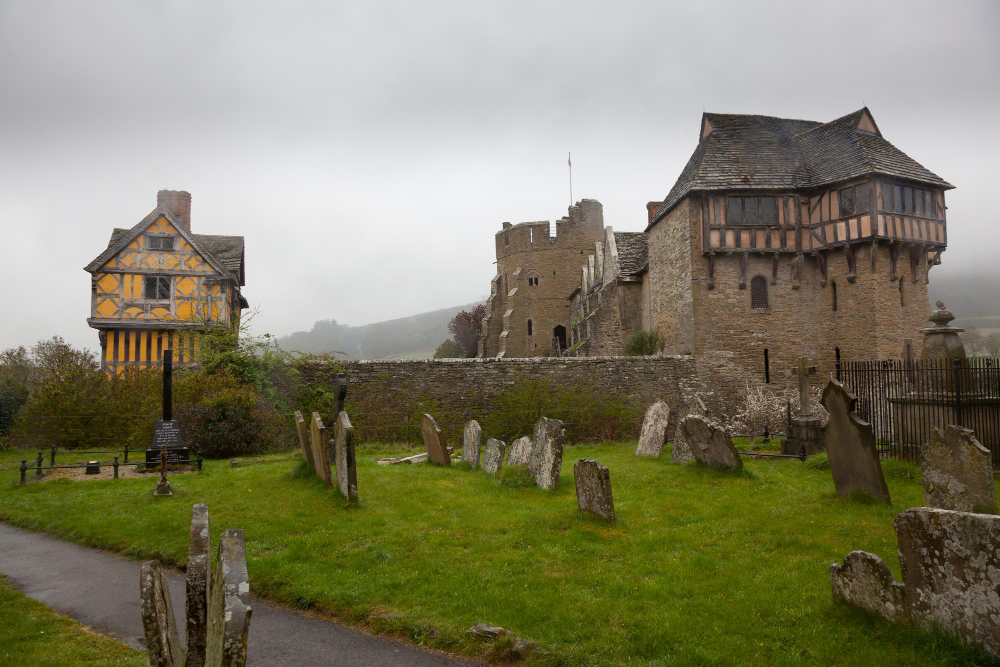
The Civil War and a siege with almost no consequences – In the 17th century, Stokesay Castle passed into the possession of the Craven family. Lady Elizabeth Craven had acquired the estate in 1620 through a consortium of investors; her son William Craven, who later became the first Earl of Craven, was a staunch supporter of King Charles I. During the political crisis of the 1640s, England was drawn into the Civil War between Royalists and Parliamentarian forces. William Craven spent much of the war abroad and supported the royal cause financially. Stokesay Castle was leased to Charles Baldwyn and his son Samuel, both of whom were also Royalists. In 1640 and 1641, Craven had the old gatehouse replaced by the half-timbered building visible today. This structure is richly decorated but has virtually no military value. When the military situation turned in Parliament’s favour in 1645, a parliamentary force of around 800 men advanced from Shrewsbury towards Ludlow. In June, the soldiers reached Stokesay. The small Royalist garrison under Captain Daurett was significantly outnumbered. A protracted defence was hardly realistic, especially as the gatehouse offered no significant protection. The surrender took place in accordance with the rules of warfare at the time. Initially, the attackers demanded the garrison’s surrender, but the garrison refused. Following a second demand, the defenders surrendered honourably and without any significant bloodshed. An attempt by the Royalists to recapture the fortress a few days later failed. Although Parliament ordered the demolition of Stokesay Castle in 1647, the complex – unlike many other castles in the country – was not systematically destroyed. Apparently, only parts of the surrounding wall were demolished. The residential buildings, the hall and the towers remained largely intact. This comparatively gentle treatment is a key reason why Stokesay still appears so cohesive today.
Decline, Rescue and Modern Heritage Conservation – After the Civil War, the Baldwyn family continued to use parts of the castle as a residence and carried out alterations, including the fitting of windows and wood panelling. In the 18th century, however, Stokesay lost its function as a manor house. The buildings were let out and used at times for agricultural and craft purposes. Around 1800, further half-timbered buildings in the inner courtyard disappeared; at the beginning of the 19th century, parts of the complex were used as granaries, workshops and smithies. In 1813, the antiquarian John Britton painted a bleak picture of the castle’s condition: It was abandoned, neglected and visibly falling into disrepair. Window panes were missing, floors and ceilings were rotten, and rain seeped through damaged roofs. In 1830, a smithy in the south tower caused a fire that inflicted considerable damage. Nevertheless, unusually careful restoration efforts began as early as the 19th century. William Craven, the second Earl of Craven, commissioned stabilisation work in the 1830s and 1850s. Rather than rebuilding the castle in a fanciful ‘medieval’ style to suit Victorian tastes, efforts were made to preserve the existing structure. This approach was remarkable for its time. In 1869, the industrialist John Derby Allcroft acquired the estate. He had made his fortune as the head of the glove manufacturer Dents and, from 1875, financed extensive restoration work. Allcroft, too, adopted a comparatively restrained approach: Stokesay was not to be reinvented, but stabilised. At the same time, the castle became increasingly popular with artists and travellers. In 1908, it was officially opened to paying visitors. In the 20th century, however, the costs of upkeep and repairs became an increasing burden for the owner’s family. In 1986, Jewell Magnus-Allcroft agreed to entrust the estate to English Heritage. Following her death in 1992, Stokesay Castle passed entirely into its ownership. English Heritage made a conscious decision neither to furnish the castle with replicas of furniture nor to present it as a ‘living’ castle representing a specific era. Instead, the complex has remained largely empty. Visitors are not meant to be guided by staged settings, but to interpret the buildings themselves: the medieval beams, the later fireplaces, the traces of decay, fire and restoration. It is precisely this restraint that makes Stokesay Castle so impressive. It tells not a fictional tale of chivalry, but a real story of trade, social advancement, civil war and heritage conservation. Behind its towers lies not so much a world of heroic battles as that of a merchant who, in the 13th century, recognised that architecture can make power visible.