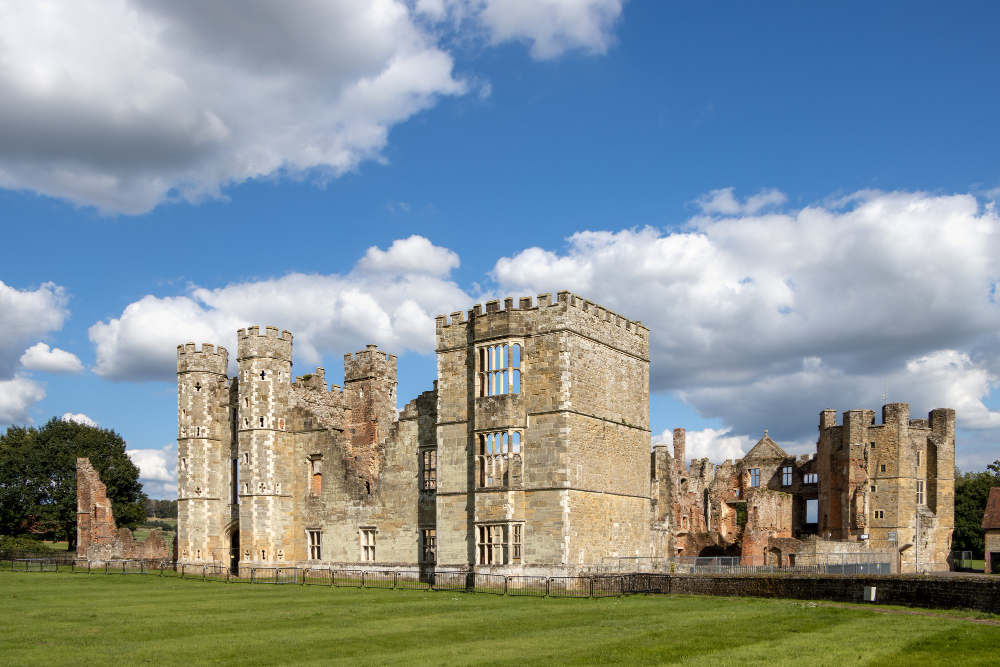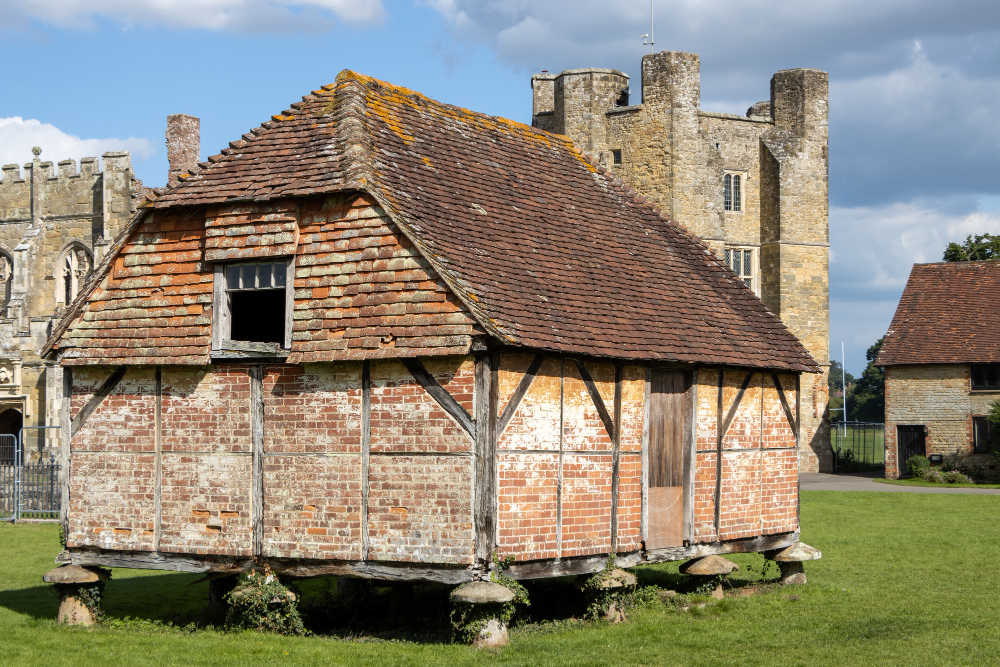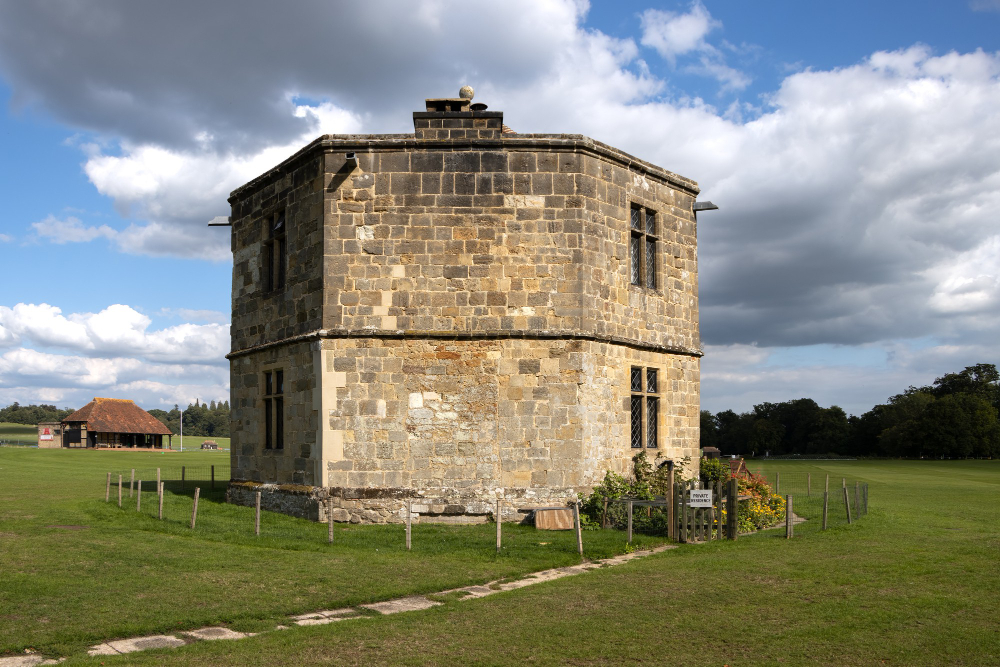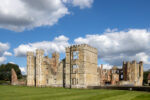

On the outskirts of Midhurst in West Sussex stand the remains of a once-magnificent country house. Cowdray House was the scene of royal visits, courtly spectacles and European power politics – and became a romantic ruin following a devastating fire. To this day, a grim legend surrounds its downfall. Anyone visiting the ruins of Cowdray House near the small town of Midhurst in southern England today will see high walls of warm sandstone, window openings without glass, shattered gables and the imposing kitchen tower. Ivy, trees and lawns surround the site on the north bank of the River Rother. The scene appears peaceful, yet behind the walls lies an exceptionally rich chapter of English history. For centuries, Cowdray was not merely a country estate of the nobility. The house maintained close ties with the Tudor court, hosting Henry VIII, Edward VI and Elizabeth I, and once housed unique murals depicting pivotal events in English military and royal history. Its decline did not begin with war, but with an accident in 1793 – and, at least according to tradition, coincided in an eerie way with an ancient prophecy.
From ‘Coudreye’ to the Tudors’ centre of power – The history of the site dates back to the 13th century. Between 1273 and 1284, Sir John Bohun had a fortified manor house built opposite Midhurst. He named it ‘Coudreye’, a Norman-French word referring to the hazel woods in the surrounding area. This name later evolved into Cowdray. The medieval estate was strategically situated at a river crossing and in a landscape that was considerably more marshy at the time than it is today. In the early 16th century, Sir David Owen, an uncle of King Henry VII, began an extensive rebuilding project. Owen had inherited the estate following the death of his wife, Mary Bohun, in 1496. On the site of the older house, a stately Tudor residence was built, modelled on the grand aristocratic palaces of its time. The approach was apparently particularly impressive: visitors approached the house via a causeway through marshy ground, leading up to a three-storey gatehouse. Such gatehouses were far more than mere entrances; they served as an architectural display of power. Anyone entering Cowdray was intended to recognise the importance of its owners even before taking their first step into the courtyard. Historians point out that the reflections of the building in the water may have further enhanced this effect. In 1529, Cowdray changed hands. Henry Owen, son of Sir David, sold the estate to Sir William Fitzwilliam, an influential courtier. A few years later, the estate passed to his half-brother and heir, Anthony Browne. Under the Browne family, Cowdray became one of the most important Catholic-influenced aristocratic residences in an England that was turning Protestant.
Henry VIII as a guest – and a prisoner of royal rank – The Brownes’ close ties to the royal court became apparent early on. Henry VIII is said to have visited Cowdray a total of five times during his reign, including in 1538, 1539 and 1545. In an era when royal journeys were enormous logistical undertakings, such a visit was a great honour, but also entailed high costs. Hundreds of people had to be catered for, rooms prepared and entertainment organised. Cowdray was also a place of political turmoil. In November 1538, Margaret Pole, Countess of Salisbury, was imprisoned on the estate. She was one of the last high-ranking members of the House of Plantagenet and, as the niece of Richard III, was politically sensitive for Henry VIII. The Countess remained at Cowdray until September 1539, before being taken to the Tower of London. She was executed there in 1541. Her fate serves as a reminder of how quickly proximity to the Crown could become a danger during the Tudor period. The religious upheavals of those years also left their mark on Cowdray. Following the Dissolution of the English monasteries, Sir William Fitzwilliam was granted the nearby priory of Easebourne in 1536. Anthony Browne, for his part, came into possession of the former Battle Abbey, one of England’s most significant monastic sites. This expansion of their holdings made the family wealthy – yet it later provided the material for one of Cowdray’s best-known legends.
The Curse of Battle Abbey – According to tradition, a monk who had lost his property and livelihood as a result of the dissolution of Battle Abbey is said to have cursed the Browne family. The words have been handed down in various versions, but the essence remains the same: ‘By fire and water shall your line come to an end, and it shall vanish from this land.’ There is no historical evidence to prove that such a curse was actually uttered. It belongs to the realm of legend. Nevertheless, following the events of 1793, it was retold so often that it has become inextricably linked with Cowdray. The story is a classic example of how real-life disasters are retrospectively linked to older narratives: Coincidences thus take on the appearance of a predestined fate.
Festivals, theatre and the Queen in the garden – Cowdray, however, was not merely a place of imprisonment and political tension, but also a stage for courtly culture. In 1548, Sir Anthony Browne inherited the house; he was later elevated to the title of first Viscount Montagu. His position was further strengthened by the marriage of Queen Mary I to Philip II of Spain. Marie de Guise, the widow of King James V of Scotland, stayed at Cowdray in 1551. A year later, the young King Edward VI visited the estate. In a letter, he wrote that they had dined and celebrated there ‘rather excessively’. Elizabeth I’s visit in August 1591 was particularly splendid. The Queen was received by an actor in armour, who symbolically presented her with the keys to the house. A few days later, an actor dressed as a pilgrim led her to an oak tree adorned with the coats of arms of local knights. A ‘wild man’ declared in an allegorical speech that no treachery could uproot this tree. That evening, by the fish ponds, a staged dialogue took place between a fisherman and a net-maker. Such performances were carefully planned political messages. They celebrated loyalty, stability and the Browne family’s allegiance to the Crown. The text of the dialogue was printed that very same year – an indication that the visit was important not only for the Queen, who was present, but also for the family’s public reputation. Henry Wriothesley, who later became the 3rd Earl of Southampton, was also born in Cowdray in 1573. He went down in literary history as a patron of William Shakespeare. Shakespeare dedicated the narrative poems “Venus and Adonis” and “The Rape of Lucrece” to him. Many scholars also regard Wriothesley as a possible candidate for the mysterious ‘Fair Youth’ of the Shakespeare sonnets.
Lost paintings as a window onto the Tudor era – Among Cowdray’s greatest cultural losses were the so-called Cowdray Paintings. In the 16th century, Sir Anthony Browne had large-scale murals installed in his hall. They depicted contemporary events from the reign of Henry VIII, including the siege of Boulogne in 1544, the English camp at Portsmouth, the King’s departure from Calais, and the coronation procession of Edward VI in 1547. Particularly valuable was the depiction of the naval battle in the Solent in 1545, during which the English warship “Mary Rose” sank. The paintings were not merely decorative: they showcased military power, royal triumphs and the role of the Browne family in the monarch’s entourage. The murals themselves were lost in the fire of 1793. However, their visual content has been preserved because they had previously been documented in copperplate engravings. These prints are of great significance to historians today. They provide information on clothing, military formations, ships, ceremonies and the visual self-presentation of the Tudor monarchy. Precisely because the originals have disappeared, the engravings have become an indispensable archive.
Civil War, Garden Design and the Disaster of 1793 – In the 17th century, Cowdray was once again caught up in the maelstrom of national conflicts. During the English Civil War, large parts of the estate belonging to Francis Browne, the 3rd Viscount Montagu, were confiscated. The house was occupied by Parliamentarian troops. Traces can still be seen on the walls of the main courtyard today, believed to be the impact marks of musket balls. In the 18th century, however, Cowdray was to be revitalised once more. In 1770, Anthony Browne, the 7th Viscount Montagu, commissioned the famous landscape architect Lancelot ‘Capability’ Brown to redesign the gardens. Brown shaped numerous English parkland landscapes with extensive lawns, loosely arranged groups of trees and artificially composed natural vistas. However, the renovation of the house ended tragically. On 24 September 1793, a fire broke out in the joiner’s workshop in the North Gallery whilst restoration work was underway. Glowing charcoal fell onto sawdust and wood shavings. As furniture, works of art and family possessions had been temporarily stored in the gallery for the renovation, the flames spread with devastating effect. Only three paintings and a few small pieces of furniture could be saved. Valuable items from Battle Abbey were also lost. Less than three weeks later, George Browne, the 8th Viscount Montagu, died whilst attempting to ride the rapids at the Rhine Falls. As subsequent heirs also died without issue, the peerage became extinct. To many contemporaries, this seemed to fulfil the old curse: the house had been destroyed by fire, and the family line ended with a death in the water.
A ruin that has been preserved – In the 19th century, Cowdray became increasingly overgrown with vegetation. Ivy accelerated the decay of the damaged walls. After several changes of ownership, Sir Weetman Dickinson Pearson acquired the estate in 1908. He was later created a Baron and eventually a Viscount Cowdray. Pearson had the rampant ivy removed, unstable structural elements secured, and the ruins thoroughly surveyed. To this day, Cowdray remains in the possession of the Cowdray family. Following extensive stabilisation and conservation work, the ruins were reopened to visitors in 2007. As a Grade I listed monument, they are among the most historically significant surviving Tudor buildings in England. Cowdray House is particularly fascinating precisely because of its incomplete state. The ruins tell not only of a lost palace, but also of the power of the Tudors, the religious schisms of the Reformation, courtly theatre, the Civil War and the enduring legacy of historical legends. Between the open windows and the silent walls, there is no longer a magnificent aristocratic residence. Yet its history is more vivid than that of many fully preserved houses.