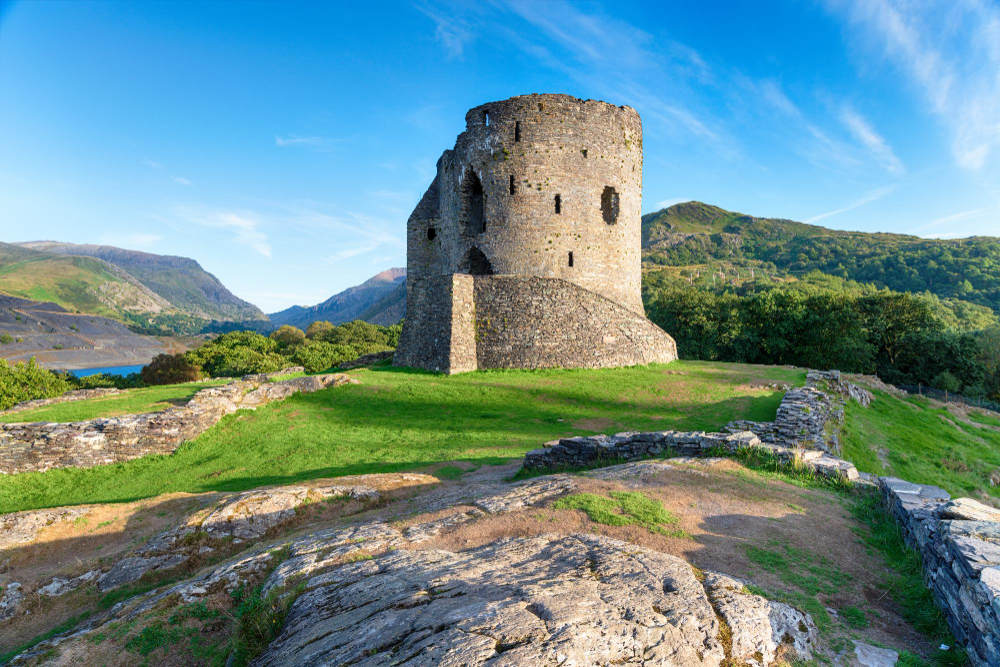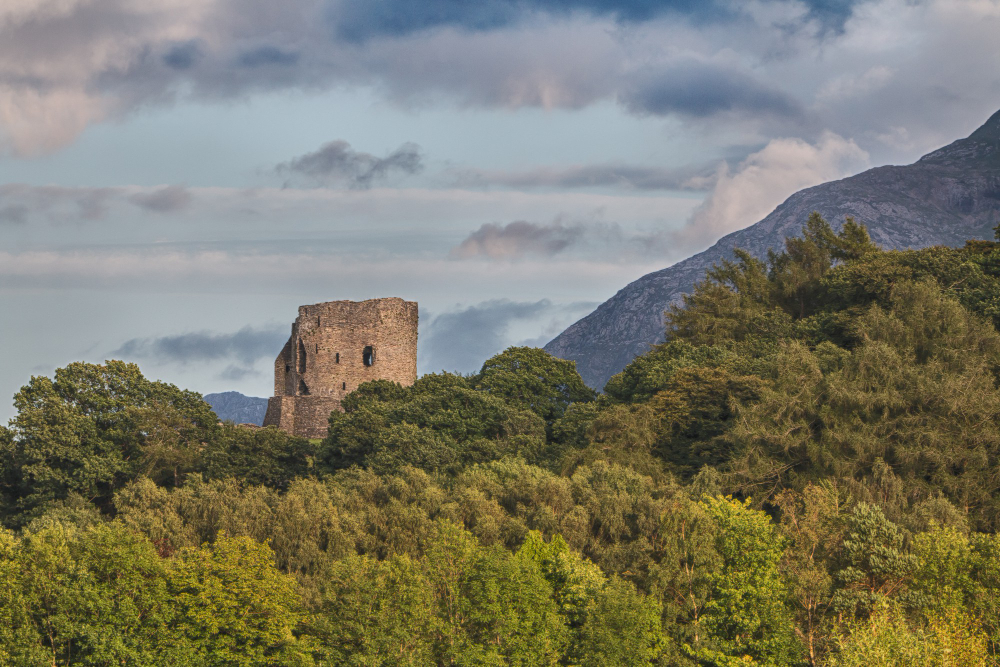

High above the lakes of Llyn Padarn and Llyn Peris stands a solitary, imposing round tower built of dark slate. Today, Dolbadarn Castle stands as a silent sentinel over the Llanberis Pass – yet in the 13th century, the castle was far more than a picturesque ruin. It served as a prison, a centre of power, a place of refuge and one of the last symbols of medieval Wales’s independence. The site near Llanberis in Gwynedd, North Wales, is one of the few surviving stone castles built not by English conquerors but by Welsh princes. It is precisely for this reason that Dolbadarn Castle occupies a special place in the history of Wales. Whilst the great English royal castles such as Caernarfon, Conwy and Harlech still bear witness to imperial power today, Dolbadarn serves as a reminder of the time when Gwynedd was still an independent principality and its rulers controlled the mountain passes of Snowdonia. The ruins are now classified as a Grade I listed building, the highest category for structures of exceptional historical interest in Wales. It is also protected by law as a Scheduled Monument. The site is managed by Cadw, the Welsh heritage agency. Visitors are free to explore the castle – and in doing so, experience a place where landscape and history are unusually closely intertwined.
A castle at a strategic chokepoint – Dolbadarn Castle lies around 800 metres south-east of the village of Llanberis. The site was carefully chosen: the fortress stands on a rocky outcrop some 25 metres high, between Llyn Padarn to the north and Llyn Peris to the south. From there, it overlooks the Llanberis Pass, one of the most important routes into the mountainous heartland of Gwynedd. Anyone travelling through this pass was not only moving through a stunning mountain landscape, but also through a corridor of great political and military significance. The valleys and passes of North Wales were of great importance to armies, messengers, traders and local rulers. A fortress at this location could control movements, protect supply lines and provide warning of potential attacks. The location also explains why Dolbadarn was built not as a magnificent court but as a compact, fortified complex. Its primary purpose was to make authority visible and militarily enforceable in a landscape that was difficult to access. The view from the castle hill stretches across the lakes and up to the mountains of what is now Eryri National Park, which was long known internationally as Snowdonia. In the Middle Ages, this mountainous region was the power base of the princes of Gwynedd.
Llywelyn the Great and the Construction of the Fortress – The castle’s origins are usually associated with Llywelyn ap Iorwerth, better known as Llywelyn the Great. He was one of the most significant rulers of medieval Wales and reigned over Gwynedd at a time when Welsh princes had to hold their ground against England’s political and military expansion. Dolbadarn Castle is thought to have been built around 1230. Although no definitive contemporary document recording its construction has survived, its architectural style, location and the political context suggest that the complex was erected during Llywelyn’s reign. The prince had consolidated his power in North Wales and required castles that not only offered protection but also enabled him to control key transport routes. Unlike the later, large-scale English castles in Wales, Dolbadarn was comparatively small. Yet it is precisely this compact design that makes it remarkable. The mighty round tower was the core and strongest part of the fortification. At a time when many Welsh seats of power still consisted of earthworks, wooden fortifications or less permanent structures, a stone keep was a clear sign of political strength and a long-term claim to power.
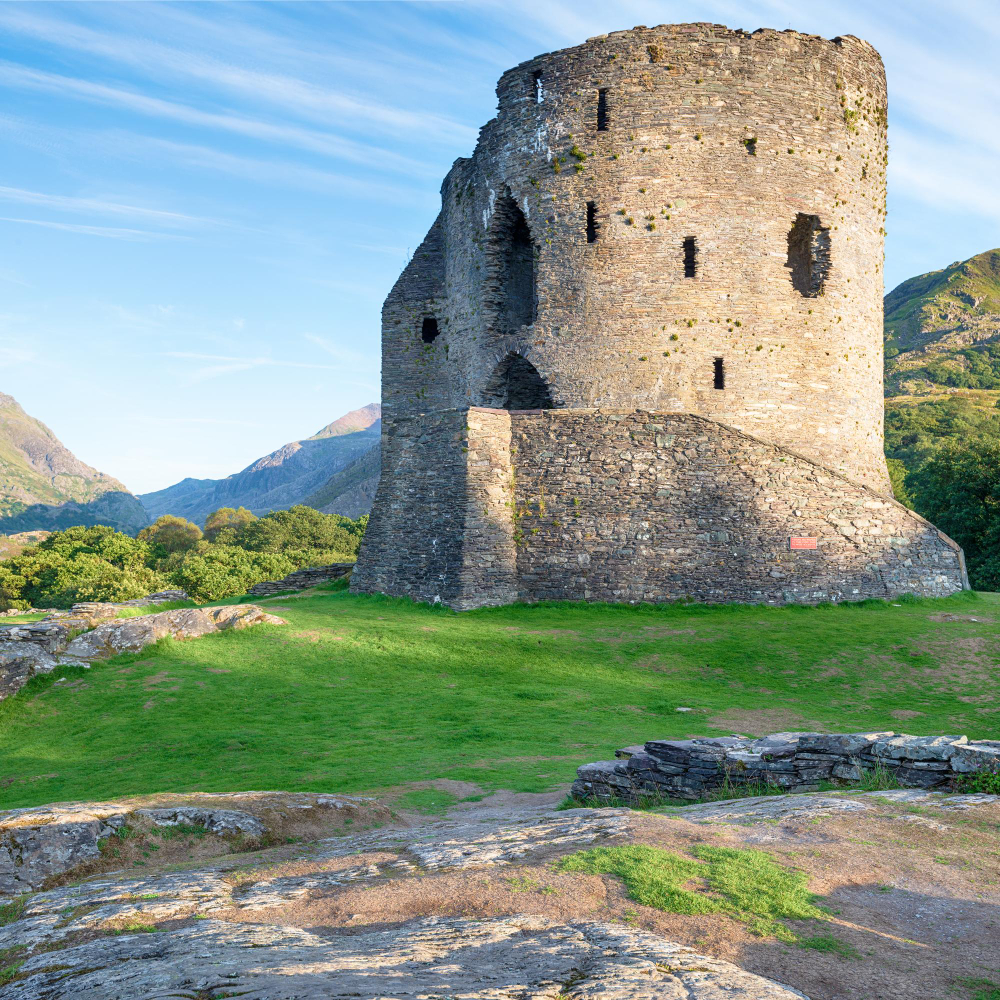
The round tower: a defensive structure and symbol of power – The most striking part of Dolbadarn Castle remains, to this day, the large round tower. It measures approximately 14 metres in diameter, with walls up to 2.5 metres thick in places. With a preserved height of over 14 metres, it dominates the ruins even from a distance. It was built from local slate, whose dark colour allows the tower to blend into the rocky surroundings. The entrance is not at ground level, but on the first floor. This design was a deliberate security feature: attackers could not simply gain entry through a gate at ground level. Access was presumably via a wooden staircase or a structure that could be easily removed. In an emergency, this made the tower easier to defend. Inside, the keep comprised several levels connected by a stone spiral staircase. The rooms served not only military purposes. A castle of this type also provided accommodation for the garrison and retinue, storage space, and a place of refuge for the lord or his representative. A rectangular annexe on the outside housed the latrine – a seemingly unspectacular but important detail that shows the tower was designed for extended stays. In terms of architectural history, Dolbadarn’s keep is regarded as one of the most significant examples of a 13th-century Welsh round tower. Its design is in some respects reminiscent of contemporary Anglo-Norman castles, yet the complex served a Welsh ruling dynasty. It thus illustrates that the princes of Gwynedd were not isolated from European castle culture, but rather utilised its forms for their own political ends.
A Prince as a Prisoner: Owain Goch at Dolbadarn – The most dramatic story associated with Dolbadarn Castle is the imprisonment of Owain Goch. The Welsh prince is said to have been held captive at the castle between 1255 and 1277. Owain was a brother of Llywelyn ap Gruffydd, the Prince of Wales later known as ‘Llywelyn the Last’. The brothers were locked in a bitter conflict over the rule of Gwynedd. Following the death of their father, Gruffydd ap Llywelyn, the sons initially lost their positions, before regaining political influence in the 1250s. However, their alliance broke down. Llywelyn ap Gruffydd prevailed over his brothers and had Owain Goch imprisoned. Tradition links his imprisonment to Dolbadarn Castle. For Owain, the mighty tower must have been not only a place of refuge but, above all, a prison. He is said to have remained cut off from the outside world and from the political power struggle for over two decades. His story lends the ruins a human, almost tragic dimension to this day: behind the thick walls, not only were wars waged and power exercised, but a family conflict was also played out, one that determined freedom and captivity. The fact that a member of the ruling family was imprisoned in such a fortress also demonstrates its political significance. Dolbadarn was remote enough to secure a prisoner, yet strategically important enough to be reliably controlled by loyal forces.
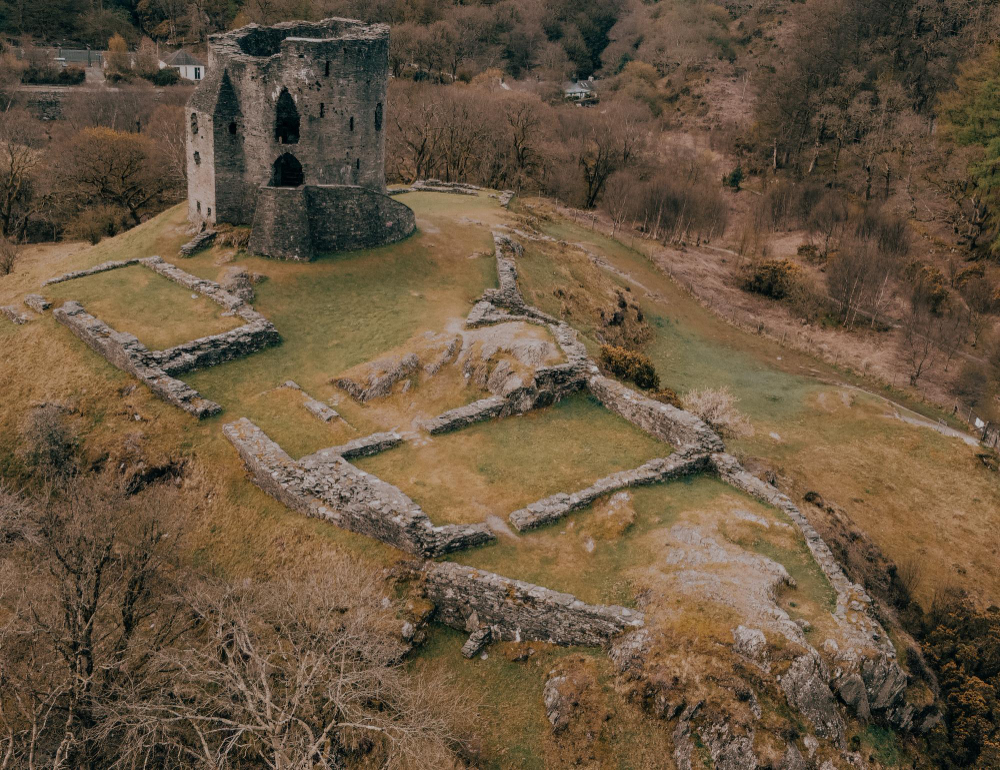
The English Conquest and the End of the Castle – The major turning point came in the 1280s. King Edward I of England led several campaigns against Wales and, following his successes, had a network of mighty castles built. The conflict ended with the collapse of Welsh princely rule in Gwynedd. Following the death of Llywelyn ap Gruffydd in 1282, his brother Dafydd ap Gruffydd continued the resistance. Dolbadarn Castle was one of the last strongholds still in his hands. After English troops had captured Castell y Bere in 1283, Dolbadarn remained an important stronghold of the Welsh uprising. In May 1283, Dafydd fled from Dolbadarn to the Snowdonia mountain range. The countryside, which had long offered the Welsh princes protection, was unable to save him this time. He was captured in June. His execution in Shrewsbury in the autumn of 1283 marked the definitive end of the organised resistance by the Welsh princes against Edward I. Dolbadarn Castle fell to English troops under William de Valence. Afterwards, the castle rapidly lost its military significance. Sources and research suggest that the complex was razed or at least deliberately rendered useless. Timber from Dolbadarn is said to have been used in the construction of Caernarfon Castle – one of those monumental royal castles with which Edward I demonstrated his new rule over Wales. The contrast could scarcely be greater: Dolbadarn, the compact castle of a Welsh prince, was stripped of its power; in Caernarfon, a huge stone fortress was erected as a symbol of English royal power.
Later Memories and a Site of Welsh History – Even after its military decline, Dolbadarn remained present in regional memory. During Owain Glyndŵr’s rebellion at the beginning of the 15th century, the tower is said to have been used once more, around 1400, as a prison for the rebels’ captives. The sources regarding this episode are less extensive than those for the events of the 13th century, yet they reflect the site’s enduring significance in times of political unrest. Today, Dolbadarn Castle is primarily a ruin – but not a silent one. Its walls tell of the self-assertion of a Welsh principality, of family power struggles and of the violent incorporation of Wales into the English sphere of influence. Precisely because the castle has not been transformed into a fully reconstructed tourist attraction, its impact remains immediate: the tower stands almost alone in the mountainous landscape, weathered, dark and astonishingly imposing. Anyone visiting Dolbadarn sees more than just a medieval fortification. You find yourself in a place where the history of Wales can be read in concentrated form – between two lakes, beneath the mountains of Eryri and in the shadow of a tower that once embodied both the freedom and the captivity of Welsh princes.