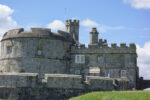

Anyone visiting Otranto on the Adriatic coast of Apulia finds themselves in a place where the great conflicts of the Mediterranean region converge as if under a magnifying glass. This south-eastern Italian port city lies just a few dozen kilometres from the Albanian coast – closer to the Balkans than many other places in Italy. For centuries, it was therefore not only a trading centre and cultural crossroads, but also a strategically vulnerable outpost. The Castello di Otranto, the town’s mighty fortress, bears witness to sieges, changing rulers, technological upheavals in the art of warfare and an extraordinary literary legacy: it lent its name to Horace Walpole’s novel “The Castle of Otranto” and thus became a symbol of an entire genre – the horror or Gothic novel. The complex is, however, far more than an isolated castle. Together with the city walls, it formed a coherent defence system designed to secure access to the city and the harbour. Its present form did not emerge in a single construction phase. It is the result of numerous alterations – from medieval fortifications through Aragonese repairs to the mighty bastions of the Spanish viceroy era.
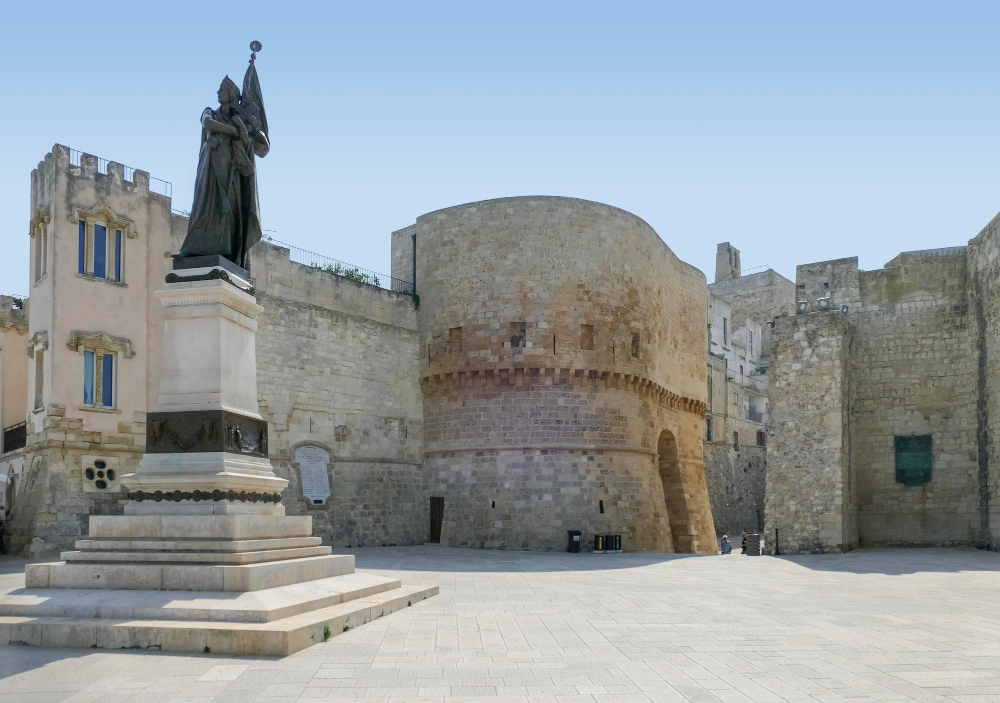
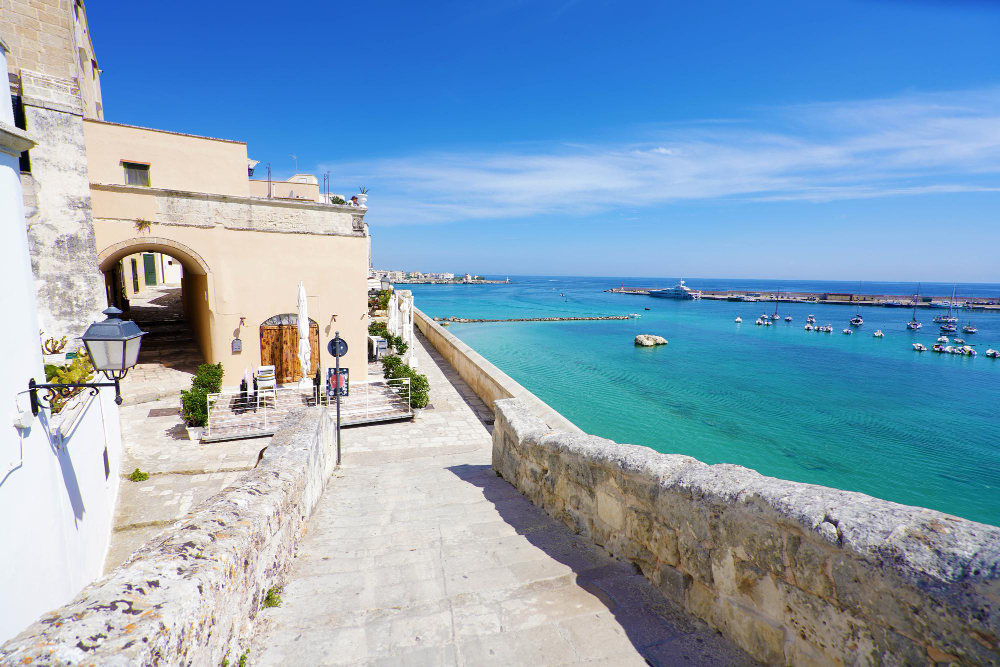
A fortress at a strategic coastal point – Otranto lies on the easternmost edge of the Italian mainland. Its location on the Strait of Otranto has made the town an important hub between Italy, the eastern Mediterranean and the Balkans since ancient times. Ships, traders, pilgrims, soldiers and envoys passed along this coast. However, it was precisely this openness towards the east that also entailed risks: attacks from the sea could reach Otranto particularly quickly. The Castello stands in the eastern part of the old town and historically controlled a crucial access point. Its function was not merely that of a seat of power. Above all, it was a military hub integrated into the system of walls. Anyone wishing to capture the town had to reckon with the fortifications; those defending it needed a structure capable of responding to new weapons and changing attack techniques. In the Middle Ages, castles still frequently consisted of high walls and towers. However, with the increasing importance of cannons and artillery, these designs reached their limits. High, thinner walls were particularly vulnerable to bombardment. This development therefore led to lower, thicker and more angular defensive structures. Otranto offers a striking example of this transformation: Its castle bears traces of several eras, but its defining appearance is that of an early modern artillery fortress.
Destruction and Reconstruction in the Norman Era – The history of the complex stretches far back, but the medieval alterations that can be traced today are linked to the severe conflicts of the 11th century. In 1067, Otranto was besieged; the fortifications sustained considerable damage as a result. A few years later, Robert Guiscard, one of the most important Norman rulers of southern Italy, had the defences repaired and reinforced. Robert Guiscard played a central role in the Norman rise to power in southern Italy. The Normans, originally from northern France, had established themselves in southern Italy and Sicily during the 11th century and had gradually gained political control there. For them, securing strategic coastal towns such as Otranto was essential. A damaged fortress on the Adriatic Sea could be not merely a local problem, but a threat to the entire order of rule. However, only limited evidence of the early construction phases remains visible in the present-day complex. Castles were rarely treated as immutable monuments. Every new military threat, every change of rule and every technical innovation could trigger alterations. It is precisely for this reason that the Castello di Otranto can be read like an architectural history book: traces of older structures lie beneath later walls and bastions.
Frederick II and the medieval remains – Another important phase of construction took place during the reign of Emperor Frederick II. In 1228, the Staufer ruler commissioned work on the fortress. Frederick II, who, as King of Sicily and Holy Roman Emperor, ruled over a vast domain, attached great importance to the administration and defence of his territories. In Apulia, he had numerous castles built or extended; the region was a core area of his power. At the Castello di Otranto, architectural remains from this period are primarily associated with a tower on the cylindrical central structure and with parts of the north-eastern curtain wall. A curtain wall is the section of wall between two fortification elements, such as towers or bastions. Investigations of the lower sections of the structure also suggest that the older fortress had a rectangular core, the corners of which were secured by round towers. This structure corresponds to the defensive requirements of the High Middle Ages. The cylindrical shape of towers was advantageous over angular structures because it offered less surface area for attack and allowed projectiles to slide off more easily. However, the introduction of heavy artillery was to fundamentally alter this architecture in the centuries that followed.
1480: The siege that shook Otranto – The most momentous event in the city’s history was the Ottoman conquest of 1480. That summer, troops from the Ottoman Empire landed on the coast and captured Otranto following a siege. The town became the scene of a dramatic conflict, the memory of which lives on to this day in local culture and religious tradition. The so-called Martyrs of Otranto – residents of the town who were killed after the capture – are venerated as saints by the Catholic Church. The city was recaptured the following year. However, these events highlighted just how vulnerable the coastal towns of southern Italy were. For the Kingdom of Naples, Otranto was not merely a remote frontier town, but a potential bridgehead for further attacks on the Italian peninsula. Simply repairing the damage was therefore not enough: the defences had to be adapted to the realities of artillery warfare. Alfonso II of Naples, then Duke of Calabria and later King, commissioned work to restore and reinforce the fortifications. Towards the end of the 15th century, Otranto was temporarily held as a pledge by Venice. The Venetians, too, had a keen interest in improving the defences. Their experience as a naval power and their conflicts in the eastern Mediterranean made them particularly aware of the importance of effective coastal fortifications. Only limited sections of the Aragonese construction phase survive today, including a tower and sections of the wall. Nevertheless, this era was decisive: it marked the transition from a predominantly medieval castle to a complex designed to withstand cannon fire and to deploy its own artillery.
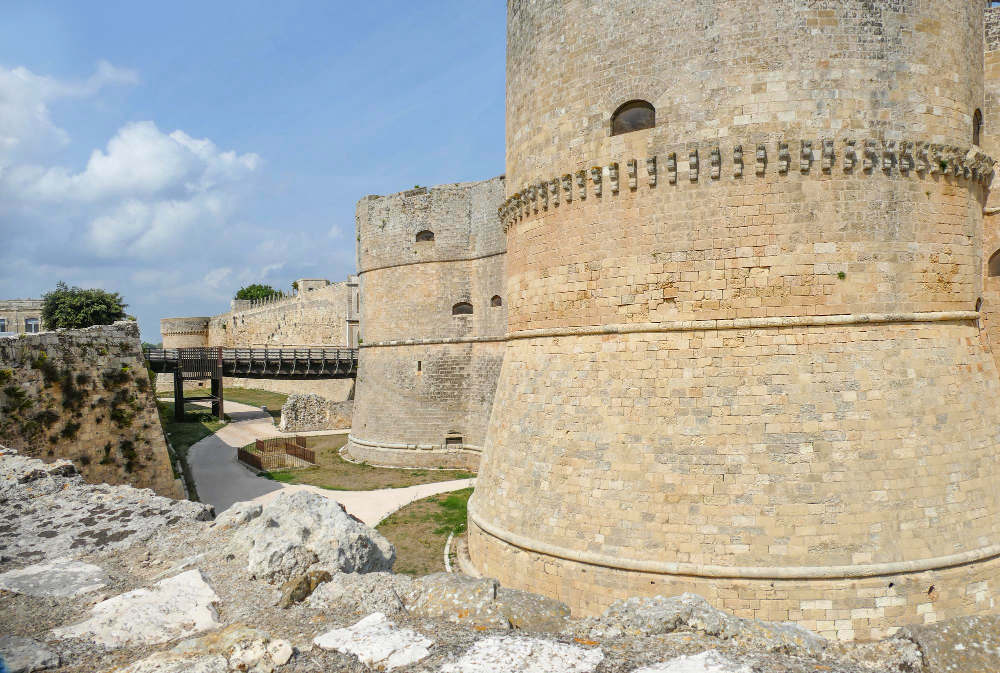
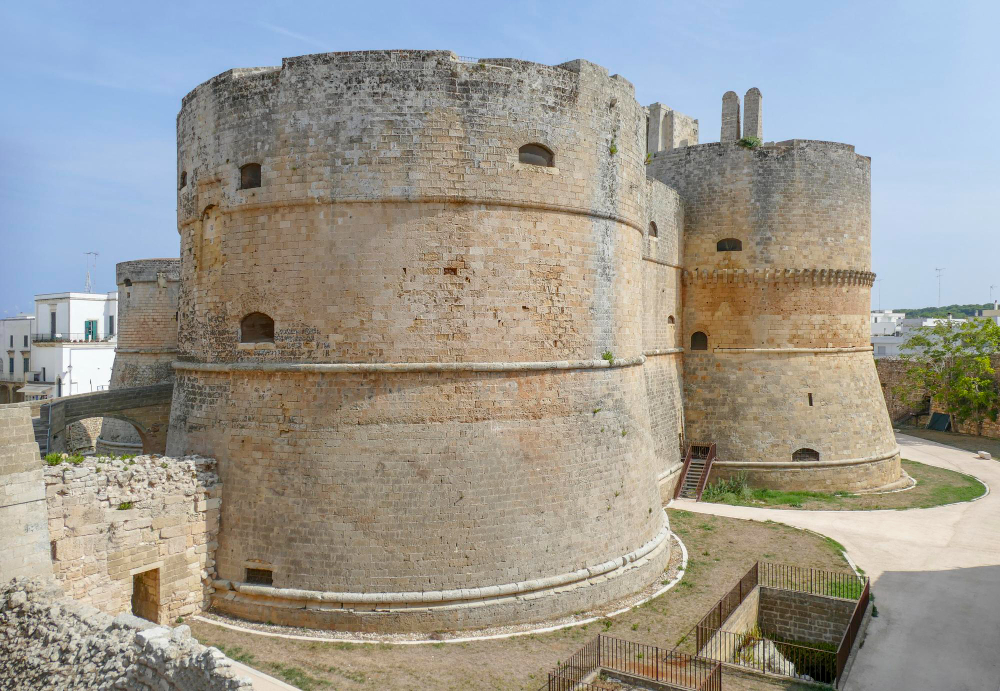
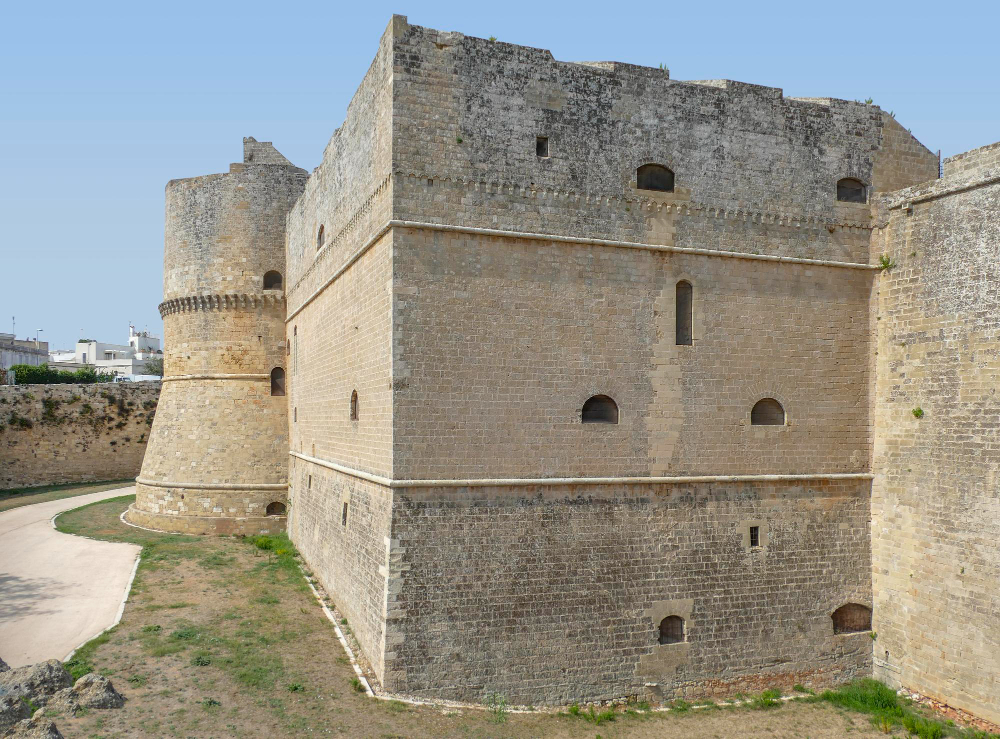
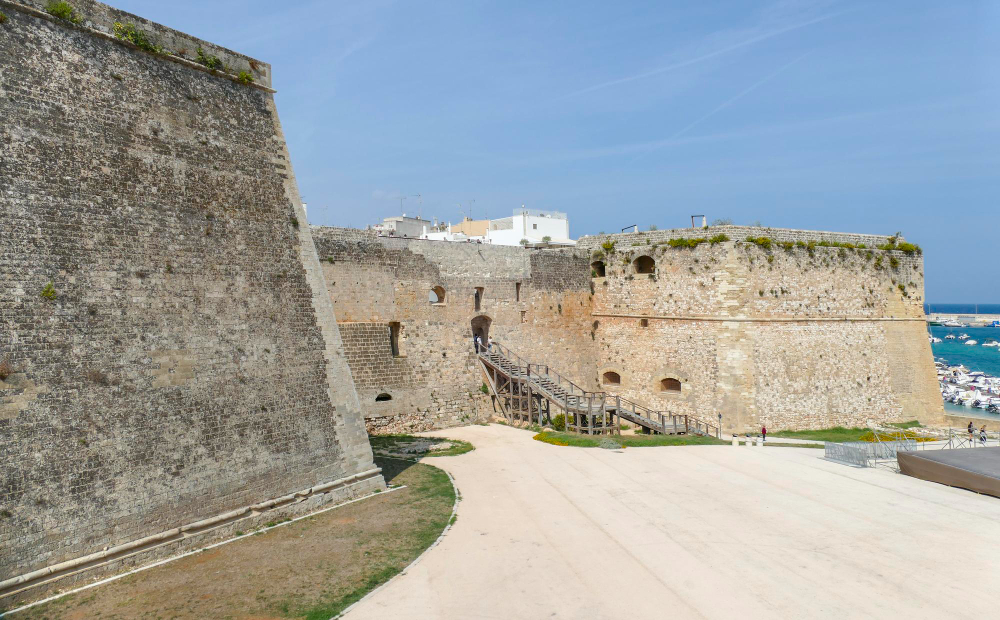
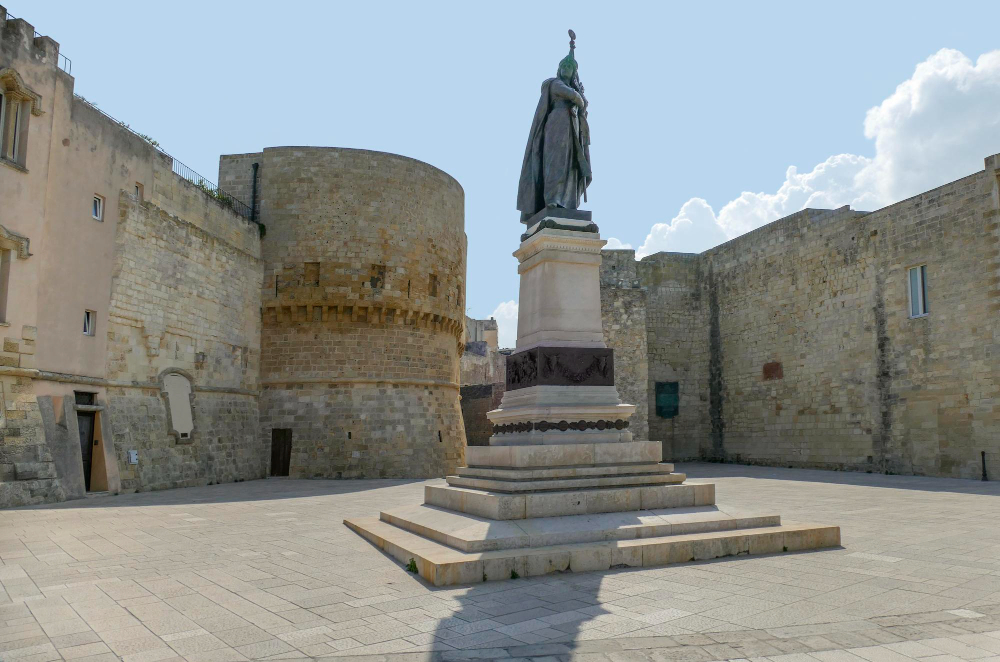
The Spanish fortress: bastions against cannons – The castle owes its current, distinctive appearance primarily to the 16th century. At that time, the Kingdom of Naples was under Spanish rule. Don Pedro Álvarez de Toledo, Viceroy of Naples since 1532, championed the expansion of numerous fortifications. His policy aimed to secure the coast and the kingdom’s major cities against threats from the Ottoman Empire and pirate raids. In 1535, significant defensive works were constructed at the Castello di Otranto. Coats of arms above the entrance gate and in the outer courtyard serve as a reminder of this period. The complex was redesigned in accordance with the principles of early modern military architecture: massive, lower bastions replaced the notion that high walls alone could provide protection. Their angled shape allowed defenders to bring attackers under fire from the flanks and to reduce so-called blind spots. In 1578, two polygonal bastions were added on the sea-facing side, incorporating older Aragonese structural elements. Particularly striking is the combination of different forms: round towers made of Carparo, a limestone common in Apulia, stand alongside more angular bastion forms. The Castello thus reflects not only the succession of political rulers but also the transition between different architectural concepts. In the 17th century, the fortress was further reinforced. The architect G. F. Saponaro, originally from Lecce, was commissioned to carry out additional work. In its present form, the complex presents itself as a pentagonal defensive structure, surrounded by a wide moat. Three round towers and a tapered defensive element facing the sea characterise the structure. The entrance, with its drawbridge, was situated on the fifth side. Its orientation towards the sea was no aesthetic coincidence. It was from that direction that the most dangerous attack was expected. The architecture itself responds to this threat: thick walls, deep moats, projecting bastions and controllable access points made capture considerably more difficult.
From Otranto to the first Gothic novel – The Castello achieved international literary significance through Horace Walpole. The English writer published the novel “The Castle of Otranto” in 1764. The work is widely regarded in literary history as the first Gothic novel, and thus as the starting point of English-language Gothic literature. Walpole’s novel is set in a gloomy, medieval-style castle world full of secrets, prophecies, underground passages and supernatural events. The title alone linked the plot to the Italian town of Otranto, even though the literary castle is not a realistic depiction of the actual Castello. Rather, the fortress became an evocative and mysterious setting that conjured up associations of distant lands, the past and danger amongst European readers. It is precisely here that a remarkable tension lies: the real Castello di Otranto is a precisely planned military structure, built in response to concrete historical threats. Walpole’s imaginary castle, on the other hand, became a place of the uncanny and the fantastical. The real history, with its sieges, political upheavals and fortified walls, nevertheless provided a backdrop that makes the literary impact understandable. Voltaire also took up the theme of Otranto. In 1769, he wrote the libretto for the comic opera “Le Baron d’Otrante”. By the 18th century, the name of the town had thus long since become part of the European collective imagination.
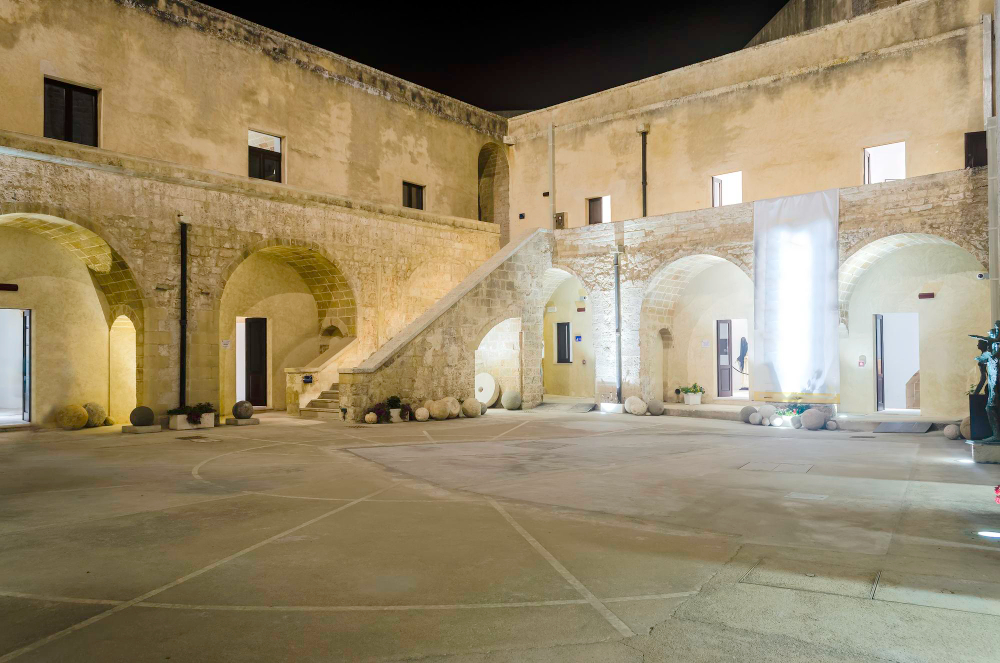
A building between memory and the present – Today, the Castello di Otranto is one of Apulia’s most striking monuments. Its walls do not preserve a single, linear history, but rather a tapestry of Norman, Staufer, Aragonese, Venetian and Spanish pasts. Every alteration was a reflection of a specific political situation: a siege, a threatened invasion, new military technology or a change of rule. It is precisely for this reason that the fortress has such a special impact. It is not merely the backdrop to a picturesque old town, nor is it simply a literary reference point. The Castello di Otranto serves as a reminder that, for centuries, the Mediterranean region was a place of intense encounters and conflicts. Between the sea and the city walls, the moat and the bastions, it becomes clear just how closely architecture, power and memory can be intertwined.