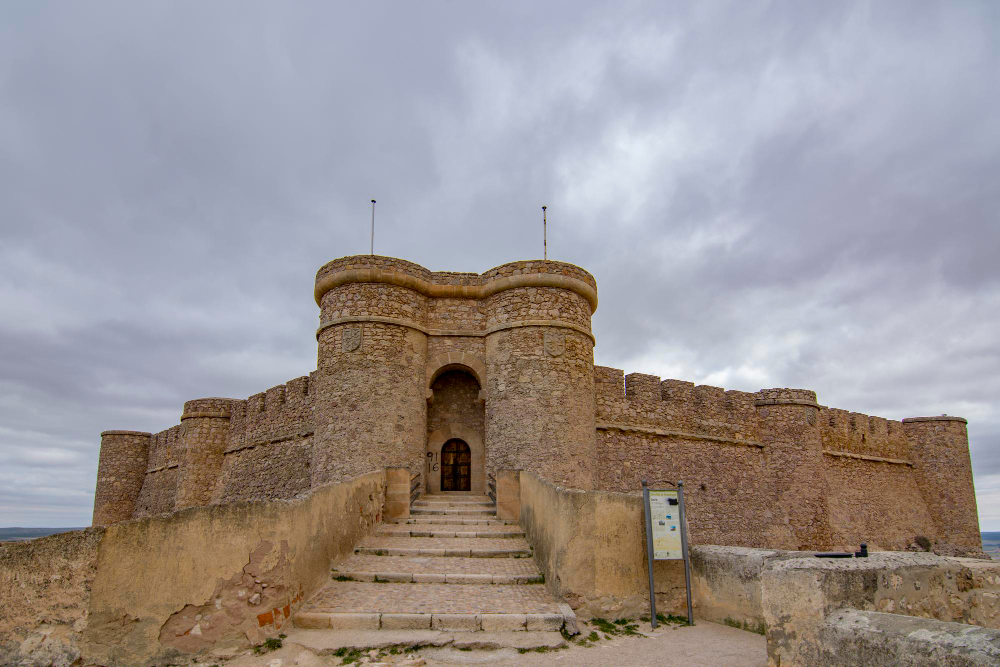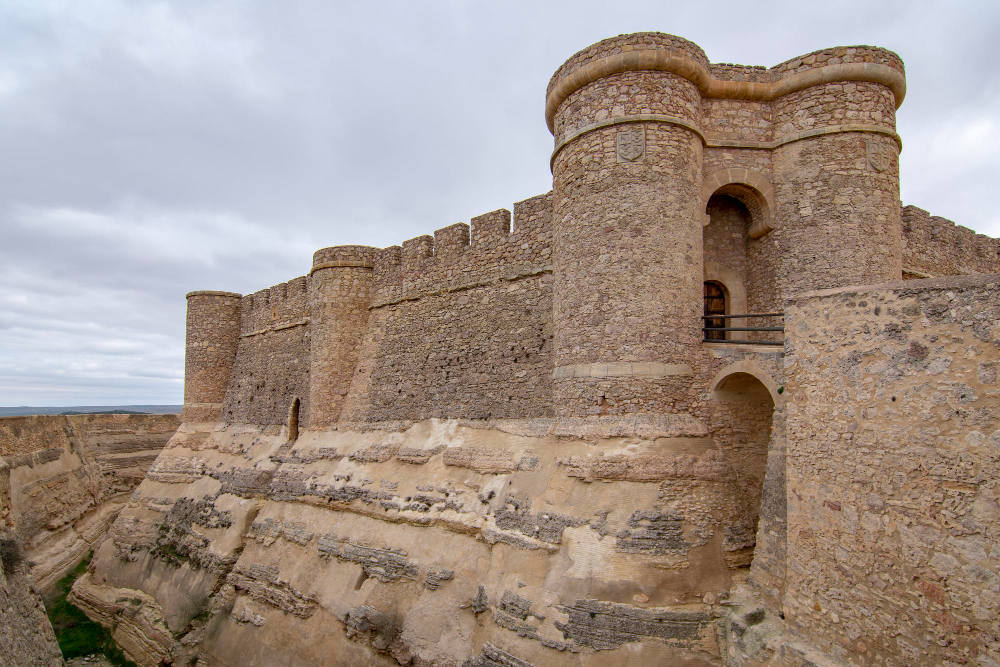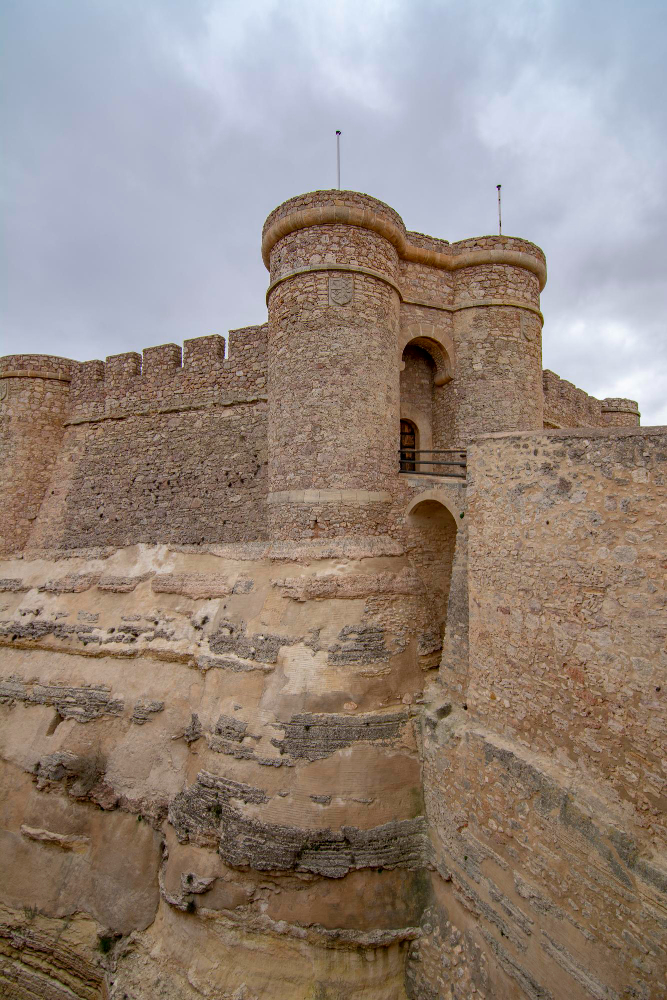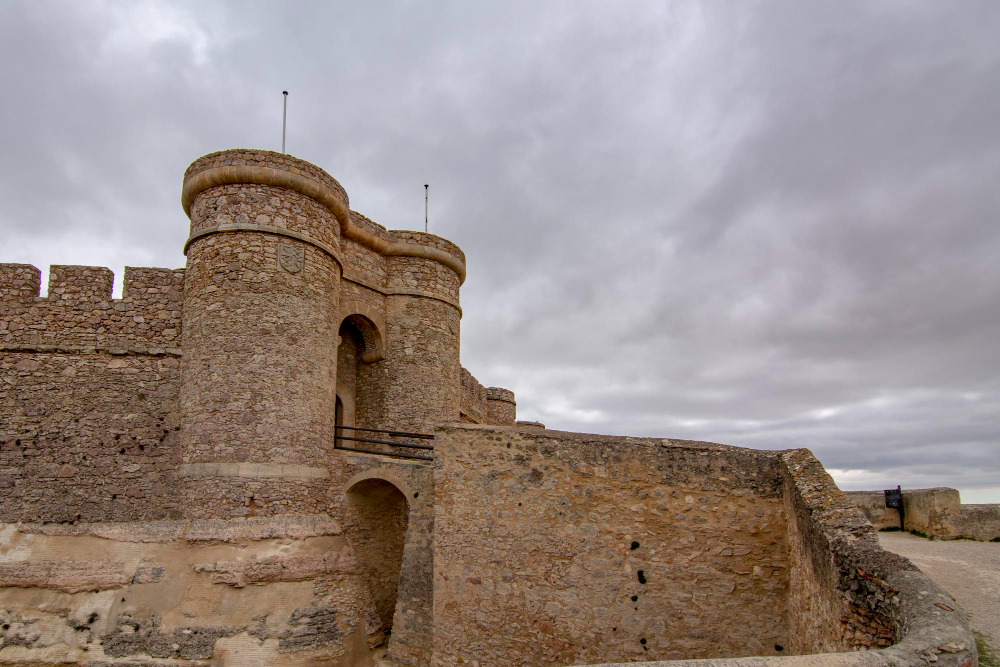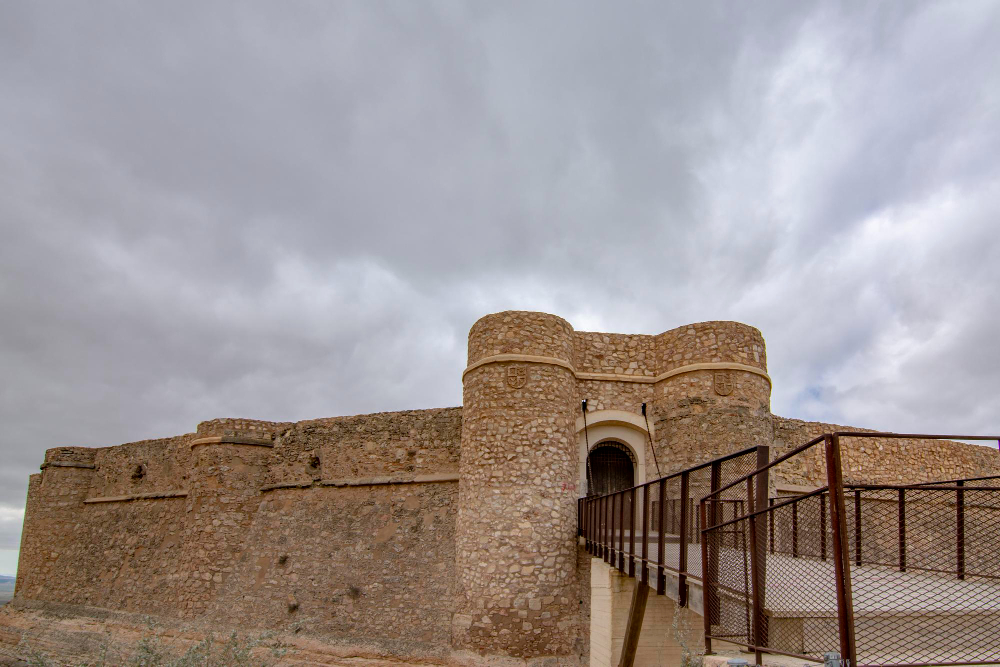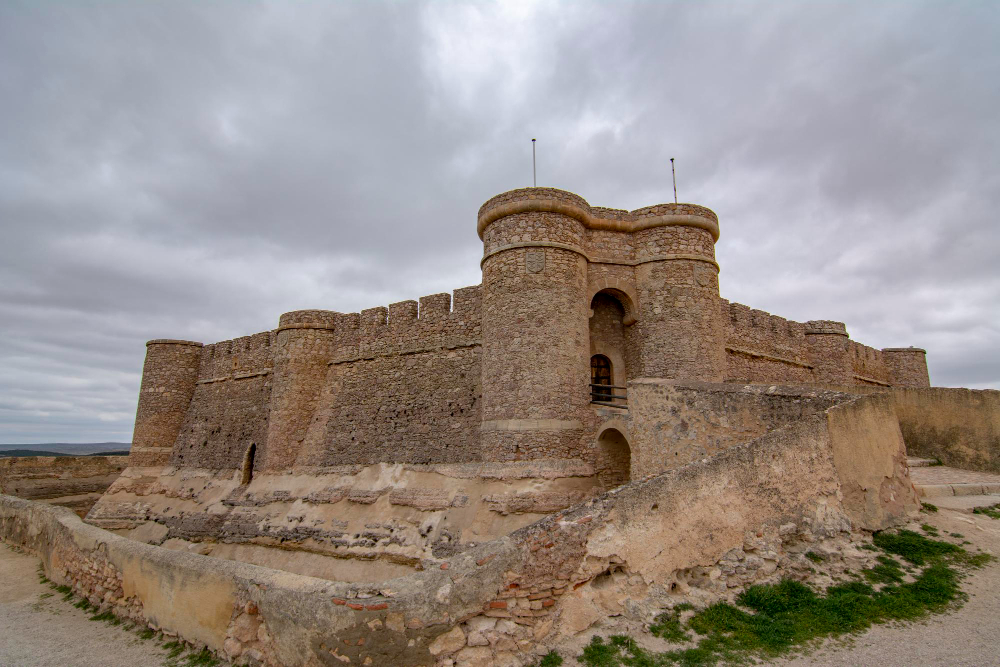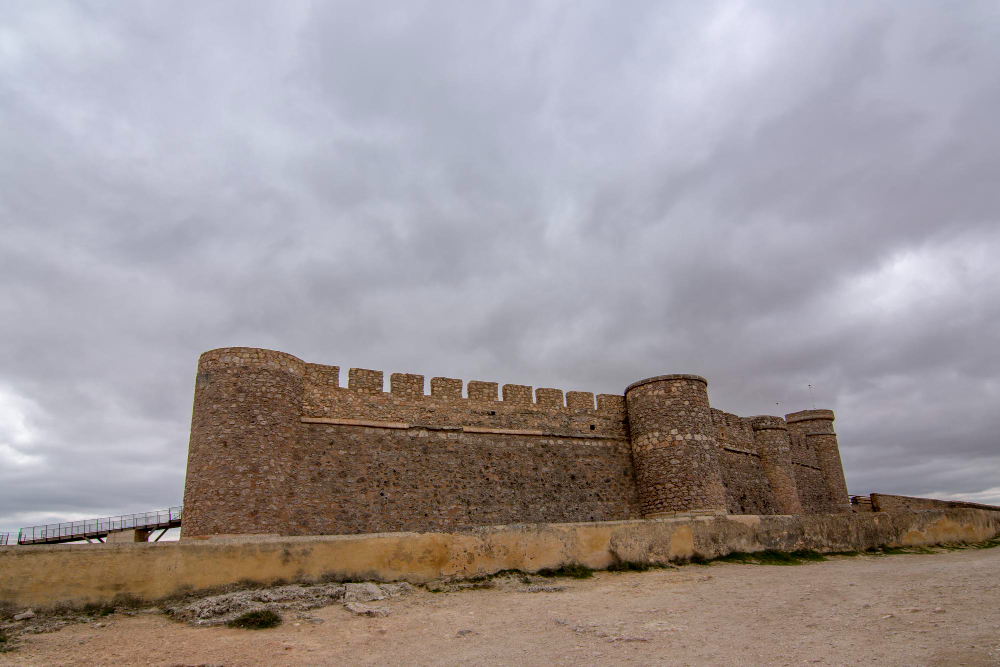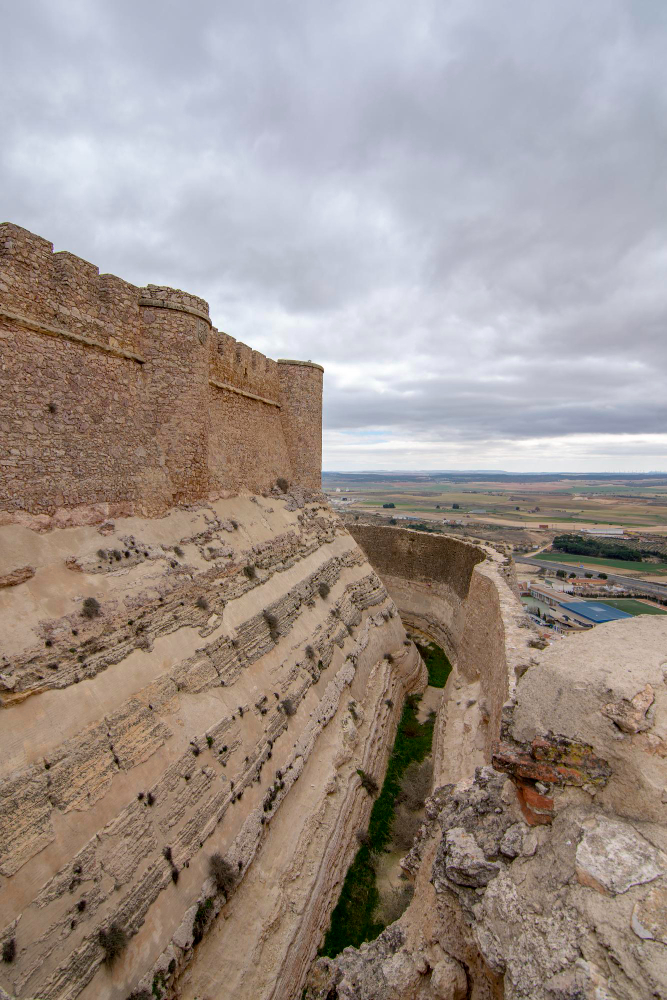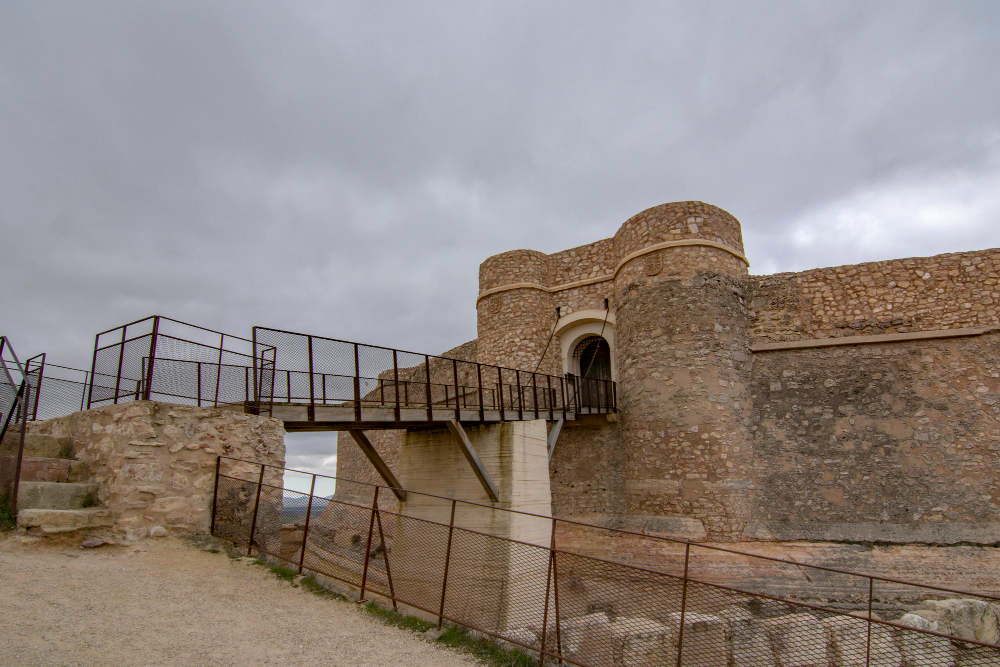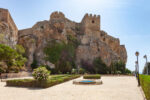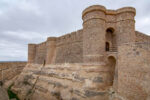

High above the rooftops of the small Castilian town of Chinchilla de Montearagón stands one of the most impressive fortifications in the Spanish province of Albacete: the Castillo de Chinchilla de Montearagón. The castle stands on a steep, rocky ridge visible from afar and has dominated the landscape of La Mancha for centuries. Anyone approaching it can make out its mighty walls, battlements and towers from a great distance. Particularly spectacular is the wide moat, which was not filled with water but was hewn directly out of the hard rock. The Castillo is more than just a picturesque relic of the Middle Ages. Its history spans from Moorish rule through the conflicts between Castilian noble families right up to the Napoleonic Wars. It served as a border fortress, a symbol of power, a prison and a military stronghold. The name Cesare Borgia is also associated with the complex as one of the most colourful figures of the Renaissance – even if certain details of his imprisonment are not entirely clear from the surviving sources. Today, the castle is classified as a protected cultural monument. It forms a central part of the historical heritage of Chinchilla de Montearagón and is an impressive example of the development of Spanish defensive architecture from the Islamic period through the late Middle Ages to the early modern era.
A strategic rock overlooking La Mancha – Chinchilla de Montearagón lies around 15 kilometres south-east of Albacete and approximately 270 kilometres south-east of Madrid. The town is situated in a region that was historically of great strategic importance: it was a crossroads for routes between the Castilian highlands, the Levante and the southern regions of the Iberian Peninsula. Whoever controlled the rock of Chinchilla held an important vantage point and could monitor transport routes and the surrounding countryside. This location explains why the hill was fortified as early as the Moorish period. During the centuries of Islamic rule, the area fell within the sphere of influence of Al-Andalus. An initial castle complex was built on the natural rock outcrop, designed to protect the settlement and maintain control over the surrounding territory. As with many Spanish castles, however, the present-day complex is not simply an unaltered structure from a single era. It is the result of alterations, extensions and adaptations to meet new military requirements. Following the Christian conquest of the area during the Reconquista, Chinchilla was integrated into the power structures of the Kingdom of Castile. The fortification remained crucial, as shifting borders, local conflicts and rival noble interests characterised the centuries that followed.
Juan Pacheco and the conversion into a late medieval fortress – A decisive phase began in 1449. At that time, the castle came into the possession of Juan Pacheco, the Marqués de Villena. Pacheco was one of the most influential figures in 15th-century Castile. He was not only a powerful nobleman but also a close confidant and political figure at the court of King Henry IV. His estates stretched across large parts of central Spain, and Chinchilla held a particularly important position within his domain. Under Juan Pacheco, the existing fortress underwent extensive alterations and reinforcement. The aim was not merely military security. The castle was also intended to visibly demonstrate its owner’s authority. In the Middle Ages, castles were always political statements carved in stone: they showed who wielded power, who could levy taxes and who had armed defenders at their disposal in the event of conflict. It was during this period that the complex acquired key elements of its present-day appearance. Particularly striking is the inner, crenellated curtain wall with its semicircular towers. These towers enabled the defenders to secure the flanks of the wall. Attackers positioned close to a wall were difficult to hit from above; protruding towers therefore improved the fields of vision and fire along the fortifications. The castle’s architecture illustrates the transition from older medieval forms of defence to an era in which firearms and artillery were becoming increasingly important. High walls alone no longer offered sufficient protection against artillery. Consequently, fortifications were increasingly equipped with moats, reinforced walls and better-protected entrances.
The moat hewn into the rock – One of the most impressive features of the Castillo de Chinchilla is its deep, dry moat. Contrary to the image of a classic castle moat filled with water, this is an artificially created channel cut into the rock. The moat separates the castle hill from the surrounding terrain on its most vulnerable sides, thereby making a direct attack considerably more difficult. For attackers, this structure posed several problems at once: they first had to cross the moat, whilst being exposed to possible fire, and were then still faced with the fortress’s high walls. Furthermore, heavy siege equipment could not easily be brought right up to the walls. The rock-cut moat was therefore not merely a decorative feature, but a well-thought-out element of the defences. Today, only parts of the outer fortifications remain. Nevertheless, the former defence system can still be clearly understood. The castle consisted of several successive barriers: the natural rock face, the man-made moat, the outer walls and, finally, the massive inner complex. This layered defence gave Chinchilla great resilience.
Gates, Towers and the Path to the Interior – Access to the castle was deliberately controlled and designed to be complicated. Among the well-known gates are the Puerta de los Diablos, the ‘Gate of the Devils’, and the Puerta de Tiradores, the ‘Gate of the Archers’. Their very names allude to the fortified nature of the complex. The Gate of the Archers is a reminder of the area’s military function; the name ‘Gate of the Devils’, on the other hand, is one of the castle’s most striking and enigmatic names. As with many historical monuments, local tales are woven around striking locations and names. Such traditions form part of a place’s cultural memory, but should not automatically be taken as verified historical events. It is precisely the gloomy gates, long walled corridors and dungeons of an old fortress that provide fertile ground for legends. The verifiable history, however, is already dramatic enough: for centuries, Chinchilla was the scene of conflicts over power, imprisonment and war. At the centre of the fortress stood the torre del homenaje, the keep or main tower. In a medieval castle, this was usually the most heavily fortified and symbolically significant part. It served as a last refuge in the event of a siege, as a lookout point and as a symbol of the rulers’ power. The tower of Chinchilla was later damaged by the ravages of war – visible evidence that even mighty stone structures could not withstand the changes in military technology indefinitely.
Cesare Borgia: The famous prisoner of Chinchilla – The castle gained particular fame through a period of imprisonment associated with Cesare Borgia. Borgia, son of the future Pope Alexander VI, was a central figure in Italian Renaissance politics. As a military leader and power-hungry politician, he established his own dominion in central Italy. His life was later depicted many times by writers and historians; Niccolò Machiavelli closely observed his political manoeuvres and included him as one of the examples in his work “The Prince”. Following his father’s death in 1503, Cesare Borgia rapidly lost his political support. He fell into the hands of Ferdinand II of Aragon, King of Castile, and was taken to Spain. According to historical accounts, he was imprisoned for a time at the Castillo de Chinchilla in 1504 or 1505, before being transferred to La Mota Castle in Medina del Campo. He managed to escape from there in 1506. Shortly afterwards, he entered military service in Navarre and was killed in action at Viana in 1507. The Borgias’ connection with Chinchilla continues to lend the castle a special aura to this day. Nevertheless, caution is advised: the exact duration and specific stages of his imprisonment are not always consistently reflected in popular accounts. It is undisputed, however, that the Spanish Crown held the once-powerful Italian condottiero captive and that Chinchilla is mentioned in this context as a place of imprisonment.
From Prison to Ruins of War – Following the great power struggles of the late Middle Ages, the castle gradually lost its former role as a noble residence of outstanding political significance. Its massive construction, however, meant it could still be used for other purposes. For several centuries, the complex served as a prison. Thus its function changed: what was originally intended to provide protection and control over the outside world now became a place of surveillance and confinement. In the early 19th century, the castle was once again directly caught up in the turmoil of war. During the Napoleonic Wars on the Iberian Peninsula – known in Spain as the Guerra de la Independencia – fighting broke out in many regions between French troops, Spanish forces and guerrilla fighters. In 1812, artillery shells struck the keep at Chinchilla. The damage serves as a reminder of just how much modern artillery transformed traditional fortresses and rendered them obsolete in many places. The damage to the tower is not merely an architectural detail, but a historical marker. It links the medieval castle to a conflict that already heralded Europe’s political modernity: the Napoleonic occupation, resistance, national mobilisation and the struggle for Spain’s future.
A monument with many layers of history – Today, the Castillo de Chinchilla de Montearagón is neither a fully reconstructed palace nor a perfectly preserved knight’s castle. It is precisely this that gives it its impact. Walls, moats, gates, towers and ruins all tell the story of several eras at once. The complex preserves traces of the earlier Moorish fortifications, Castilian rule, the expansion under Juan Pacheco, its use as a prison and the destruction of the early 19th century. For visitors, the castle offers one thing above all else: an extraordinary view of the interplay between landscape and architecture. The rock is not merely the site of the fortress – it is part of its defence system. The builders made full use of the topography and, together with the rock-cut moat, shaped it further into a military obstacle. Anyone visiting Chinchilla de Montearagón therefore encounters more than just an imposing architectural monument. The castle is a stone archive of Spanish history. Its walls reflect the conflicts of the Reconquista, the ambition of great noble houses, the intrigues of the Renaissance, the fate of famous prisoners and the violence of the Napoleonic Wars. Between its battlements and the hewn rock moat, one can still sense why this fortress was regarded as a key location in the region for centuries.