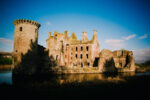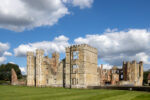

As you approach Caerlaverock Castle in south-west Scotland, you will not see a castle perched on a crag nor a fortress atop a steep hill. Instead, the ruins rise from a flat landscape characterised by wetlands near the Solway Firth. Moats, mighty walls and an impressive double gatehouse dominate the scene. It is precisely this unusual location that makes Caerlaverock one of the country’s most fascinating medieval castle complexes. The castle lies around 13 kilometres south-east of Dumfries in the region of Dumfries and Galloway, not far from the modern-day B725 road. For centuries, it was far more than just a stately residence: Caerlaverock served as a frontier fortress, the centre of power for the Maxwell clan and a theatre of the Anglo-Scottish wars. Its history tells a tale of ambitious architecture, strategic miscalculations, sieges and the transformation of a contested border region.
A castle that sank into the marshes – The complex visible today was not the first castle at Caerlaverock. Around 1220, Sir John Maxwell, an influential Scottish nobleman, had a predecessor complex built some 200 metres south of the later castle. Its purpose was clear: it was intended to secure an important access route into Scotland. At that time, the area lay within a tidal marsh and coastal zone. The water level was significantly higher than it is today; parts of the landscape formed a sort of natural bay or harbour area. The first fortress was built on difficult, clayey ground. The builders first had to create a roughly square, artificially reinforced platform on which buildings and defensive walls could be erected. A moat surrounded the complex, with a bridge providing access from the north. A residential building stood on the south side, whilst further buildings and walls gradually expanded the complex. Two main buildings, situated opposite one another, were connected by a sheltered passageway. This allowed food to be transported from the kitchen area to the residential building in dry and sheltered conditions – a small but telling detail about the practical organisation of everyday life at the castle. Later, towers were added to the corners of the outer fortifications. However, the construction had a fundamental flaw: the ground was too damp and unstable. The heavy stone walls settled, buildings were damaged and parts of the complex collapsed. It is likely that one of the planned towers was never even fully completed. Less than five decades after its foundation, the first castle was abandoned. Excavations carried out in 1978 confirmed its significance: Caerlaverock First Castle is one of the earliest Scottish stone castles. Today, however, only low remains of walls and traces of the ground plan are visible. It is precisely these remains that demonstrate just how risky medieval construction could be, despite all the experience available – particularly in a landscape dominated by water.
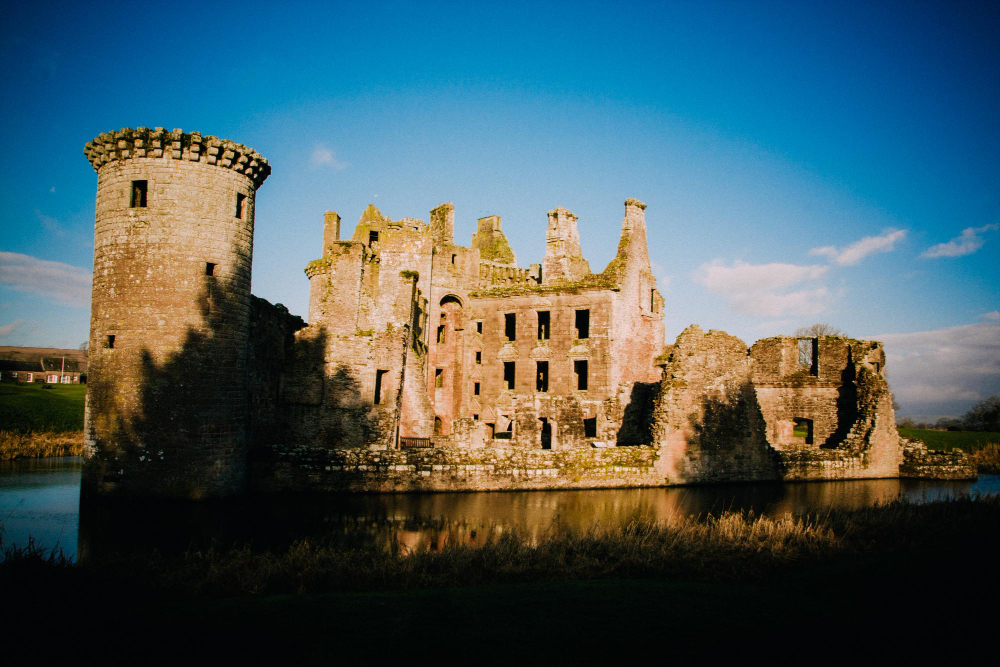
The New Castle: a rare triangular fortress – Around 1270, the Maxwells decided to make a fresh start. Caerlaverock New Castle was built some 200 metres north of the failed predecessor. Dendrochronological analyses of the timber used in its construction suggest that the new castle was largely completed by 1277. Its shape makes it unique: Caerlaverock is the only triangular castle complex in Great Britain. The three sides of the ground plan are protected by massive fortifications, whilst towers stand at the corners. At the northern tip stands the monumental gatehouse with two tall round towers. It was not only the entrance to the castle, but also its strongest and most striking defensive section. A wide, water-filled moat surrounded the entire complex. This made the castle appear like a stone island. Unlike many hilltop castles, Caerlaverock did not make use of natural rock or steep slopes, but rather water, ramparts and man-made obstacles. Attackers had to approach across open ground, surmount the outer rampart and, in doing so, constantly expect to come under fire. Archers were able to reach targets in the castle’s forecourt effectively from the towers and battlements. The unusual triangular shape was not merely an architectural whim. It made it possible to cover the walls from several points and limit the number of potential weak spots. At the same time, the only regular access was on the northern side – where the imposing gatehouse controlled the passage. However, the location by the water also had its drawbacks. The castle was excellent to defend, but its inhabitants could hardly break out unnoticed or bring in supplies during a siege. Unlike some other castles, Caerlaverock apparently did not have a known escape or supply passage. When supplies ran low, the defenders often had no choice but to surrender.
A border fortress in the war between England and Scotland – Caerlaverock’s location made the castle politically and militarily significant. It stood close to the English border and secured routes along the River Nith and the Solway Firth. The Maxwells were among the most important families of the western border region, known as the West March. Their castles and estates lay in a region where sovereignty was never a given. The situation became particularly dramatic during the Scottish Wars of Independence. When England, under King Edward I, sought to extend its influence into Scotland, Caerlaverock became the focal point of a major military campaign. In the summer of 1300, Edward I advanced on the castle with an army. The siege began on 10 July. The defenders were significantly outnumbered. Contemporary accounts speak of a garrison of around 60 men. Nevertheless, they put up a fight. The English deployed siege engines, including large projectile-throwing machines. The so-called ‘Warwolf’, a huge blide or trebuchet-catapult, became particularly famous in later accounts. Such machines hurled heavy stones at walls, roofs and battlements. Even if the walls did not collapse immediately, the impacts could produce deadly shards of stone and drive the defenders from their positions. Caerlaverock fell after just two days. The fate of the garrison is not entirely clear. Some sources suggest that their lives were spared; other reports mention captivity for some of the men and executions for others. What is certain, however, is that the siege left behind an exceptionally rich written record. An unknown poet, presumably a herald in the English army, composed the so-called “Song of Caerlaverock”. This medieval poem describes not only the siege but also the coats of arms of numerous noblemen involved. For historians, it is therefore an important source on heraldry and the composition of the English army. At the same time, it shows that the capture of the castle was perceived as a political event of particular significance. Caerlaverock initially remained under English control. As early as 1312, the Scottish King Robert I, better known as Robert the Bruce, personally led a siege against the English garrison. The castle probably fell back into Scottish hands shortly afterwards.
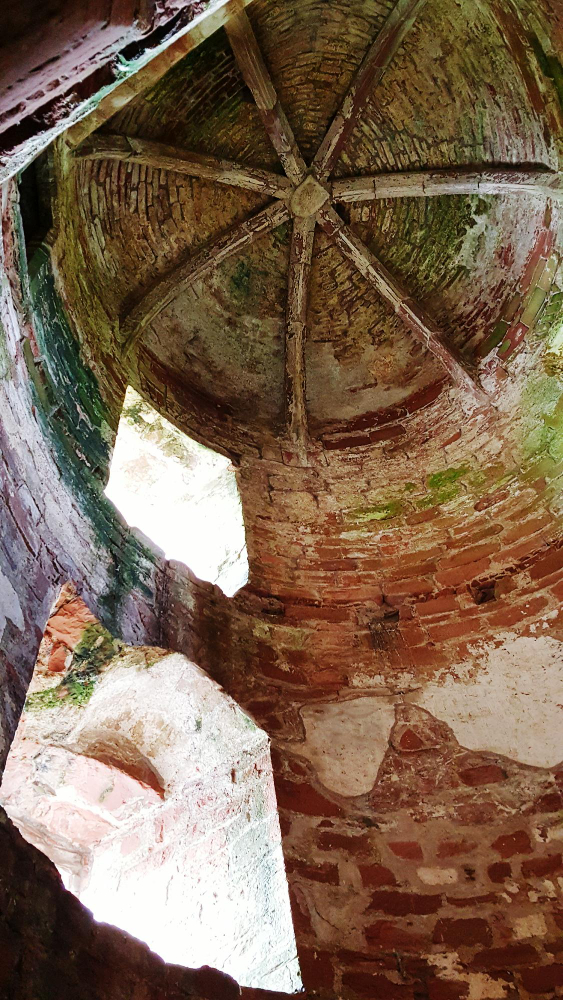
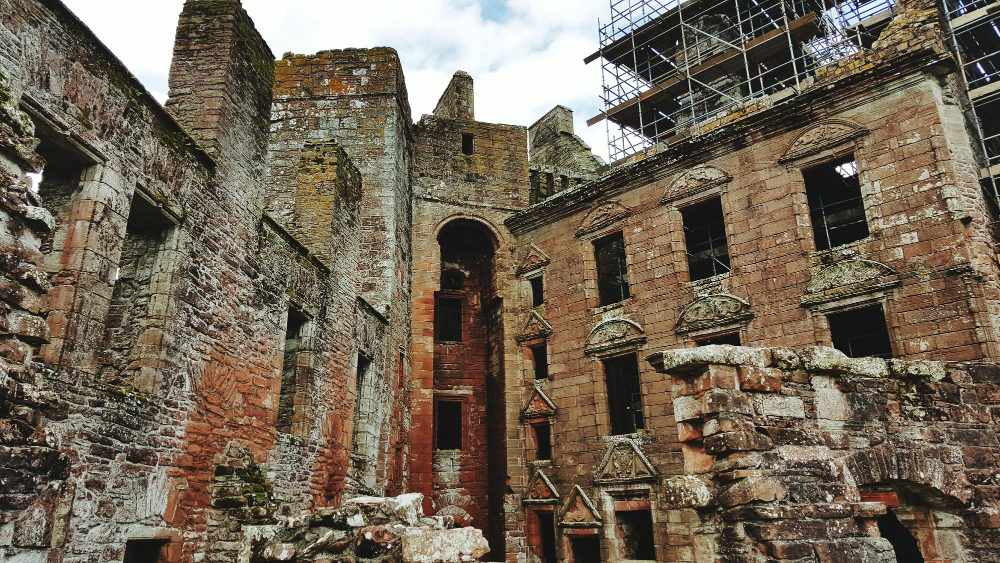
Repeated attacks and a magnificent residence – Caerlaverock was not spared from wars in the centuries that followed either. English troops attacked the complex again in the 16th century or occupied it at times, including in 1544 and 1570. The castle’s military function only began to lose its significance when, in 1603, the Scottish and English crowns were united in a personal union: King James VI of Scotland also became James I of England. Although the border remained in place, open conflicts between the two kingdoms came to an end. Thereafter, Caerlaverock evolved more into a stately residence. The castle had been extensively altered and modernised over a long period. Whilst many roofs were still thatched in the late 13th century, later generations replaced them with more durable materials. Various architectural styles can still be discerned in the surviving parts today. Particularly noteworthy is the Nithsdale Lodging, a stately residence within the castle. It was completed in 1634 and is regarded as one of the most elaborate Scottish castle buildings of its time. Its richly decorated façade serves as a reminder that castles were not merely military structures; they were also intended to display wealth, education, family prestige and political standing.
The End of Its Days as a Fortress – The last major siege took place during the Wars of the Three Kingdoms, which also shook Scotland to its core. The Maxwells supported King Charles I. In 1640, Caerlaverock was besieged by an army of Presbyterian Covenanters. The defenders held out for 13 weeks. The attackers were apparently unable to simply storm the castle; in the end, the lack of food proved decisive. As supplies ran low, the garrison was forced to surrender. The siege left severe damage in its wake, presumably also caused by the use of artillery. Afterwards, Caerlaverock was never restored as a fully functional fortress. Its days as a military stronghold were finally over. The site subsequently changed hands several times. Via the Herries family, it eventually passed to the Dukes of Norfolk. In 1946, the castle was transferred to state ownership. Today it is managed by Historic Environment Scotland, which is responsible for its conservation, research and visitor access.
A monument to the history of the Scottish border – Caerlaverock Castle is now a ruin, but not a silent one. The walls, the moat and the double gatehouse tell of a time when the border between England and Scotland was a contested political reality. The castle symbolises the power of the Maxwells, the military ambitions of Edward I and the shifting alliances of Scottish history. Around the castle, replicas of medieval siege engines serve as a reminder of the violence of the year 1300. Yet Caerlaverock is more than just a setting for spectacular military events: the site also illustrates how people in the Middle Ages responded to the landscape, technology and political uncertainty. It is precisely the failed first castle and the successful new construction that make Caerlaverock exceptional. Here, one can directly appreciate how a construction error on marshy ground gave rise to one of Scotland’s most striking fortresses – a triangular moated castle whose history remains visible in the masonry to this day.