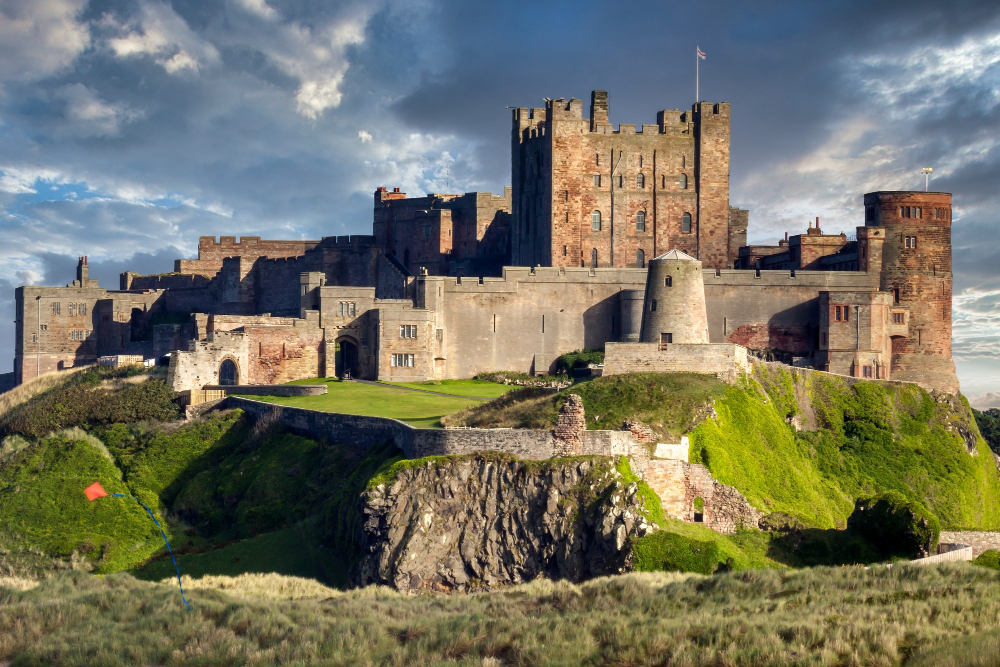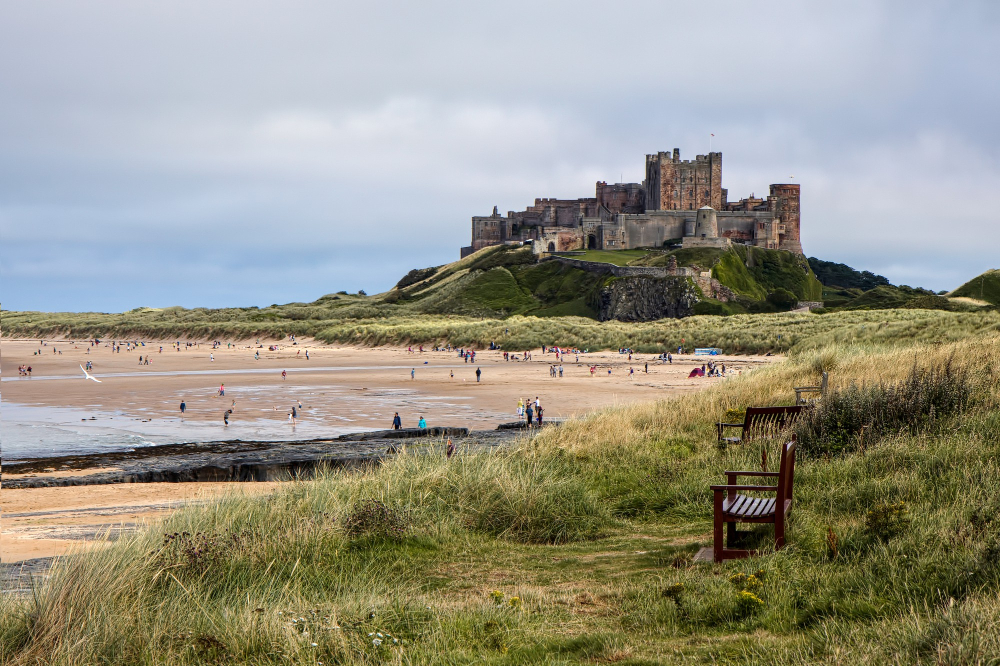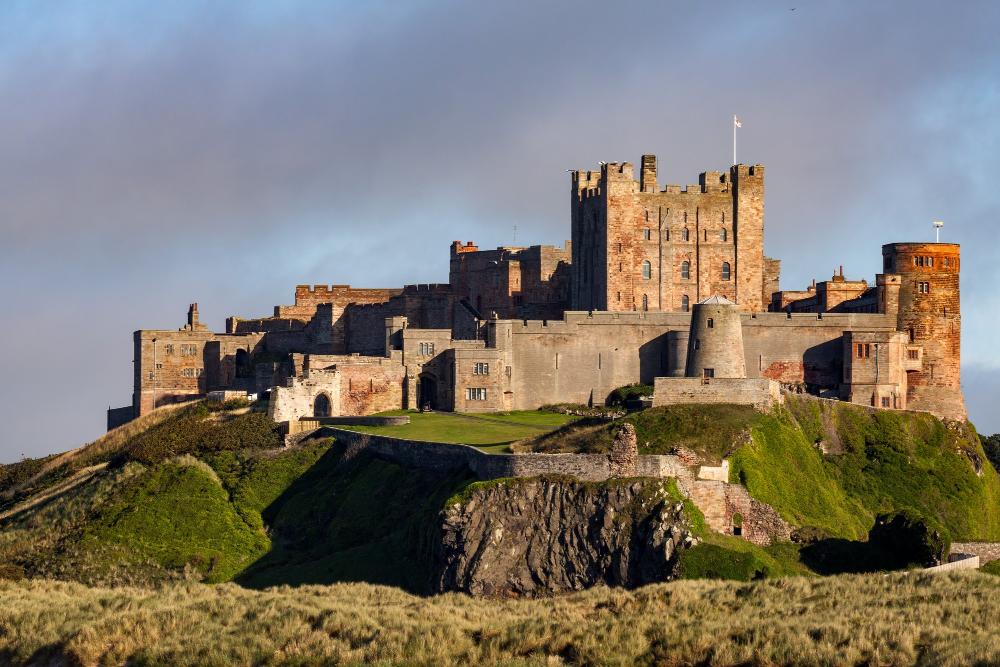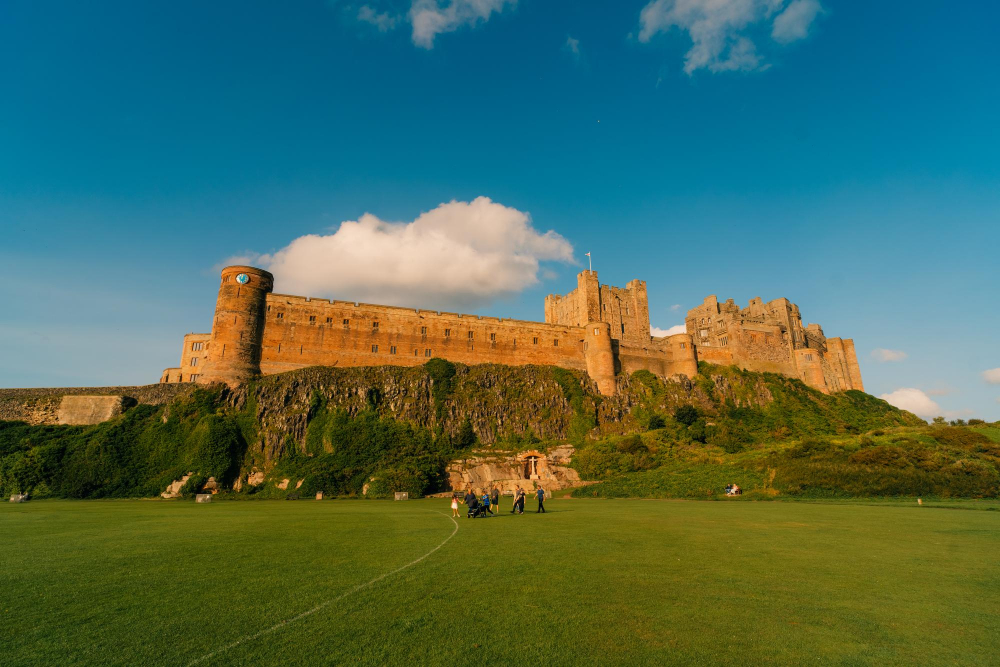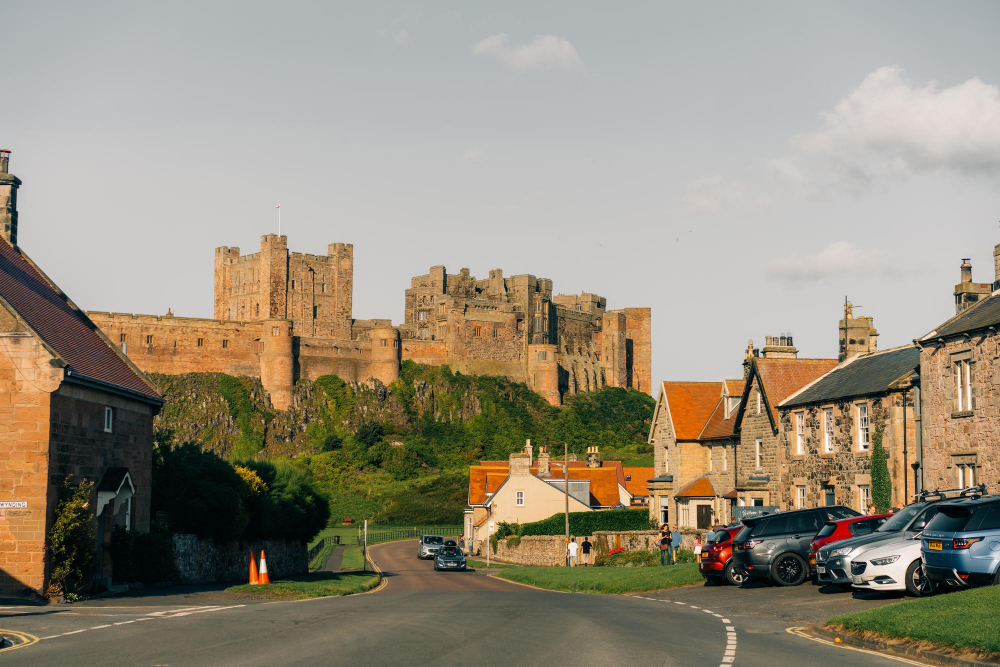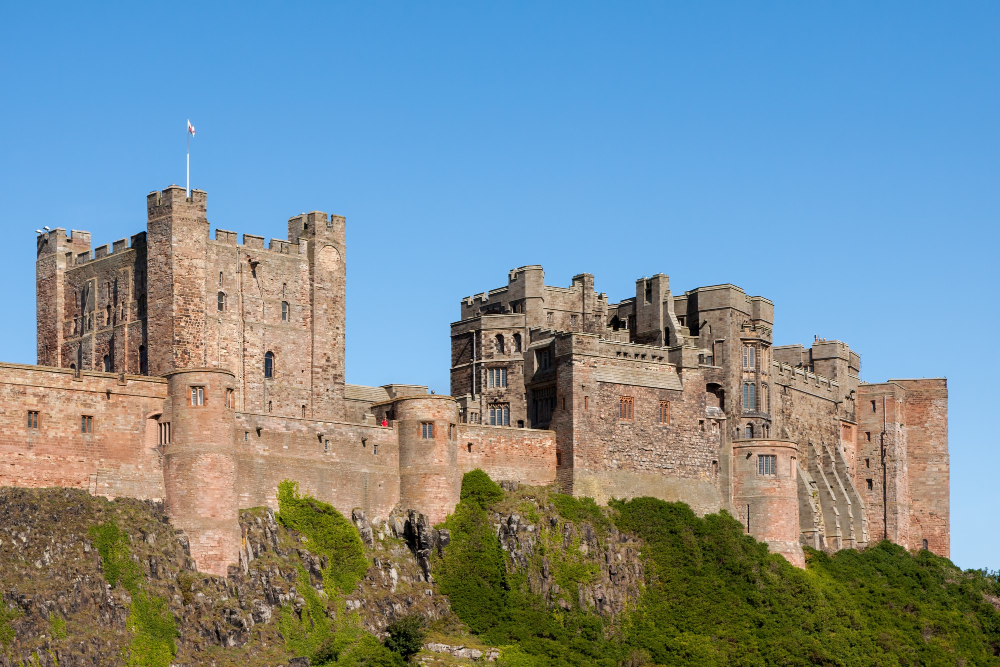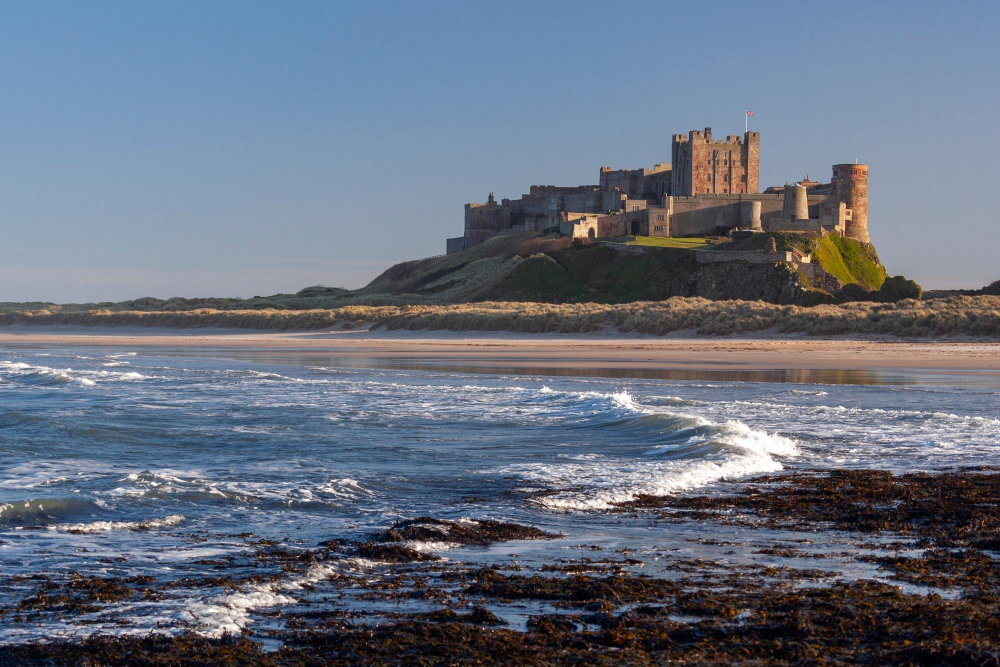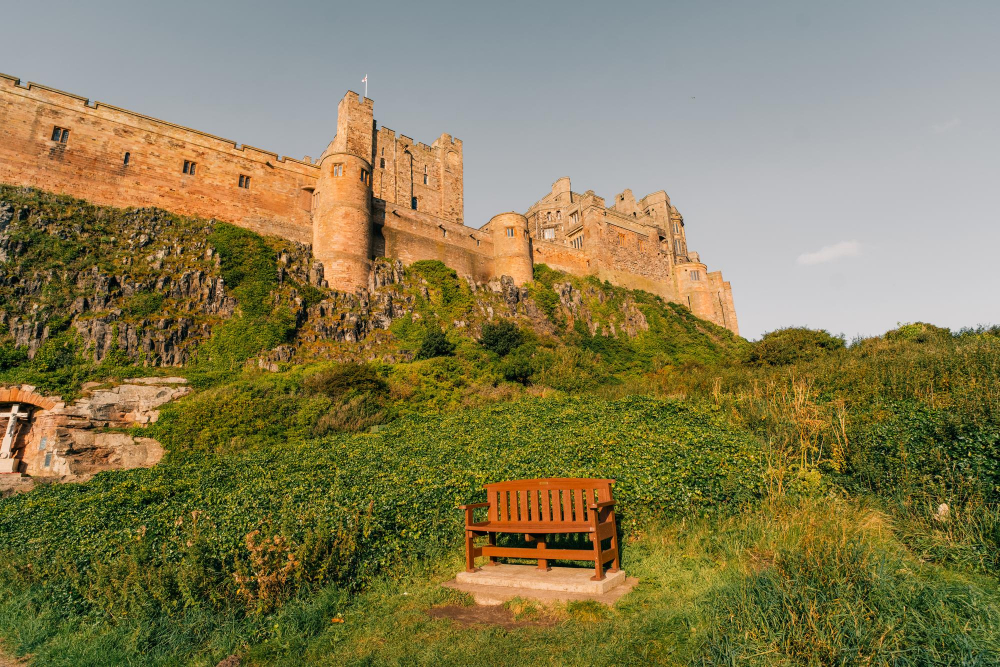

On the north-east coast of England lies one of Britain’s most fascinating historical sites: Bamburgh Castle, an imposing fortress that captivates visitors not only with its strategic location and impressive architecture, but also with its rich and eventful history. From its Celtic origins through medieval battles to modern film sets – Bamburgh Castle tells a story that spans centuries and continues to fascinate.
Origins: A Celtic fortress called Din Guarie – The history of Bamburgh Castle begins long before the time of the Normans or Anglo-Saxons. Originally, this site – a massive black dolerite rock along the Whin Sill – was home to a Celtic-Briton fortress known as Din Guarie. Historians believe that from around 420 AD, this fortress served as the capital of the Kingdom of Bernicia, an early Celtic realm. It was not until 547 that the site was conquered by King Ida of Bernicia, who made Bamburgh the central power base of his kingdom. The fortress’s history remained turbulent: in 590 it was recaptured by the Britons, before the Anglo-Saxons regained control shortly afterwards. The castle eventually took its name from Bebba, the wife of Ida’s successor, Æthelfrith. The name ‘Bebbanburh’, which later became Bamburgh, still serves as a reminder of this historical figure and Anglo-Saxon rule over the region.
Power struggles in the Middle Ages and the Norman intervention – With the Norman conquest of England around the year 1066, the fate of Bamburgh Castle changed drastically. William II, son of William the Conqueror, besieged the castle in 1095 during a rebellion against Robert de Mowbray, the Earl of Northumbria. Although the siege was initially unsuccessful, the king’s threat to blind Robert’s wife eventually led to the castle’s surrender. Bamburgh thus passed into royal ownership. Under the reign of King Henry II, significant structural changes followed; he had the central keep built, the heart of the castle’s present-day structure. At the same time, Bamburgh became an important military stronghold in the north of England and the scene of numerous conflicts. A particularly notable episode occurred during the Wars of the Roses in 1464, when Richard Neville, the ‘Kingmaker’, besieged the castle for nine months, employing artillery on a large scale for the first time – a turning point in the history of warfare.
Decline and Revival in Modern Times – Over the centuries, the castle lost its military significance and eventually fell into a state of visible disrepair. Financial difficulties faced by the owners led to Bamburgh Castle being taken over in 1704 by the then Bishop of Durham, Lord Crew. With a group of trustees, restoration work began, saving the castle from further decay. Thomas Sharp and his son John Sharp, in particular, implemented significant measures: not only were the living quarters renovated, but a hospital was also built on the castle grounds – a sign of social change and a spirit of care. But it was not until the castle was purchased in 1894 by the Victorian industrialist William Armstrong that Bamburgh Castle experienced its definitive renaissance. Armstrong invested considerable funds to fully restore the castle and transform it into an architectural masterpiece. His vision and influence have had a decisive impact on the castle’s current condition.
Archaeological finds: A glimpse into the past – A key factor that makes Bamburgh Castle a site of inestimable value is the wealth of archaeological finds from the surrounding area. As early as the 1960s, archaeologist Brian Hope-Taylor discovered two extraordinary artefacts: the gold plate known as the ‘Bamburgh Beast’ and the legendary Bamburgh Sword. These relics shed new light on the significance of the castle and its inhabitants during the Middle Ages. Between 1998 and 2007, the Bamburgh Research Project investigated an early medieval burial site at Bowl Hole near the castle. Here, the remains of 120 individuals were found, whose origins ranged from Ireland and Scandinavia to the Mediterranean and North Africa. This discovery underscores the castle’s role as a hub for international contact in centuries past. Since 2016, the remains have been housed in the crypt of the nearby St Aidan’s Church – a place open to all who wish to experience history at first hand.
A place of legends and literature – The historic charm of Bamburgh Castle has inspired not only archaeologists and historians, but also writers and artists. The castle features in the medieval ballad The Laidly Worm of Spindleston Heugh, a tale of a cursed princess who is redeemed through love and courage. Bamburgh also plays a central role in the Arthurian legend: Sir Thomas Malory identified the castle with Joyous Gard, the mythical seat of Sir Lancelot. In modern literature, Bamburgh is known by its Anglo-Saxon name, Bebbanburg, as the home of Uhtred Uhtredson, the protagonist of Bernard Cornwell’s The Saxon Stories series, which forms the basis for the successful television series The Last Kingdom.
The role of Bamburgh Castle in film and television – Thanks to its picturesque setting and impressive architecture, Bamburgh Castle has served as a filming location for numerous film and television productions. From historical dramas such as Becket (1964) and Macbeth (1971) to modern blockbusters such as Indiana Jones and the Dial of Destiny (2023) – the castle has carved out a firm place for itself in the world of film over the years. The castle has also played a prominent role in video games such as Forza Horizon 4 and the documentary series Time Team, taking its fame beyond the borders of England.
A place beyond time – Bamburgh Castle is more than just a historical attraction. It is a living link between the past and the present, between history and legend. Whether as a Celtic fortress, a medieval castle or a modern tourist attraction – the castle holds a wealth of stories waiting to be discovered. For visitors travelling to the north of England, Bamburgh Castle is a must-see: a place where the stones speak, the wind whispers tales and history itself comes to life.