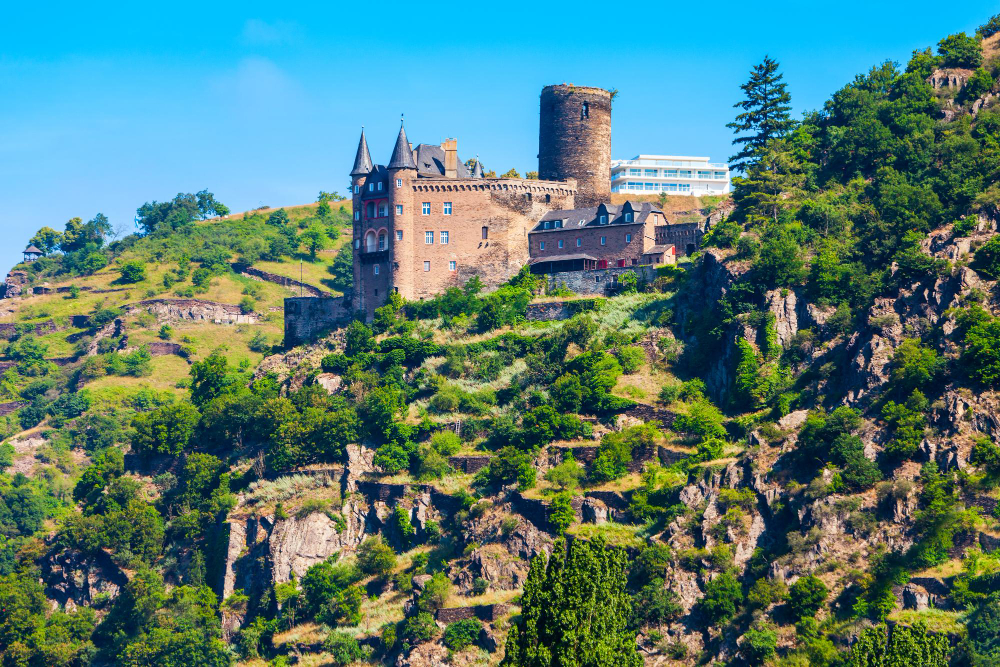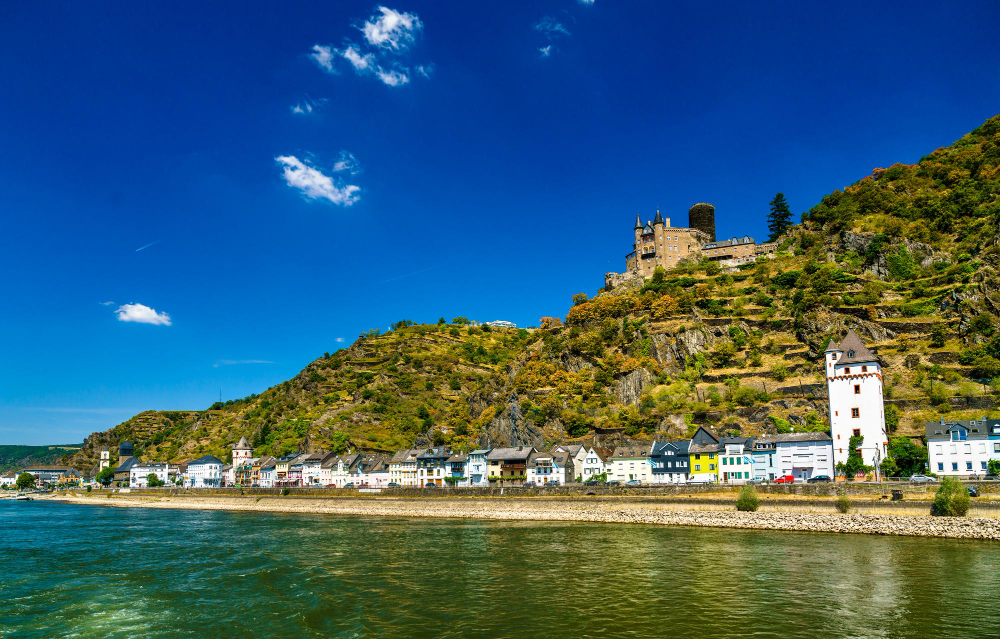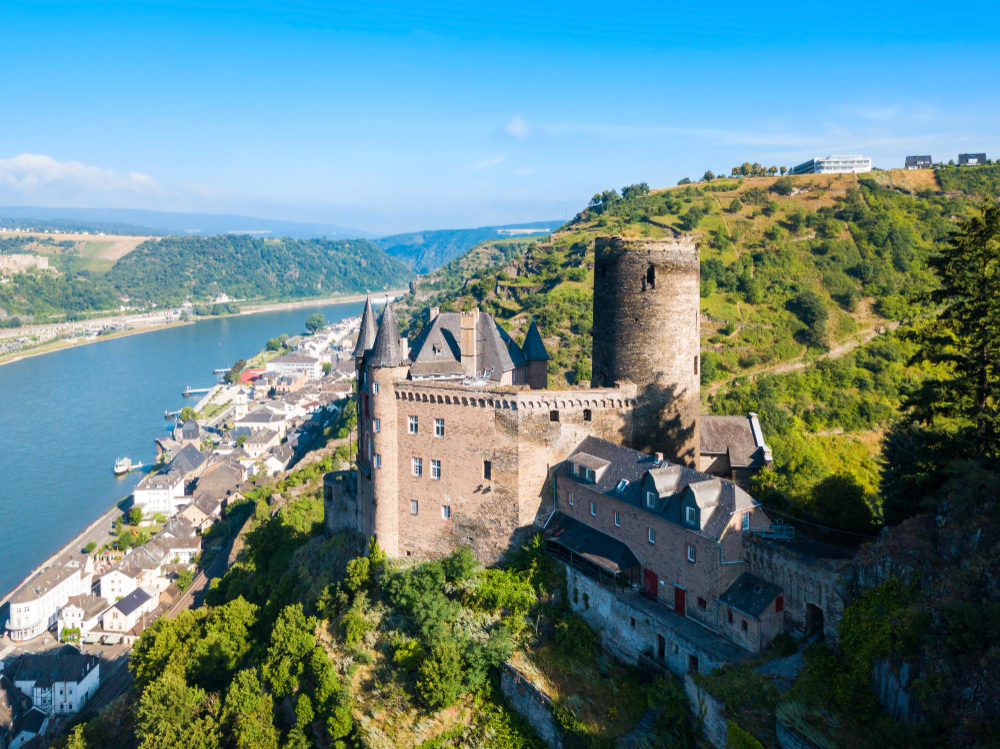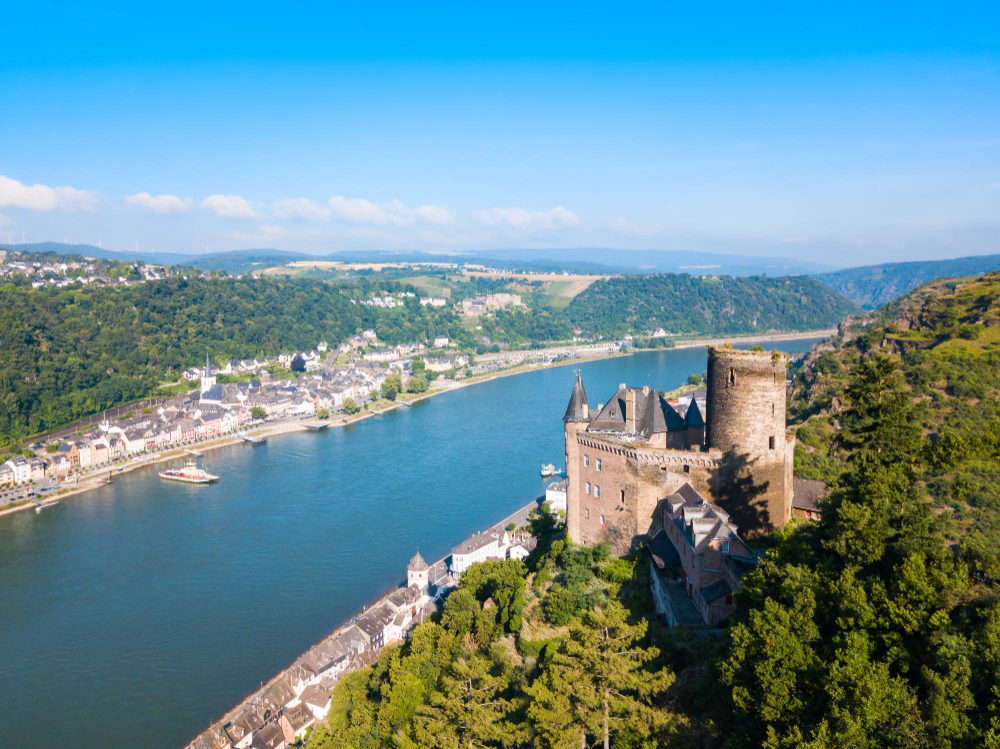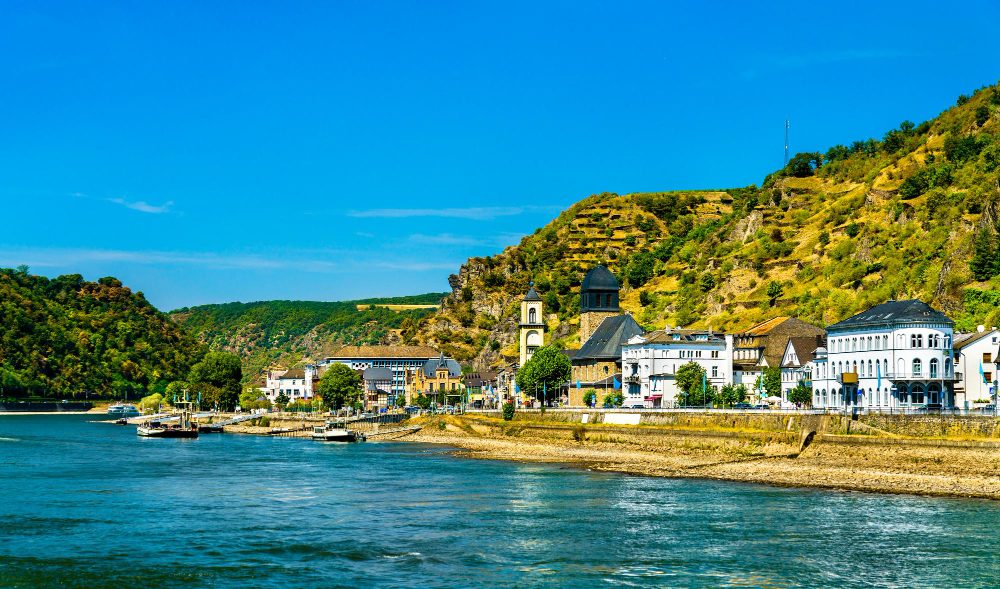

As you travel along the Rhine, a castle rises above St. Goarshausen that not only catches the eye with its striking silhouette, but is also characterised by a rich, eventful history and ancient legends: Katz Castle. Once known as ‘Neukatzenelnbogen Castle’, it has, over the centuries, become a symbol of the Upper Middle Rhine Valley. Since 2002, it has even been a UNESCO World Heritage Site. But what makes this castle so unique? A look into its past and its significance reveals fascinating stories and secrets.
From a stronghold to a ruin – its historical development – The foundation stones for Katz Castle were laid between 1360 and 1371 by the Counts of Katzenelnbogen. At that time, the neighbouring Maus Castle, belonging to the Electorate of Trier, was already under construction, which led to a kind of rivalry developing between the two structures. However, the construction of Katz Castle had a clear strategic purpose: together with Rheinfels Castle on the opposite bank, it was intended to form a customs barrier on the Rhine. This measure served to secure control over an important trade route and to increase the counts’ revenue. The male line of the Counts of Katzenelnbogen died out in 1479. The castle passed to the Landgraves of Hesse and was besieged and damaged on several occasions during the succession conflicts between Hesse-Kassel and Hesse-Darmstadt. Although it was repeatedly fortified, the castle suffered considerable damage over the years. In particular, the conflicts during the War of the Palatinate Succession (1692) and the Seven Years’ War left their mark. Finally, in 1806, Napoleon had the castle complex blown up, reducing it largely to ruins.
From Reconstruction to Modern Use – Following its destruction by Napoleon, the castle initially fell further into disrepair. It was not until the 19th century that its revival began, when it was rebuilt in 1896 by District Administrator Ferdinand Berg. However, the reconstruction was based less on the original medieval structure and was strongly influenced by the contemporary tastes of the era. As a result, the castle was given new architectural elements that were more reminiscent of a romantic fairytale castle than a medieval fortress. In the years that followed, the castle changed hands several times and was put to various new uses. From 1928, it belonged to the Reich Labour Service, which set up a training camp there. After the Second World War, it belonged to the Federal Republic of Germany and even served as a temporary school for a time. In particular, the boarding school of the Hofmann Institute shaped the castle’s post-war history. The pupils lived there until 1966, before the Wilhelm-Hofmann-Gymnasium opened in the centre of St. Goarshausen. A new turning point came in 1989, when Katz Castle was acquired by the Japanese entrepreneur Satoshi Kosugi. It was said that he planned to convert the castle into a hotel for Japanese tourists, but this plan was never realised. Since then, the castle has been in private Japanese ownership and is no longer open to the public.
Architecture and distinctive features of the castle – The compact design of Katz Castle is one of its most striking features. Despite its comparatively small footprint, it nevertheless impresses with its strategically ingenious design. The centrepiece of the complex was originally a 40-metre-high main tower, which dominated the castle’s front line of defence. This tower was further protected by a neck ditch and an outer bastion – an impressive example of medieval fortification architecture. The residential tower itself consisted of three storeys and, in addition to living quarters, also housed important military functions. Today, only a few parts of the original complex remain, including the ruins of the keep as well as sections of the shield wall and the forecourt. The structure added on the Rhine side during reconstruction also serves as a reminder of the medieval castle, though it is highly stylised and romanticised.
Myths and legends surrounding Katz Castle – Like many castles on the Rhine, Katz Castle is shrouded in numerous stories and legends that have further cemented its fame. One of the best-known stories tells of the rivalry with the neighbouring Maus Castle. It is said that the name ‘Maus’ was originally a derisive nickname given to the smaller castle by the Lords of Katzenelnbogen to demonstrate their own superiority. Another legend tells of a hidden treasure said to lie deep within the walls of Katz Castle. It is said that a knight hid it there before setting off for a battle from which he never returned. To this day, it is rumoured that this treasure remains undiscovered – a dream for anyone who believes in the romance and magic of bygone times.
The castle’s significance as a UNESCO World Heritage Site – The Upper Middle Rhine Valley is renowned for its castles like almost no other region. With its location high above the Rhine and its eventful history, Katz Castle is a symbolic example of the cultural and historical significance of this area. The fact that it forms part of the UNESCO World Heritage Site underscores its role as a cultural heritage site of international standing. At the same time, it symbolises the transformation that many castles have undergone: from centres of power, through a period of decline, to objects of modern interest.
A castle full of stories and secrets – Katz Castle is far more than just a medieval fortress. It bears witness to the power struggles and political intrigues of its time, is a place of stories and legends, and a symbol of the evolution of castle architecture over the centuries. Its imposing location and mysterious aura make it a fascinating destination – even though its interior is not open to the public. Although the castle is now privately owned, it remains an important part of the cultural landscape along the Rhine. It invites visitors to explore the history of the Middle Rhine Valley, immerse themselves in its world of legends, and discover the beauty of a region shaped by its past. Anyone who dares to take a closer look and listen to the stories will realise that Katz Castle is more than just stone and mortar – it is a living monument to German history.