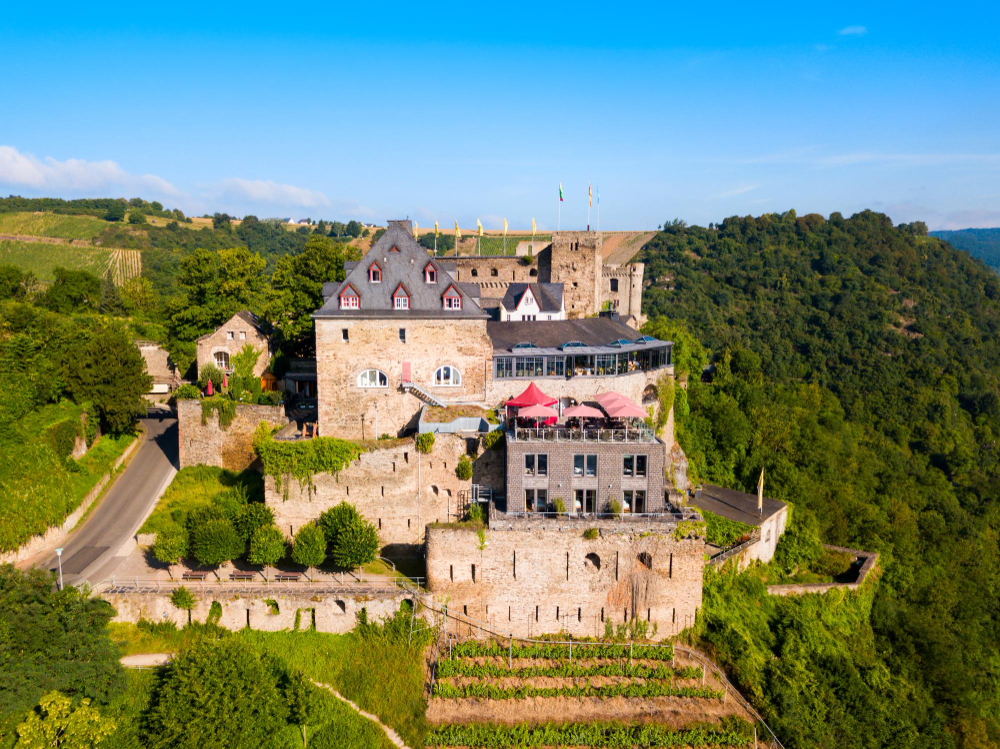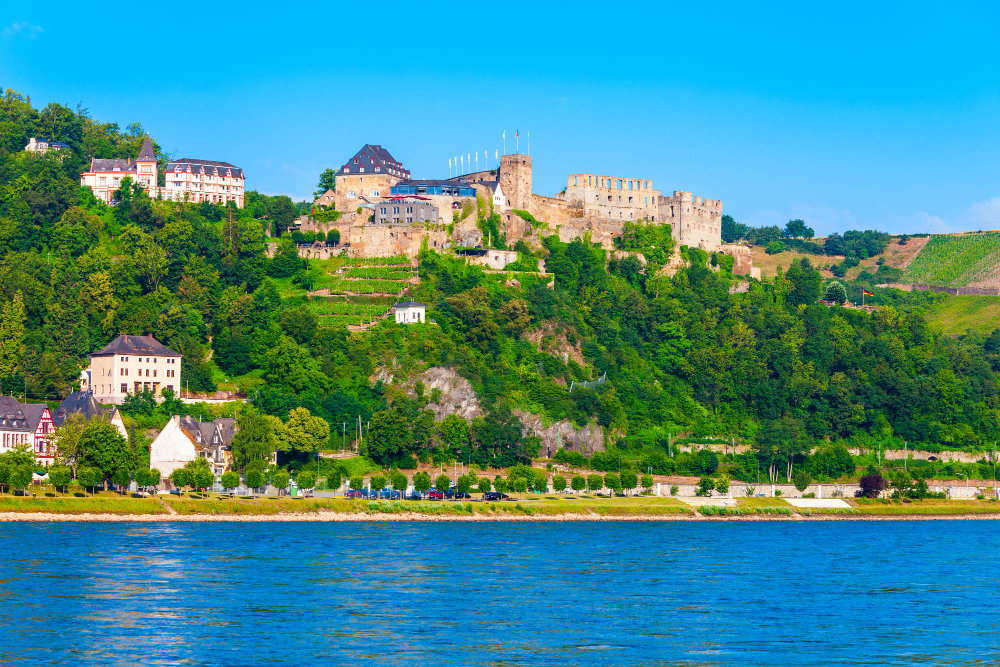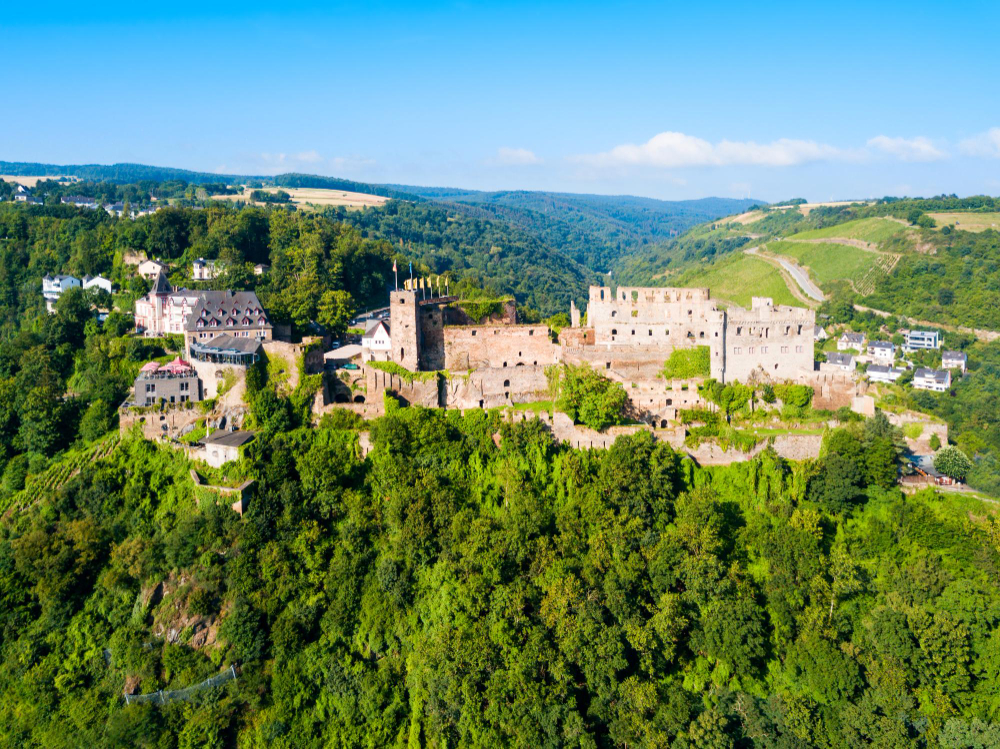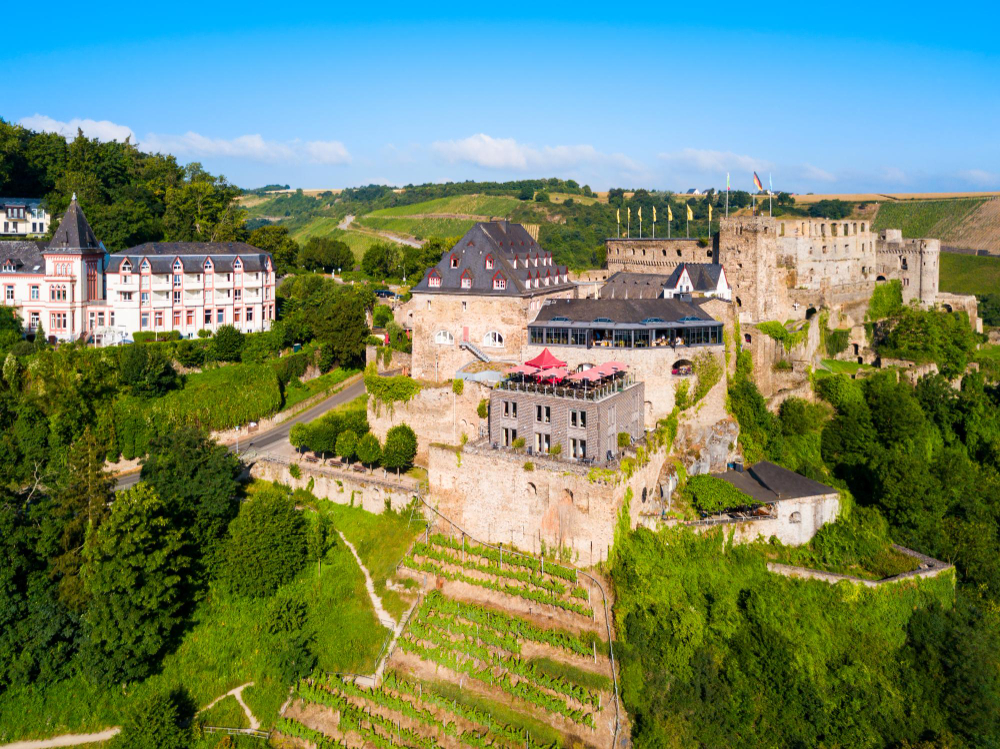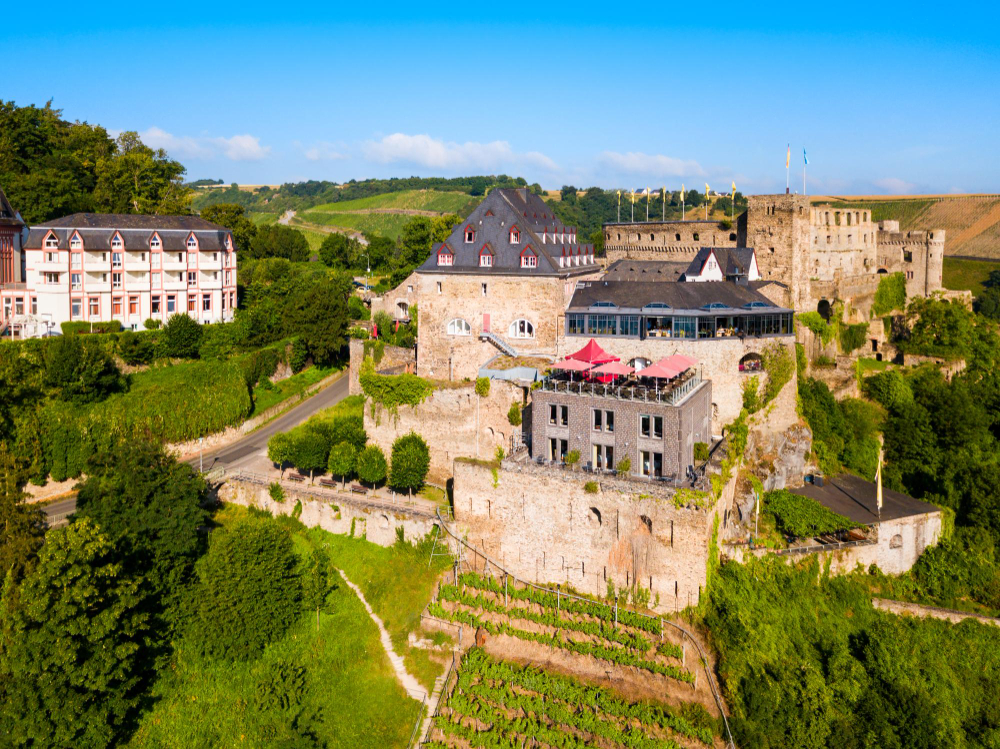

The imposing ruins of Rheinfels Castle tower majestically above the left bank of the Rhine near St. Goar and have captivated visitors and history enthusiasts for centuries. Once a mighty fortress and later the scene of dramatic wartime events, the castle tells of an eventful past full of intrigue, legends and strategic importance. With its unique architecture, it is not only a testament to medieval architecture but also part of the UNESCO World Heritage Site ‘Upper Middle Rhine Valley’. But how did a customs castle belonging to the Counts of Katzenelnbogen become one of the region’s most important defensive structures?
The Beginnings: From a Customs Castle to an Impregnable Fortress – The history of Rheinfels Castle begins in 1245, when Diether V of Katzenelnbogen had the complex built as a customs castle to levy duties on passing ships. Just eleven years later, in 1256, the count’s customs policy met with considerable resistance. The Worms Annals mention that Diether broke the peace of the land and was subsequently besieged by an army of the Rhenish League of Cities. Surprisingly, the young castle proved impregnable – a reputation that was to endure for centuries. Rheinfels’ importance grew further when the County of Katzenelnbogen was divided in the mid-13th century. Whilst the Upper County of Darmstadt served as the political centre, Rheinfels became the seat of the Lower County and developed into the administrative and economic heart of the region. A residence was built here, which was continuously extended under Count Wilhelm II of Katzenelnbogen through a series of additions well into the 14th century. A striking feature of this period was the round keep, which was later raised to a total height of 54 metres by the addition of a so-called ‘Butterfass’ spire – the tallest keep of any German castle.
Weddings and inheritance disputes: the castle’s eventful history – In the 15th century, Rheinfels was the centre of courtly life. The complex enjoyed a golden age, particularly under the young Count Philipp of Katzenelnbogen. Following his untimely death, however, a decades-long inheritance dispute ensued with the House of Nassau, before the castle finally passed into the possession of Landgrave Heinrich III of Hesse-Marburg. This chapter in the history of family feuds illustrates just how closely political power struggles were intertwined with the history of these stone walls. Under Heinrich’s descendants, both architectural and military innovations were pursued. Landgrave Philipp the Magnanimous, for example, transformed Rheinfels into a Renaissance castle that not only offered residential comfort but also boasted strategically significant defensive features. Later, in the 17th century, under Landgrave Ernst of Hesse-Rheinfels, the fortress developed into a bulwark against France – a decision that made the castle unique, but also made its future dependent on military conflicts.
Dramatic sieges: The battle for Rheinfels – The sieges of Rheinfels are among the most famous episodes in its history. One of the most spectacular took place during the War of the Palatinate Succession in 1692, when French troops under the Comte de Tallard attempted to capture the castle. Despite a numerical superiority of 28,000 soldiers against just 3,000 defenders, the attack failed. A legendary marksman named Johann Kretsch played a key role in the defence: using a double-hook musket, he managed to fire a precision shot from a distance of 200 metres, seriously wounding Tallard and thereby significantly weakening the French. The castle’s fate was also sealed during the Seven Years’ War. In 1758, it was surrendered to French troops without a fight, which many contemporaries regarded as a disgrace. Several decades later, during the French Revolution, revolutionary troops destroyed large parts of the fortress. The once-mighty walls and the keep were blown up, and the castle irrevocably lost its function as a defensive structure. Victor Hugo, who later visited the ruins, poetically described them as ‘an agricultural outbuilding’ and recognised in them the melancholic decay of a once-proud bastion.
From quarry to historic landmark: the castle’s modern face – After the ruins had long been used as a quarry, Prince Wilhelm of Prussia succeeded in saving them from complete destruction in 1843. However, some of the building material had already been used for the expansion of Ehrenbreitstein Fortress in Koblenz. Since then, restoration work has been carried out to preserve the remaining structures. Today, Rheinfels Castle belongs to the town of St. Goar and delights thousands of visitors every year. Particularly impressive are the large vaulted cellar – the largest self-supporting cellar in Europe – and the underground tunnels, which offer insights into 17th-century strategic architecture. In addition to their historical significance, the castle ruins have also taken on a role in tourism. Guided tours recount fascinating stories from the past, whilst the ‘Rheinfelspfad’ trail explores the nature and geology surrounding the castle. Rare plant species and bird colonies have made their home here, making the site a cultural and ecological gem on the Middle Rhine.
Between tradition and modernity: the Hotel Schloss Rheinfels – In 1973, a hotel was opened next to the castle, blending perfectly into the historic surroundings. Now known as the ‘Romantik Hotel Schloss Rheinfels’, it offers an exclusive view of the Rhine and combines the beauty of medieval architecture with modern comfort. The long-standing dispute over ownership of the castle, which most recently flared up between the town of St. Goar and Georg Friedrich, Prince of Prussia, was settled out of court in 2020 – further proof of how closely history and politics remain intertwined even today.
A place full of stories and secrets – Rheinfels Castle is far more than just a ruin. It stands as a symbol of the power struggles, dreams and tragedies that have shaped the Middle Rhine Valley over the centuries. From its status as an impregnable fortress to the poetic melancholy of today’s landscape dotted with ruins, it remains a place that brings history to life and offers scope for interpretation. Thanks to careful restoration work and ongoing research, Rheinfels will continue to be a historical gem that enchants its visitors with fascinating stories and breathtaking views.