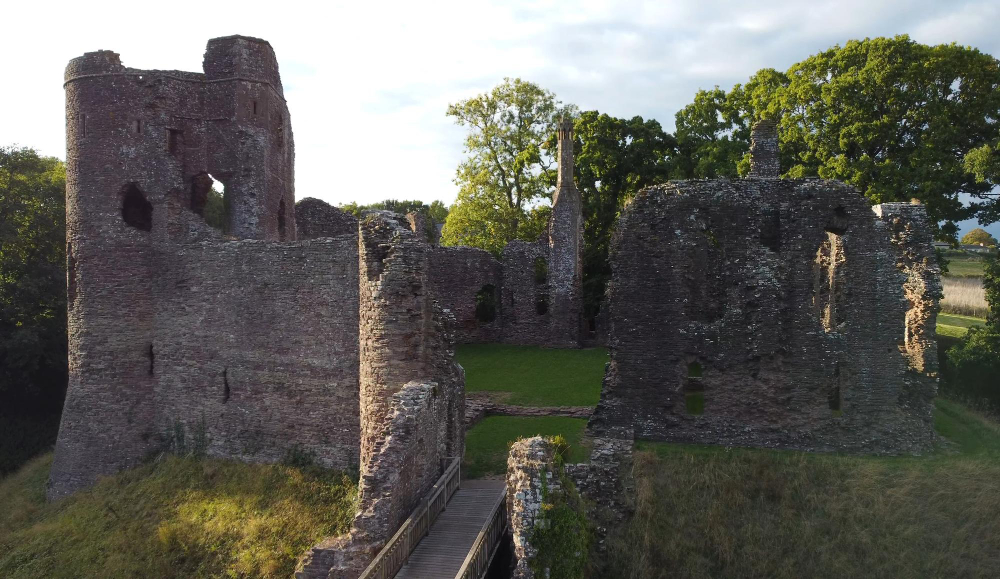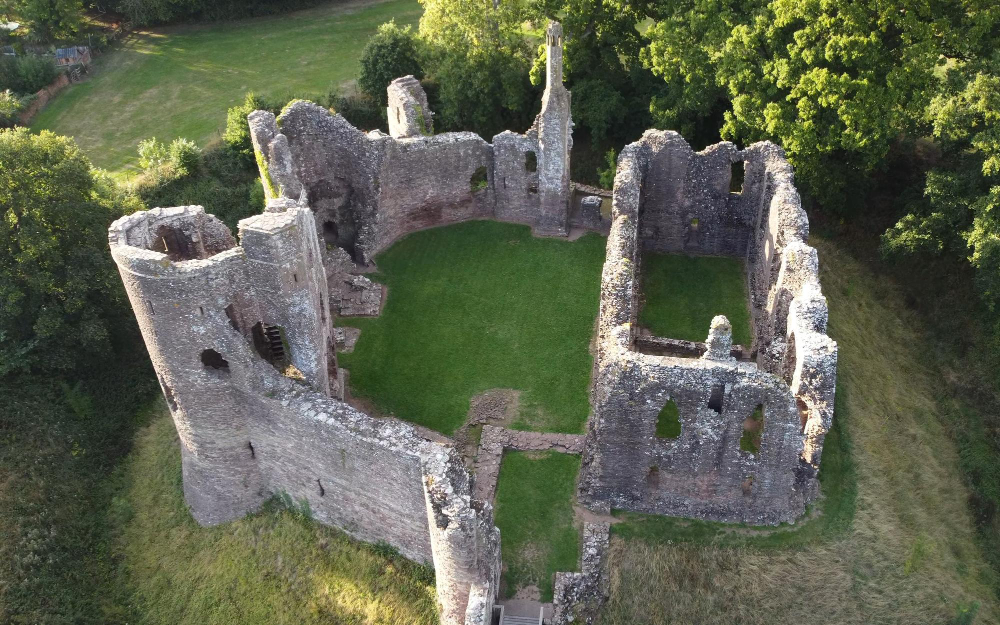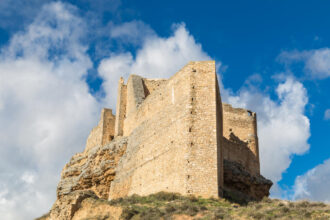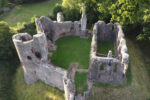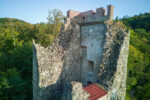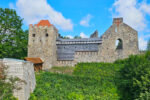

High above the village of Grosmont in Monmouthshire stand the ruins of a castle that, at first glance, appears quiet and secluded. Yet for centuries, Grosmont Castle was a contested site on the border between England and Wales. Its walls tell tales of Norman expansion, Welsh resistance, royal power struggles and a spectacular night-time attack on a royal army. Today, the site is one of the most impressive, if less well-known, castle ruins in the Welsh Marches – that border region where English and Welsh interests clashed particularly fiercely. Grosmont Castle, together with Skenfrith Castle and White Castle, forms part of the so-called ‘Three Castles’. This defensive system secured access from the Welsh borderlands towards Hereford for a long time. The castle’s history dates back to the years following the Norman Conquest of England in 1066 – and it makes it clear that medieval castles were far more than simply fortified residences. They were administrative centres, military strongholds, symbols of power and places of refuge in times of crisis.
A castle from the Norman Conquest – Following William the Conqueror’s victory over the Anglo-Saxon King Harold II in 1066, the Normans began to extend their control not only over England but also over the border regions with Wales. The Welsh principalities had not been completely conquered, but the new rulers established a dense network of castles along the border. From these strongholds, they were able to control roads, move troops, protect new settlements and assert political claims. Grosmont was probably founded during this early phase. William FitzOsbern, the first Earl of Hereford and one of William the Conqueror’s closest confidants, is considered a possible founder. FitzOsbern was granted extensive estates in the western border regions and had several fortifications built there. Alongside Grosmont, Monmouth and Chepstow were also among the strategically important locations within his sphere of influence. The first castle at Grosmont was probably a typical Norman timber-and-earth structure. On an artificially raised mound, a motte, stood a wooden defence tower or a fortified platform. Wooden palisades and a moat secured the site. Such castles could be erected relatively quickly and provided the conquerors with immediate military protection. Nevertheless, they were vulnerable to fire, decay and attack – and were often replaced by massive stone structures in later centuries. A small settlement, a ‘borough’, developed right next to the castle. This gave rise to the present-day village of Grosmont. The fortress was thus not merely a military outpost: it became the centre of local rule and economic organisation.
The ‘Three Castles’: a shield against Welsh attacks – In the early 12th century, Grosmont changed hands several times. Following the rebellion of Roger de Breteuil, the son of William FitzOsbern, against the Crown in 1075, parts of the family’s estates were confiscated and redistributed. At the beginning of the 12th century, Grosmont was owned by the Anglo-Norman nobleman Pain fitzJohn. The year 1135 marked a decisive turning point. At that time, a major Welsh uprising took place. King Stephen responded by bringing Grosmont, Skenfrith and White Castle more closely under the Crown’s control and organising them collectively as the ‘Three Castles’ domain. The three strongholds were situated in the valley of the River Monnow and complemented one another militarily: they monitored routes, fords and settlements in a conflict-ridden border region. The threat remained very real. Although there was a period of reduced tension under King Henry II in the 1160s, the rivalry between Norman Marcher lords and Welsh rulers persisted. In the 1170s and 1180s, attacks by powerful border families such as the De Braoses and the Mortimers once again exacerbated the situation. Following a Welsh attack on the nearby Abergavenny Castle in 1182, Grosmont was also prepared for a possible siege. Royal accounts document expenditure on work carried out on the wooden fortifications of the time.
Hubert de Burgh and the conversion to a stone castle – The complex visible today bears the hallmark of one man in particular: Hubert de Burgh. King John Lackland granted him control of the Three Castles in 1201. De Burgh was initially a relatively minor landowner, but rose rapidly through the ranks at the royal court. He became Chamberlain, later Justiciar – one of the most important royal officials – and finally Earl of Kent. Hubert de Burgh began a fundamental reconstruction of Grosmont. Instead of the old timber structures, he had a stately and durable stone castle built. First, a new hall was constructed, the central building of medieval castle life. In this large hall, meals were eaten, court was held, counsel was given and guests were received. It thus served as living quarters, an administrative centre and a stage for political power all at once. De Burgh’s career, however, did not follow a straight path. In 1205, he was taken prisoner in France. King John subsequently stripped him of his castles and handed them over to his rival, William de Braose. The de Braose family, too, later fell out of the king’s favour; during the First Barons’ War, William de Braose’s son of the same name took advantage of the political unrest to recapture the castles. It was not until 1219 that Hubert de Burgh regained Grosmont. He then continued the expansion: the wooden defences were replaced by a stone curtain wall, and a gatehouse and several keep-like towers were added. These alterations transformed Grosmont into a modern, resilient 13th-century fortress. At the same time, the expansion demonstrated the high social standing of its owner. Grosmont was not merely intended to be defensible – the castle was also meant to radiate power and prosperity.
The night-time raid of 1233 – One of the most dramatic events in the history of Grosmont Castle took place in November 1233. Hubert de Burgh had by then once again fallen out of favour, and the castle was under royal administration. King Henry III marched with an army to Wales to take action against Richard Marshal, the Earl of Pembroke, and his Welsh allies. The royal army encamped outside the castle. Richard Marshal seized the opportunity to launch a surprise night-time attack. His troops did not storm the castle itself, but raided the royal camp. The attack apparently caused panic and confusion; the royal army was forced to retreat. Grosmont did not fall, but the incident was a serious embarrassment for Henry III and illustrates just how dangerous the political situation in the Marches remained. Just one year later, in 1234, Hubert de Burgh was temporarily reconciled with the king and had the castles returned to him. However, this reconciliation did not last long either. In 1239, Henry III once again stripped him of Grosmont. Under the royal official Walerund Teutonicus, building work continued, presumably including the construction of a new chapel.
From border fortress to comfortable residence – In 1267, the Crown handed over the Three Castles to Edmund, Earl of Lancaster. From then on, the castles remained associated with the House of Lancaster for centuries, initially with the earldom, and later with the Duchy of Lancaster. When King Edward I subjugated Wales by military force in 1282, the strategic situation changed fundamentally. The old border lost its significance. Castles such as Grosmont were no longer needed to the same extent to repel incursions from the Welsh principalities. However, this did not mean that the complex was immediately abandoned. Rather, in the 14th century, Grosmont was transformed into a comparatively comfortable residence. The interiors were modernised, the living quarters improved, and a game park was maintained in the surrounding area. The castle historian Jeremy Knight described Grosmont during this period as a small but very pleasant residence. The fortress remained defensible, but its character shifted: it increasingly became a place for living, administration and representation. Particularly striking are the surviving remains of the north block, which was extended in the 14th century. It consisted of several building sections and included a multi-storey residential tower. A distinctive octagonal chimney with a decoratively designed top reflects the high standards of the inhabitants at that time. The round towers were also converted for residential use; some cellar rooms were filled in and the upper storeys adapted.
Owain Glyndŵr and the final siege – Grosmont played its last significant military role during the great Welsh uprising led by Owain Glyndŵr at the beginning of the 15th century. From 1400 onwards, Glyndŵr led a rebellion against English rule in Wales, which at times engulfed large parts of the country. In 1404, a battle took place near Grosmont between Welsh forces and an English army under Richard Beauchamp, the Earl of Warwick. The English emerged victorious. However, this did not bring the conflict to an end: the following year, Gruffudd, a son of Owain Glyndŵr, laid siege to the castle. An English relief force, dispatched on the orders of Prince Henry – the future King Henry V – liberated the stronghold. Following this conflict, Grosmont lost its military significance for good. The political and military order in Wales had changed, and the castle lay far from the major centres of royal power.
Decline, Rescue and a Monument to Welsh History – By the 16th century, Grosmont Castle was already largely abandoned. A survey carried out in 1563 noted that the bridge had collapsed. Although the outer walls were still standing, the interior structures were falling into disrepair; building materials had been removed or had already rotted away. A description from 1613 simply referred to the castle as ‘ruinous and dilapidated’. In 1825, the Three Castles estate was sold to Henry Somerset, the 6th Duke of Beaufort. At the beginning of the 20th century, Grosmont came into the possession of the soldier and local historian Sir Joseph Bradney. In 1922, the site was finally entrusted to the state. This was followed by stabilisation and conservation work, including the clearance of the buried cellar in the north block. Today, Grosmont Castle is managed by Cadw, the Welsh heritage organisation. The castle is listed as a Grade I building, the highest heritage classification in Wales and England. Despite its ruined state, it still impressively conveys the structure of a medieval fortress: the gatehouse, the moat, the curtain wall, the round towers and the great hall all bear witness to the site’s former importance. Grosmont Castle is therefore not merely a picturesque destination for visitors. The ruins embody almost five centuries of border history – of conquest and resistance, royal ambitions and local daily life, of war, reconstruction and slow decay. Precisely because Grosmont is less well-known than the great castles of Caernarfon, Conwy or Cardiff, the site retains a special atmosphere: here, one encounters history not as a monument to national power, but as a visible trace of a long-contested borderland.