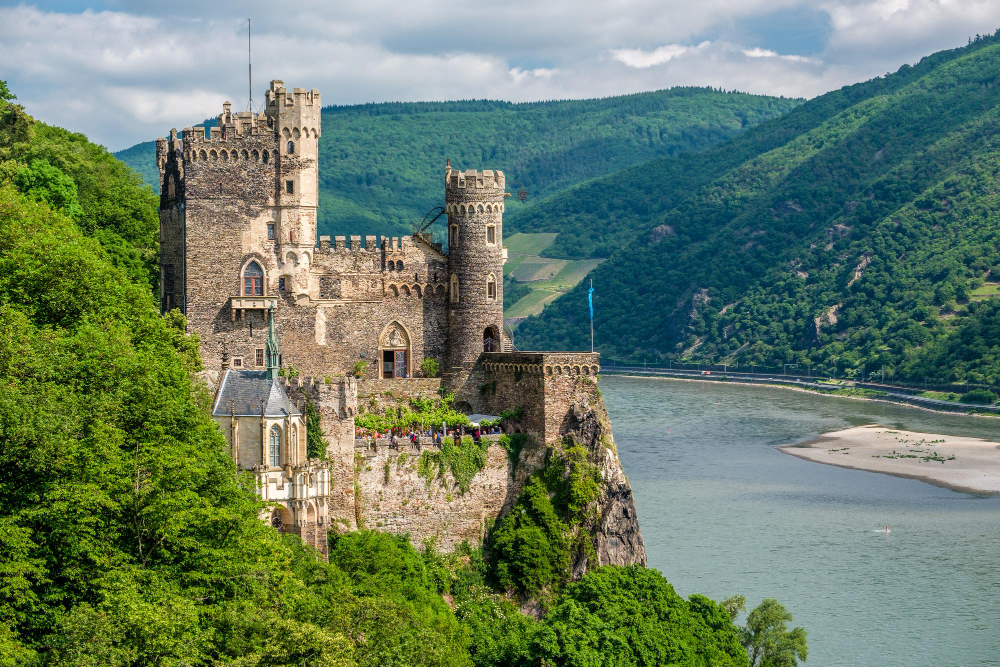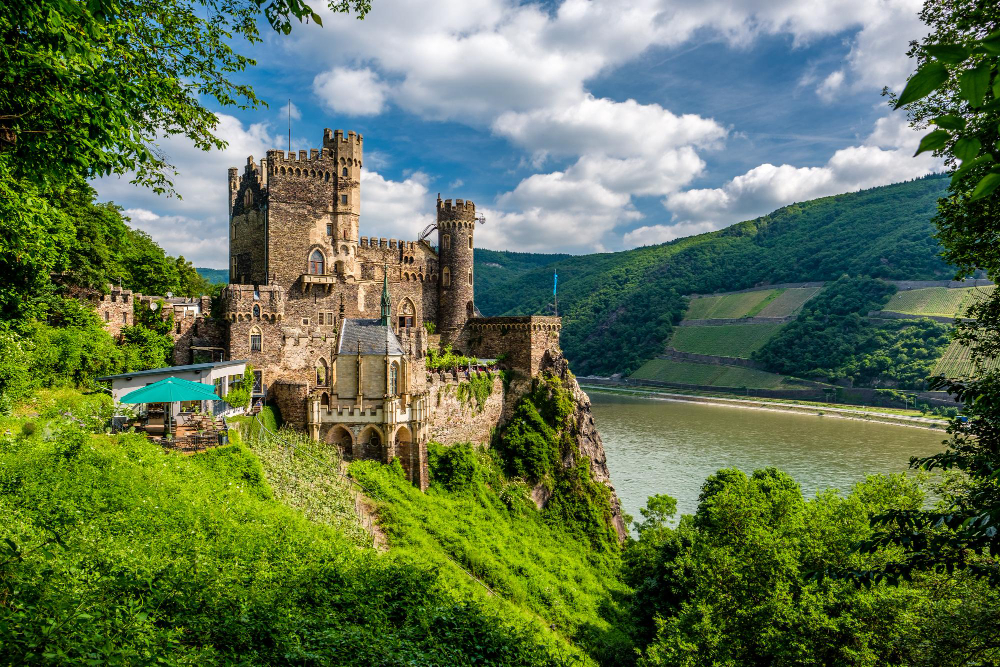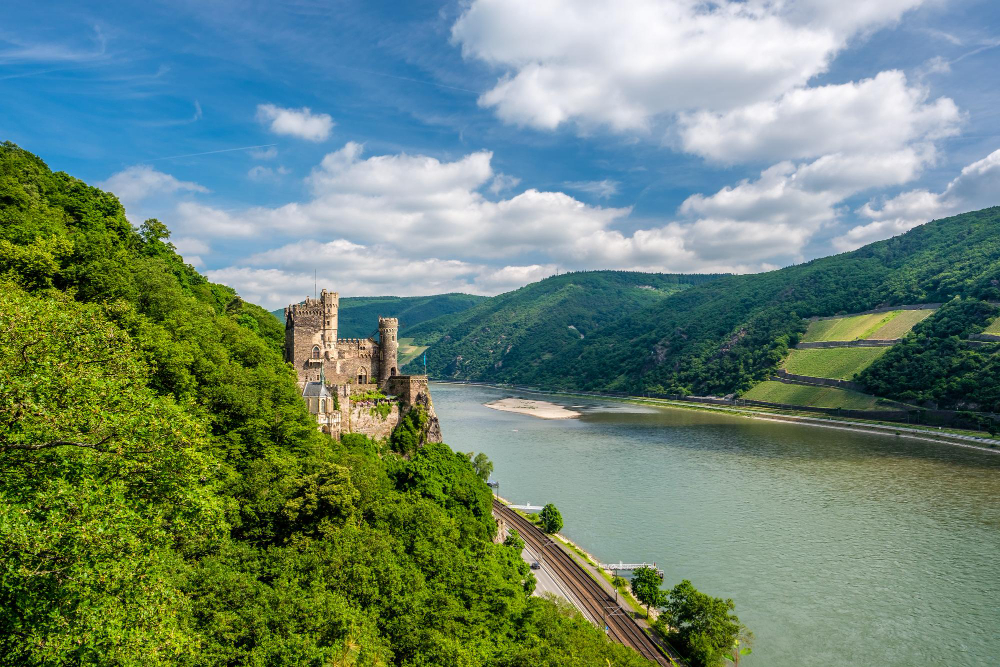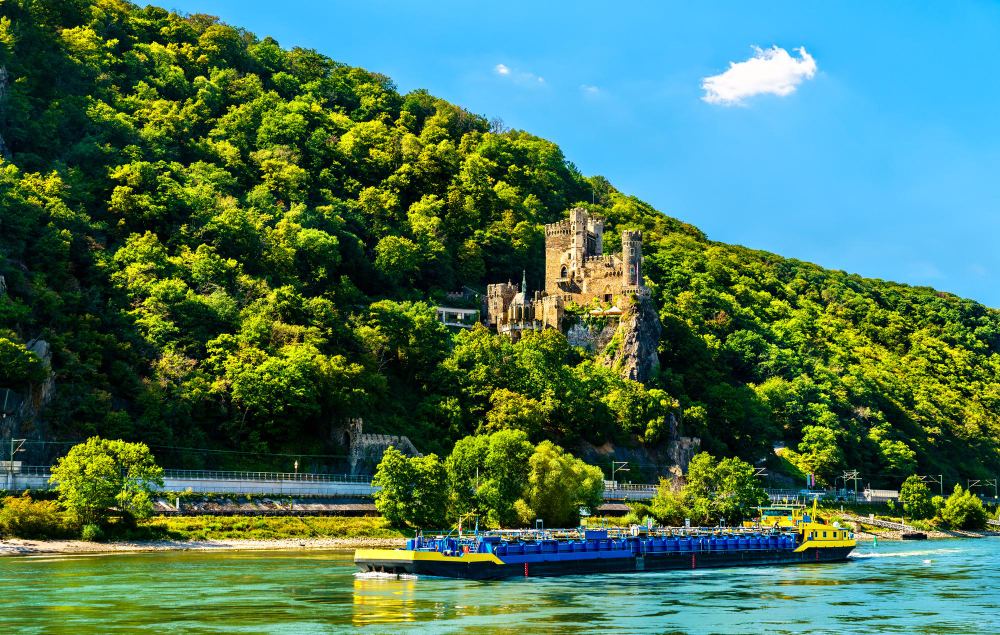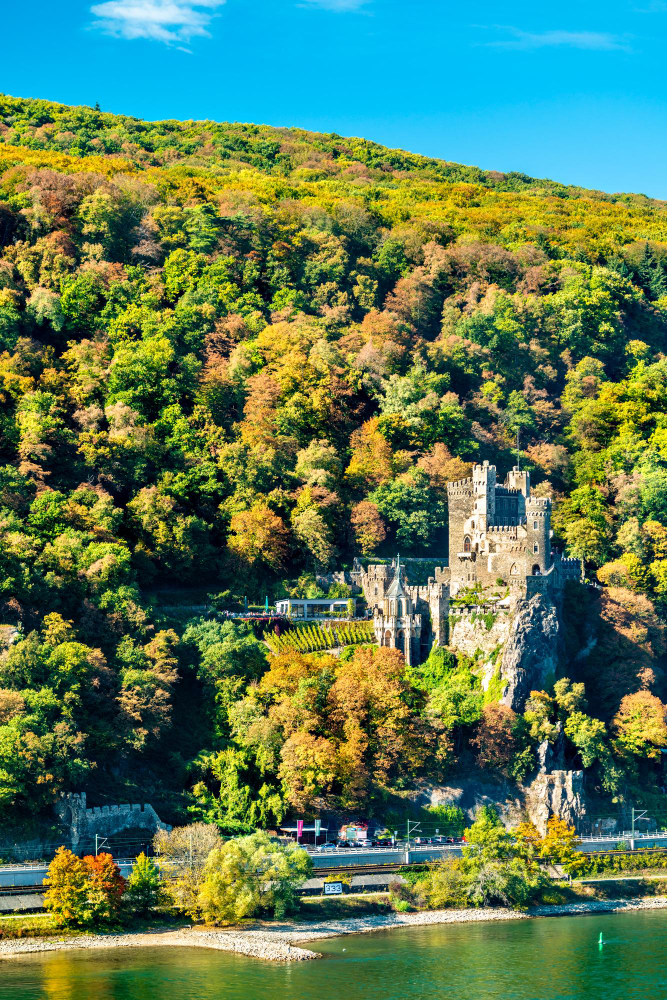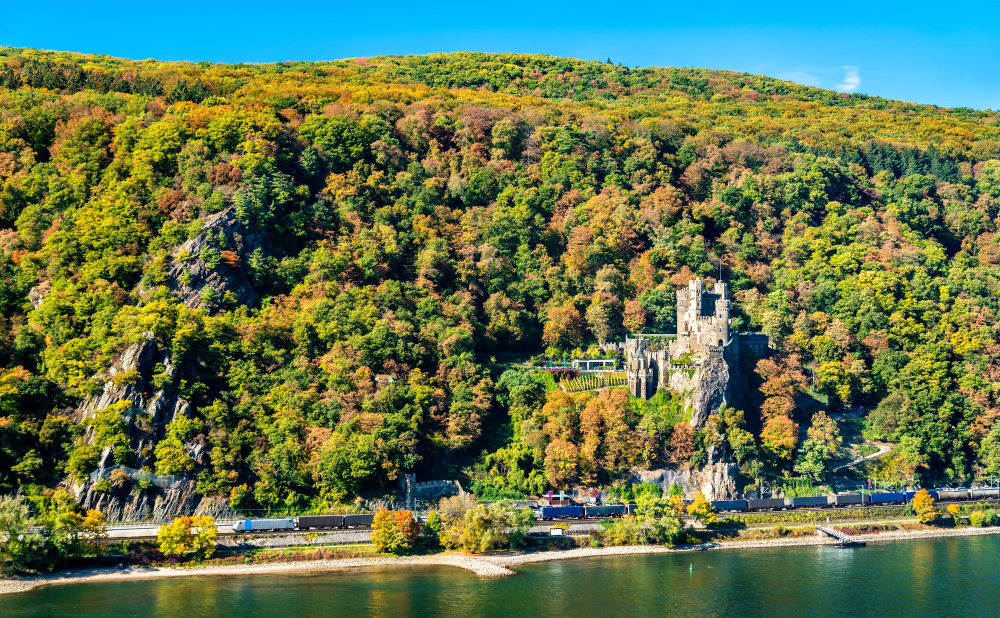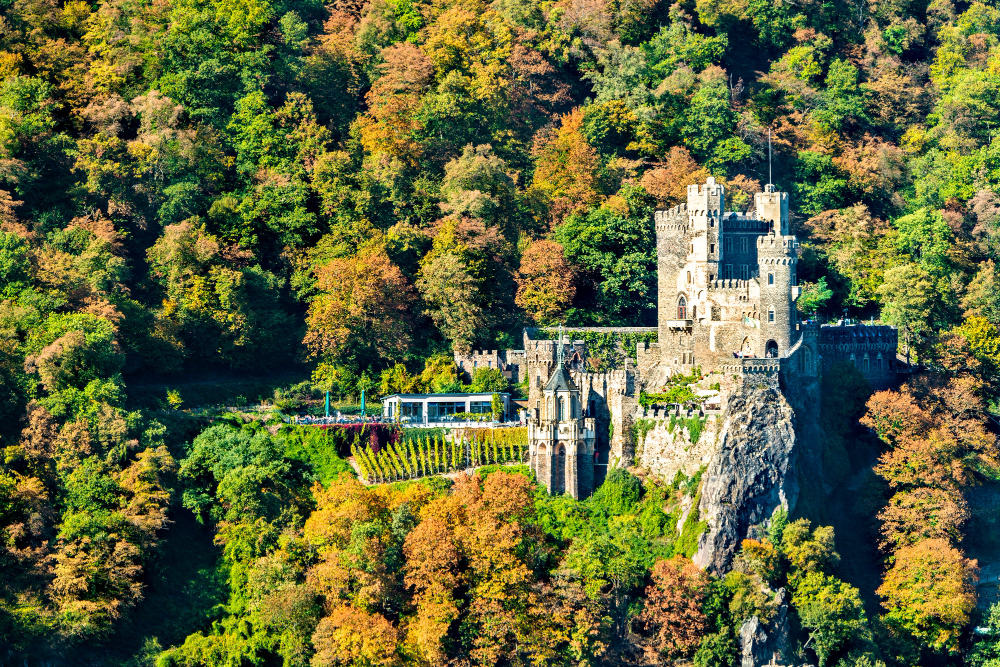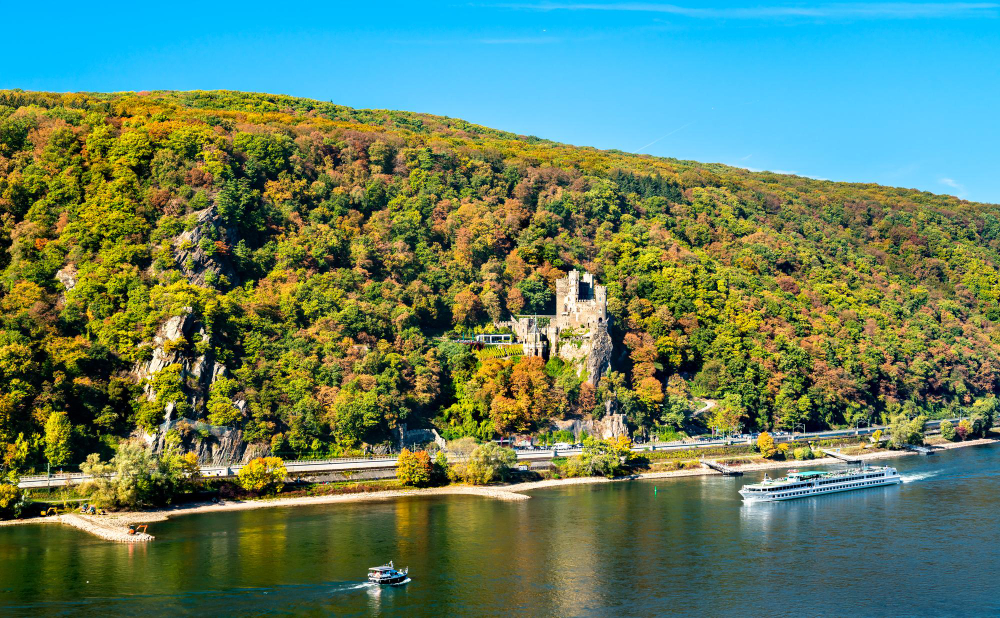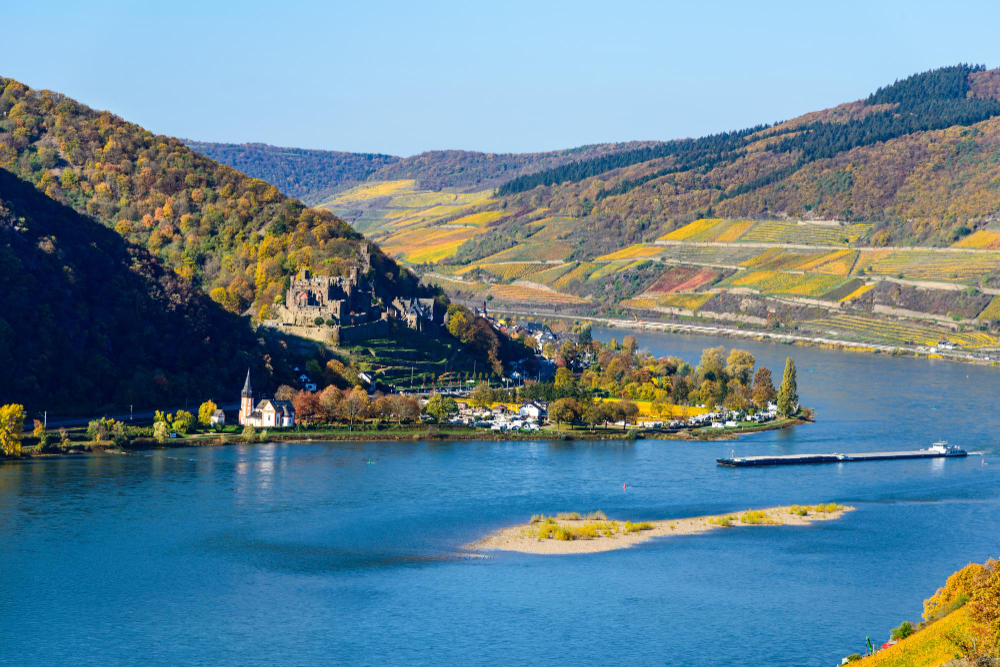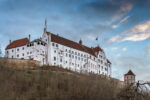

High above the Rhine, on a steep rocky outcrop between Trechtingshausen and Assmannshausen, stands Rheinstein Castle. Anyone approaching it from the river or the main road is first struck by its dramatic setting: battlements, towers and walls seem to grow right out of the wooded slope. Yet the castle’s present-day appearance is not simply that of an unaltered monument from the Middle Ages. Rather, Rheinstein tells a story of power politics, decay, romantic rediscovery and elaborate reconstruction.
The complex is one of the best-known castles in the Upper Middle Rhine Valley, which has been a UNESCO World Heritage Site since 2002. Its history dates back to the early 14th century – and it exemplifies just how closely the castles along the Rhine were linked to trade, territorial conflicts and the later image of an idealised German past.
A fortress to secure Mainz’s influence – According to current research, Rheinstein Castle was built around 1316 or 1317. It was probably originally known as Vaitzburg or Fautsburg. The client was the Archbishopric of Mainz, one of the most influential ecclesiastical territories in the Holy Roman Empire. The Archbishop of Mainz was not only a prince of the Church but also an elector and a secular ruler with considerable political interests along the Rhine. The castle’s location was strategically chosen. In the Middle Ages, the Rhine was one of Europe’s most important transport and trade routes. Ships carried wine, grain, timber, salt and other goods; at the same time, travellers, pilgrims, merchants and armies moved along the river. Whoever controlled a castle at a favourable point on the river could assert their authority, monitor routes and secure claims to territory. Rheinstein was built at a time when Mainz sought to assert its influence in the middle Rhine Valley against rival powers. Its proximity to other castles and territories, in particular, made the fortification significant. It lay at the crossroads between the territory of the Electorate of Mainz and the interests of the Counts Palatine of the Rhine. The castle was thus less a secluded noble residence than a building block in a dense network of power and control points along the river. As early as the 14th century, Rheinstein was granted as a fief. The Archbishops of Mainz entrusted the castle and associated rights to various officials and vassals. Among the feudal lords mentioned were the Archbishop of Mainz, Matthias von Bucheck, later Kuno II von Falkenstein, and members of the House of Nassau. The frequently changing jurisdictions reflect the complex structure of power in the medieval Empire: ownership, rights of use and political allegiances were often separate and were governed by feudal relationships.
Early Decline Despite a Strategic Location – Although Rheinstein was strategically situated from a military perspective, the castle lost its importance relatively early on. Records indicate a state of decline as early as 1344. The reasons for this likely lay in changing political and economic conditions. Castles were expensive: walls, roofs, battlements and living quarters had to be continuously maintained. When revenue failed to materialise or the military function diminished, many sites were maintained only in a makeshift manner. In the 15th and 16th centuries, Rheinstein remained part of the Electoral Mainz system of ownership and feudal tenure. For instance, in 1459, the Archbishop of Mainz, Diether von Isenburg, enfeoffed the cathedral scholar Volpert with the castle and town of Assmannshausen. In 1572, the complex and its appurtenances passed to Anton Wiltberg, the cathedral custodian and treasurer of Mainz. Yet even he was apparently unable to finance its upkeep in the long term. The castle fell into increasing disrepair, though it remained inhabited until Wiltberg’s death. Changes in military technology exacerbated the problem. With the spread of firearms and heavy artillery, many high-altitude castles from the High Middle Ages lost their original defensive value. Their high, comparatively narrow walls offered only limited protection against cannon fire. At the same time, during the early modern period, many rulers favoured more comfortable palaces and residences in towns or more easily accessible countryside. By the time of the War of the Palatinate Succession at the end of the 17th century at the latest, Rheinstein was severely damaged and largely in ruins. The war, in which French troops ravaged numerous towns and fortifications in the Palatinate and along the Rhine, left a deep mark on the region. By this time, Rheinstein Castle was apparently already so dilapidated that it could scarcely fulfil its former function. In 1779, the ruins changed hands once again. They first passed to Privy Councillor J. von Eys and were subsequently sold for a comparatively small sum to Government Councillor Johann Jacob, Lord von Goll. The low price clearly illustrates the practical value the ruined complex held at that time: it was more of a quarry, a plot of land and a pile of ruins than a prestigious property.
Romanticism discovers the Rhine ruins – The decisive turning point came in the 19th century. During that era, the Rhine landscape became a place of longing for artists, writers, travellers and members of European royal families. The Romantic movement discovered ruins, knight’s castles, steep vineyards and river valleys as symbols of a supposedly primordial German history. Painters such as William Turner and numerous travel writers shaped the image of the Rhine as a landscape full of legends, castles and memories. In this cultural climate, Prince Friedrich of Prussia purchased the ruins of Rheinstein, including the rock, on 31 March 1823. Friedrich, a nephew of King Frederick William III and Queen Louise, was not only a member of the Prussian royal family but also an enthusiastic champion of Romantic architectural ideas. For him, Rheinstein was not merely a building site, but a place where history, landscape and dynastic prestige could be brought together. Reconstruction began in 1825 under the direction of the architect Claudius Lassaulx, who is regarded as a leading exponent of Rhenish historicism. Following his departure, his pupil Wilhelm Kuhn continued the work and completed it in 1829. The result was not a purely archaeological reconstruction in the modern sense. Rather, it was a romantic, neo-Gothic ‘ideal castle’ modelled on medieval forms, but reinterpreted in the style of the 19th century. Prince Friedrich named the complex ‘Rheinstein’ – a fitting name given its spectacular position overlooking the river. The castle became his favourite residence. Its reconstruction took place at a time when the middle classes and the nobility increasingly viewed historical architecture as an expression of national identity and cultural continuity. Rheinstein was intended to have a medieval appearance, yet it was at the same time a 19th-century residence and a venue for receiving guests. According to tradition, the prince’s guests included high-ranking European figures, amongst them Queen Victoria and the Russian Empress Alexandra Fyodorovna. Such visits underscore the international appeal that the romantic Rhine Valley possessed in the 19th century. For many members of the European elite, a journey along the Rhine was an integral part of their cultural education.
Chapel, Crypt and the View over the River – The rooms that blend the medieval fortifications with the romantic domestic style of the 19th century are particularly instrumental in shaping the castle’s current atmosphere. Access is via a fully functional drawbridge and a portcullis – two elements that still define the image of the classic knight’s castle today. They immediately give visitors the impression of a fortified complex, even though the appearance visible today is largely shaped by the 19th-century reconstruction. Behind the entrance area lies the castle courtyard, offering sweeping views of the Rhine. There you will find the so-called Burgundy Garden. Its name derives from a Burgundy grapevine which, according to the castle, is said to be around 500 years old and still bears grapes. It is this garden in particular that illustrates the contrast which makes Rheinstein so charming: within a very small space, rugged cliffs, medieval-looking walls, vineyards and the vast river landscape come together. A flight of stairs leads up to the chapel, which Prince Friedrich had built to plans by the Wiesbaden architect Philipp Hoffmann. It was opened in 1844, together with the royal crypt. The neo-Gothic interior is deliberately designed to be sacred and solemn. At the centre of the altar is a wood carving depicting the Last Supper of Jesus. Beneath the chapel lies the crypt of the family of Prince Friedrich Wilhelm Ludwig of Prussia. The Knights’ Hall is one of the castle’s most impressive rooms. Stained-glass windows, decorative paintings and historicising design elements create an atmosphere that speaks less of the austere daily life of a medieval garrison than of the romanticised notion of a chivalric age. It is precisely here that Rheinstein’s cultural and historical significance lies: the castle preserves not only traces of the Middle Ages, but also the 19th-century view of the Middle Ages.
From Prussian ownership to a visitor magnet – Following the death of Prince Friedrich in 1863, his son Prince Georg of Prussia inherited the castle. In 1902, it passed to Prince Heinrich of Prussia, the brother of Emperor Wilhelm II. After his time, his wife, Irene of Hesse and by Rhine, became the owner. Princess Barbara of Prussia, Duchess of Mecklenburg, is recorded as the last aristocratic owner. Rheinstein Castle has been privately owned since 1975. Over the decades, the complex has been preserved, restored and made accessible to visitors. Today, it features a café and a museum shop. Yet the real attraction remains the castle itself: its unusual architecture, the narrow staircases, the vantage points and the interplay between the Rhine landscape and its architectural history. Rheinstein Castle is therefore far more than just a beautiful backdrop. It symbolises the political fragmentation of the Middle Ages, the decline in significance of many fortifications in the early modern period, and the romantic enthusiasm of the 19th century. Its walls tell of the Archbishops of Mainz, Prussian princes, changing owners and the desire of later generations to bring a bygone era back to life. So, anyone crossing the drawbridge today is not entering an unchanged castle from the year 1317. They are entering a place where medieval history and romantic reinvention intertwine in a fascinating way.