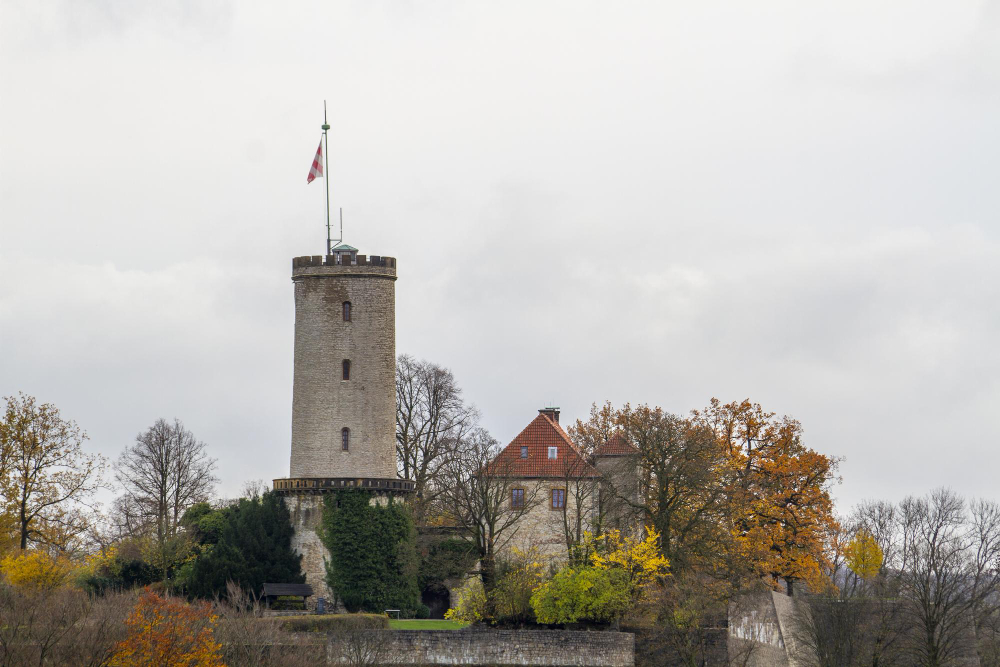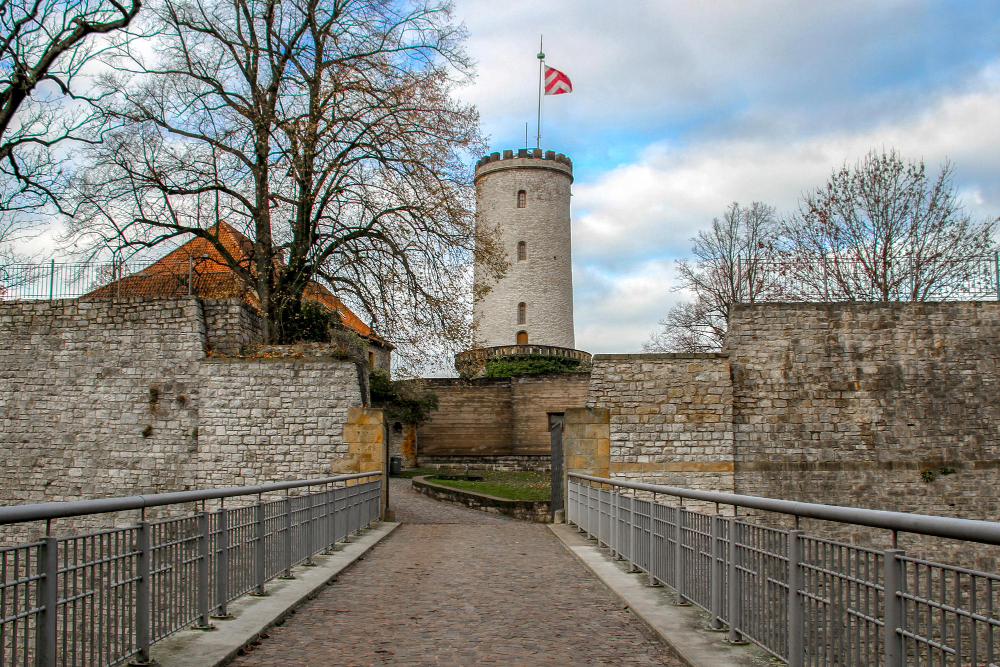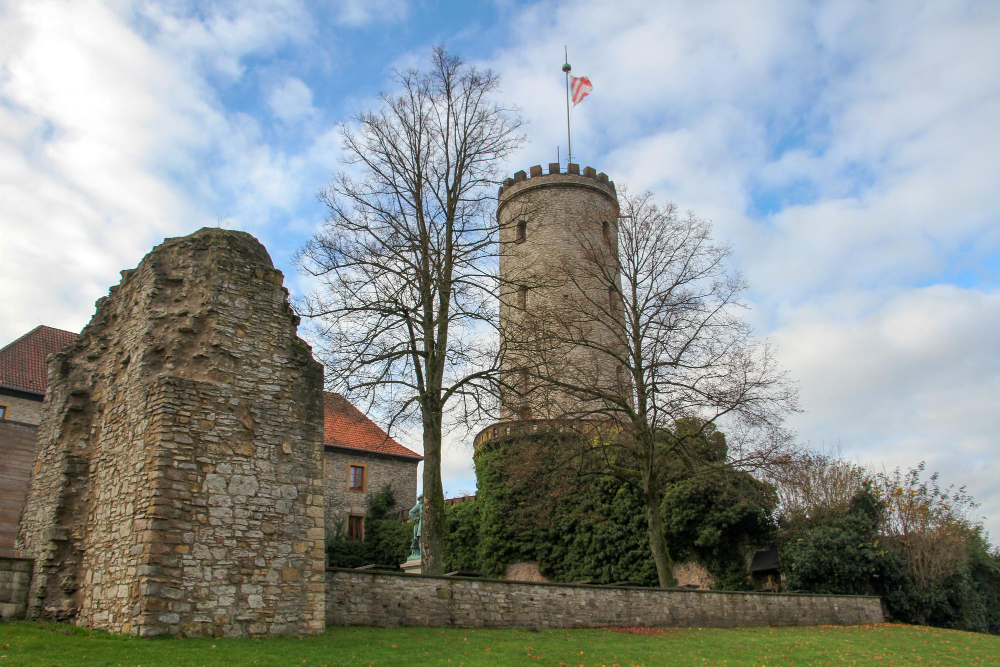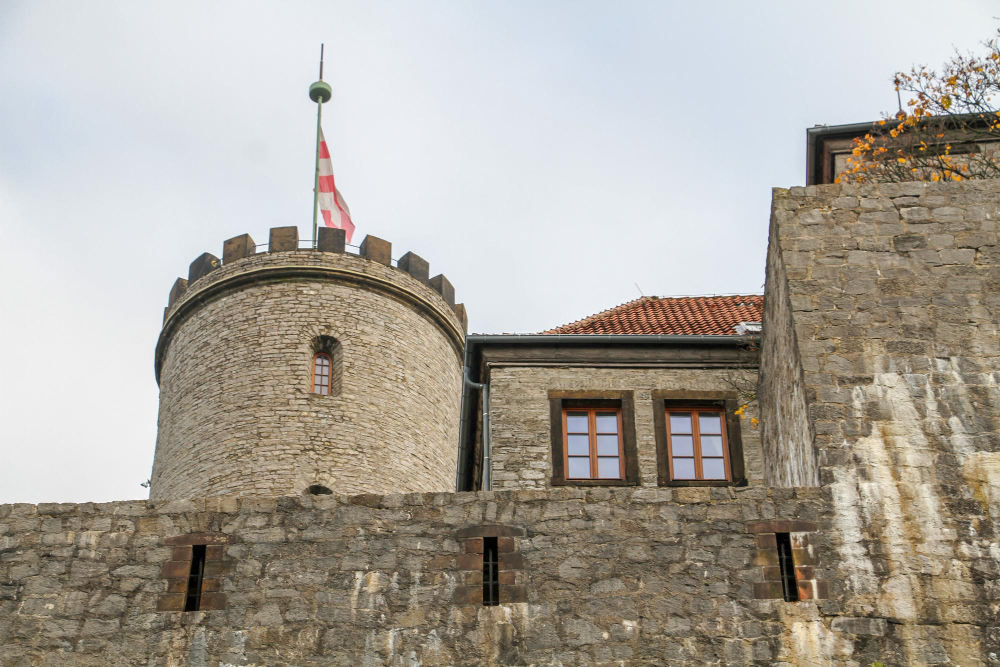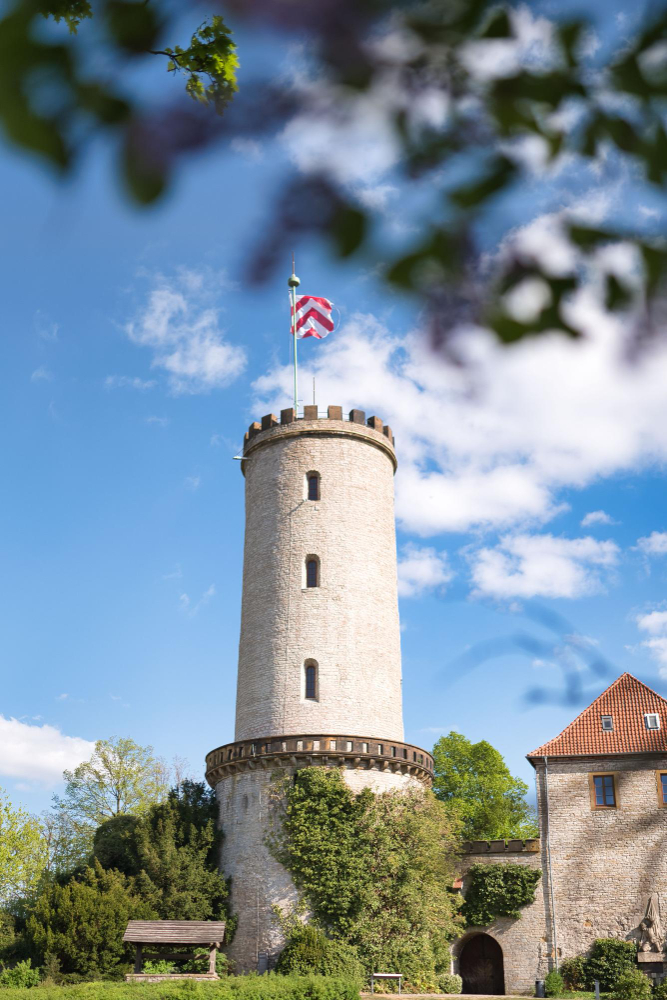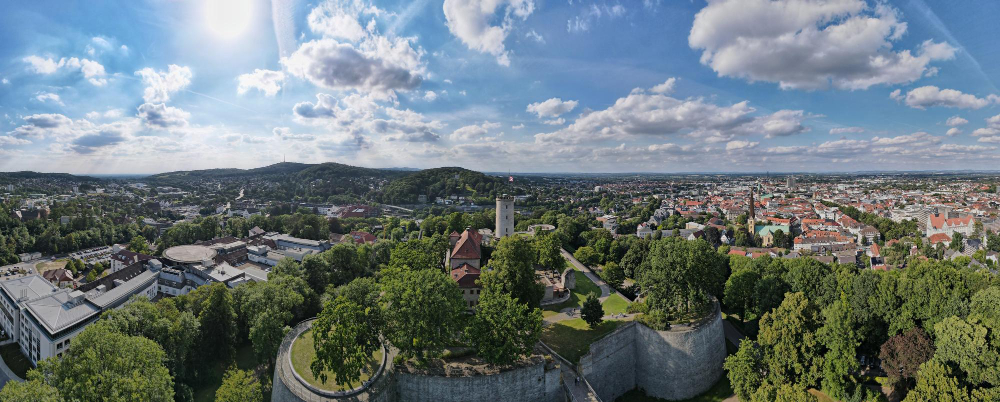

Towering high above downtown Bielefeld stands one of East Westphalia’s most famous structures: Sparrenburg. Anyone standing on the Sparrenberg today looks out over a complex that, at first glance, resembles a classic knight’s castle—complete with a tower, walls, a gate, and sweeping views of the city. But this impression tells only part of the story. The Sparrenburg, officially known as Sparrenberg Castle and Fortress, served over the centuries as a seat of power, a border fortress, a theater of war, a prison, a quarry, and ultimately a symbol of civic historical memory. Its walls bridge the Middle Ages and the Renaissance, Prussian history and Romantic preservation of historical monuments—and to this day, they hold archaeological mysteries.
A Castle Above the Pass Through the Teutoburg Forest – Sparrenburg is located in Bielefeld’s Mitte district on the approximately 180-meter-high Sparrenberg, a ridge in the Teutoburg Forest that was formerly known as “Osning.” From there, the complex towers about 60 meters above the city center. This location was by no means chosen at random: The hill controlled an important trade route through the Teutoburg Forest, the so-called Bielefeld Pass. The castle was likely built before 1250 by the Counts of Ravensberg. The first documented mention dates back to 1256. Its strategic purpose was clear: it was intended to secure the passage through the low mountain range, protect the young city of Bielefeld, and at the same time serve as the seat of power for the Counts of Ravensberg. Bielefeld was founded around 1214. Because cities in the Middle Ages often arose under the protection of an existing castle, historians and archaeologists debate whether there might have been an older predecessor structure on the Sparrenberg. However, there is no clear evidence to support this. One thing is certain: today’s Sparrenburg was built at a time when castles were not only residences for the nobility but also military checkpoints, administrative centers, and visible symbols of power. The location above Bielefeld had yet another significance. The New Town later developed between the castle and Bielefeld’s older Old Town. The complex thus shaped not only the city’s defense but also its spatial development.
From the Counts of Ravensberg to the Dukes of Jülich – With the death of Count Bernhard von Ravensberg in 1346, the male line of the House of Calvelage-Ravensberg came to an end. Through family ties, the castle passed to Gerhard I of Jülich-Berg, who was married to Bernhard’s niece, Margarete. As a result, Sparrenburg gradually lost its role as the rulers’ permanent seat of power—though its political and military significance remained. Emperor Charles IV also stopped at the castle during his travels: on November 18, 1377, he spent the night at Sparrenberg. For several years, the complex regained special significance as a residence. Between 1410 and 1428, it served as the seat of power for Count Wilhelm II of Ravensberg. In the early 16th century, the castle changed hands once again. After the death of Duke Wilhelm of Jülich-Berg in 1511, the County of Ravensberg and Sparrenburg passed to his son-in-law, Johann of Jülich-Kleve-Berg. Under his rule, the most profound transformation of the complex began: the medieval castle was turned into a modern fortress.
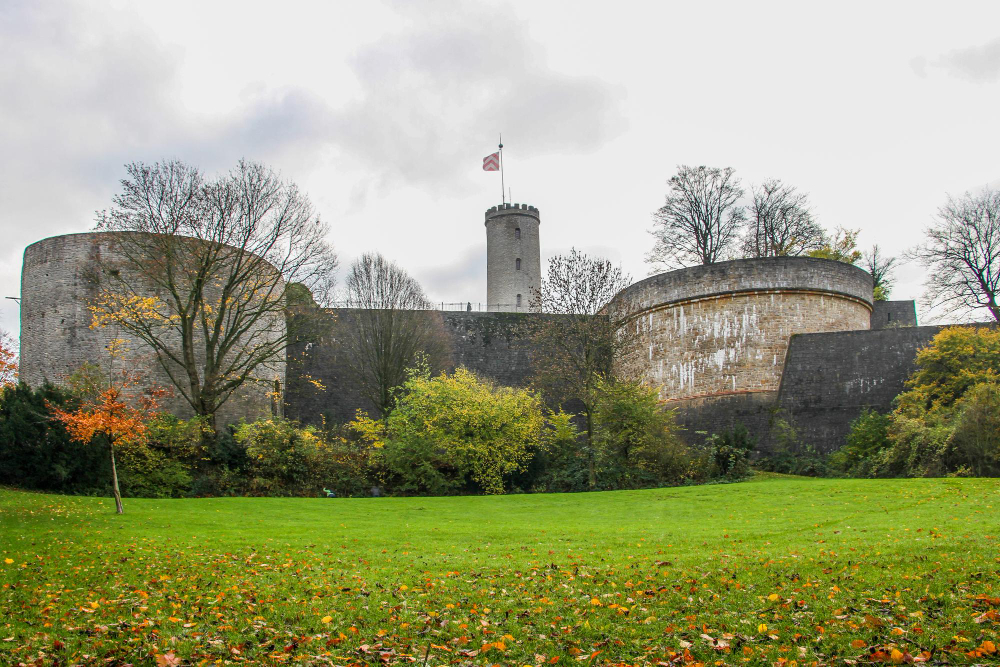
Cannons Change the Nature of War—and Sparrenburg – The invention and spread of gunpowder and artillery posed a fundamental problem for medieval defensive architecture. Tall, comparatively narrow walls and towers offered cannons a large target area. Fortresses therefore had to be built lower, more massive, and better suited for the use of their own artillery. This redesign began at Sparrenberg around 1530. To the west of the older castle complex, a gun tower was first built, which was later referred to as the battery tower. It was connected to the castle only by a stone arch bridge and was intended to enable the defenders to use cannons. Beginning in 1535, Johann III of Jülich-Kleve-Berg had the complex systematically expanded into a rondel fortress. Rondels were round or semicircular fortifications on which artillery could be positioned. The Kiekstattrondel was built on the north side. Later, the Schuster and Marien rondels were added on the southeast side. These defensive structures were connected by curtain walls—that is, fortification walls between the individual bastions and rondels. A new gatehouse was also built in front of the older castle gate. In the area between the inner castle and the outer fortifications, vaulted passageways, rooms, and connecting corridors were constructed. Subsequently, much of the space was filled with earth. This created the casemates—those underground structures that are among the most impressive areas of Sparrenburg today. Particularly noteworthy is the western bastion known as the “Scherpentiner.” From a military standpoint, the older gun tower was poorly situated and constituted a weak point. For this reason, the Italian architect Alessandro Pasqualini was summoned to Bielefeld in 1556. He designed a bastion for the western corner based on the principles of Italian fortification architecture, which was highly advanced at the time. The existing gun tower was incorporated into the new structure. The name “Scherpentiner” is unusual. According to current research, it has been documented only at Sparrenburg and is associated with the “serpentine” or “field snake,” a lighter type of artillery from the 15th and 16th centuries. With these expansions, Sparrenburg developed into the largest fortress in Westphalia and one of the most significant surviving Renaissance fortifications in northern Germany.
Sieges, Earthquakes, and the Thirty Years’ War – The fortress was not only planned but also put to the test. After the death of Duke Johann Wilhelm of Jülich-Kleve-Berg in 1609, the Jülich-Kleve succession dispute broke out. The conflict ended in 1614 with the Treaty of Xanten. The Sparrenburg fell to Brandenburg-Prussia. Initially, the allied Netherlands were granted the right to occupy the fortress. Dutch soldiers arrived in Bielefeld in November 1615. But the situation remained precarious. As early as 1612, an earthquake had caused damage to the castle—an event that shows that wars were not the only threat to the structure’s integrity. During the Thirty Years’ War, the garrisons changed hands several times. In 1623, the Dutch were forced to retreat before Spanish troops led by Count Johann von Rietberg. Two years later, an attempt by Brandenburg forces, supported by Ravensberg peasants, to recapture the castle failed. From 1636 to 1637, Swedish and Hessian-Kassel troops besieged the Spanish garrison at Sparrenburg for nearly a year. Eventually, the garrison surrendered. In 1642, the complex was handed over to the French, who were allied with Sweden. It was not until the Peace of Westphalia in 1648 that its affiliation with Brandenburg-Prussia was finally confirmed. The Great Elector Frederick William stayed at Sparrenburg on several occasions and used it at times as a secondary residence in Westphalia. Two of his children were born there. During the Dutch War, the fortress withstood its last major military trials: sieges by the Bishopric of Münster in 1673 and by French troops in 1679.
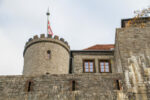
From Military Stronghold to Decay – By the end of the 17th century, military technology had already advanced. Sparrenburg no longer met the military requirements of its time. It lost its function as a modern fortress, was used in part as a prison, and became increasingly neglected. In the following decades, numerous buildings and walls disappeared. Building materials from the complex were removed, sold, or reused. At the behest of King Frederick II, stones from the Sparrenburg were used, among other things, to construct parts of today’s 55th Barracks on Hans-Sachs-Straße. What once embodied protection and power became raw material for new structures. It was not until the 19th-century castle romanticism movement that perceptions of the ruins began to change. Across Europe, the middle class rediscovered medieval castles as places of remembrance. In Bielefeld, a committee was formed to restore the tower on the Sparrenberg. In 1842 and 1843, the keep was rebuilt. In the process, the older section—which had a teardrop-shaped floor plan—was covered with a round observation tower. In 1879, the city of Bielefeld purchased the complex from the Prussian state for 8,934.90 marks—significantly less than the previously estimated 70,000 marks. Based on plans by architect Eberhard Hillebrand, a new great hall in the Neo-Gothic style was constructed beginning in 1886. It featured a banquet hall, a restaurant, and museum spaces, and was opened in 1888. The building was not a reconstruction of a medieval great hall, but rather a 19th-century historicist new construction.
Destruction During the War, Research Beneath the Ground – During World War II, the Sparrenburg served as an anti-aircraft gun emplacement. During the heavy air raid on Bielefeld on September 30, 1944, the complex sustained significant damage; the tower remained intact. Between 1948 and 1987, extensive cleanup, stabilization, and restoration work was carried out. From 1955 to 1972, the German Playing Card Museum was housed in the rebuilt farm building. Since the renovations and archaeological investigations beginning in 2007, further findings have come to light. On the Kiekstattrondell, an older floor of the defensive structure was uncovered, lying about three meters below the current level. In addition, experts discovered a staircase leading to the casemates. In 2008, archaeologists uncovered the foundations of a large rectangular building in the area of the main castle. Based on architectural details, it is dated to around 1500. It apparently had five rooms. Also in 2008, two deep ventilation shafts were discovered that lead into areas of the underground complex that have so far been only partially understood. One shaft opens into an opening in the outer wall; the other leads to an unknown vault. Its exact function remains unclear. In 2014, Sparrenburg Castle received a modern visitor center designed by Swiss architect Max Dudler. The rammed-earth structure stands on the southeastern edge of the castle courtyard and houses a ticket office, a shop, and a kiosk.
Today, Sparrenburg Castle is far more than just a popular lookout point. The above-ground area is accessible year-round, while the tower and casemates can be visited seasonally. The underground passages, which stretch a total of 285 meters, vividly illustrate how Renaissance defensive technology is concealed beneath the seemingly familiar image of a castle. Parts of the complex remain closed to protect hibernating bats. Sparrenburg is thus not merely Bielefeld’s landmark. It is a structure that reflects nearly 800 years of city, regional, and military history—from the Counts of Ravensberg through Prussian rulers to modern historic preservation.