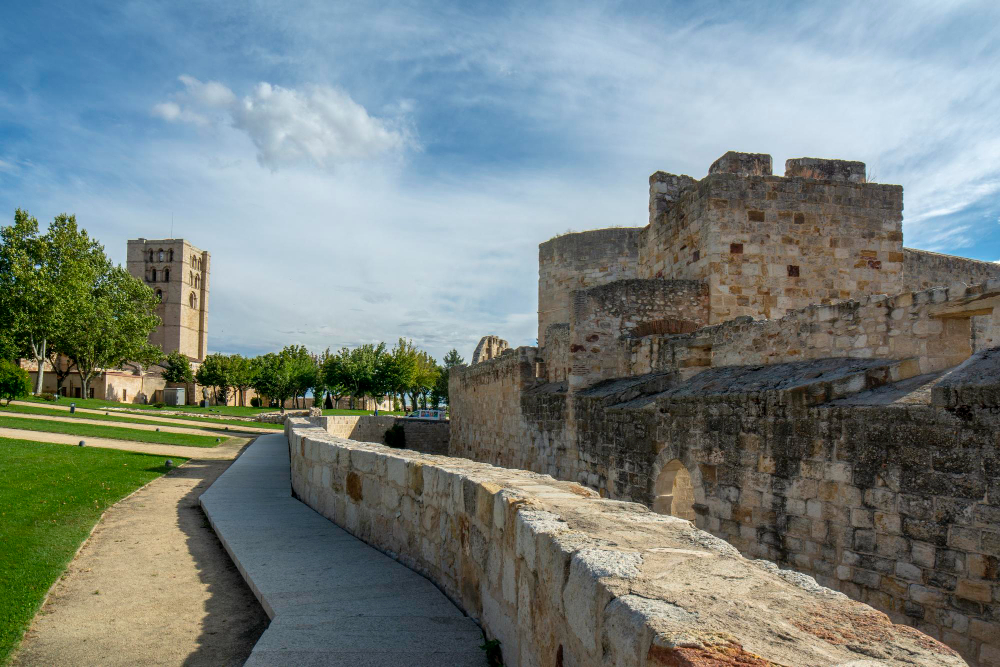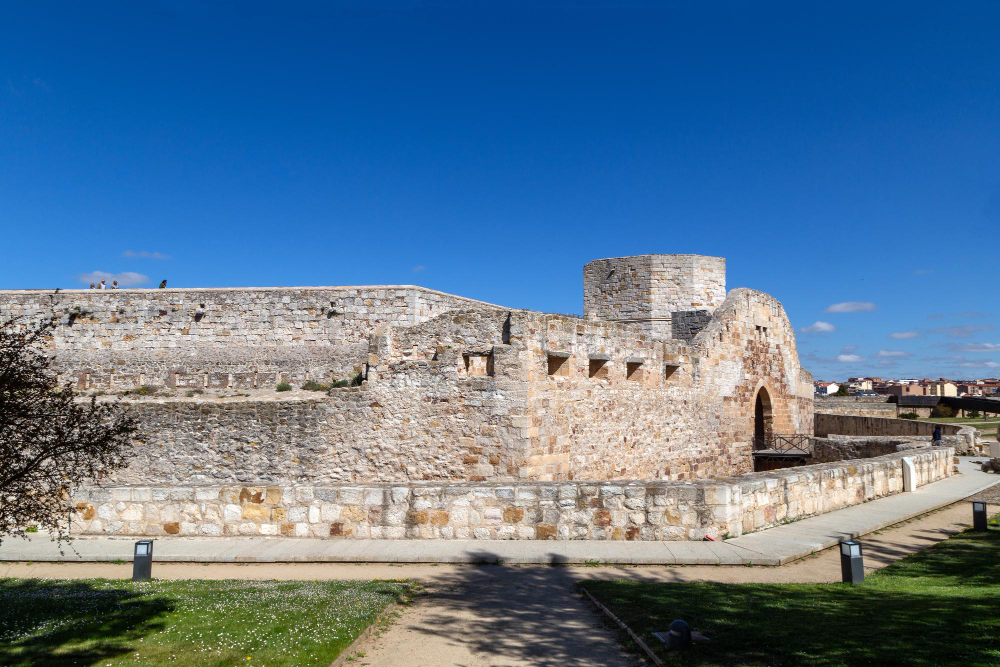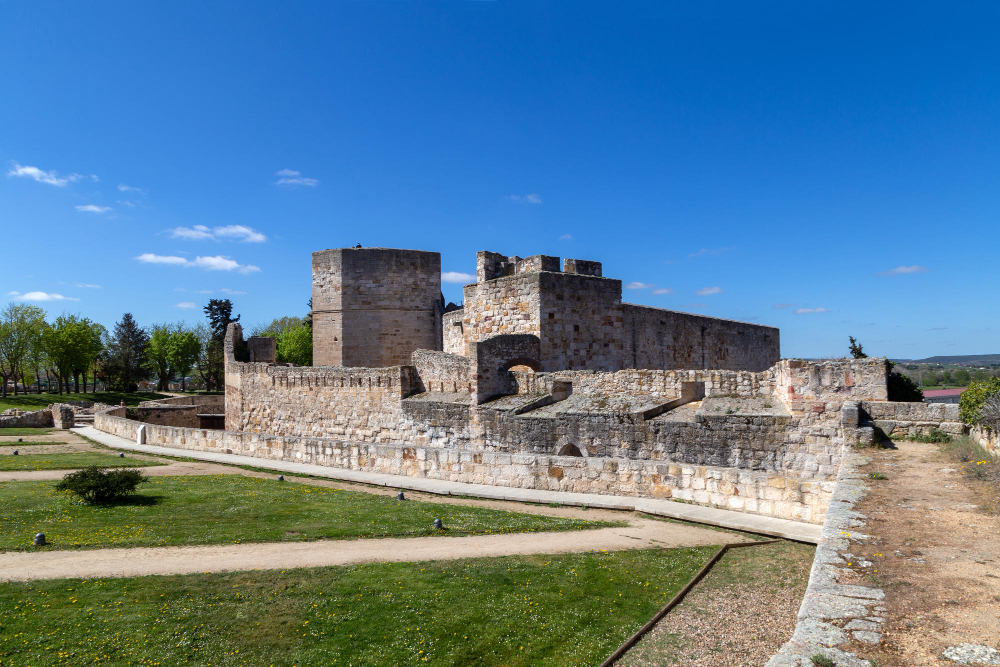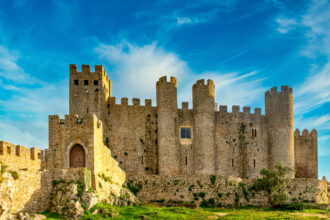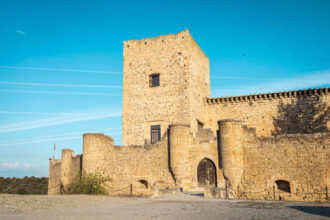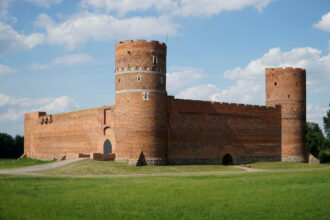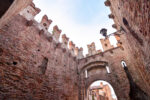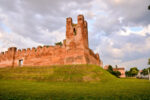

Towering high above the River Duero, Zamora Castle stands as one of the most impressive examples of medieval defensive architecture in Castile and León. Anyone strolling through the castle grounds today, gazing down into the deep moat and looking up at the towers with their unusual layouts, sees far more than just an old fortress: the structure tells of Zamora’s strategic importance on the border between Christian and Muslim territories, of the political conflicts of the Middle Ages, and of a city whose name remains closely associated with resistance and indomitable spirit to this day. The complex forms part of the city’s historic defence system and is situated on a natural hill on the western edge of the old town. From there, it was possible not only to monitor the surrounding area but also to keep a strategic watch over the River Duero and the approaches to the city. Its present form is the result of numerous phases of construction. Medieval walls, later reinforcements designed for the use of artillery, and modern restorations form an architectural history book carved in stone.
Origins shrouded in mystery – The castle’s origins are not entirely clear. Older chronicles report that Alfonso II of Asturias commissioned its construction. This tradition points to Zamora’s early importance in the Christian north of the Iberian Peninsula. However, historical and archaeological research tends to date the main origins of the fortification as we know it today to the mid-11th century, during the reign of Ferdinand I of León. Ferdinand I, King of León and later also of Castile, reigned from 1037 to 1065. His reign saw the consolidation of Christian territories north of the Duero. Zamora was by no means an insignificant provincial town. Its location on the river and along important transport routes made it a key military stronghold. A strong castle was therefore not merely a demonstration of power, but part of a defence strategy vital for survival. However, only a few clear remains of possible early construction phases have survived. Over the centuries, the fortress was altered, extended, repaired and adapted to new forms of warfare. It is therefore difficult to distinguish the oldest structural elements precisely from later alterations. Yet it is precisely this layering that makes the castle particularly interesting: it is not a static monument to a single century, but the result of a long process of military and urban development.
Zamora and the memory of the Reconquista – The history of Zamora cannot be separated from the Reconquista, the centuries-long process of the expansion of Christian kingdoms across the Iberian Peninsula. The city was situated in a region that was repeatedly contested. In medieval accounts, the loss of Zamora to Muslim rulers is described as a severe setback; conversely, control of the city was regarded as crucial for securing Christian influence in the region. The city’s significance is also reflected in its motto, which is still well known today: ‘No se ganó Zamora en una hora’ – Zamora was not conquered in an hour. The phrase is widely used in Spanish and refers to the idea of a particularly resilient city that was difficult to capture. It is not a sober assessment of military history, but a cultural memory drawn from real conflicts and subsequent narrative traditions. Zamora is also associated with one of the best-known political stories of the Castilian-Leonese Middle Ages: the siege of the city by Sancho II of Castile in 1072. Following the death of Ferdinand I, his realm had been divided amongst his children. Zamora fell to his daughter Urraca. Sancho II attempted to reverse this division and bring the city under his control. The siege came to an abrupt end when the king was killed outside the walls of Zamora. Medieval tradition names Vellido Dolfos as the perpetrator. Scholars remain cautious as to whether the details of this account are historically accurate. What is certain, however, is that Sancho’s death altered the political landscape and paved the way for his brother Alfonso VI to ascend to the throne. The episode was later embellished in chronicles, romances and literary works. History became legend – and Zamora was forever branded as a city that does not yield without a fight.
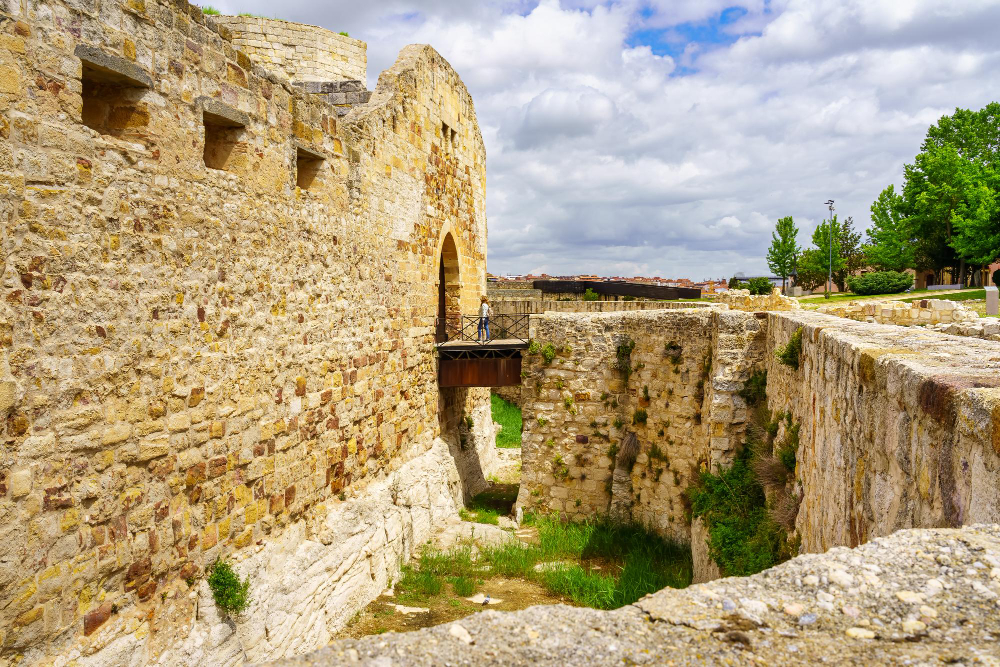
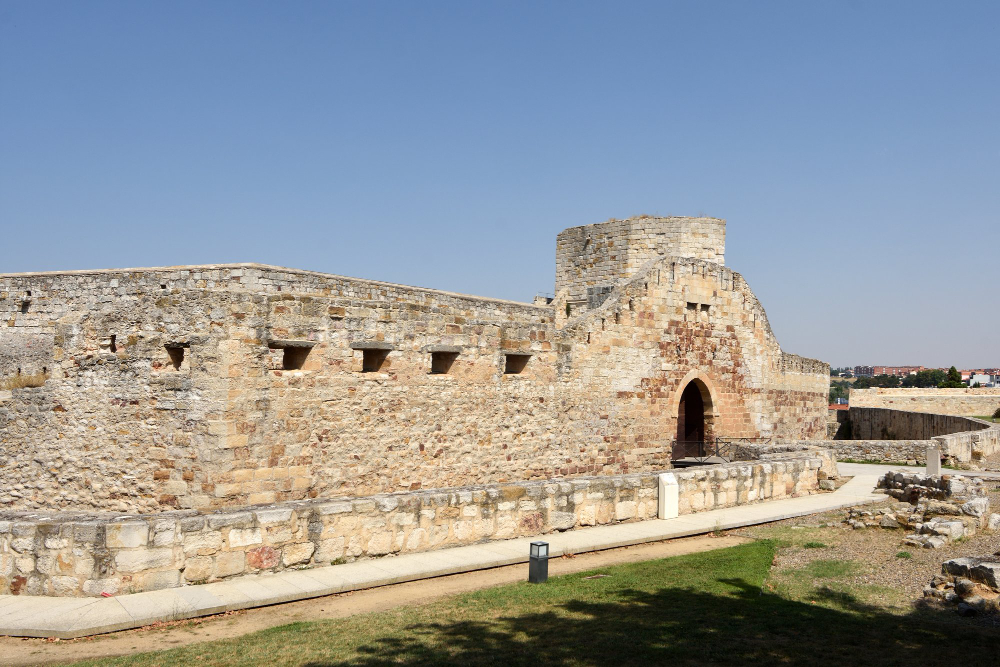
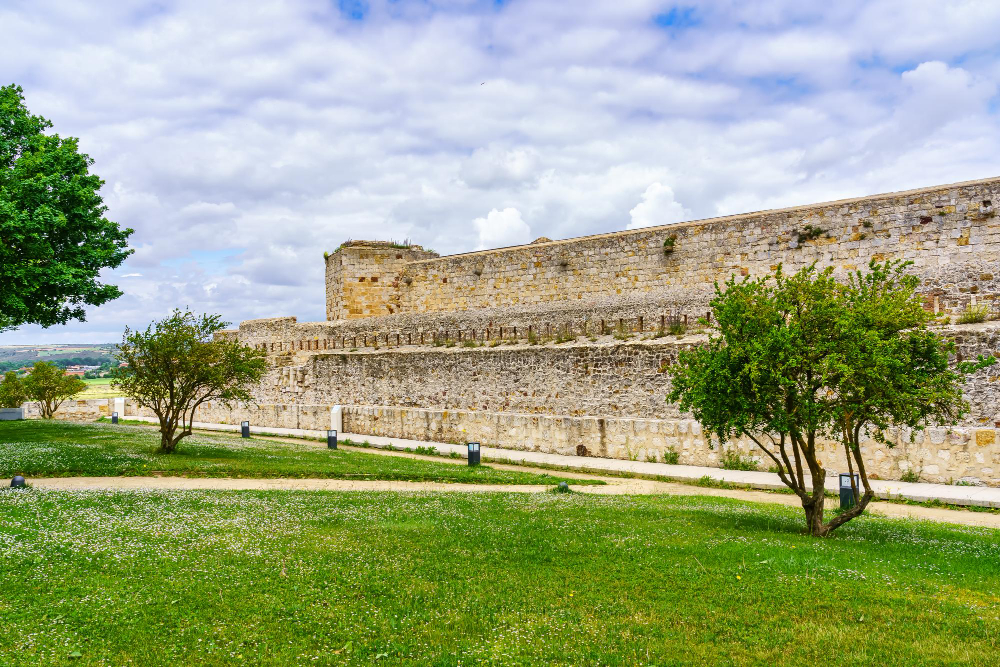
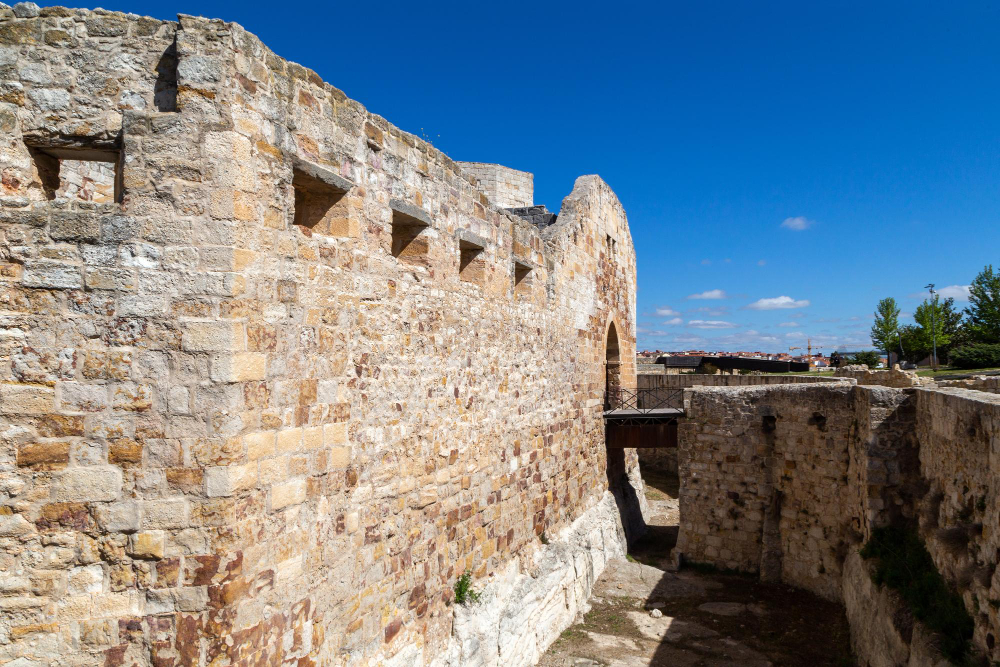
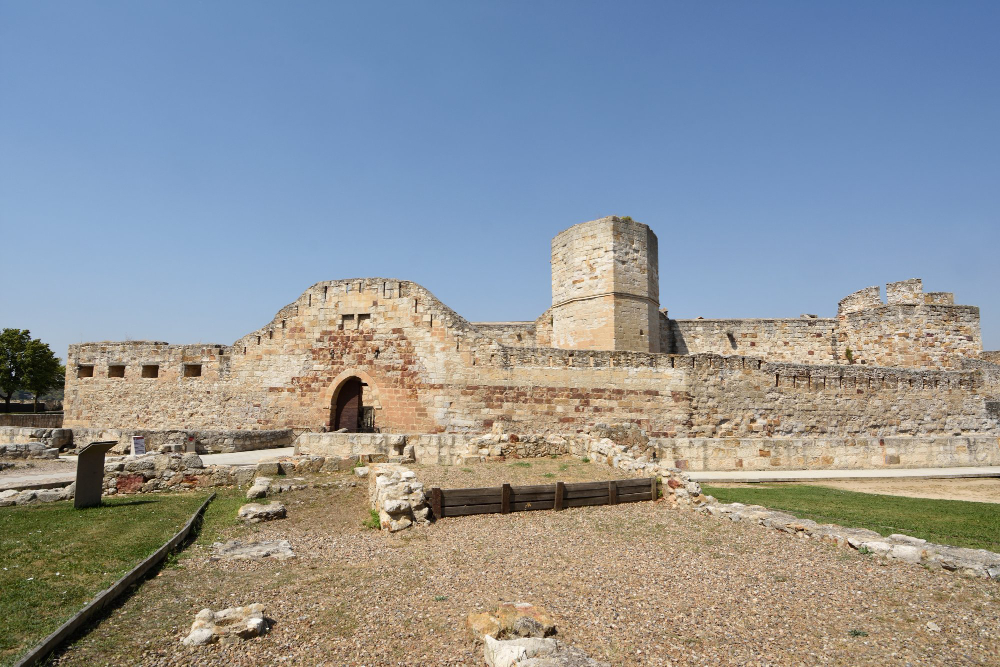
A fortress with an extraordinary layout – The castle itself is particularly impressive due to its unusual layout. The inner core has an almost diamond-shaped ground plan. The towers are particularly striking: descriptions of the complex highlight seven pentagonal bastions or towers, as well as the keep on the eastern side. This design gives the fortress its characteristic, almost jagged appearance. Access was originally via a drawbridge spanning the moat. Today, the bridge is fixed, but its function remains clear: anyone wishing to enter the castle first had to cross the deep moat and then pass through a gate with a pointed arch. The fortifications thus relied on a series of successive obstacles. High walls alone were not enough; the key was the interplay between the moat, the gate complex, the towers and the elevated terrain. The walls are on average more than two metres thick. Together with the largely preserved moat, they still convey a sense of the resilience the complex was once intended to possess. The castle was not merely a refuge for local rulers. It formed an important component within the much larger walled enclosure of Zamora, the remains of which are visible in numerous places throughout the old town. The official description as a cultural heritage site highlights three areas. The inner, diamond-shaped precinct forms the centre of the complex. An outer, irregularly shaped defensive ring encloses it and is connected to the city wall on the north and west sides. To the west lies the Puerta de Santa Columba, a 12th-century gate. Finally, outside the moat lies a further defensive area, a so-called ravelin. Such advanced works were intended to keep attackers at bay and protect particularly vulnerable access points.
From sword to cannon: alterations in the modern era – Zamora Castle is primarily characterised by its medieval features, yet its history did not end in the Middle Ages. With the advent of powerful firearms and heavy artillery, many tall, narrow walls lost their former protective effect. Fortresses had to be adapted: earthworks, reinforced sections and flatter defensive elements were better able to withstand cannon fire than stone walls alone. Zamora, too, underwent such changes. Under Philip V, the first Bourbon king of Spain, alterations were carried out to adapt the complex to the new demands of warfare. These interventions included, amongst other things, earthworks and changes to the terrain’s profile. As a result, part of the older structure was reshaped. Today, the castle thus illustrates not only the logic of medieval sieges, but also the transition to the age of artillery fortresses. This blend of different eras is particularly evident in the castle’s surroundings. The castle grounds, with their gardens and vantage points, are closely linked to later alterations carried out between the 16th and 18th centuries. From there, one can also enjoy a view of Zamora Cathedral and across the Duero river valley. The castle should therefore not be viewed as an isolated structure, but as part of a historic cityscape.
Stonemason’s marks: traces of the people behind the walls – Among the lesser-known but particularly fascinating details are the stonemason’s marks. Small symbols have been preserved, chiselled into the ashlars of the fortifications, which builders and work crews used to mark their work. Such marks may have served to organise a building site, for accounting purposes, or to assign specific tasks. Around 600 marks of 142 different types have been identified on the central ring of fortifications. In the outer area, a further 155 marks of 60 different types were found. These figures clearly illustrate how many people must have been involved in the construction and maintenance of the fortress. The castle is therefore not merely a monument to kings, military commanders and political conflicts; the work of unknown craftsmen is also inscribed in its stones.
Protection, restoration and new uses – Since the 20th century, the castle has been under special legal protection. A decree dated 22 April 1949 placed Spanish castles under state protection regulations as a matter of principle. The Spanish Law on Historical Heritage of 1985 further enshrined this status within the framework of heritage conservation. The site is regarded as an important part of the cultural heritage and is managed by the state. For a long time, the site also served practical purposes. The castle housed educational institutions, including the Zamora School of Art and Design; until 2007, the language school Escuela Oficial de Idiomas also used parts of the complex. This use demonstrates that historic monuments were not always merely museums, but often remained integrated into the everyday life of a town. Following four years of restoration and conservation work, the castle was reopened to visitors in 2009. The aim was to preserve the defensive structures whilst improving access to the site. The castle complex now also houses the Baltasar Lobo Exhibition Centre, Castillo Centro de Arte. It is dedicated to the Zamora-born sculptor Baltasar Lobo and combines historic architecture with modern art.
A monument that continues to tell its story – Zamora Castle is one of the most important defensive structures within the city walls and one of the most remarkable fortifications in Castile and León. Its strength lies not solely in its thick walls or its deep moat. It lies in the multitude of stories that intersect at this site: the uncertain beginnings in the early Middle Ages, the conflicts of the Reconquista, the siege of 1072, the adaptation for cannons, and its present-day transformation into a cultural venue open to the public. Visitors to the site therefore encounter more than just a castle. They enter a place where historical facts and centuries-old tales coexist. The legends surrounding Urraca, Sancho II and Vellido Dolfos may have been embellished in many details for literary effect. Yet they explain why Zamora is still regarded today as a symbol of steadfastness. Within the walls, amongst the stonemasons’ marks and with a view across the Duero, this past remains astonishingly alive.