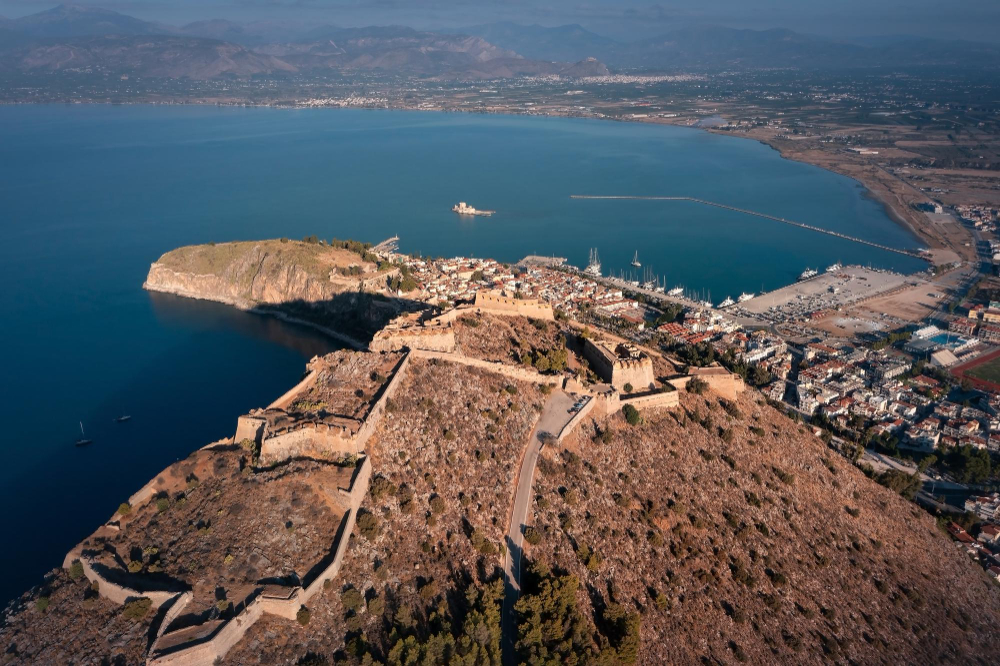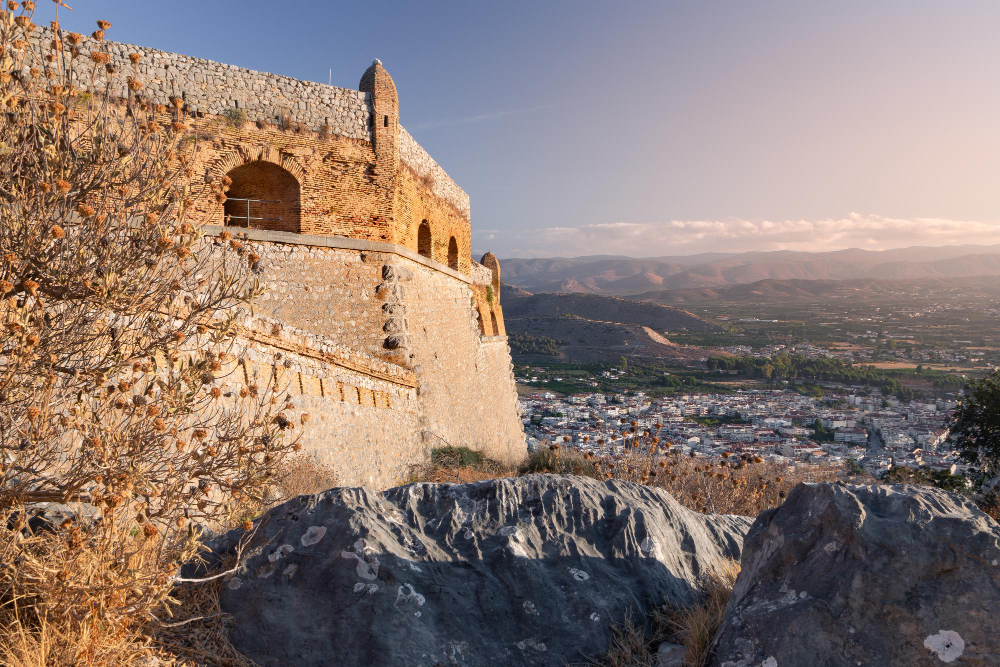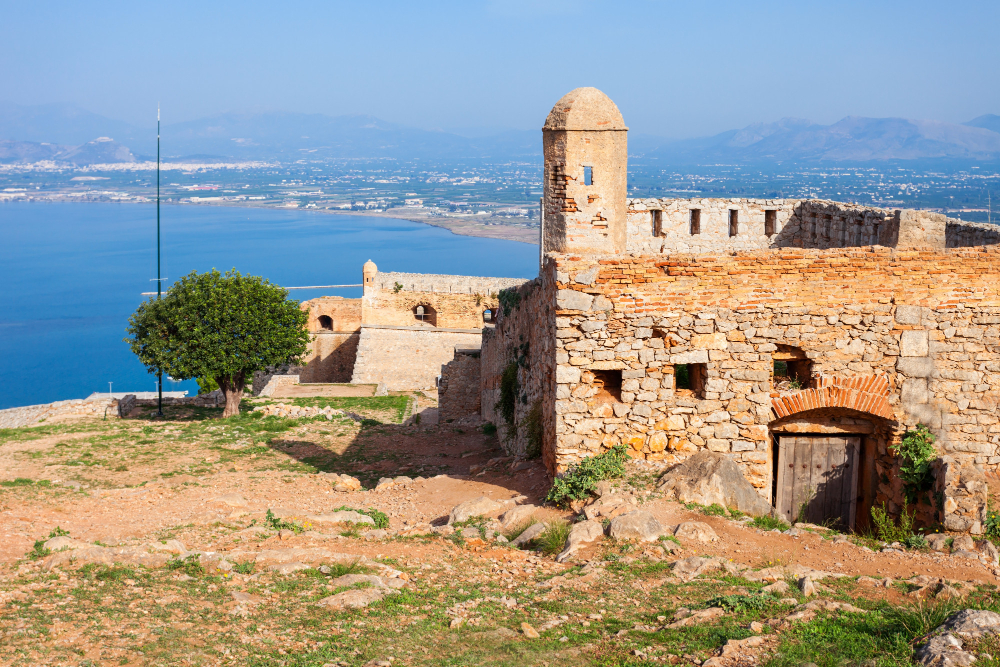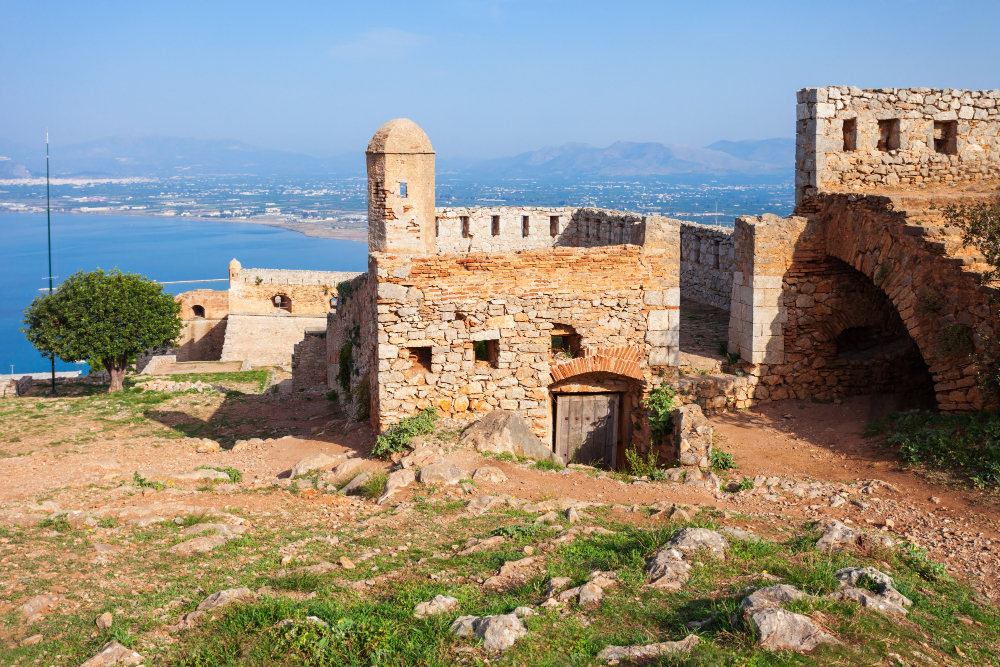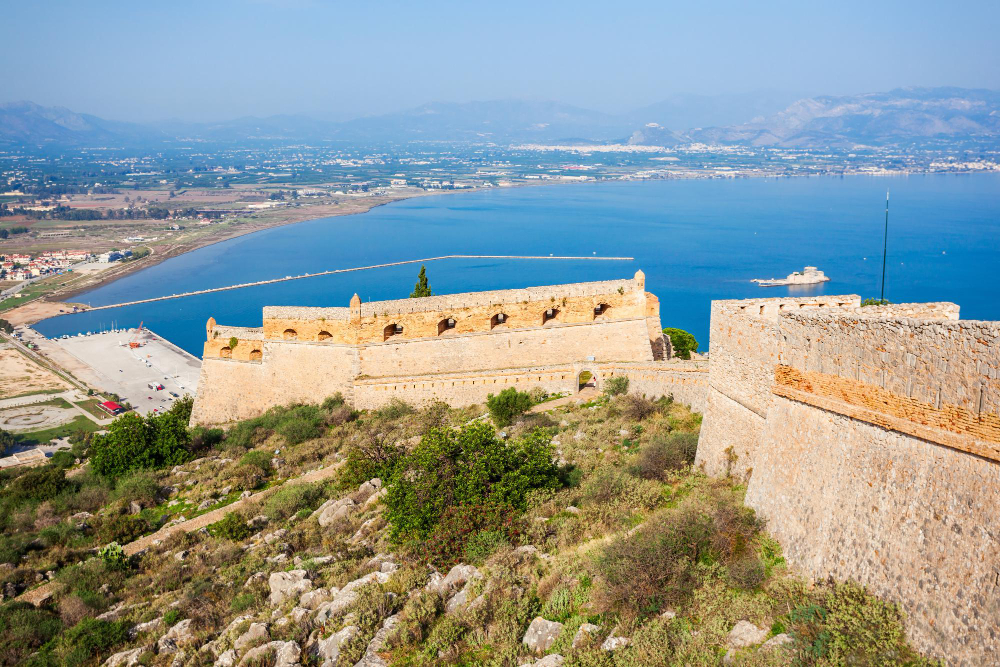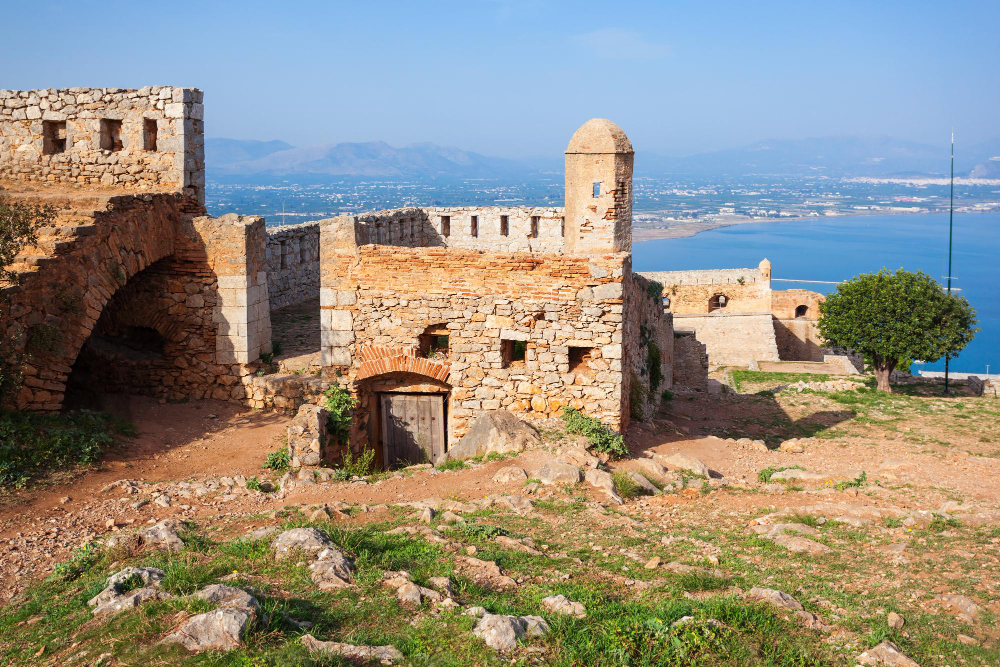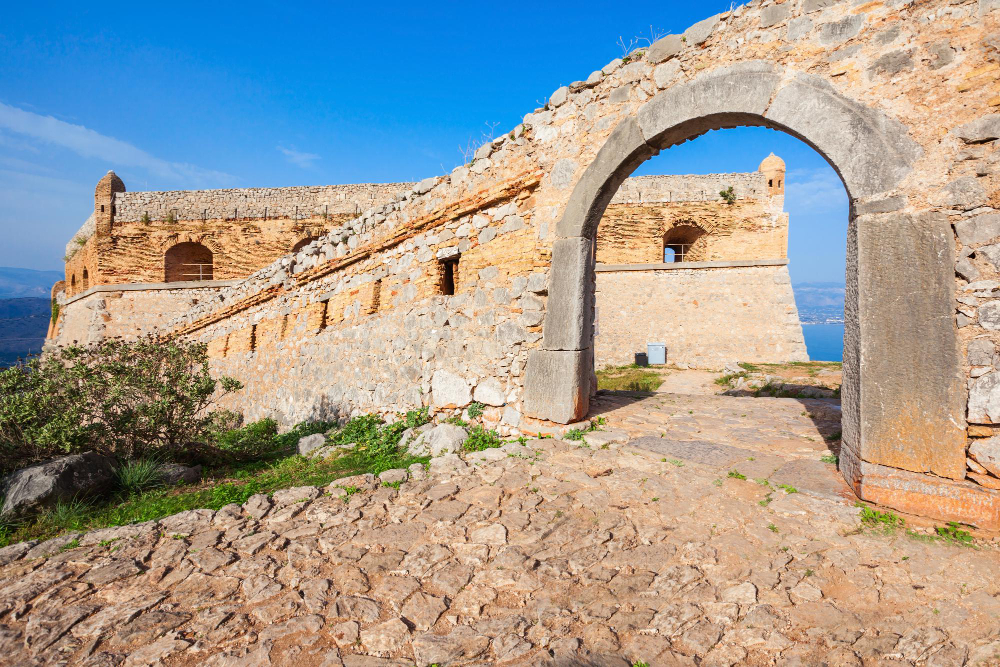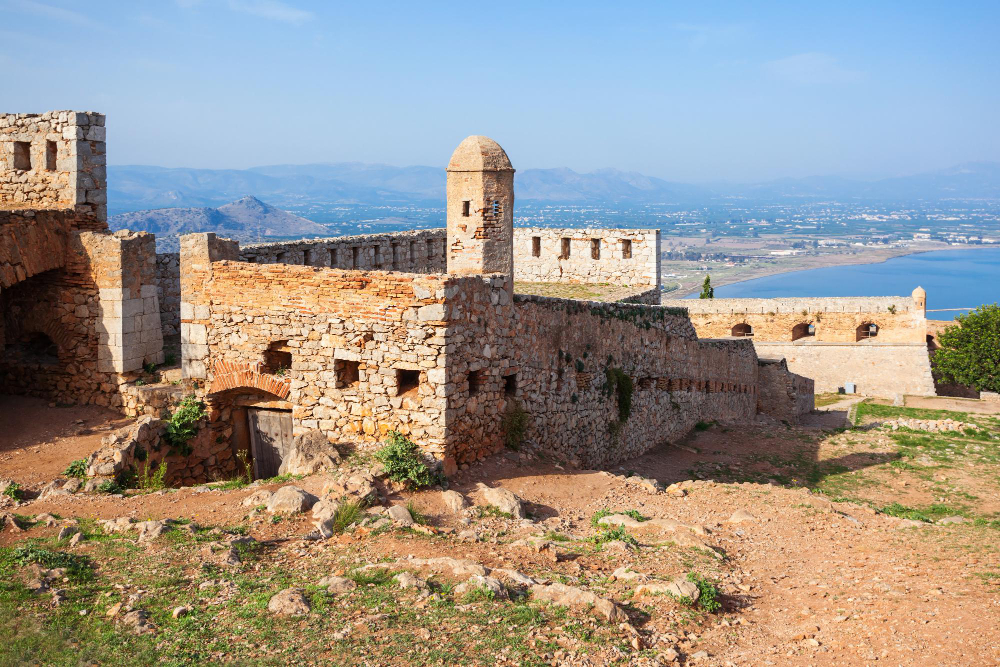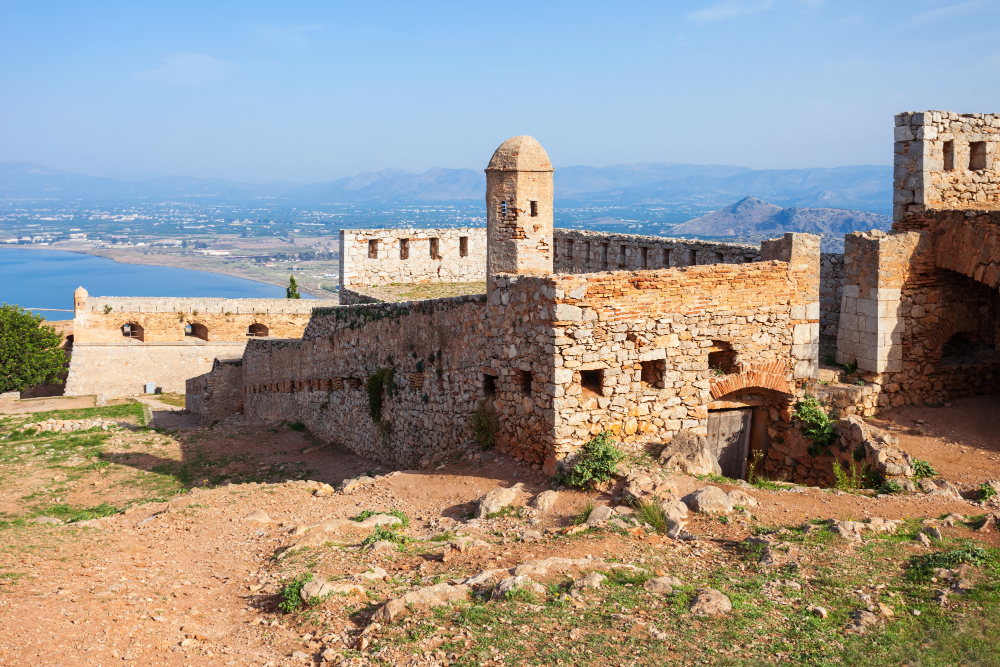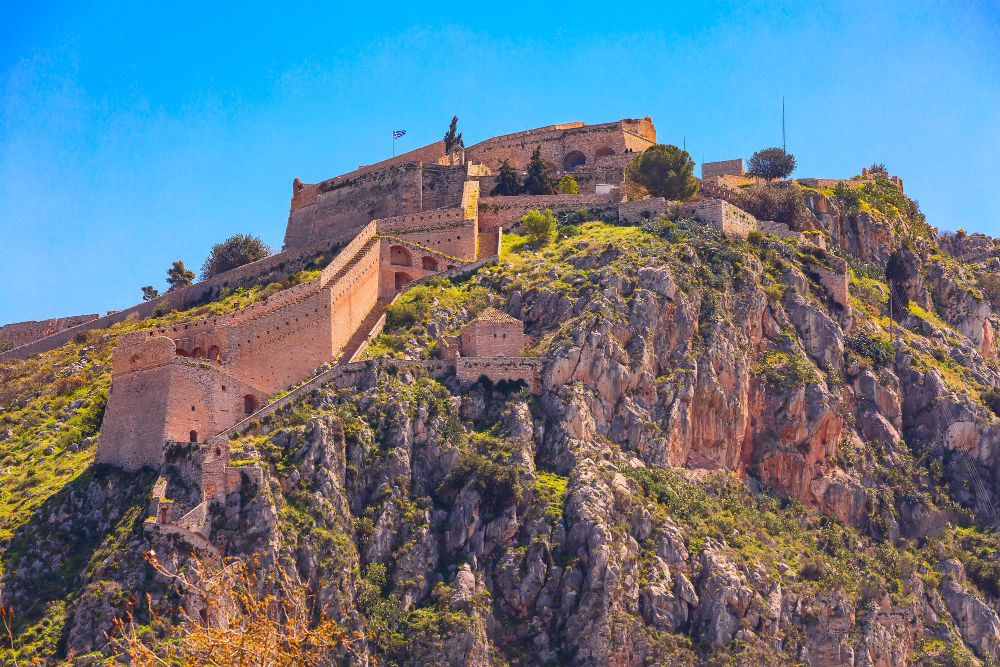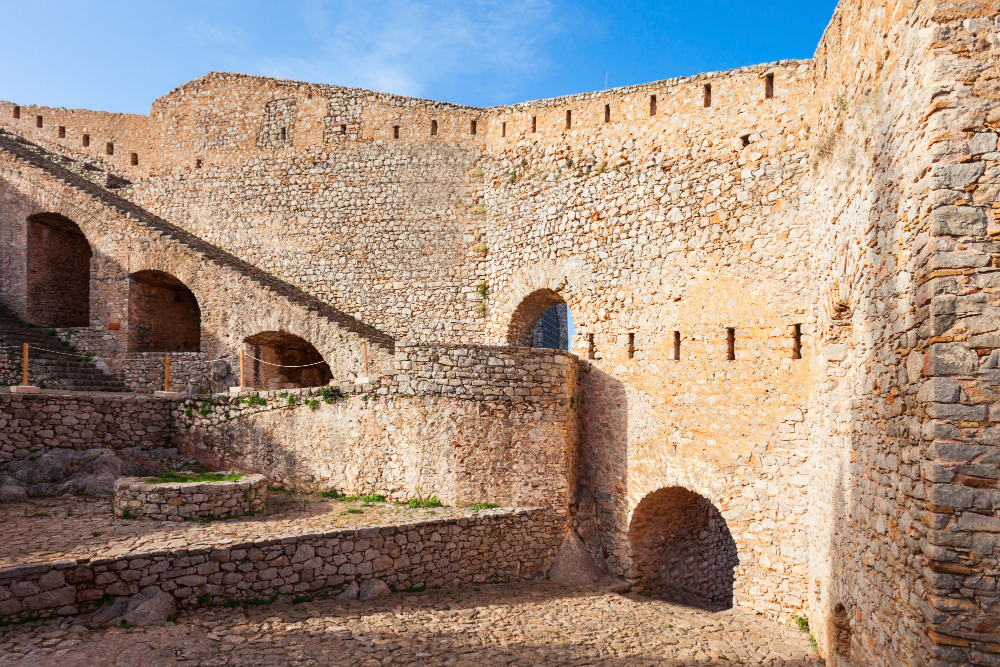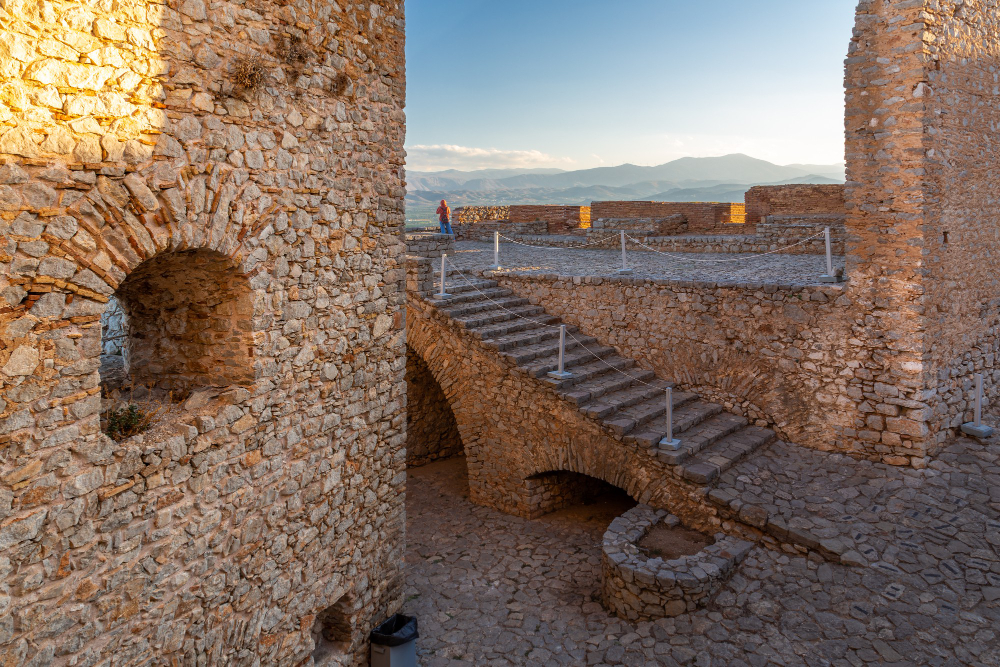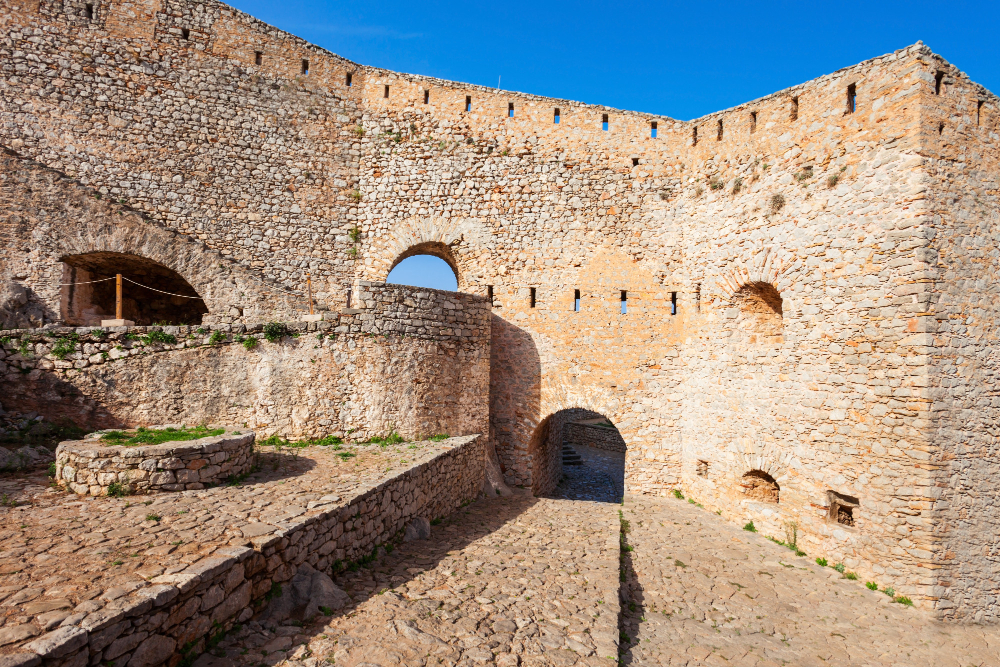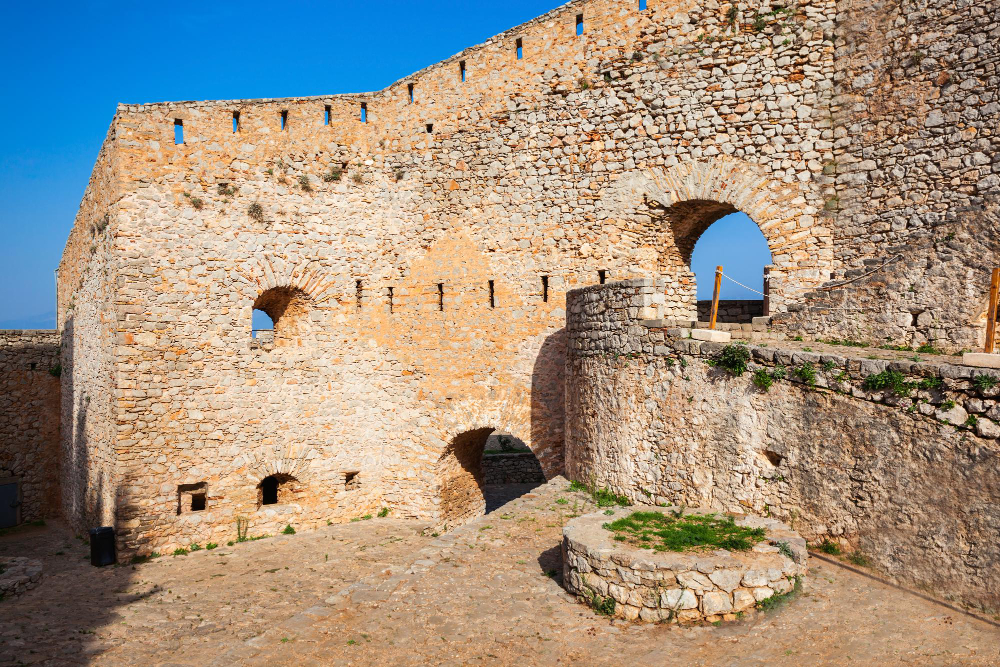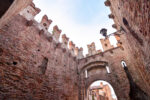

High above the red rooftops of Nafplio stands one of Greece’s most impressive fortresses: Palamidi. Perched on a rock some 220 metres high at the edge of the Argolic Plain, this mighty structure has dominated the town, the harbour and the gulf for more than three centuries. Anyone climbing the steep steps to the fortress today, or taking the access road, encounters more than just thick walls, bastions and gun emplacements. Palamidi tells the story of Venetian claims to power, Ottoman rule, the Greek struggle for freedom and a young state that found its first capital in Nafplio. The fortress is regarded as one of the most significant examples of Venetian military architecture in the Peloponnese. At the same time, it is a place where history and memory overlap particularly clearly: on its walls, the winged lion of Venice stands side by side with Greek national heroes. Its name even harks back to the world of ancient legend.
A name from the Trojan War – Palamidi is named after Palamedes, a figure from Greek mythology. Palamedes was regarded as a wise hero associated with the Trojan War. In ancient accounts, he is credited, amongst other things, with the invention of letters, numbers, units of measurement and even games – attributions that demonstrate just how much he was regarded as a symbol of inventiveness and wisdom. The association of the mountain near Nafplio with Palamedes is part of a long tradition of linking Greek landscapes with mythical figures. Palamedes is not a historically verifiable figure from legend; his significance lies in the cultural memory of antiquity. The fortress itself, however, was built many centuries later, at a time when the major European powers were vying for control of trade routes and coastal regions in the eastern Mediterranean.
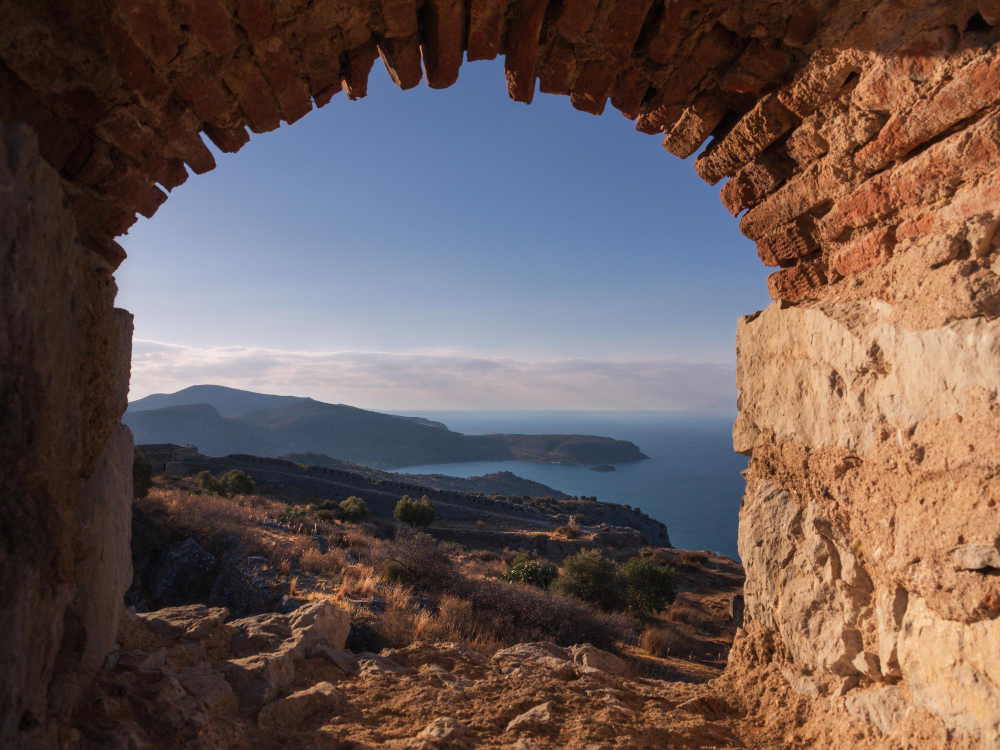
Venice’s ambitious project in the Peloponnese – At the end of the 17th century, Nafplio – then known by the Italian name Napoli di Romagna – was a strategically extremely important location. The town had a sheltered harbour and was situated on the Argolic Gulf, a significant bay in the north-east of the Peloponnese. Whoever controlled Nafplio could influence shipping, supplies and military movements in the region. After the Venetian commander Francesco Morosini had captured Nafplio for the Republic of Venice in 1686 during the so-called Morea War, the Venetians began a comprehensive expansion of the defences. Venice’s rule over large parts of the Peloponnese lasted only a few decades, from 1685 or 1686 to 1715. Nevertheless, this brief period left behind an extraordinary structure. The core complex of Palamidi was built between 1711 and 1714. For a project of this scale, that was a remarkably short construction period. The fortress was designed according to the plans of the engineers Antonio Giancix and Pierre de la Salle. Its architecture follows the principles of early modern fortification: instead of high medieval walls, which were easy for artillery to hit, the design relied on deeply staggered fortifications, wide earthworks, low bastions and overlapping fields of fire. Palamidi was not conceived as a single castle, but as a complex defensive system. The complex was intended to secure access to the town of Nafplio, monitor the harbour and make enemy attacks by land or sea more difficult. From its heights, a sweeping view still opens up today over the Argolic Gulf, the plain of Argos and the opposing mountain ranges of the Peloponnese. This view was once, above all, a military advantage.
The weak point in the east – The Venetian planners relied on the natural protection afforded by the steep terrain. The eastern side of the mountain, in particular, appeared so difficult to access that it was evidently given less attention during the construction of the surrounding wall. This assessment was to prove fatal. Just one year after the completion of the main complex, the balance of power shifted once again. In 1715, during the Ottoman–Venetian War, Ottoman troops recaptured the Morea. Palamidi, which had only just been completed as a symbol of Venetian strength, fell to the Ottoman Empire. The conquest demonstrated that even the most modern fortresses could not be held by walls alone: the strength of the garrison, supplies, leadership and the general military situation remained decisive factors. Under Ottoman administration, the fortress continued to be used and expanded. For almost a century, it remained part of the Ottoman defence system in the region. During this period, Nafplio was an important administrative and port town. The mighty walls overlooking the town thus symbolised not only changing rulers but also the town’s enduring strategic importance.
The night of 29–30 November 1822 – During the Greek War of Independence, Palamidi took on a new, almost symbolic significance. The revolution against Ottoman rule had begun in 1821, yet many important towns and fortresses remained in Ottoman hands. Nafplio and its fortifications were among the key targets of the Greek insurgents. Several attempts to capture Palamidi initially failed. The breakthrough came on the night of 29 November 1822 according to the Julian calendar, which was still in use in Greece at the time; according to the Gregorian calendar in use today, this corresponds to 11 December. In Greek tradition, however, the event is traditionally associated with 29 or 30 November. Under the leadership of Staikos Staikopoulos, a small group of Greek fighters succeeded in overcoming a section of the fortifications considered particularly difficult. The number of participants is often given as around 350 men. They exploited the weak defences at a section of the wall, which is said to have been only about two metres high. A decisive factor was that the Ottoman garrison was apparently small and taken by surprise. Once they had breached the fortifications, there was no prolonged battle: the defenders surrendered. The capture of Palamidi was far more than a local success for the Greek Revolution. With Nafplio, an important port and administrative centre fell into Greek hands. In the years that followed, the town developed into the political centre of the nascent state. From 1828 to 1834, Nafplio was the first capital of independent Greece, before Athens took on this role. Even today, at the end of November, the city commemorates the liberation of the fortress. The annual commemorative events combine religious ceremonies, historical remembrance and local tradition. Palamidi is thus not only a monument to past wars, but also a key site of remembrance for the founding of the Greek state.
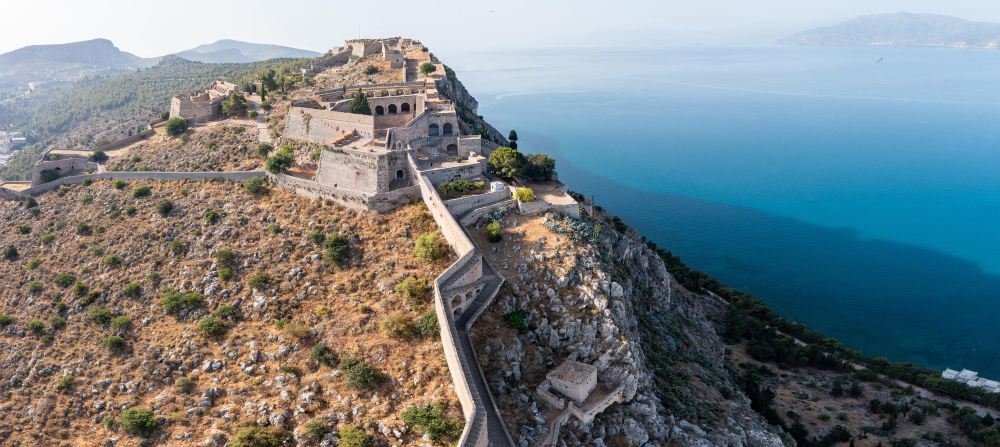
Eight bastions, eight names, several rulers – The Palamidi complex consists of eight bastions, each functioning as a small fortress in its own right. They were connected by walls, gates, paths and lines of fire. This system made it possible to continue defending individual areas even if another section had already fallen. The Venetians initially named the bastions after officials or administrative units of their rule. Following the Ottoman conquest, they were given Turkish names. With the Greek reconquest, a new round of naming began – this time in the spirit of national history and ancient tradition. Today, the bastions bear names such as Epaminondas, Miltiades, Leonidas, Phokion, Achilles and Themistocles. They commemorate military commanders, statesmen and mythical heroes of ancient Greece. Two further sections are dedicated to the Apostle Andrew – Agios Andreas in Greek – and to the French philhellene Francis Robert. Robert lost his life during the battles for the Athenian Acropolis in 1821–22 and stands as a symbol of the many European supporters of the Greek independence movement. These layers of names turn Palamidi into a stone history book. Venetian, Ottoman, Christian, ancient and modern Greek memories are intertwined in a single place.
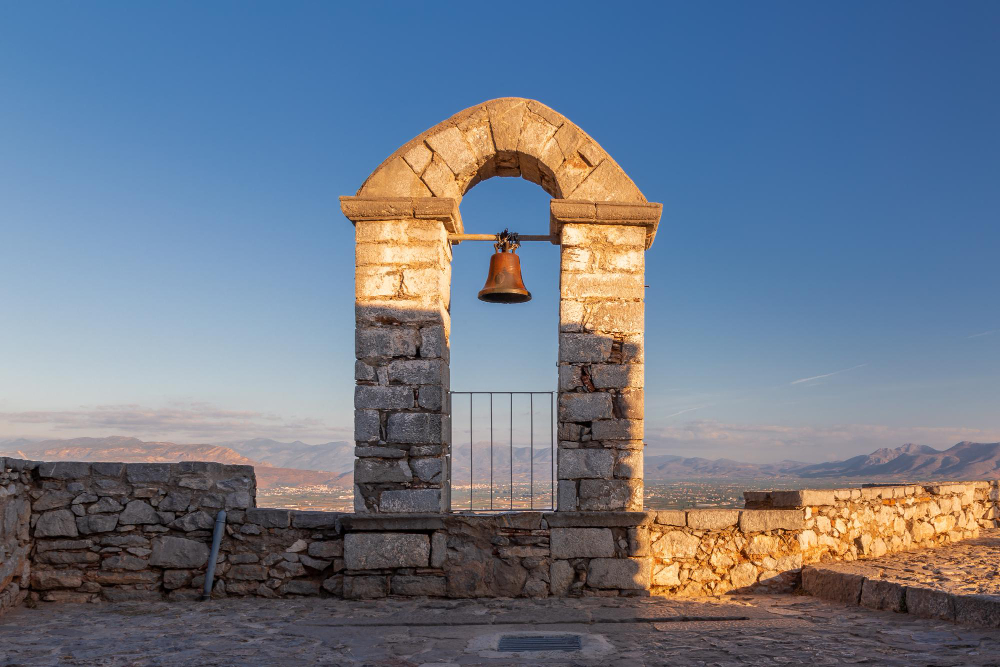
Church and Prison: The Miltiades Bastion – At the centre of the complex stands the Agios Andreas Bastion, featuring a small church embedded directly within the fortifications. The Church of Saint Andrew is a visible reminder that fortresses were not merely military installations; they also served as living quarters for soldiers, administrative centres and places of worship. Another particularly well-known section is the Miltiades Bastion, which is now often referred to as the ‘Kolokotronis Prison’. Theodoros Kolokotronis, one of the most important military leaders of the Greek War of Independence, was imprisoned there for around eleven months between 1834 and 1835. His imprisonment highlights a difficult chapter in early Greek political history. Following liberation from the Ottoman Empire, the country was by no means politically united. The early years were characterised by rivalries between regional power groups, military leaders and the new state leadership. Kolokotronis, who was revered as a hero of the revolution, came into conflict with the regency of the underage King Otto. The fact that a freedom fighter, of all people, was imprisoned in a fortress that had only recently become a symbol of liberation is one of the historical paradoxes of Palamidi.
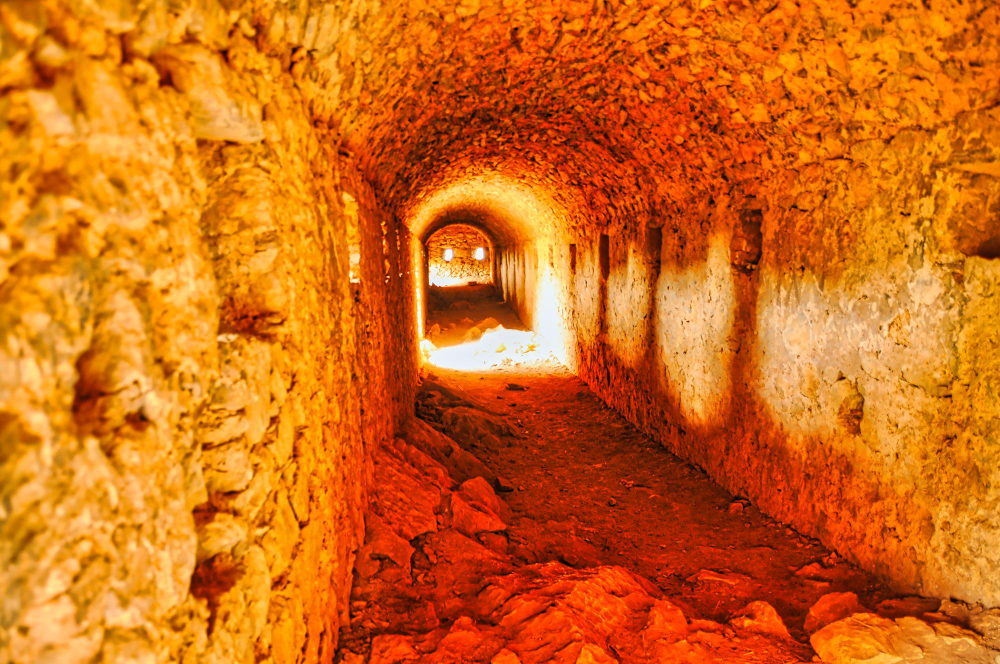
A monument overlooking the town – Today, Palamidi is one of Nafplio’s most important attractions and an outstanding example of Venetian fortress architecture in Greece. Visitors can reach the complex via a road or via the famous staircase, the number of steps of which varies in different guidebooks. The often-cited figure of 999 steps is more a matter of local tradition than a reliable count – depending on the starting point and method of counting, the result varies. What is undisputed, however, is the impact of the ascent: with every metre, you move further away from the bustling town of Nafplio and draw closer to a landscape of walls, cisterns, vaults and stone sentry posts. Once at the top, it becomes clear why this hill was contested for centuries. Palamidi is not merely a ruin that tells of a distant past. The fortress demonstrates how political power was constructed: through sightlines, gun emplacements, supply systems and controlled access points. At the same time, it serves as a reminder of how quickly dominion can change. The Venetians, Ottomans and Greeks all left their mark – and each era gave the fortress new names, new functions and new meanings.