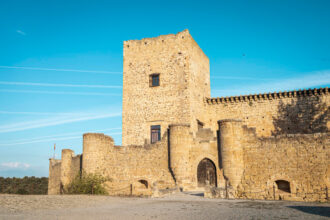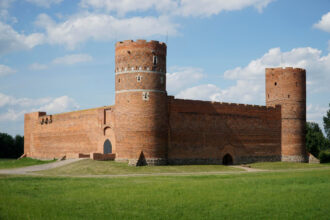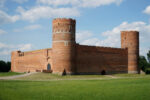

In the heart of Genoa, a city characterised by centuries-old fortifications, Forte Sperone stands as one of the most imposing examples of military engineering. This fortress, nestled within the so-called ‘Mura Nuove’ (New Walls), was strategically built on the summit of Monte Peralto at an altitude of 512 metres. Precisely at the point where the two defensive lines of the city walls meet – on one side the wall facing the Val Polcevera, on the other the wall facing the Val Bisagno – a striking, bastion-like angle was formed. Its shape, resembling the bow of a ship, gave Forte Sperone its name.
Strategic Significance and Architectural Features – Due to its elevated position above the city, Forte Sperone was one of the key positions in Genoa’s defence system. The complex is characterised by its intricate, three-storey structure. These three levels are situated at different heights and each fulfilled a specific function. The lowest level housed storage rooms, service areas and cisterns, which ensured the vital water supply at the time. The middle storey housed the officers’ quarters as well as accommodation for officers and non-commissioned officers. Finally, the top level served as accommodation for the soldiers. In peacetime, around 300 soldiers lived here; in the event of war, however, the garrison could be increased to up to 900 men if necessary. The fortress’s military significance is also evident from its impressive armament. A total of 18 cannons of various calibres, nine howitzers and numerous smaller guns made it a heavily guarded and resilient fortress. This artillery enabled controlled surveillance of the surrounding area, thereby effectively supporting the defence of Genoa.
The Beginnings: From the ‘Bastia del Peralto’ to the Fortress – The history of the town dates back to the Middle Ages. There is evidence as early as 1319 of a Ghibelline fortress there called ‘Bastia del Peralto’, originally a wooden structure which was later rebuilt in stone. This first bastion was thoroughly renovated in 1530 by the Senate of the Republic of Genoa with a budget of 7,400 lire. However, this fortification was not incorporated into the 17th-century ‘Mura Nuove’; instead, it was demolished and replaced by the triangular bastion known as the ‘Sperone’. The ‘Mura Nuove’ themselves were constructed at the beginning of the 17th century, between 1629 and 1633, to further strengthen the town’s defences. During the Austrian attempt at a siege in 1747, the fortress was considerably expanded: a raised platform was built at the point where the two walls met, in order to significantly increase the bastion’s firepower. Between 1747 and 1815, the fortress’s layout remained more or less unchanged. There were only two structures on the bastion: the aforementioned raised platform (which was demolished after 1815) and an unfinished barracks. It was not until after 1815 that work began on developing Forte Sperone into its present form, a process that unfolded in several phases until around 1830. In this way, Forte Sperone gradually acquired the imposing appearance that it has retained to this day.
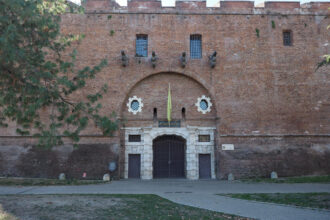
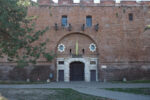
Napoleonic and subsequent alterations – During the Napoleonic era, an additional wall was designed to ‘seal off’ the town centre, thereby offering the fortress further protection against potential uprisings and unrest. This so-called ‘Cortina muraria’ was built after 1815 by the Sardinian Corps of Military Engineers and incorporates the fortress’s monumental main gate. This gate is adorned with a marble coat of arms of the House of Savoy and features a fully functional drawbridge mechanism that has been preserved to this day. An interesting plan from 1823, drawn up by a commission set up specifically for this purpose, envisaged linking the three fortresses on Peralto Hill – Castellaccio, Sperone and Begato – into a single, contiguous citadel. However, due to the high costs involved, the project was never implemented.
Forte Sperone in the 19th and 20th centuries – During the revolutions of 1848–49, Forte Sperone briefly served as the centre of the uprising. It was captured by the rebels, but when the political situation turned in favour of the royal troops, they abandoned the fortress. At the start of the 20th century, the fortress’s function changed fundamentally. In 1914, the fortifications were officially decommissioned. During the First World War, Forte Sperone served as a prison camp for prisoners of war from Croatia and Serbia. One notable figure who held command here from 1918 onwards was Francesco Calì, the first captain of the Italian national football team – an interesting link between military history and sport. After the war, the fortress served as barracks for the financial police until 1981, when its military use finally came to an end. The City of Genoa subsequently took over the site and has since used it as a venue for cultural events, particularly during the summer months, thereby breathing new life into the old fortress.
Access and current use – Forte Sperone is easily accessible to visitors. From the Righi district, Via del Peralto leads to a small turn-off that takes you directly to the fortress’s main entrance. A scenic alternative is the walking trail along the old city walls. This path begins at the Belvedere, passes several other fortresses such as Crocetta and Begato, and climbs spectacularly uphill to Forte Sperone. For lovers of historical walks, this route offers a particularly rewarding opportunity to explore Genoa’s military belt.
A monument to history and defence – Forte Sperone is not only an impressive testament to 17th–19th-century fortification architecture, but also a symbol of Genoa’s historical significance as a heavily fortified city on the Mediterranean. From its medieval beginnings through the turbulent conflicts of the modern era to its current peaceful cultural use, the fortress tells countless stories. Its exceptional location, complex multi-storey construction and extensive arsenal of defensive weapons underline the fortress’s great military value – an indispensable element in the network of the ‘Mura Nuove’. At the same time, Forte Sperone embodies the transformation of historic sites that manage to constantly redefine themselves and continue to flourish as cultural monuments. Genoa, with its numerous fortresses and defences, preserves in Forte Sperone a unique bridge between the past and the present – an invitation to visitors to experience for themselves the fascinating history of this Ligurian coastal metropolis.
* Ringrazio il professor Beri dell’Università di Genova per la piccola segnalazione di correzione