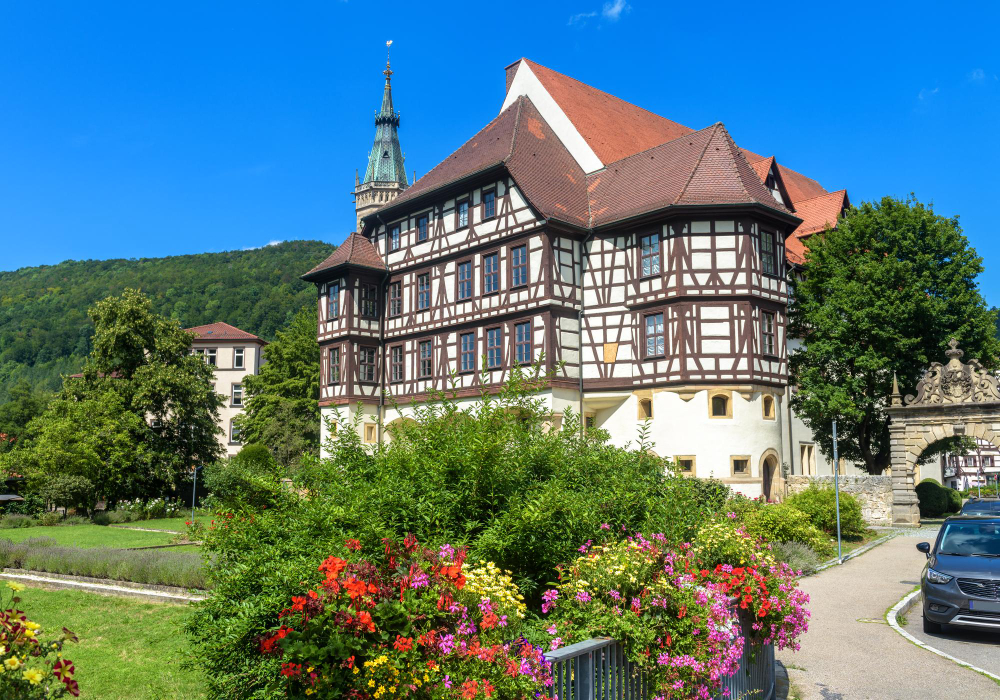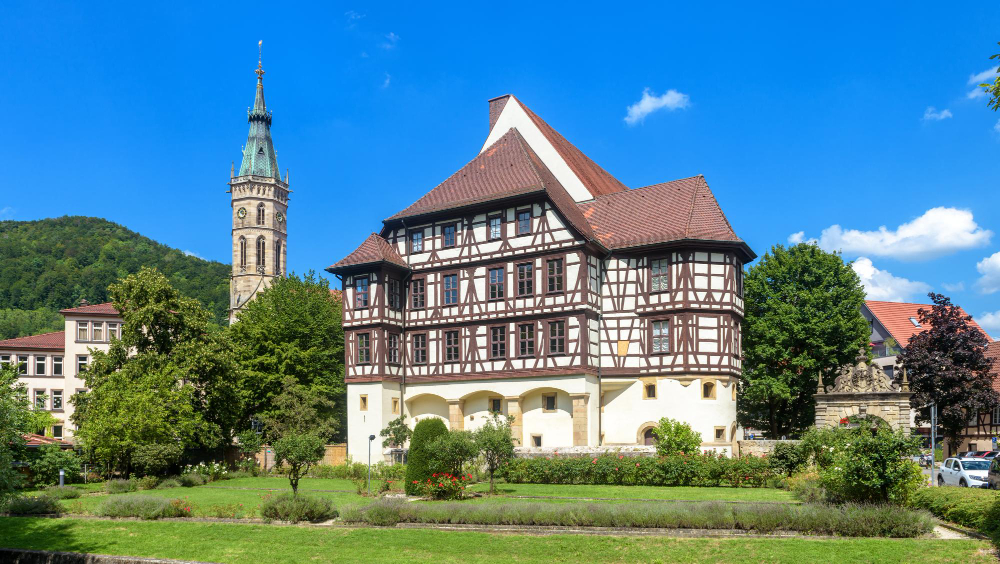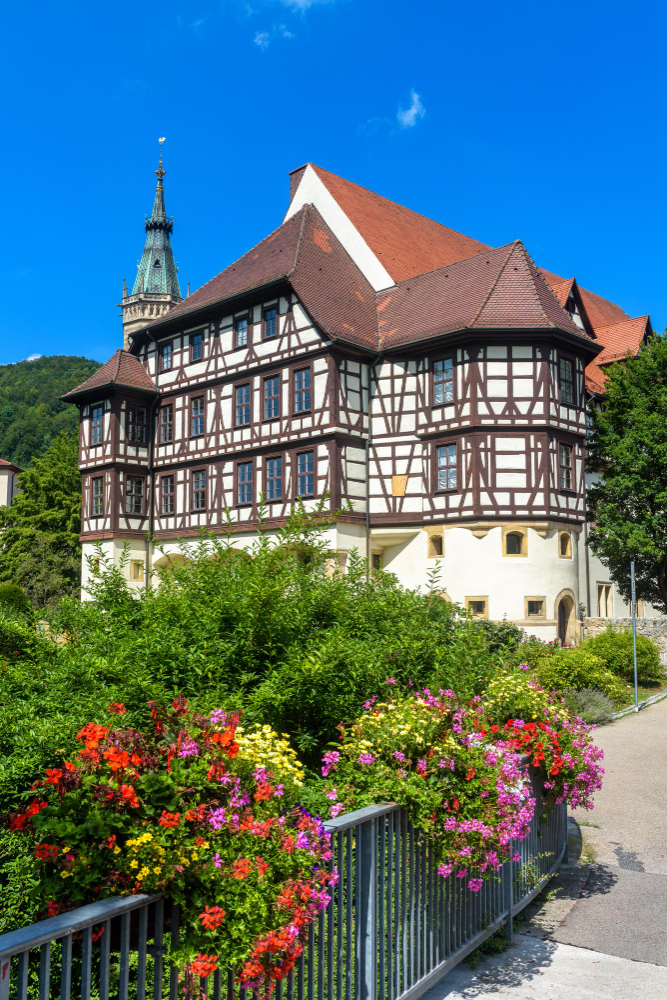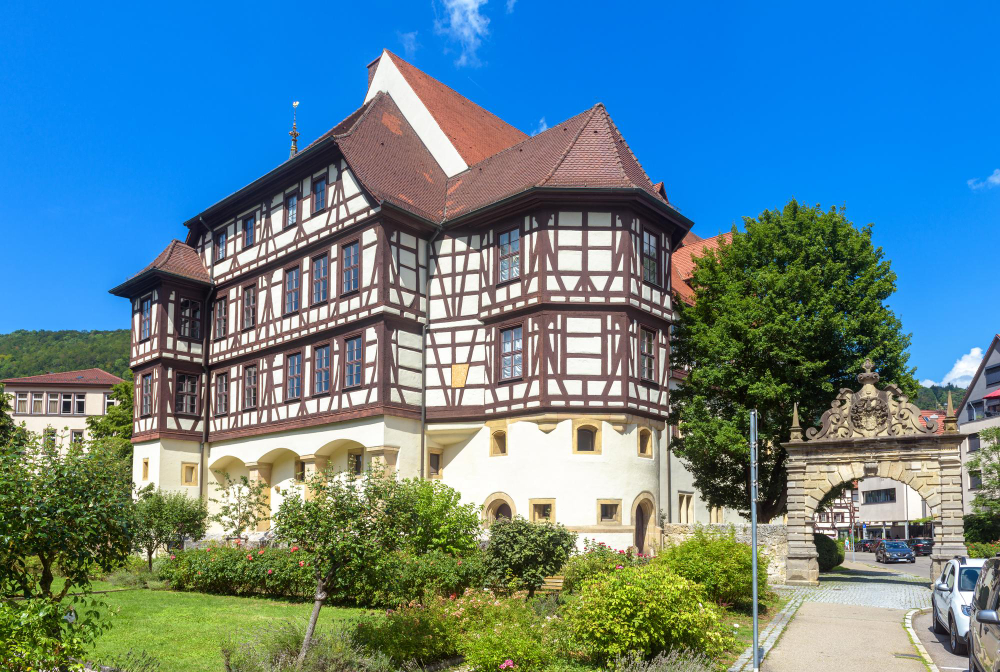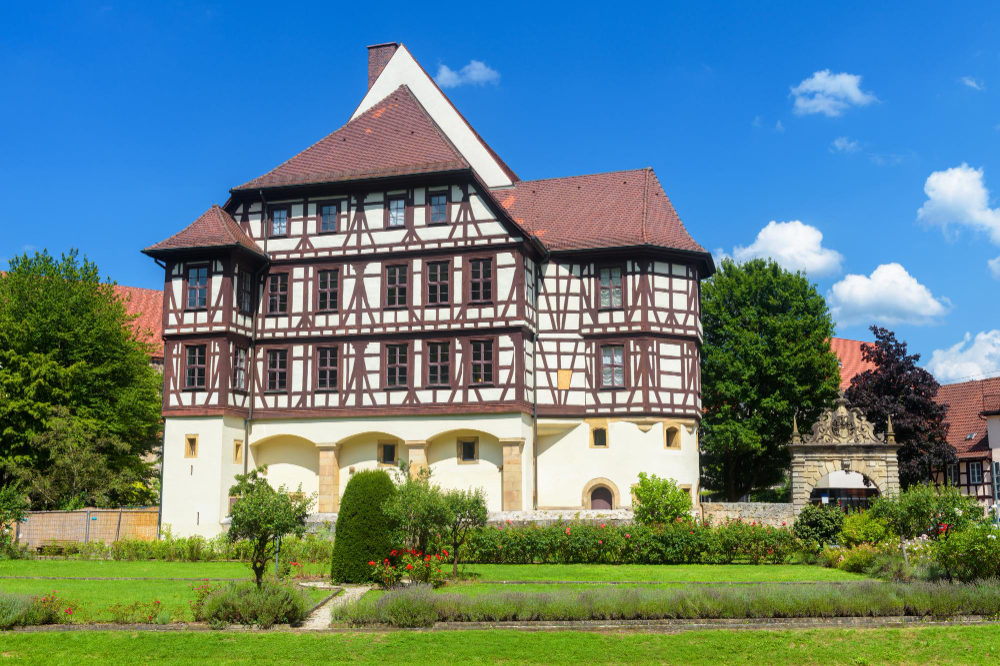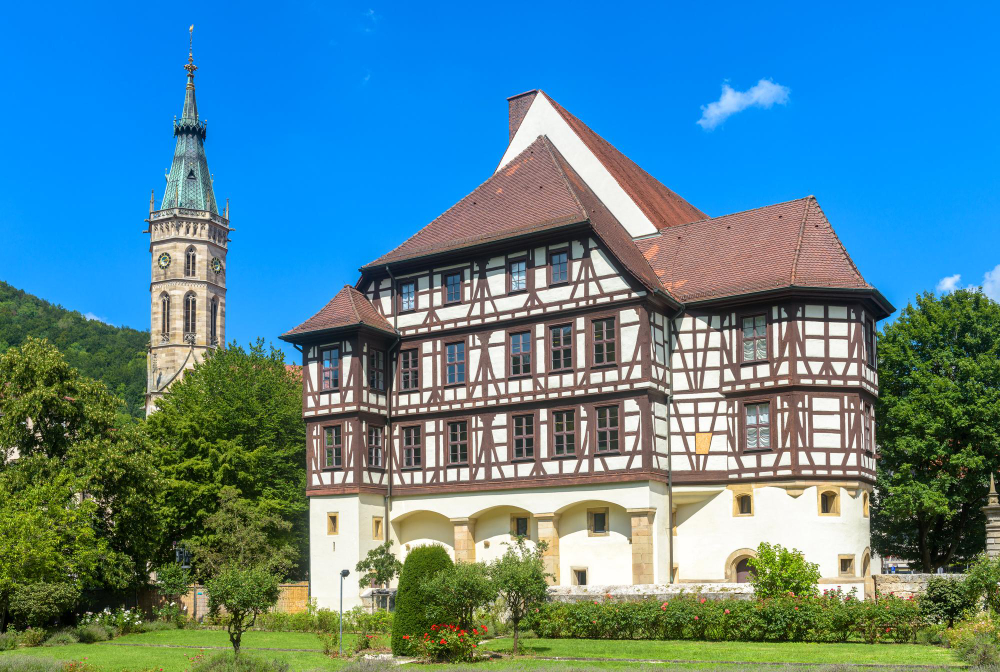

Urach Castle is a striking historical landmark in the town of Bad Urach in the district of Reutlingen, Baden-Württemberg. Its magnificent architecture, deep historical roots and ornate interior make it a fascinating symbol of Württemberg’s regional history and Renaissance culture.
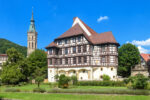
Location and architectural features – The castle is situated on the edge of Bad Urach’s old town and consists of several building complexes that have been constructed over the centuries: the gate tower, the professors’ building, the gatekeeper’s building and the castle itself. The latter is a rectangular structure with a characteristic gabled roof, the origins of which date back to the early 15th century. Later on, the castle was extended to the west with an annex featuring a hipped roof and a tower-like rectangular extension. Particularly striking is the large south tower, which lends the complex a fortified appearance. This architectural style bears witness to the castle’s original function as a fortified seat of power and, at the same time, reflects its development into a stately residence.
The Golden Hall – a masterpiece of the Late Renaissance – A highlight inside the castle is the so-called Golden Hall. This magnificent and richly decorated room dates from around 1600 and is regarded as a significant ceremonial hall of the Late Renaissance in Württemberg. The room on the second floor is characterised by its flat ceiling; it is illuminated by windows on three sides and divided by Corinthian columns, which, together with the walls, are artfully gilded – hence the name ‘Golden Hall’. The gilding, delicate stucco work and wooden wall panelling reflect the artistic heyday of the Renaissance at the Württemberg court. In addition to its aesthetic significance, the hall was a central venue for ceremonial festivities and political gatherings.
Historical Development and Significance – The origins of the palace date back to the 11th century, when a moated castle was built in the valley alongside Hohenurach Castle. This served as the urban seat of the Counts of Urach and had a military function, monitoring and controlling access to the Ermstal valley. Its strategic location enabled control over important transport routes in the valley. In 1264, the castle and its domain passed to the Counts of Württemberg, who developed the complex into a ducal residential palace. In 1400, the current palace was rebuilt, initially primarily as a rectangular hall complex comprising elongated rooms on the ground floor and first floor, as well as living quarters in the attic. The patrons were presumably Count Eberhard III of Württemberg and his wife Antonia Visconti of Milan, who had the palace designed on the model of the Old Palace in Stuttgart. Following the division of the territory in 1442, Urach became the capital of Count Ludwig I, who established his seat of government there. The castle’s significance grew at the beginning of the Renaissance, when Eberhard I of Württemberg undertook extensive modernisation work on the occasion of his marriage to Barbara Gonzaga of Mantua in 1474. Particularly noteworthy is the design of the Hofstube (Dürnitz) on the ground floor, which stands out for its elaborate four-nave vaulted ceiling. The first floor is also adorned by the Palmensaal, featuring a monumental mural depicting the ancestral coats of arms and the castle lord’s motto. Urach Castle is also the birthplace of several prominent Württemberg princes: Eberhard I of Württemberg (1445–1496) and Duke Christoph of Württemberg (1515–1568) were born here, which underscores the castle’s high status.
Changes in Function and Use – Following the reunification of Württemberg in 1482, Urach Castle lost its role as a seat of government in favour of other residences. From then on, it served mainly as a hunting lodge and retreat for the ducal family. It was also used as alternative accommodation and for festive occasions. Nevertheless, around 1600, the castle underwent an extensive interior refurbishment in the late Renaissance style, including the imposing Golden Hall. The castle’s eventful history is also reflected in military events: for instance, it was occupied in 1546 during the Schmalkaldic War by Spanish troops under the Duke of Alba, and captured in 1634 during the Thirty Years’ War by imperial forces. Such occupations left their mark on the building’s structure and led to a constant need for repairs. Under Duke Eberhard III, extensive renovation work took place in 1663–64, restoring the building to its former splendour. At the end of the 18th century, the core of the original moated castle – which was the oldest part of the structure – was demolished under Duke Carl Eugen. The rubble from the demolition was also used to drain the adjacent Schwanensee, which permanently altered the castle’s surroundings.
Restoration and current condition – In the 1960s, Urach Castle underwent extensive renovation. At the time, modern conservation methods were employed, though these were partly at the expense of the historic fabric: some valuable structural elements were removed without adequate documentation and replaced with steel and concrete structures. Photographs of this phase of renovation are now part of the exhibition in the castle’s museum and document the tension between preservation and modern restoration. Today, the castle, together with other historic buildings, presents itself as an impressive site that allows visitors to immerse themselves in the history of the House of Württemberg. In addition to the architecture and interior décor, the museum’s exhibits provide deep insights into the eventful eras and courtly culture that found expression here.
Significance and Legends – Urach Castle exemplifies the regional power politics of the Middle Ages and the early modern period in southern Germany. Its structure tells of the interplay between defensive fortifications and grandeur, typical of many noble residences of that time. The connections to Italian noble families such as the Visconti or Gonzaga underline the cultural networks of the House of Württemberg. Although it lacks the spectacular legends or myths associated with some castles, the history of Urach Castle paints a vivid picture of medieval and early modern life, of political alliances, intrigues and courtly festivities.
Urach Castle is far more than just a set of ancient walls – it stands as a testament to Württemberg’s political and cultural development over several centuries. From a medieval moated castle, through a late medieval residential building, to an artistically decorated Renaissance palace, it reflects the transformation of a dynasty and the architectural fashions of various eras. Its preserved structures and magnificent interiors invite visitors to experience history at first hand and discover the stories behind its walls. Anyone visiting Bad Urach should by no means miss this uniquely well-preserved palace complex, offering a chance to delve deep into Württemberg’s eventful past and proud tradition.