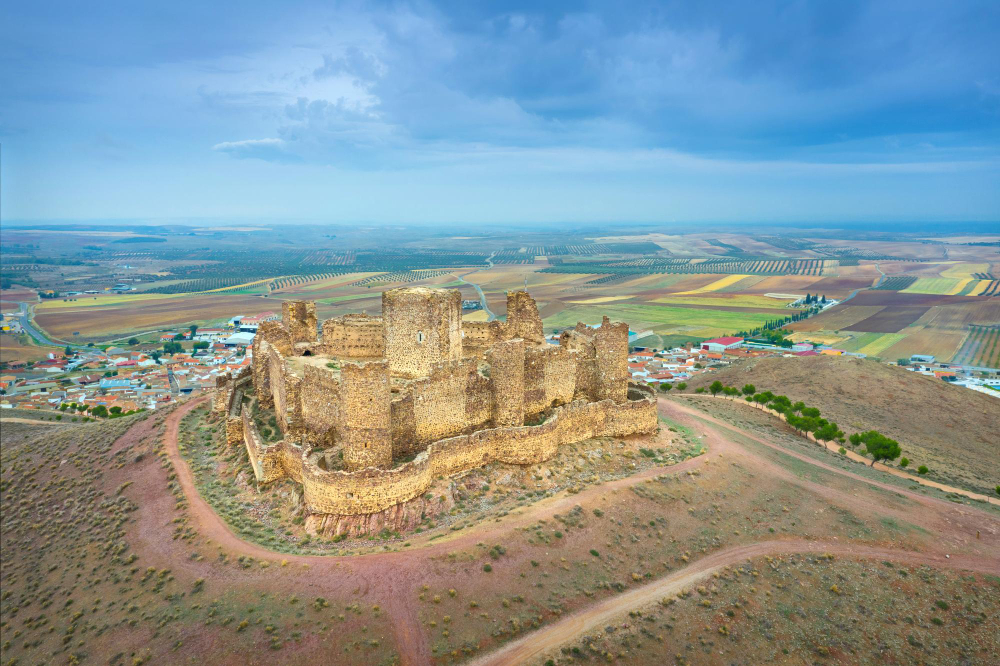

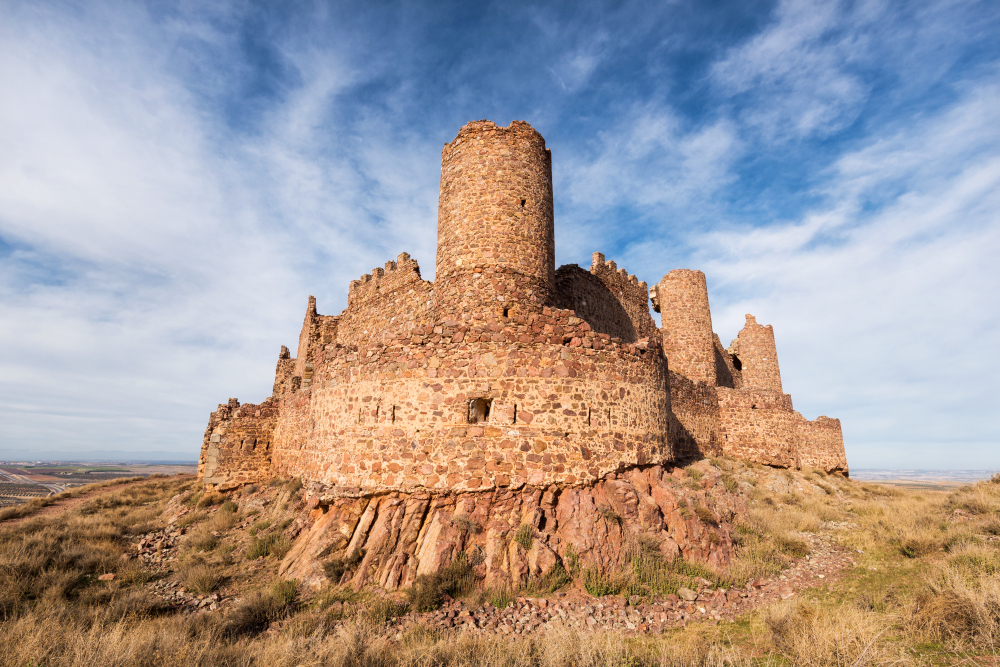
Nestled amongst the rolling hills of Castilla-La Mancha stands the Castillo de Almonacid, an impressive medieval fortress whose walls have told tales of wars, power struggles and legends for centuries. Situated in the small village of Almonacid de Toledo, just under 20 kilometres from the historic city of Toledo, the castle stands atop a hill that is visible from several kilometres away. Its strategic location, once an important vantage point along the trade routes of La Mancha, gave the castle its significant role in Spanish history. Yet behind its imposing walls lies far more than just stone – it is the destinies and events that have made the Castillo a living testament to times gone by.
A castle from the Muslim era – The origins of the Castillo de Almonacid date back to the year 848, a time when the Iberian Peninsula was under Muslim rule. At that time, the castle served as a strategic outpost for monitoring the roads and trade routes of La Mancha. The Moorish builders placed great emphasis on the functionality and defensive capabilities of the complex, which is still evident today in its high walls and fortifications. With the Reconquista, the Christian reconquest of Spain, the history of the fortress also changed radically. In the 11th century, the castle became part of the dowry of Zaida, a Moorish princess who married King Alfonso VI of León. This political alliance was not only a romantic union but also a shrewd move to secure control over key territories. Later, in 1086, Alfonso VI donated the fortress to the Cathedral of Santa María in Toledo, heralding the start of a new era for the building. Under the direction of Pedro Tenorio, the Archbishop of Toledo, the castle underwent extensive renovation work in the 14th century. It was converted into a mighty fortress, which even served as a prison for high-ranking prisoners such as Alfonso Enríquez, an illegitimate son of King Henry II of Castile.
War and Destruction – The apparent invincibility of the Castillo de Almonacid was repeatedly challenged over the centuries, particularly during the Napoleonic Wars in the early 19th century. In 1809, during the Spanish War of Independence, the fortress became the scene of the Battle of Almonacid, in which General Venegas attempted to hold back the French troops. Despite the heroic resistance of the Spanish soldiers, the castle eventually fell to the French, an event that significantly diminished its importance as a military stronghold. Following this period, the Castillo de Almonacid began its slow decline. In 1839, the local council permitted residents to remove bricks from the fortress and sell them in order to address the municipality’s pressing economic problems. This measure led to a visible deterioration of the architecture, the effects of which are still evident today. Although the castle has been restored on several occasions, much of its original splendour has been irretrievably lost.
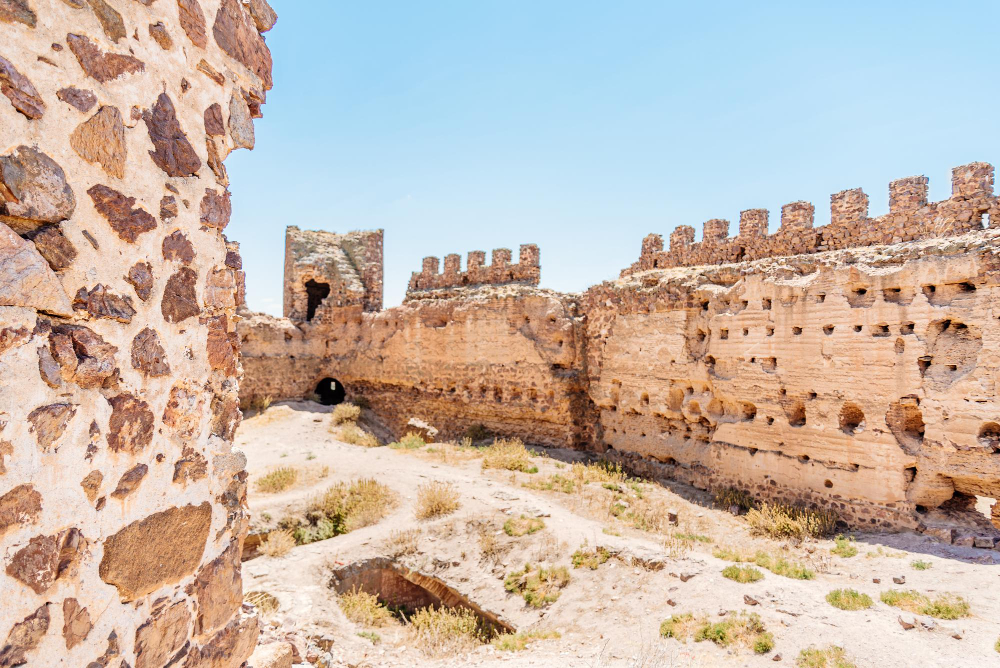
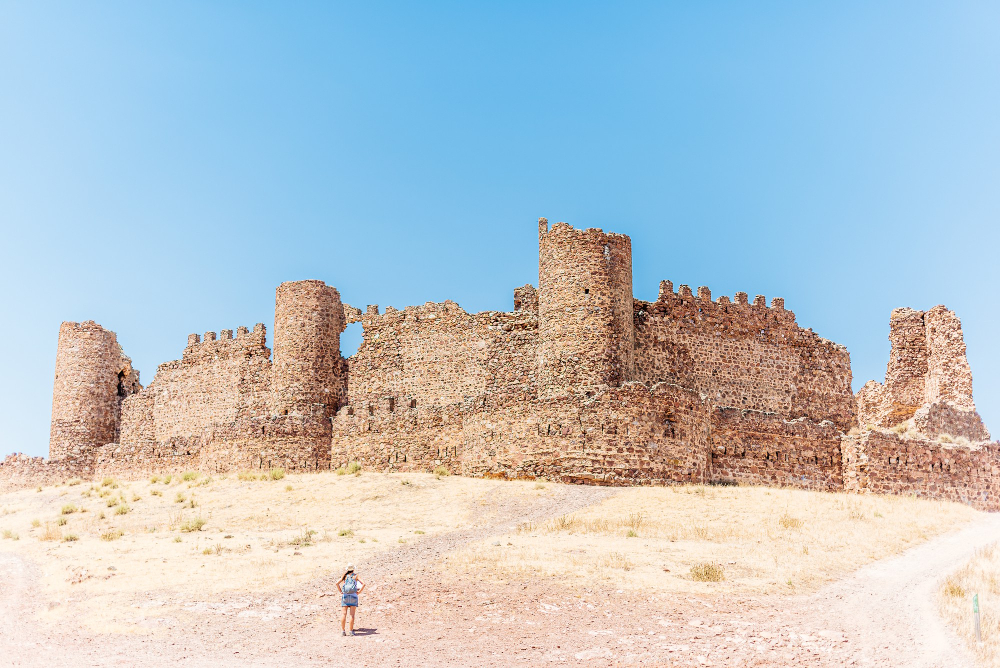
Architectural Beauty and Secrets – Despite the damage, the Castillo de Almonacid still retains impressive architectural features that give a glimpse of its former importance. The high, crenellated outer walls bear witness to its defensive nature, whilst the central Torre del Homenaje (Tower of Homage), with its three storeys featuring brick arches, forms the fortress’s main attraction. During the Middle Ages, the tower was often used to receive important guests or to hold ceremonial events. Inside, there are also the remains of two cisterns, storerooms and rooms that were once used by soldiers and residents. Particularly fascinating are the so-called triple embrasures, which formed a sophisticated defence system and allowed the fortress’s defenders to combat their opponents effectively. In a 16th-century report, the architect Don Pedro Gumiel describes the fortress as one of the finest in Castile, equipped with bakeries, water reservoirs and firearms. He also documented detailed restoration work, including repairs to the walls, doors and staircases, as well as improvements to the living quarters and stables.
The role of prominent owners – Over the centuries, the castle changed hands several times. It passed from the Archdiocese of Toledo to the Counts of Mora. Of particular note is its connection to María Eugenia de Guzmán y Portocarrero, the 12th Countess of Mora and, at the same time, Empress of France. As the wife of Napoleon III, she played a key role in bringing the castle to the forefront of European attention. Nevertheless, no major renovations took place during her time, so the castle remained at the mercy of the ravages of time.
Myths and Legends – Like many historic sites in Spain, numerous legends surround the Castillo de Almonacid. One of the best-known stories tells of a hidden treasure that is said to lie buried beneath the fortress’s walls. Historical documents suggest that, during the Battle of Almonacid, valuable artefacts and coins were hidden in the castle to protect them from the French troops. To this day, this legend continues to attract treasure hunters and historians alike, although no evidence of the mysterious treasure has yet been found. Another legend tells of the ghost of a Muslim prince who is said to wander through the ruins at night, searching for his lost love. These stories, whether true or not, lend the Castillo a mystical aura that fascinates visitors from near and far.
The Castillo today – Today, the Castillo de Almonacid is a popular destination for history buffs and architecture enthusiasts. Although many parts of the fortress lie in ruins, a stroll through the grounds clearly reveals traces of the past. Particularly impressive is the view from the hill, which stretches far across the landscape of Castilla-La Mancha and offers a moment of tranquillity that stands in stark contrast to the turbulent events that once unfolded here. The challenge remains to preserve this cultural treasure for future generations. Initiatives to restore and conserve the fortress, including archaeological studies, are continuing; however, additional funding is required to fully protect Almonacid’s heritage.
The Castillo de Almonacid is far more than just a historic building – it is a window into the past, a place that has preserved the stories of conquerors, rulers and ordinary people. Its walls tell of the splendour of the Muslim era, the strength of Christian rule and the horrors of the wars that Spain has endured. Anyone embarking on a journey into the heart of Castilla-La Mancha should take the time to explore this impressive testament to history – and perhaps discover a legend or two that still lives on amongst the ancient stones.