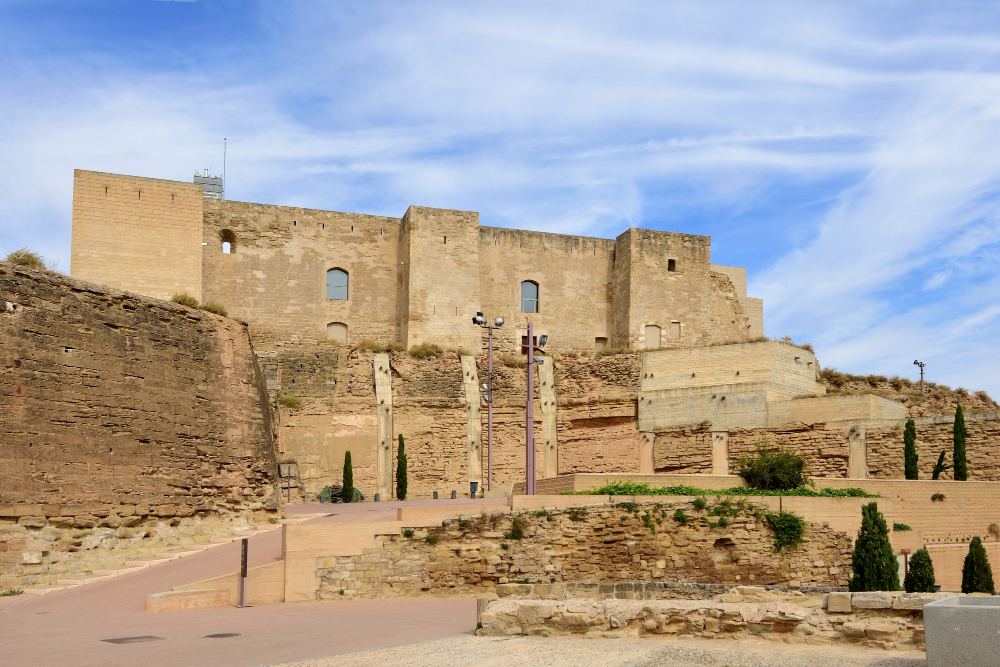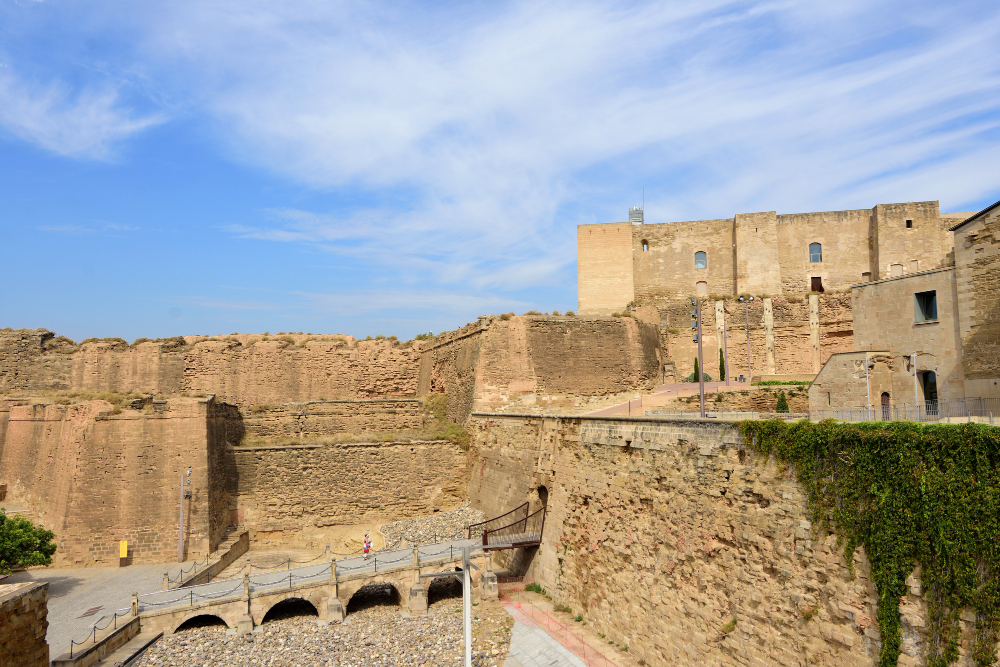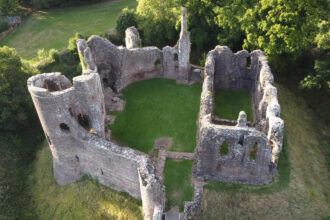

High above the city of Lleida in Catalonia stand the imposing ruins of the Castell del Rei, also known as La Suda Castle. This architectural masterpiece from the 13th and 14th centuries reveals a history that extends far beyond its Romanesque-Gothic walls – for hidden beneath these stones lies the legacy of a much older, Moorish fortification dating back to the 9th century. The historical significance of this site, with its varied uses as a royal palace, military headquarters and, today, a monument, impressively reflects Catalonia’s eventful past.
From an Andalusian kasbah to a royal seat – The name ‘Suda’ derives from the Arabic term for ‘enclosed urban area’ and refers to the complex’s origins as a Moorish fortress, which formed the centre of Islamic rule over Lleida in the 9th century. Archaeological investigations confirm that the fortress played a significant role during the reign of the Hudid dynasty between 1046 and 1092. Its strategic location enabled it to control and defend the city and its surrounding countryside. During the 12th century, Lleida was besieged and conquered on several occasions. Particularly significant was the siege by the Catalan counts Ramon Berenguer IV of Barcelona and Ermengol VI of Urgell in 1149. The conquest of the formerly Moorish city was a significant step in the Reconquista and marked the beginning of a new era. In the run-up to this important battle, Ramon Berenguer IV and Ermengol VI agreed that the latter should receive La Suda Castle as a fief, whilst the town was to be divided between the two rulers. This agreement illustrates the complex political power dynamics of the time. At the same time as La Suda, the Gardeny fortress was built on a neighbouring hill. This 12th-century Romanesque castle, constructed by the Knights Templar, secured the only accessible route into the town and thus perfectly complemented the defences. The proximity of the two castles provided a double line of defence, which proved its worth time and again over the following centuries.
The castle as a royal palace and political arena – In the 13th century, La Suda transformed from a military fortification into a royal residence. Of particular note is the court session held in 1214. In that year, James I of Aragon, then just six years old, was officially recognised as king and crowned before an assembly of Catalans and Aragonese. This event marked a decisive turning point in the dynastic and political development of Catalonia and Aragon. Other important documents were also signed at La Suda: in 1313, James II of Aragon granted the Arantal (Val d’Aran) far-reaching autonomy through the so-called ‘Querimonia’. Furthermore, the so-called ‘Paréages’ of Andorra originated here in 1278 and 1288; these were treaties governing the joint rule over Andorra and remain in force to this day. These historical events demonstrate how the castle held not only military but also great political significance. It was not merely a stronghold, but also a venue for major power struggles and diplomatic decisions in which the fate of an entire region was decided.
War, Destruction and Renewal – However, the eventful history of La Suda was also marked by conflict and suffering. During the Reapers’ War (1640–1659), a rebellion against the Spanish Crown, the castle served as a military headquarters. It retained this function well into the 20th century, even though it had already been declared a national monument in 1931. A catastrophe occurred during the War of the Spanish Succession in the early 18th century: A massive explosion in the arsenal destroyed large parts of the original castle complex. Nevertheless, La Suda remained a strategically important site, which was continuously fortified and utilised. It was not until 1941 that the castle was finally demilitarised, heralding the start of a new phase – the transformation of the complex from a functional military structure into a cultural and historical monument. Near the castle stands the Old Cathedral of Lleida, the foundation stone of which was laid shortly after the conquest of Lleida by the Christian counts in 1203. This place of worship symbolises the city’s religious transformation and its integration into the Christian world order of the Middle Ages.
Architecture and relics of bygone times – The diverse architectural remains discovered at La Suda are impressive. In addition to the visible Romanesque-Gothic building complex, remnants of the Roman city wall, dating from between 26 and 16 BC, can still be seen at the main gateway, the Puerta del León (Lion’s Gate). Over the centuries, these walls were repeatedly extended and reinforced – once in the 9th to 10th centuries, then in the 14th and 19th centuries. These continuous structural interventions bear witness to the strategic importance of this site, which always knew how to adapt anew to the challenges of its respective era. The archaeological finds within the castle fortress also reveal the multitude of eras that converge here – from Roman origins through Moorish rule to the medieval royal seat.
Legends and Symbolism of La Suda – Like many ancient castles, La Suda is shrouded in legend. Although documentary evidence forms the basis of any analysis, tales of hidden treasures, secret passages and haunting ghosts swirl around the ruined walls. Such stories lend the historic site a mystical quality and captivate visitors. Particularly symbolic is the name ‘Puerta del León’ – the Lion’s Gate – which is regarded as the castle’s guardian and symbolises strength and courage. The lion also frequently appears in the coats of arms of the Catalan and Aragonese ruling families and stands for royal power. This gate thus represents not only the entrance to the castle, but also the prestige and dignity of its inhabitants.
Modern-day significance and visitor access – Today, La Suda is an important cultural monument that offers visitors the chance to delve deep into the history of Catalonia. The well-preserved, albeit partially restored, remains provide a vivid picture of medieval architecture and the complex history of a place that has had many faces. Together with the Old Cathedral and the Gardeny Fortress on the neighbouring hill, it forms an ensemble that significantly shapes Lleida’s medieval cityscape. Numerous guided tours, exhibitions and events shed light on the castle’s history and its changing roles over the centuries. Archaeological research also helps to uncover further secrets of the site and keep its heritage alive.
La Suda Castle is more than just a ruin – it is a reflection of Catalan history, shaped by Moorish culture, medieval power politics and armed conflicts. From its origins as a kasbah to its time as a royal palace and military stronghold, it tells stories of rule, resistance and change. For history enthusiasts, it offers a fascinating insight into the development of a region that has always stood at the crossroads of different cultures and powers. In the heart of the modern city of Lleida, La Suda stands as a silent guardian of the past, its stones bearing witness to centuries and generations – a timeless invitation to bring history to life.