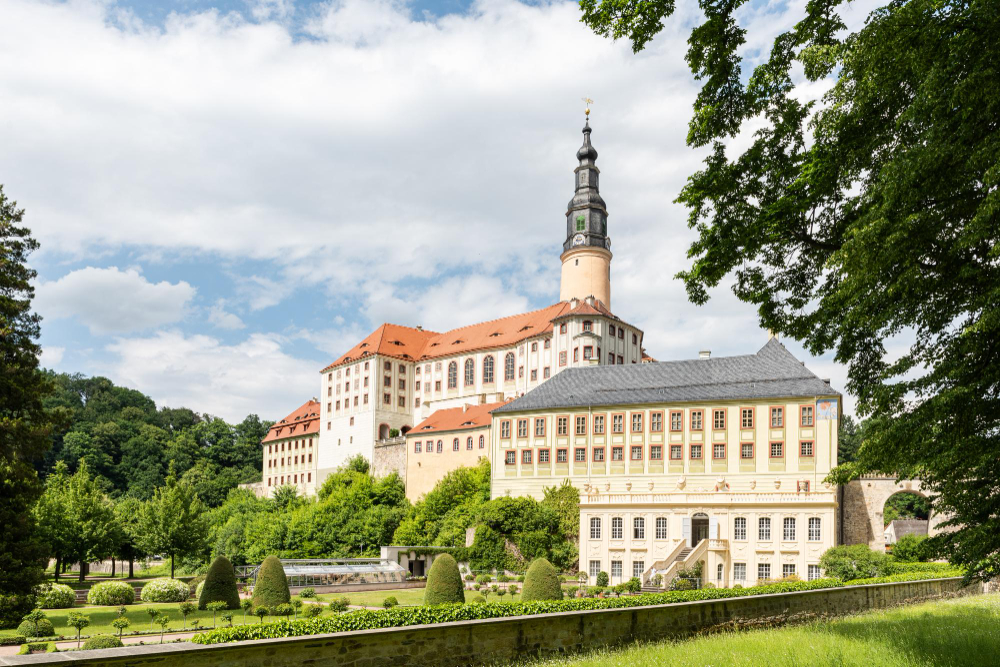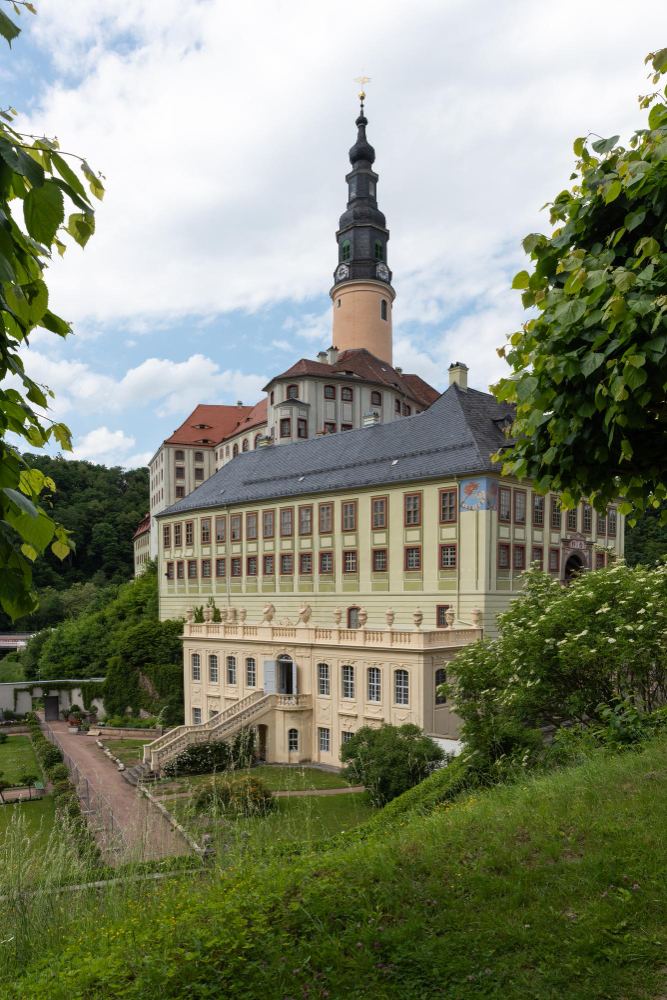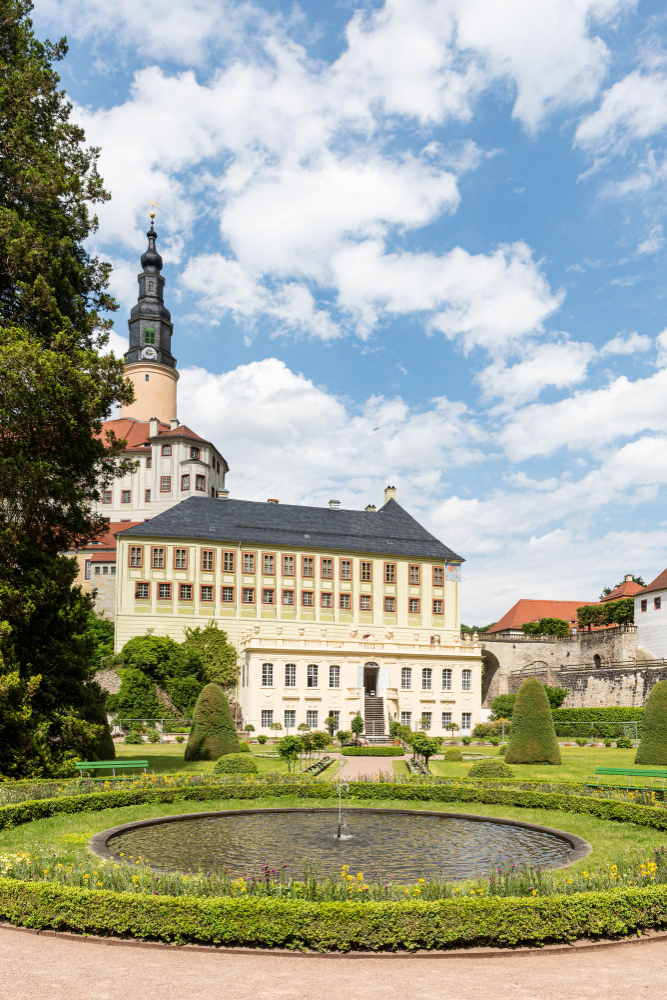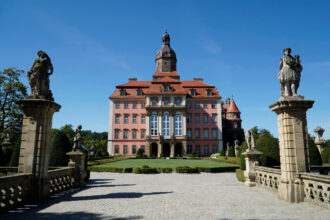

The majestic walls of Weesenstein Castle rise proudly above the Müglitz Valley on a rocky outcrop of knotty mica schist with quartzite inclusions. Situated some three kilometres south of Dohna, in the picturesque hamlet of Weesenstein in the municipality of Müglitztal, this building tells tales of noble houses, wars, works of art and royal festivities. With its original furnishings, exquisite wallpaper and neoclassical conservatory, the castle today attracts history buffs and romantics alike. Yet behind its impressive façade lies an eventful past full of legends and historical twists and turns.
The beginnings of a castle: between power and stone – The first written mention of Weesenstein Castle dates from 17 December 1318, although its origins probably go back much further. The name of the building derives from the predominant rock on the cliff – quartzite – which was formerly known as ‘Wese’ or ‘Waise’ and is sometimes also referred to as ‘false opal’. The white colour of the stone inspired various spellings such as ‘Weisinberg’ or ‘Weißenstein’. Over the centuries, these evolved into the present-day form ‘Weesenstein’, which has been the official name since the mid-19th century. The castle’s history can be explained by the marital alliances of the nobility and the strategic importance of the trade routes. Around 1275, the area around Weesenstein was presumably brought into the marriage of Otto the Elder of Dohna as a dowry by the daughter of Burgrave Meinhard III of Meissen. Thus, the area came into the possession of the Burgraves of Dohna, who played an important role in the region. The famous architect Gottfried Semper even believed that the castle tower dated from the 10th century – a claim which, however, remains unproven.
Wars and intrigues: The fate of a fortified house – The Middle Ages were a time of constant conflict, and Weesenstein Castle was no exception. The fortress suffered severe damage, particularly during the Dohna Feud (1389–1402). It was only after several military conflicts that the castle fell into the hands of the von Bünau family, who radically remodelled and expanded it. The von Bünaus were among the leading noble families of the time; they owned extensive estates not only in Saxony but also in Thuringia, and steadily expanded their power. In the 15th century, Weesenstein was to experience turbulent times once again when the Hussites invaded the region, wreaking havoc and destruction. Heinrich von Bünau rose to these challenges, though not always successfully. His ongoing disputes with his neighbours and the Church even led to his excommunication by the Council of Basel. Nevertheless, the von Bünau family remained closely associated with Weesenstein Castle until the 18th century, before it was eventually sold.
Splendour and Misery: From the Royal Court to the Turmoil of War – After a chequered history of ownership, Weesenstein came into the possession of the Saxon royal house, the Wettins, in 1830. King Anton the Benevolent acquired the castle for a considerable sum. His successor, King Johann of Saxony, bestowed particular splendour upon the estate. The cultured monarch often withdrew to the tranquillity of the castle to work on his German translation of Dante’s Divine Comedy. Even after his reign, the castle and its magnificent interior remained a favourite retreat for the Saxon rulers. Yet world history did not stop at the castle gates. During the Thirty Years’ War, Weesenstein suffered severe devastation, particularly at the hands of Swedish troops. The conflicts of the Seven Years’ War and the Napoleonic Wars also brought with them military threats and destruction. During the Second World War, in turn, the castle served as a depot for art treasures from Dresden’s museums, including works from the Picture Gallery and the porcelain collection. Thanks to extensive security measures, both the building and the treasures stored within it survived these dark times.
A new era: from museum to cultural centre – After the war, the castle initially served as emergency accommodation, but as early as 1952 the municipality of Weesenstein opened a museum within its historic walls. This marked the beginning of a new era: Weesenstein Castle as a cultural venue. Repeated restoration work and investment, particularly following the political upheavals in Germany, have comprehensively revitalised the building. Between 1991 and 2015, around 27 million euros were invested in the renovation. In the process, valuable wall paintings and furnishings from the 15th and 16th centuries were discovered and made accessible to the public. However, the devastating ‘flood of the century’ in August 2002 once again caused great suffering. The castle gardens were completely destroyed. Thanks to intensive efforts, the part of the garden closest to the castle was made accessible again just one year later, whilst full completion was not achieved until 2007. Today, Weesenstein Castle not only offers an insight into aristocratic life in centuries past, but has also established itself as a vibrant cultural centre. Whether it’s concerts in the castle chapel, theatre evenings, special guided tours or private celebrations such as weddings – the castle is a popular venue. Visitors can also enjoy the unique atmosphere of the historic rooms, including the Leather Wallpaper Room, the Bird Wallpaper Room and the Chinese Salon, whose ornate wall decorations were created by master craftsmen.
Legends and Curiosities: A Castle Turned Upside Down – As well as its historical significance, Weesenstein Castle also fascinates with its architectural design and the stories that surround it. One architectural peculiarity is its ‘upside-down’ construction: whilst in conventional castles the cellars are located at the very bottom, in Weesenstein they are, curiously, on the fifth floor. The stables, on the other hand, were housed on the fourth floor. The centuries-old tower, which probably dates from the 12th century, now rises significantly higher than it originally did. It once served as a vantage point on an important military and trade route linking Bohemia with Saxony. According to tradition, medieval court proceedings took place here, and inside there was even a so-called torture chamber – the setting for dark and fascinating tales. The castle grounds impress with their artistic design. There stands, for example, a statue of the Roman goddess Flora, who offers a rose to the viewer in quiet grandeur. This work of art was commissioned by King John of Saxony and underlines the castle’s long-standing connection to the royal family.
A brewery steeped in tradition – It is not only its architectural and cultural highlights that make Weesenstein a fascinating destination. The castle also boasts a remarkable culinary history. Beer has been brewed here since the early 16th century; thanks to its excellent flavour, it was even supplied to the court in Dresden. Although the brewery closed in 1863, the tradition was successfully revived in the 1990s. Today, the historic brewery produces various types of beer which visitors can enjoy during their visit.
A living cultural heritage – The current condition of Weesenstein Castle and its magnificent grounds is the result of decades of work and investment. Under the management of the Saxon State Institute for Palaces, Castles and Gardens, the palace enjoys a steady stream of visitors. Whether as a museum, an event venue or simply a picturesque oasis of tranquillity – it is a living part of Saxon history and a monument to the region’s eventful past. In every corner of Weesenstein Castle, time seems to have stood still, preserved in the details of its architecture, the stories of past owners and the legends of the surrounding area. A visit here is not only a journey into the past, but also an invitation to experience the magic of this place with your own eyes.