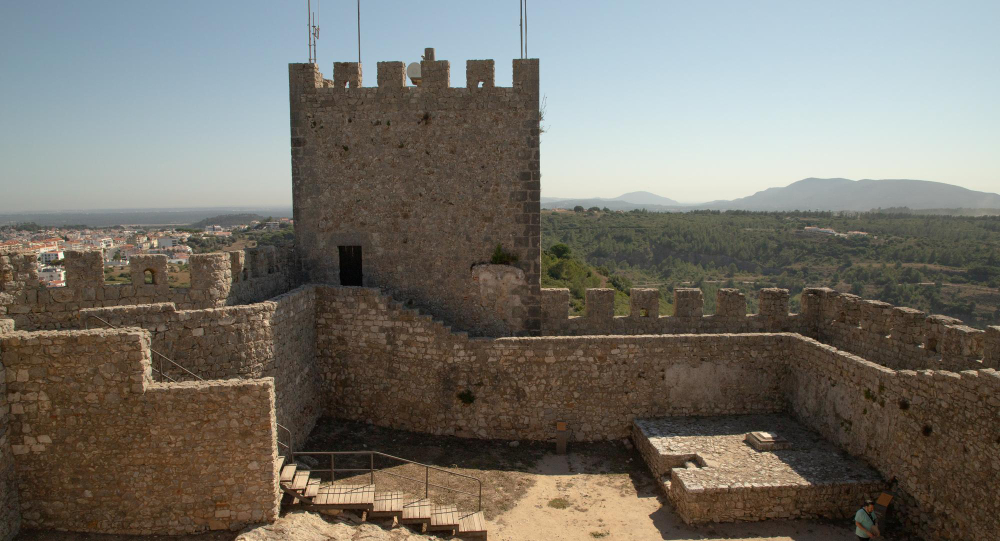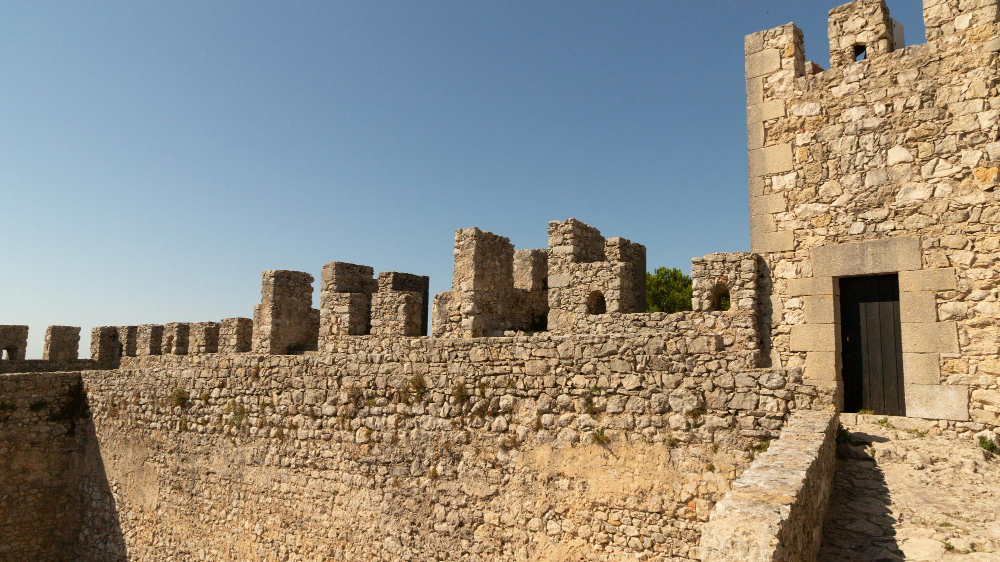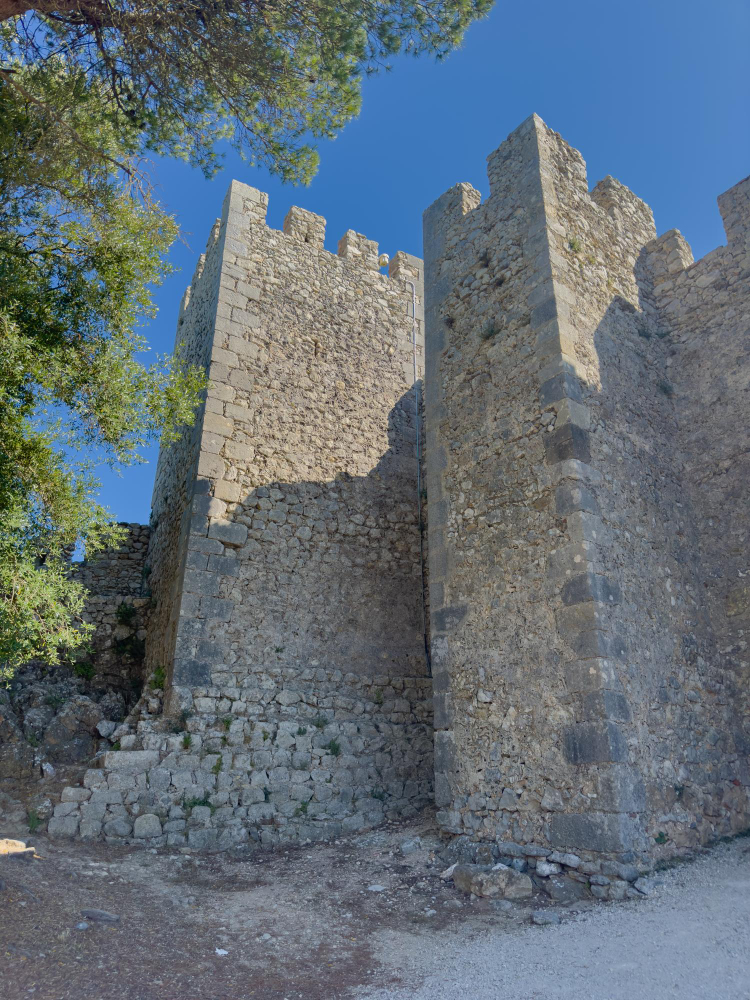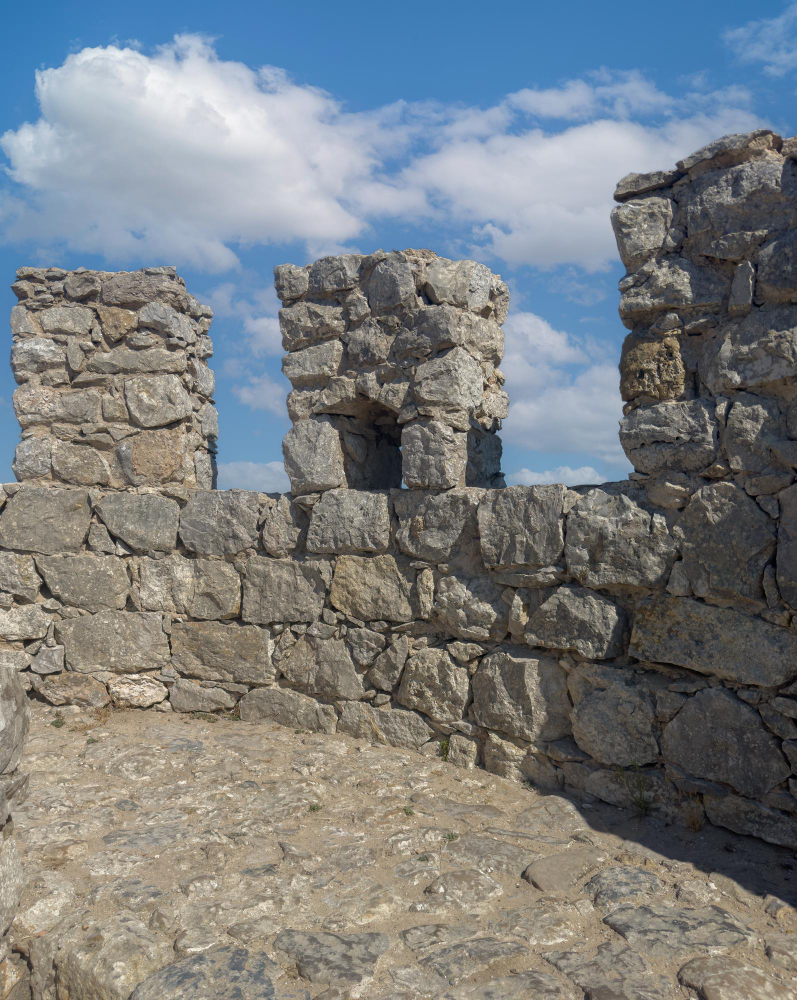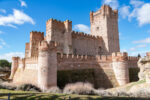

High above Sesimbra Bay, between the mouths of the Tagus and Sado rivers and just a few kilometres from Cape Espichel, stands one of Portugal’s most impressive medieval structures. Sesimbra Castle, often referred to as ‘Castelo dos Mouros’ – the Moorish Castle – is far more than just a picturesque ruin overlooking the Atlantic. Its walls tell of prehistoric settlement, Muslim rule, the battles of the Portuguese Reconquista, attacks by North African pirates and the gradual transformation of a mountain settlement into today’s fishing and seaside resort. Since 16 June 1910, the site has been protected as a “Monumento Nacional”, a Portuguese national monument. Its history makes it clear why: hardly any other place in the region so visibly combines its military, religious and maritime past.
A fortress in a strategic location – The castle’s location was no coincidence. It stands on a hilltop overlooking the sheltered bay of Sesimbra, which has always been used as a natural harbour. From the ramparts, one can survey the coastline and control access to the bay. The site was attractive to traders, fishermen and seafarers – and to military rulers alike. Archaeological and historical evidence shows that the area was already inhabited in prehistoric times. The region around Sesimbra bears numerous traces of early communities, including megalithic monuments and prehistoric sites. The castle that was later built therefore did not arise in an untouched landscape, but in a place whose strategic and economic importance had been recognised long before the Middle Ages. In the 9th century, Sesimbra formed part of the Muslim-ruled region of the Iberian Peninsula, al-Andalus. The fortified settlement was known at that time as “Alcáçova” – a term referring to a citadel or a fortified domain. The Muslim complex formed the basis for the medieval castle, the basic structure of which was altered and extended several times over the course of the following centuries.
Conquest, Reconquest and Destruction – The history of the castle is closely linked to the Reconquista, that is, the centuries-long expansion of Christian rule across the Iberian Peninsula. In 1165, Portugal’s first king, Afonso Henriques, captured Sesimbra. The conquest was part of a phase in which the young Kingdom of Portugal sought to secure its position south of the Tagus. However, this possession was not to last. In 1191, the Almohads, a Muslim ruling dynasty originating from North Africa, succeeded in recapturing Sesimbra. According to historical accounts, the fortress was largely destroyed in the process. By this time, the Almohads had strengthened their military presence on the peninsula and were able to bring several areas previously under Christian control back under their rule. It was not until 1199 that Sesimbra finally reverted to the Portuguese Crown. King Sancho I, son of Afonso Henriques, received support from Frankish crusaders in this endeavour. This involvement of foreign crusaders was by no means an isolated incident: on their way to the Holy Land, groups from Northern and Western Europe repeatedly reached the Iberian coast and supported Christian rulers there in military campaigns against Muslim towns and fortresses. Following the final reconquest, the castle was swiftly rebuilt and reinforced. Its importance lay not solely in controlling the town of Sesimbra; it was a key component of a larger defensive system along the Portuguese Atlantic coast and in the southern outskirts of Lisbon.
Walls against attacks from the sea – During the Middle Ages, the complex was extended on several occasions. The surviving remains of the fortifications still show today that the castle served not only as a residential or administrative centre, but above all fulfilled a military function. Walls enclosed the hilltop settlement, towers allowed the surroundings to be observed, and the elevated position offered a clear tactical advantage. In 1323, the walls were further reinforced. It was during this work that the west tower was built. Its function was closely linked to the threats posed by the sea: it served as a lookout point to spot ships and potential attackers at an early stage. Raids by North African corsairs – frequently referred to in Portuguese sources as ‘Barbary pirates’ – were particularly feared. For centuries, Portugal’s coastal towns were not only trading centres but also vulnerable targets. Piracy, privateering and military conflicts in the western Mediterranean and the Atlantic shaped the security mindset of the coastal population. Sesimbra’s castle should therefore not be viewed in isolation: it formed part of a landscape comprising watchposts, fortresses and, later, coastal fortifications. The castle also played a role during the Portuguese succession crisis of 1383 to 1385. In the conflict with Castile, João of Avis – later King João I – and his troops sought refuge in Sesimbra in 1384. The war determined Portugal’s political independence. The fact that the fortress was used as a place of retreat during this tense period underlines its military value.
When life moved down into the valley – Despite its defensive function, the hilltop castle gradually lost its importance in everyday life. From the 15th century onwards, more and more inhabitants moved down from the slopes to the bay. That was where the economic opportunities lay: fishing, processing the catch, trade and shipbuilding increasingly shaped Sesimbra’s development. The shift of the population to the coast was both practical and logical. Those who made their living from the sea wanted to live close to boats, nets, landing stages and workshops. The medieval settlement within the castle walls, by contrast, became increasingly unattractive. As early as 1516, sources point to a state of decline and the beginning of its abandonment. Although the castle remained as a military outpost, its former role as the town’s centre was over. This transformation can still be seen today in the topography of Sesimbra: the historic fortress lies above the modern town, whilst economic and tourist life is concentrated along the bay.
Church, Earthquakes and Decay – Within the castle grounds stands the Church of Santa Maria do Castelo. According to tradition, it dates back to King Afonso Henriques; however, its present appearance is the result of later alterations and restorations. The church was renovated in 1721. To this day, it remains an important part of the complex, as it serves as a reminder of the time when the castle was not only a garrison and a refuge, but also an inhabited place with a vibrant religious life. As early as the end of the 17th century, in 1693, the fortifications had been reinforced once again. However, these measures could not prevent the complex from suffering severe damage in the 18th century. The great Lisbon earthquake on 1 November 1755, the effects of which were felt across large parts of Portugal, dealt a severe blow to the already weakened castle. Many parts of the structure fell into disrepair or were destroyed. In 1875, part of the site was converted into a cemetery – a clear sign that the complex had finally lost its military function. The castle was now primarily a historic site; whilst its walls still dominated the landscape, it was not systematically preserved for a long time.
From a site of ruins to a national monument – The protected status granted in 1910 was an important step, but comprehensive measures did not follow until decades later. Between 1933 and 1945, the then Directorate-General for Buildings and National Monuments, the “Direção-Geral dos Edifícios e Monumentos Nacionais” (DGEMN), commissioned conservation and restoration work. The aim was to stabilise the remaining sections of wall and preserve the site’s historical character. Further restoration work took place in 1998. Today, the castle is managed by the municipality of Sesimbra. Visitors can explore large sections of the defensive walls on foot. From the higher vantage points, there is a sweeping view across the bay, the town and the coastal landscape of the Setúbal Peninsula. Permanent exhibitions explain the history of the site; there is also a shop and a café for visitors. Sesimbra Castle is therefore not merely a viewpoint overlooking a popular holiday resort. It is a rare testament to the long history of a Portuguese coastal community: from prehistoric settlers through the Islamic “Alcáçova”, the struggles for Portuguese statehood and the threat of attacks from the sea, right up to the 1755 earthquake and modern efforts to preserve the site as a historic monument. Anyone standing on the ramparts today looks out not only onto the sea. Below lies a bay which, over the centuries, has provided people with shelter, food and trade, whilst at the same time posing a danger. It is precisely this tension that gives Sesimbra Castle its special fascination.