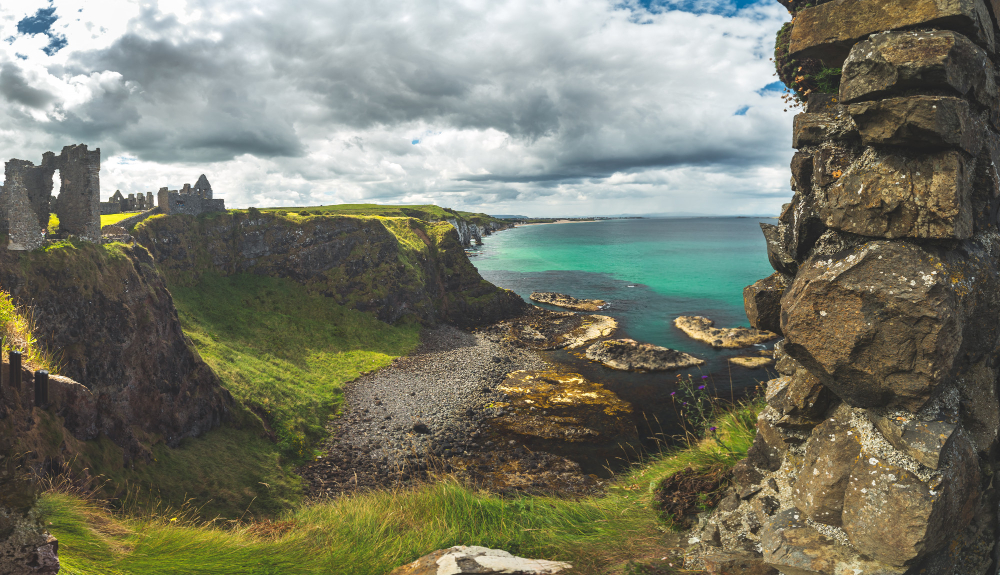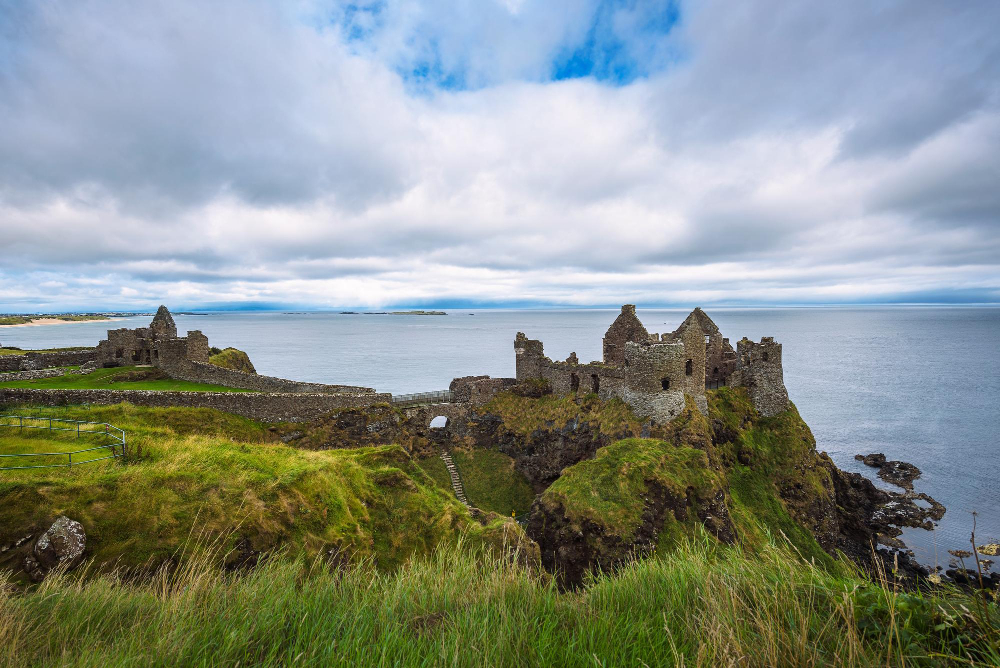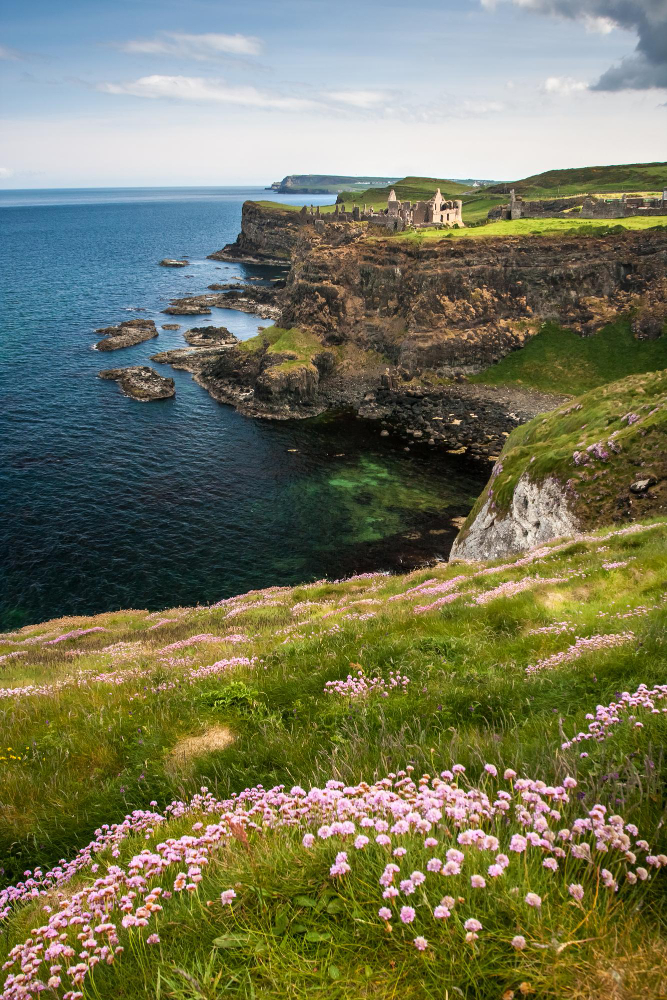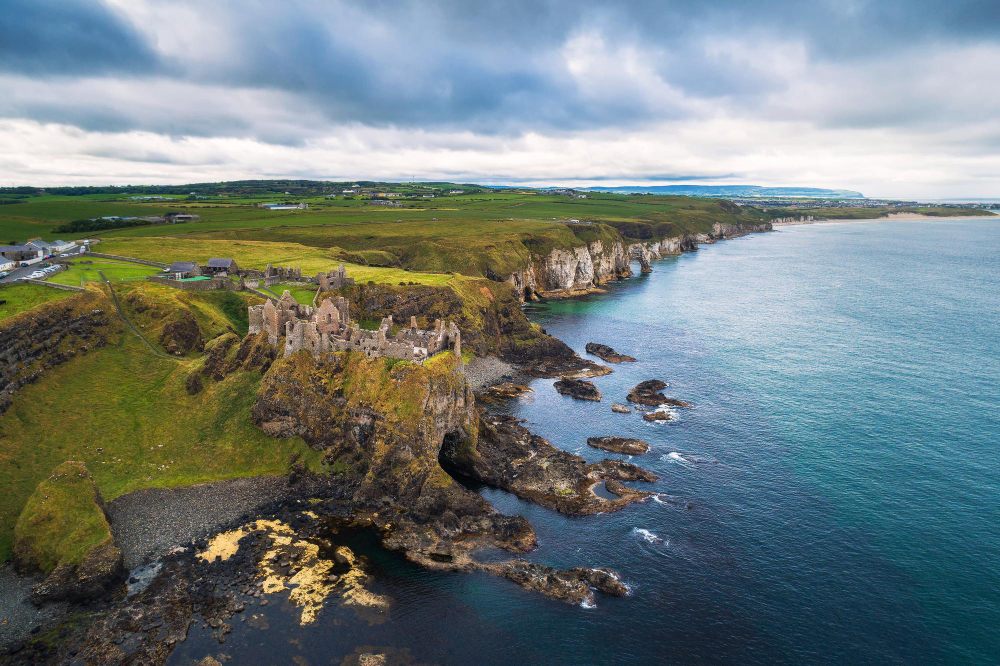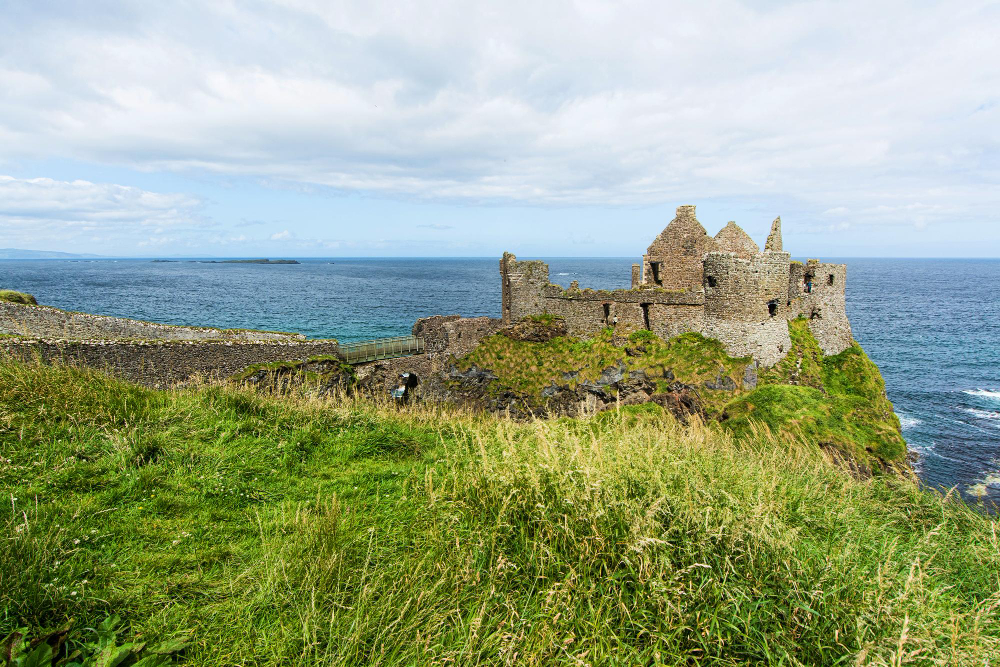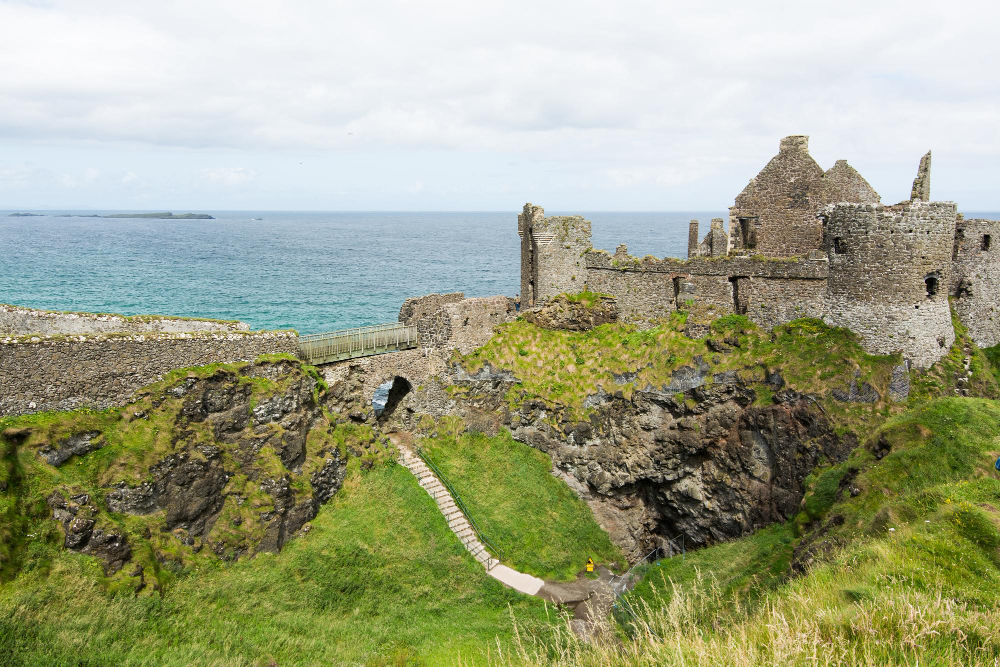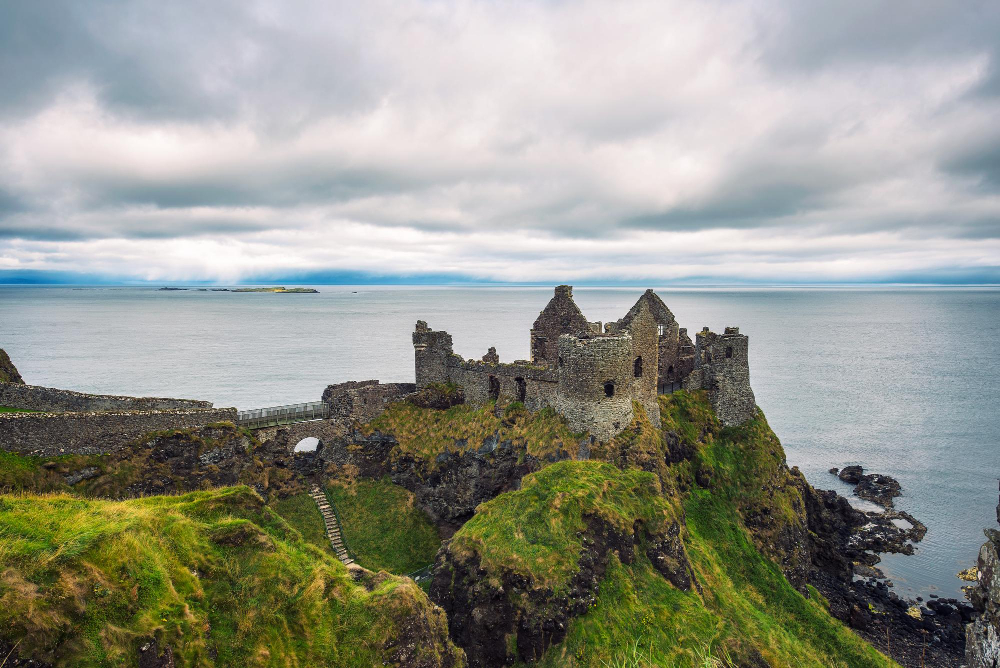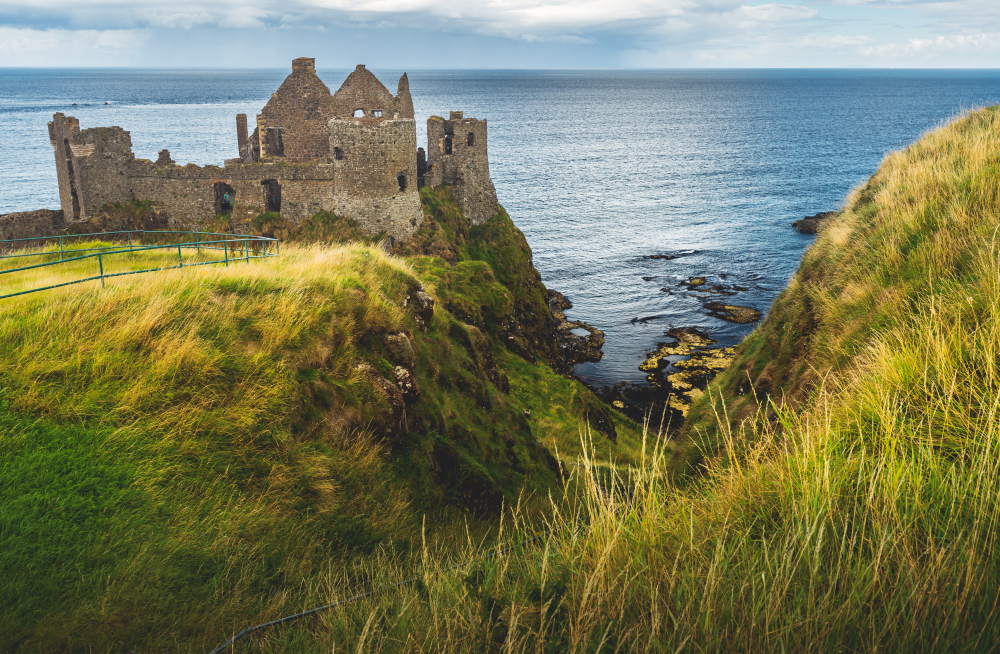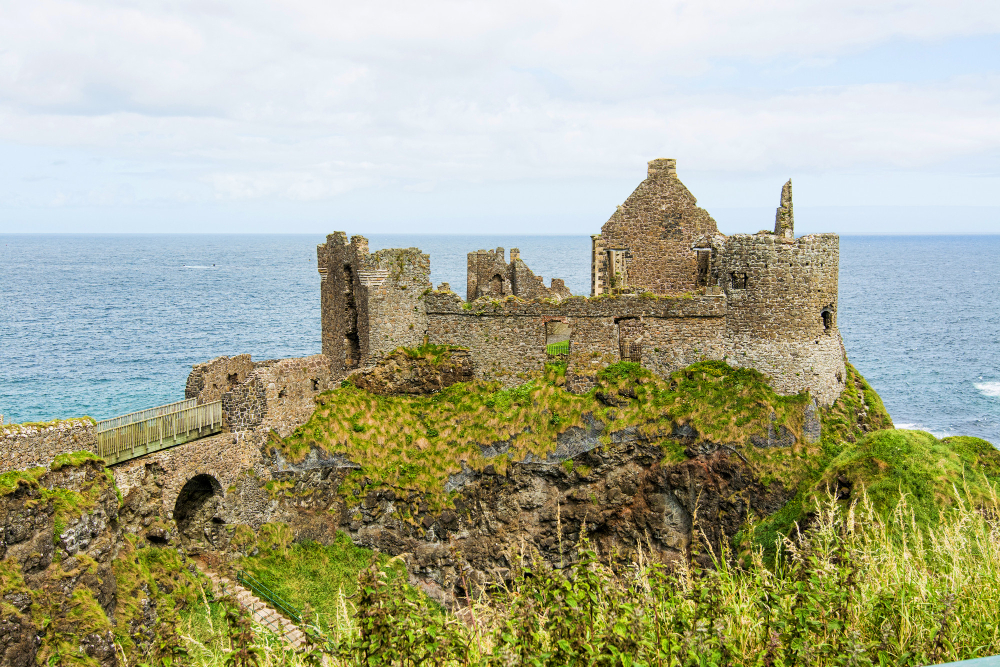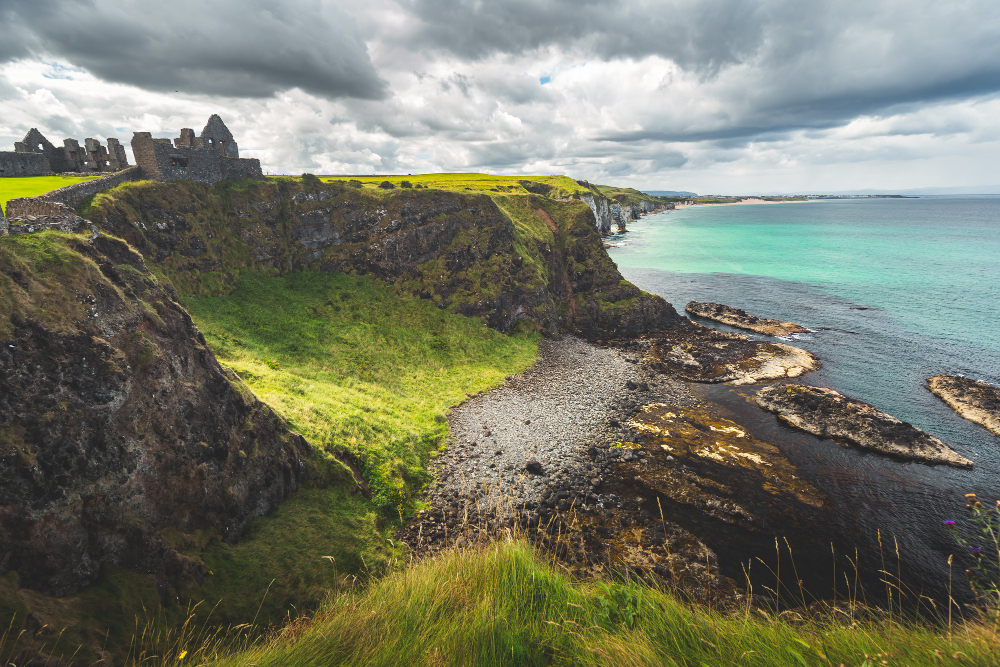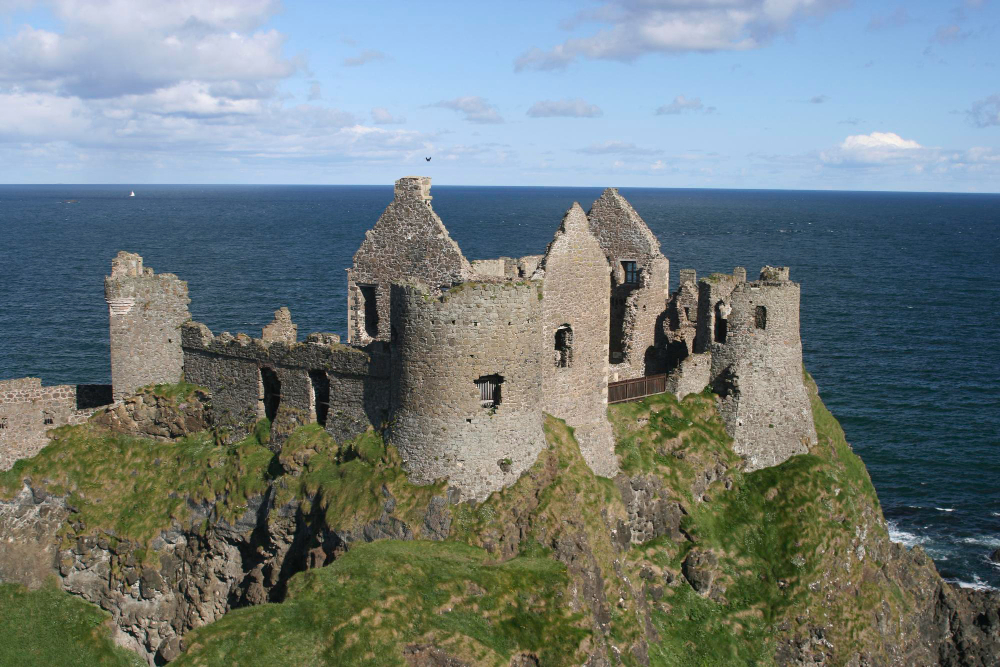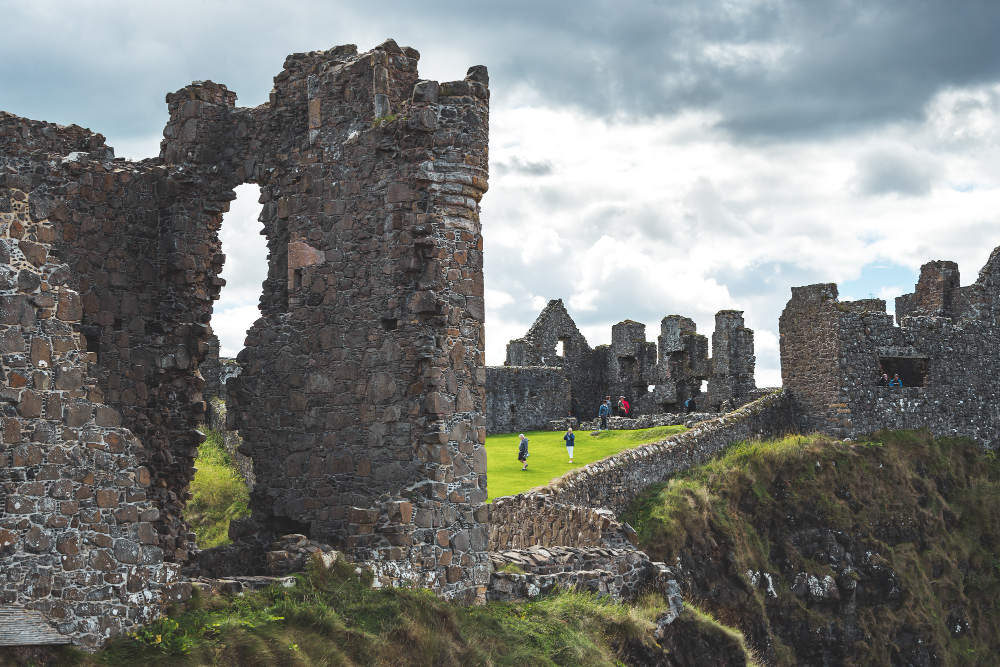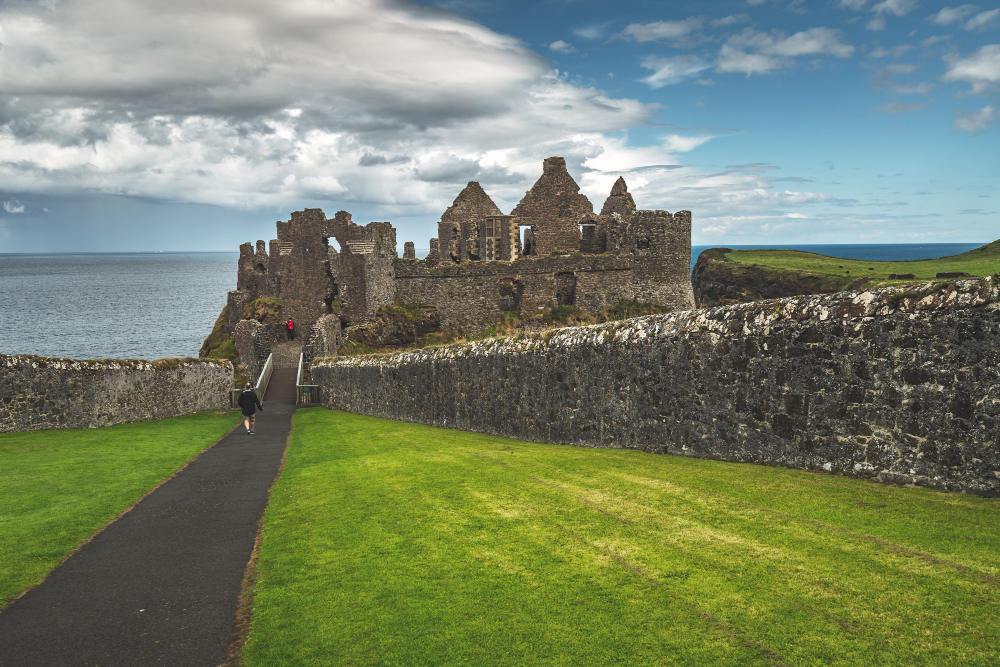

Rugged cliffs, the untamed roar of the waves crashing far below, and the shadowy remains of centuries-old stone walls – Dunluce Castle is a hauntingly beautiful testament to Ireland’s medieval past. Dramatically perched on a basalt cliff on the north coast of County Antrim, this castle bears witness to over 800 years of history, ranging from Viking raids and bloody clan battles to a shipwreck involving the infamous Spanish Armada. Dunluce Castle is not merely an impressive ruin, but a gateway to the stories, legends and battles that have helped shape the history of Ireland and Scotland.
The Beginnings: A Fortress Built on Power – The history of Dunluce Castle begins in the 13th century, when Richard Óg de Burgh, the 2nd Earl of Ulster and one of Ireland’s most powerful Anglo-Norman magnates, had the first version of the fortress built. Its strategic location was no coincidence. The steep cliffs surrounding the site on all sides made it an impregnable fortress, accessible only via a narrow bridge. Archaeological finds suggest that this area was considered sacred long before the medieval castle was built, as early settlements and fortifications date back to the early Christian and Viking periods. At the beginning of the 16th century, the McQuillan family took over the castle, heralding a new era for Dunluce. They further fortified it and added defensive drum towers on the eastern side, each of which had an imposing diameter of 9 metres. The McQuillans were no ordinary landowners; they ruled as lords over the ‘Route’ (a medieval territory in the north of Antrim) and consolidated their power through military might. However, the McQuillans’ dominance was ultimately short-lived. In the mid-16th century, following two decisive defeats, they were ousted by the Scottish MacDonnell clan. This marked the beginning of Dunluce Castle’s most historic chapter.
The MacDonnells: Scottish nobility and tragic tales – Under the MacDonnells, Dunluce Castle was transformed from a remote fortress into a vibrant centre of political and social life. Clan chieftain John Mor MacDonald – a son of ‘Good John of Islay’, the Lord of the Isles, and a descendant of the Scottish royal family – used the castle as a springboard to consolidate his control over the region. The MacDonnells, known for their connections to both the Scottish and Irish nobility, brought with them a wealth of culture and architectural innovation. Sorley Boy MacDonnell, one of the clan’s most famous leaders, captured the castle in the late 16th century after defeating his rivals. He had parts of the fortress renovated, incorporating a Scottish style that reflected his dual heritage. Sorley Boy allied himself with Queen Elizabeth I of England – a move that illustrates the fine line Gaelic chieftains had to tread during this politically turbulent period in order to maintain their power. The castle was also the scene of one of the most dramatic episodes in the region’s maritime history. In 1588, the ‘Girona’, a galleass belonging to the doomed Spanish Armada, was shipwrecked off the rocky coast near Dunluce. Sorley Boy salvaged cannons from the ‘Girona’, which were reused as part of the castle’s defences. The wealth he gained from selling the ship’s remaining cargo enabled him to finance extensive repairs and fortification works. Traces of these efforts can still be seen in the castle ruins today.
The Decline: From Nobility to Decay – Despite its splendour, Dunluce Castle could not withstand the relentless passage of time and changing geopolitical circumstances. At the beginning of the 17th century, Randal MacDonnell, the first Earl of Antrim, attempted to modernise the castle and transform it into a luxurious residence. Lady Katherine Villiers, his wife and a member of the influential Buckingham family, added sumptuous furnishings and decorative elements that reflected the immense wealth and status of the MacDonnell family. But dark clouds were gathering on the horizon. The Irish Rebellion of 1641 – a major conflict that sparked sectarian violence between Catholics and Protestants – left its mark on Dunluce. The nearby settlement of Dunluce Town, founded in 1608 by Randal MacDonnell, was razed to the ground during the rebellion, signalling the beginning of the end for this once-thriving centre. The final blow came in 1690, when the MacDonnells lost much of their wealth following the Battle of the Boyne, a decisive engagement in the Williamite War. Dunluce Castle was abandoned shortly afterwards, and its stones were stripped away by locals for building projects in the surrounding area. What remains today are the skeletal ruins of a once-mighty fortress, clinging precariously to the cliffs as they have done for centuries.
The Lost City of Dunluce: An Archaeological Treasure – In recent decades, Dunluce Castle has remained the focus of interest not only for historians but also for archaeologists. In 2011, a groundbreaking excavation brought to light the remains of a ‘lost town’ in the immediate vicinity of the castle. This settlement, believed to have been built around 1608, offers a fascinating insight into life in the early 17th century. What set this town apart were its revolutionary features, including indoor toilets and a carefully planned grid-pattern street layout – innovations that were remarkably advanced for their time. The discovery has provided a clearer picture of the community that once flourished in the shadow of Dunluce Castle’s imposing walls. However, researchers estimate that 95 per cent of the town remains hidden beneath the ground, meaning many secrets are still waiting to be uncovered.
A cultural icon – Over the centuries, Dunluce Castle has inspired countless artists, writers and filmmakers. Some believe it served as the inspiration for Cair Paravel, the fictional castle in C. S. Lewis’s The Chronicles of Narnia. In 1921, the musician Edward Norman Hay composed a tone poem entitled ‘Dunluce’, in which he captured the castle’s haunting beauty in music. Furthermore, Led Zeppelin fans may recognise the castle’s silhouette on the inside of the gatefold cover of the 1973 album Houses of the Holy. More recently, Dunluce Castle gained worldwide attention as a filming location for the hit series Game of Thrones, in which it served as the eerie Castle Pyke of House Greyjoy. These cultural references have reinforced Dunluce Castle’s status not only as a historic landmark but also as a symbol of enduring mystique.
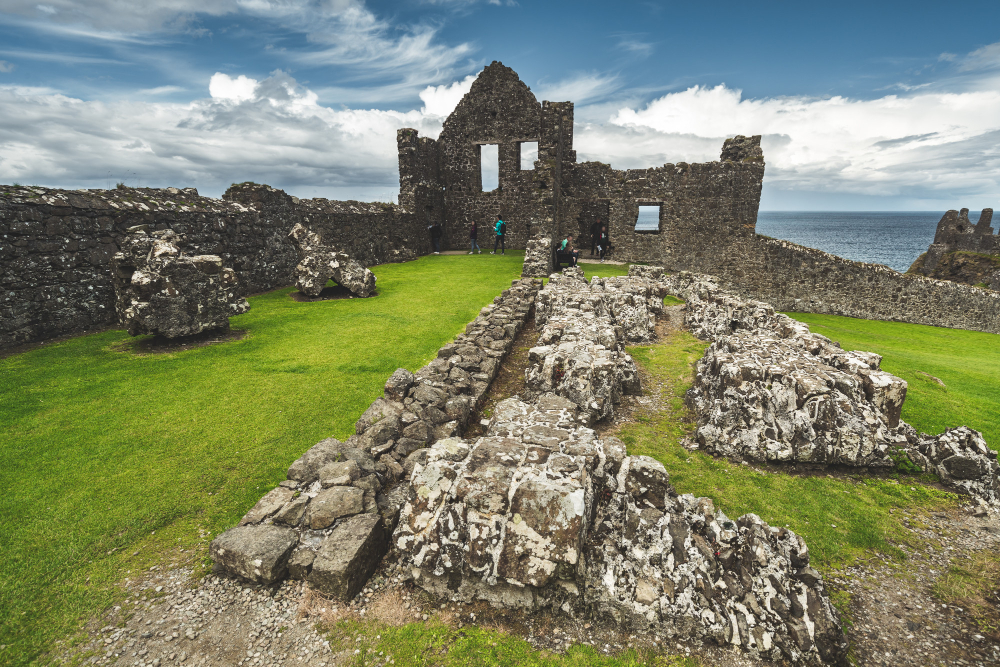
Heritage Protection and Tourism – Today, Dunluce Castle is under the care of the Northern Ireland Environment Agency. Visitors are drawn to its dramatic setting and weathered ruins, where they can explore the remains of grand halls, kitchens and watchtowers, imagining the lives of those who once called this place home. Conservation measures have ensured that future generations will also be able to experience its fascination. Nevertheless, challenges remain in terms of conservation, particularly given the site’s precarious position on weather-beaten cliffs.
Dunluce Castle is more than just a ruin; it is a microcosm of the complex interweaving of Irish and Scottish history. From its origins as a Norman fortress, through its role as the seat of powerful clans, to its current status as a cultural landmark, the castle stands as an enduring testament to resilience and change. For visitors who cross the narrow bridge into its weather-beaten embrace, Dunluce offers an unforgettable journey into the past – a realm where history, legend and natural splendour converge. Those wishing to delve deeper into the history of Dunluce Castle and similar sites across Northern Ireland will find valuable insights into this fascinating era of history from organisations such as the Northern Ireland Environment Agency, the Irish Archaeological Research Group and local heritage organisations. Whether you’re a historian, a traveller or simply a dreamer keen to discover stories carved in stone – Dunluce Castle awaits you: timeless, untamed and unforgettable.