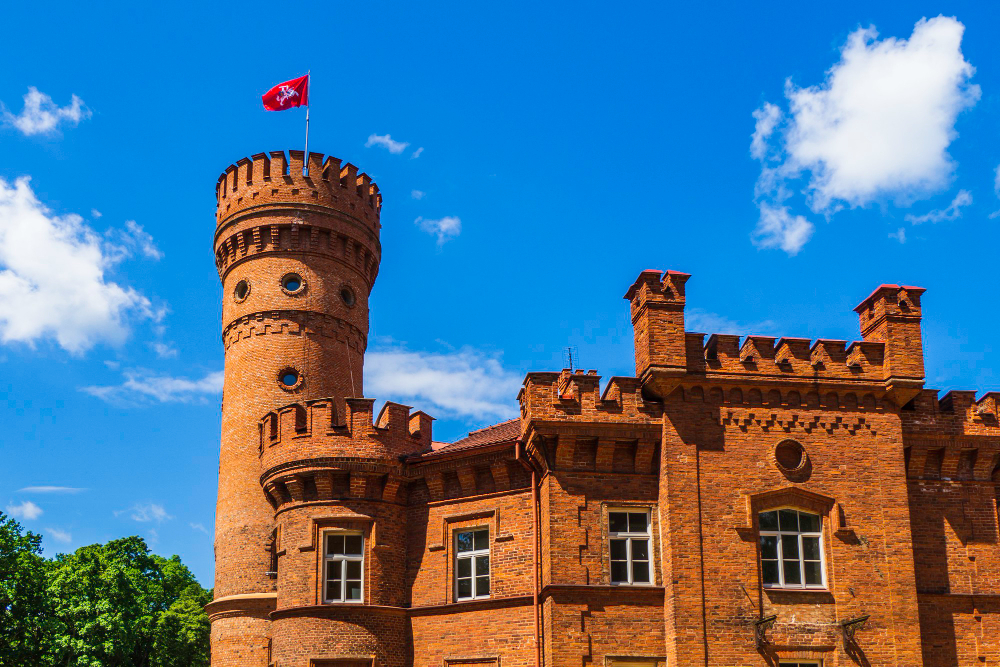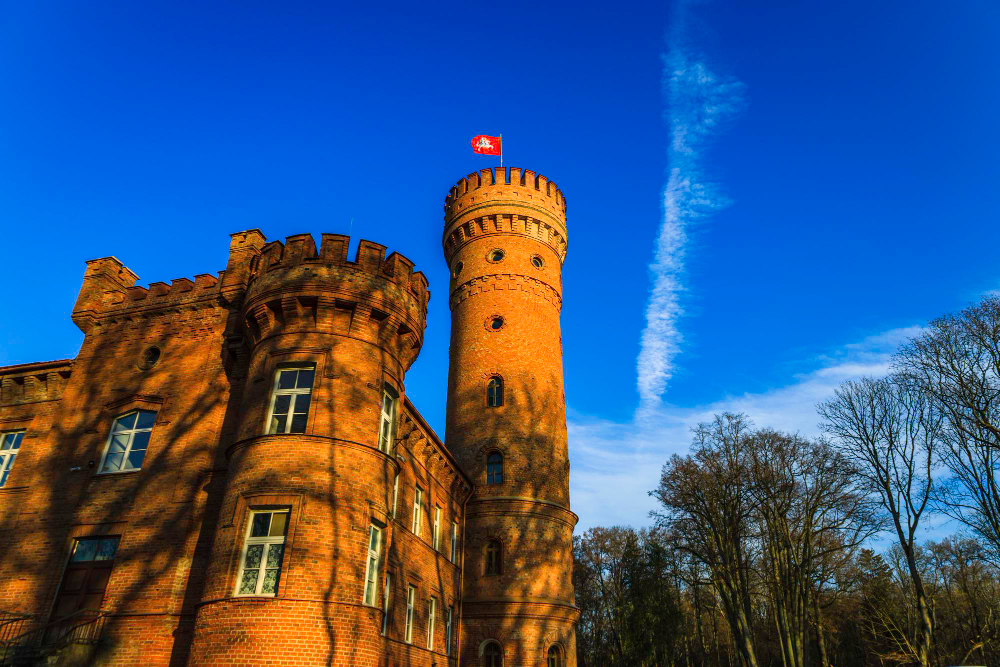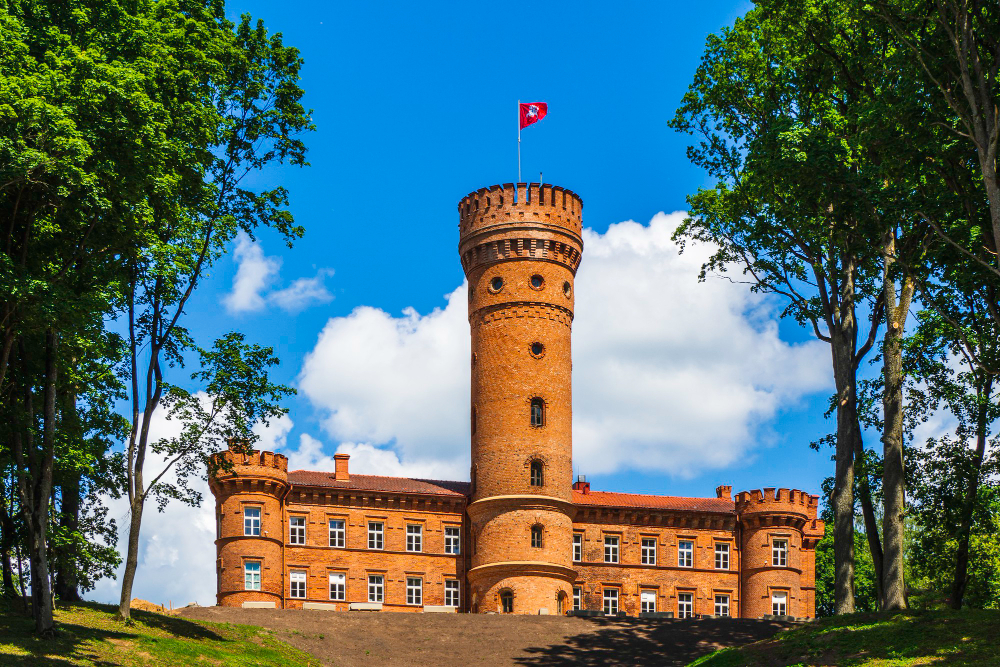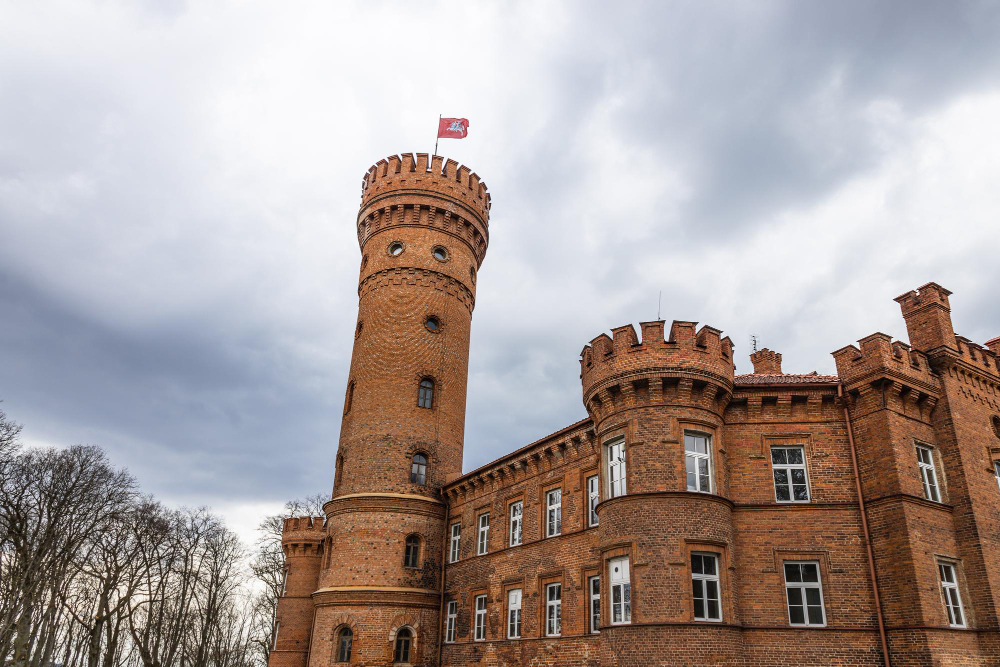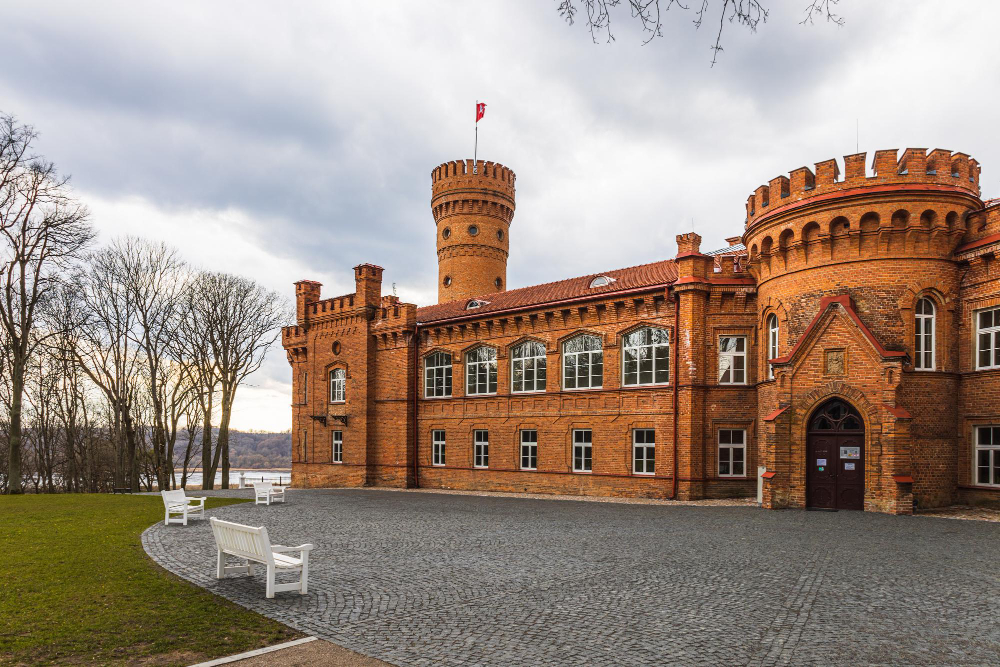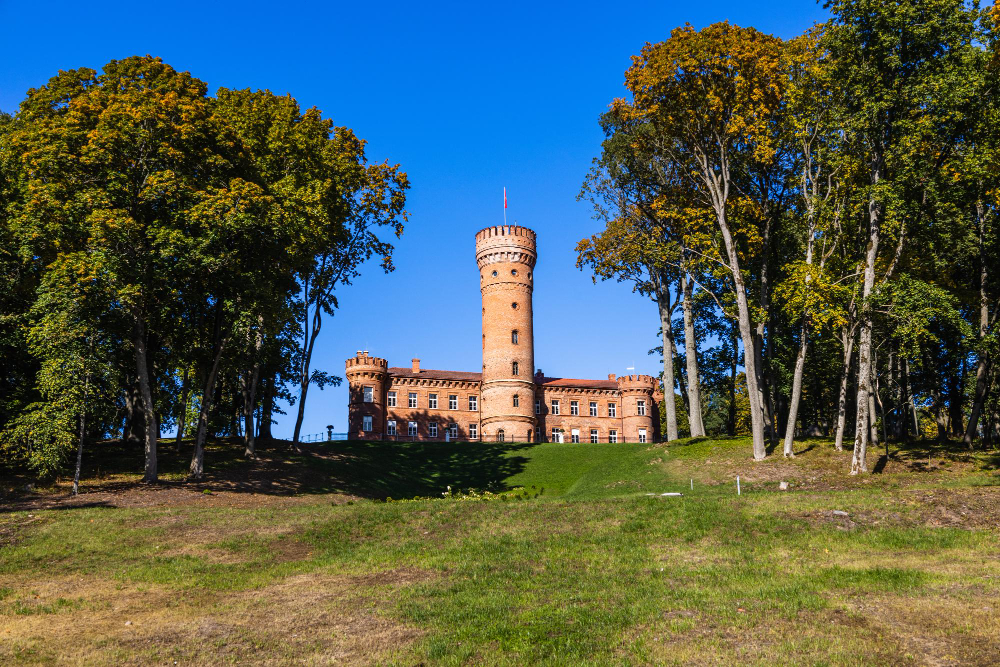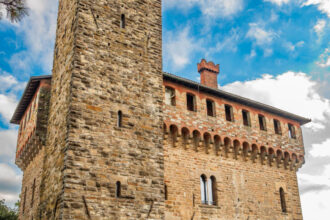

Raudonė Castle, a majestic 19th-century building, is nestled in the picturesque landscape of the Nemunas Valley in Lithuania. With its eventful history, fascinating legends and impressive architecture, the castle plays a significant role not only as a former school building but also, today, as a museum and cultural centre. This article takes you on a journey through its turbulent past and reveals the secrets of this remarkable building.
The Beginnings: Bayersburg II and the ‘White Maiden’ – Before the present-day castle was built, a medieval castle stood on this very spot: Bayersburg II. At a time when the region was still under the rule of the Teutonic Order, this castle was of strategic importance. But it is not only its historical role that is interesting, but also the legends that surround it. In particular, the legend of the ‘White Maiden of Bayersburg’ is still told to this day. She is said to haunt the ancient walls and is a symbol of the tragic stories and secrets of that era. The ‘White Maiden’ is regarded as an unhappy soul who found no peace due to a broken promise or an unfulfilled love. Much like many European legends about ghostly figures, this story has fascinated generations of locals and visitors to the region. Today, the myths evoke the mystical atmosphere of centuries past, which can still be felt on the grounds of Raudonė Castle.
From a royal estate to a Renaissance building – In the 16th century, the region underwent a profound transformation. The Grand Duke of Lithuania, Sigismund II Augustus, gifted the estate to a Prussian merchant named Krispin Kirschenstein. He set himself the goal of transforming the former castle into a magnificent Renaissance-style manor house. Under his direction, a striking 34-metre-high tower was also erected, which remains one of the castle’s most distinctive features to this day. The architecture of this period was characterised by elegance and functional design – a style that was popular throughout Europe during this historical phase. The influence of the Renaissance turned Raudonė into a centre of artistic and cultural life and laid the foundations for the castle’s later significance.
Changes over the centuries: from noble families to princes – Over the centuries, the castle changed hands several times. Of particular significance were the changes brought about by two influential families: the Polish-Lithuanian szlachta family of the Olędzki (Olendskiai) and the Russian Zubows. In the 18th century, the Olędzki family commissioned Laurynas Stuoka-Gucevičius, a highly regarded architect in the region, to renovate and modernise the castle. His work gave the estate a timeless aesthetic and strengthened the building’s presence within the Lithuanian cultural landscape. The next chapter was written by Prince Platon Zubov, who acquired the castle at the beginning of the 19th century. Under his ownership and under the direction of the architect Cesare Anichini, the estate was redesigned in the Neo-Gothic style – a style characterised by its romantic yet dramatic effect. The Neo-Gothic buildings and the extensive castle grounds gave the entire complex a distinctive identity.
Raudonė Park: Nature and History United – A key feature of the castle is the adjoining park, which impresses not only with its size but also with its botanical highlights. Rare tree species such as the silver fir, the Swiss stone pine and the grey walnut grow here, making the place an oasis of tranquillity and beauty. Particularly noteworthy is the so-called ‘nine-trunk lime tree’, whose appearance is as impressive as it is unusual. The Gediminas Oak, another of the park’s proud trees, is said to have a special history. According to legend, Grand Duke Gediminas once dined beneath this tree, which lends it symbolic significance. Unfortunately, the mighty tree no longer bears any leaves, but its place in the park serves as a reminder of the rich past and the importance of nature to Lithuanian culture.
The Last Owners – An Island’s History and a Tragic End – A particularly fascinating episode in the castle’s history concerns the late 19th and early 20th centuries. The castle’s last owner, Sophia Waxell, was the granddaughter of Sophia von Pirch-Kaiserov, the niece of Prince Platon Zubov. Sophia Waxell was married to José Carlos de Faria e Castro from Madeira, who also managed the estate. Following her untimely death, the castle initially passed to her husband and later to her son, Josef Carlo de Faria e Castro, and his family. This period was marked by personal loss and political upheaval. In 1937, the castle’s history took a new turn: it was taken over by the National Bank of Lithuania and has remained a valuable part of the Lithuanian cultural landscape to this day.
Transformation: From School to Art Museum – In the 20th century, the castle took on a new role as a state school. For decades, it served as an educational institution for Lithuania’s younger generation. However, with growing interest in historic architecture and the preservation of heritage sites, the castle was eventually converted into a museum and arts centre. Today, visitors can stroll through the corridors, enjoy the impressive view of the Nemunas Valley from the tower, and admire the works of art on display inside.
A Symbol of Cultural Identity – Today, Raudonė Castle stands not only as a symbol of Lithuania’s architectural and historical splendour, but also of the turbulent times the country has endured. Whether as the residence of noble families, a school or a museum – every phase of the castle’s history reflects an important chapter in Lithuania’s development. What makes this castle so special, however, are the stories hidden behind its walls and across its grounds. From the ‘White Maiden’ to the Gediminas Oak – the myths and legends lend the place a mystical aura that attracts visitors from all over the world. Raudonė Castle is a true treasure of Lithuania, captivating visitors with both its history and its architectural beauty. Its links to significant historical figures, its role as the setting for fascinating legends and its unique location in the Nemunas Valley countryside make it a destination that leaves no visitor unmoved. Anyone interested in culture, history and nature should definitely include this enchanting place in their itinerary.