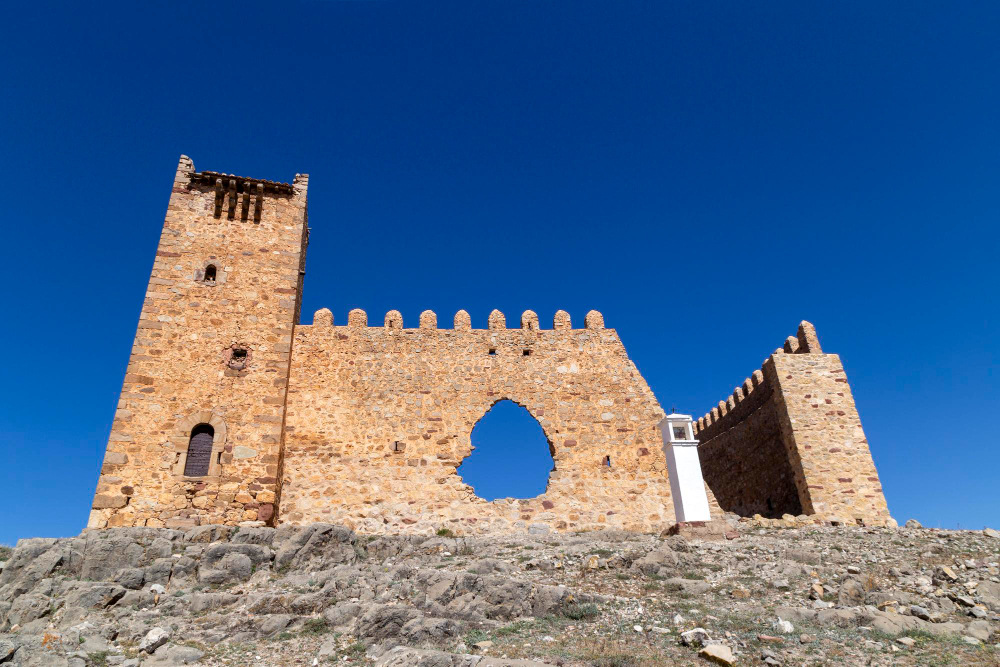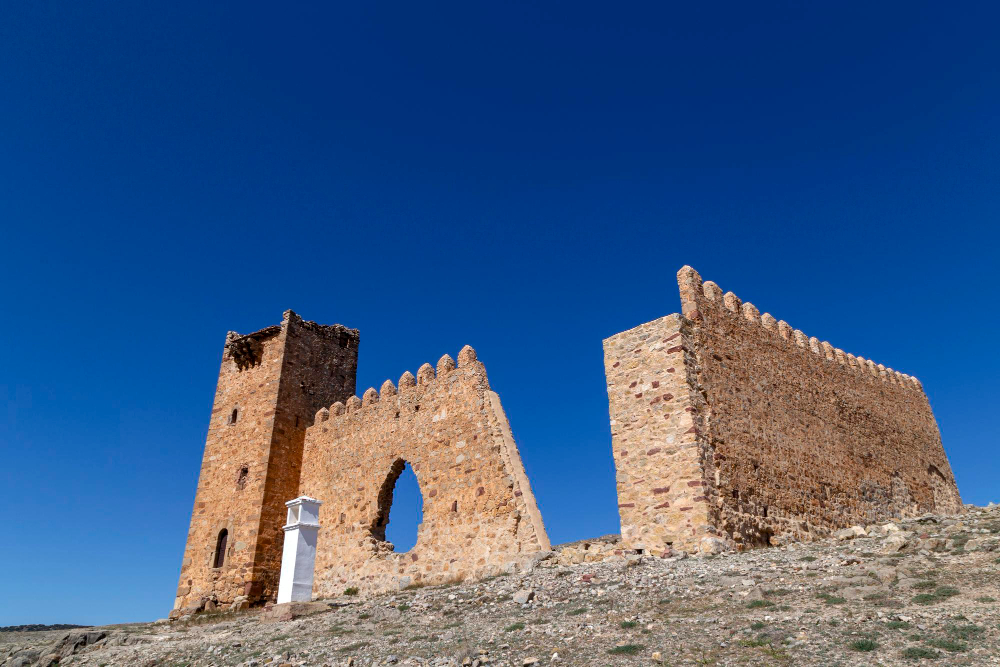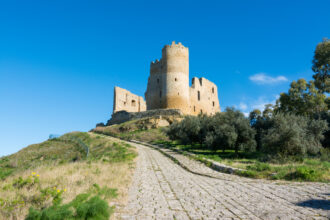

In the remote and peaceful countryside of the province of Teruel, in the small municipality of Alba de Campo to be precise, the ruins of a medieval stronghold – Castell Alba de Campo – stand on a gentle hill. Although today only crumbling walls bear witness to the once-proud structure, this fortress conceals a rich history that is closely linked to the power struggles of the Middle Ages and the defence of the border between Aragon and Castile. As a listed cultural asset of special interest, the castle stands as a valuable testament to Aragon’s past, one that deserves far more attention than the state of neglect it is in today.
Historical background: A border fortress of strategic importance – The existence of Castell Alba de Campo can be traced back to the reign of James I, the ‘Conqueror’ of Aragon (reigned 1213–1276). Even at that time, the fortress was part of a complex defence system on the border with the Kingdom of Castile. Its location on a small hill gave the castle an outstanding vantage point and control over the surrounding valleys and paths, making it a strategically indispensable outpost. Alba de Campo played an active role during the complex entanglements between the two kingdoms of the Basque Country and Aragon in the 13th and 14th centuries. In particular, during the conflicts that took place under, amongst others, King Peter IV of Aragon (reigned 1336–1387) and his Castilian counterpart, the castle was used as a military stronghold. In 1308, Martín de Galvanes was appointed alcaide – the castle commander – a move that underlines the fortress’s importance. This role was of critical importance, as the alcaide not only directed the defence but also ensured the administration and upkeep of the castle. In 1357 in particular, Queen Leonor of Aragon and Foix had the castle repaired and an aljibe – a water reservoir – built. This work was essential, as a sufficient water supply within the walls was vital for survival during sieges. The construction of the aljibe also suggests prolonged stays or sieges, during which self-sufficiency was essential. Another historical conflict in which the Castell played a role was the so-called ‘War of the Two Pedros’ (1356–1369), a dynastic conflict between Pedro IV of Aragon and Pedro I of Castile. During these hostilities, the castle once again found itself at the centre of the fighting, as it controlled the border and was therefore of crucial importance to supply routes and troop movements.
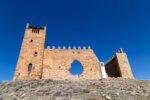
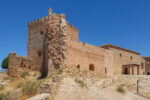
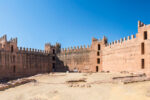
Architecture and structural features – Despite its current state of ruin, the Castell Alba de Campo still provides insights into its original construction and function. The complex follows a rectangular ground plan measuring approximately 30 by 20 metres. Whilst large sections of the surrounding walls have been lost, two sections of wall – on the north and east wings – still remain, crowned by characteristic pointed battlements. At the eastern corner stands a particularly well-preserved square tower structure with a side length of approximately five metres. The tower is topped by an ‘Amataknadel’ – a pyramidal tiled roof – a typical defensive feature that provided protection from the elements whilst also serving as a watchtower. The tower’s position was strategically chosen: it overlooked the castle’s main entrance, which was also the only access point and was clearly recognisable as a round-arched portal constructed from carefully worked stone blocks. Inside the complex lies a further entrance, now bricked up, which also featured a round arch. The use of round arches with dovetails was a common architectural feature for castle entrances at the time, as they provide structural stability whilst also being aesthetically pleasing. Furthermore, the ruins of three further towers can still be seen today: one at each of the remaining corners and one centrally located within the inner courtyard. These towers served as important defensive positions from which the surrounding area could be monitored and attacks repelled. Its proximity to the Ermita Santa Bárbara, a small chapel, is also noteworthy. Such religious sites were often situated near military installations, as patron saints such as Saint Barbara were traditionally associated with protection against sudden death and danger – something of great psychological significance to the castle’s inhabitants, particularly in times of war.
Legends and cultural significance – Like many medieval castles, Castell Alba de Campo is linked to stories and legends that have been passed down through folklore. Although there are no extensive written sources to substantiate these myths, local traditions tell of hidden treasures and mysterious ghosts said to haunt the ruins. Such legends not only reflect the castle’s deep cultural roots in the local consciousness, but also mirror the mystical atmosphere that emanates from the ancient stone walls. Research into these legends also highlights the fortress’s social role as a community hub, which played a significant part not only militarily but also culturally. Festivals, markets or local court sessions may have taken place near the castle – an assumption supported by archaeological findings from other similar sites in Aragón.
Current condition and conservation measures – Today, Castell Alba de Campo stands as a ruin, its stone remains defying transience and the ravages of time. Overgrown with vegetation and partly damaged by neglect, the castle is nonetheless an important monument. Its designation as a ‘Bien de Interés Cultural’ (cultural asset of special interest) under Aragonese heritage legislation is a significant step towards the preservation and appreciation of this historic structure. Law 3/1999 on Aragonese Cultural Heritage ensures the legal protection of such sites and opens up opportunities for restoration, research and tourist use – provided that the necessary funding and plans are put in place. For Alba de Campo, this means that the castle is not only to be preserved as a relic of history, but could also play a role as an educational and visitor attraction in future local development projects.
Outlook and significance for the region – The rediscovery and revitalisation of Castell Alba de Campo can extend far beyond the preservation of a single monument. As a symbol of the eventful history of Aragon and its border region, it offers opportunities to strengthen regional identity and promote cultural tourism. Targeted investment in archaeology, restoration and marketing could attract new streams of visitors who would not only satisfy their historical curiosity but also revitalise the local economy. Furthermore, the castle invites visitors to engage more deeply with the history of the medieval borderlands – a chapter that is often overshadowed by major political centres in Spanish historiography. It serves as a reminder of how, centuries ago, territories and systems of rule vied for control of every hill, every road and every village – conflicts whose traces remain visible to this day.
Castell Alba de Campo may now stand as little more than a ruin, yet its stone walls tell of a vibrant past full of conflict, clever defence and regional power politics. From the time of James I, through the Wars of the Kings, to its current status as a protected cultural monument, the fortress embodies the facets of an eventful history. For historians, archaeologists and those with an interest in culture, the Castell remains a fascinating site whose secrets are yet to be fully explored. The challenge now is to preserve and utilise this valuable legacy in such a way that it can vividly convey the heritage of Aragon to future generations — a silent guardian of history, yearning to be brought back to life.