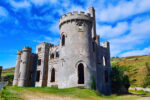
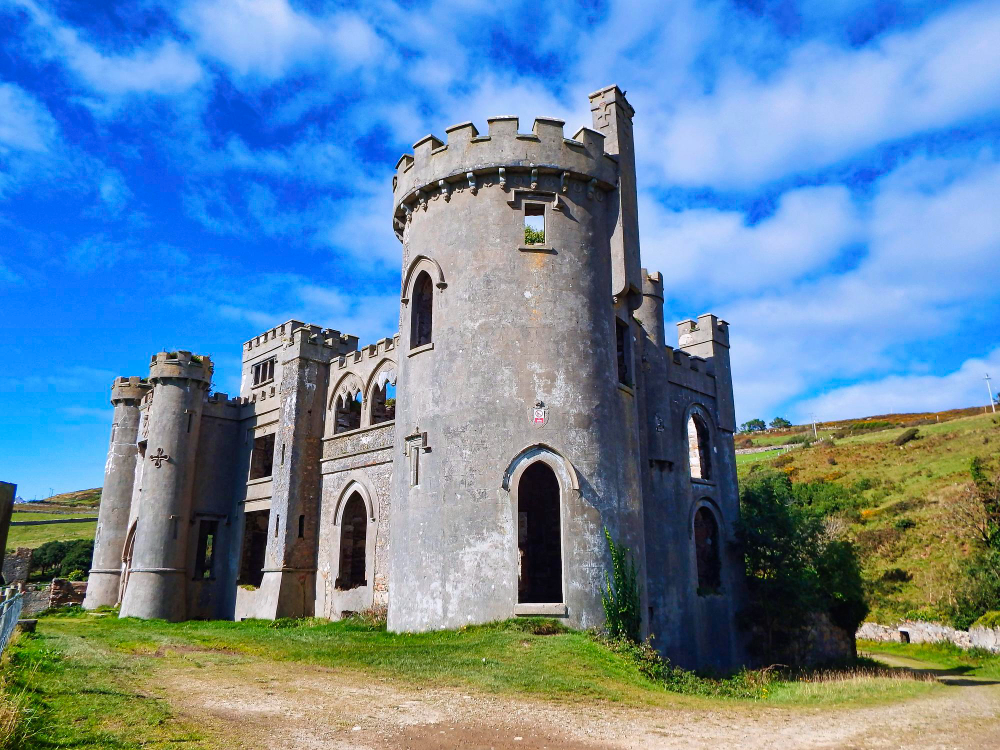
To the west of the small town of Clifden, nestled in the rugged and picturesque landscape of Connemara in County Galway, stands the ruined manor house of Clifden Castle – an impressive relic from the era of 19th-century Irish landed gentry. Built around 1818 in the Neo-Gothic style, the castle now stands as a symbol of the region’s turbulent history, the splendour of days gone by, and the challenges that have shaped the land and its people over the centuries.
The Origins of Clifden Castle – Clifden Castle was built around 1818 at the instigation of John D’Arcy, the local landowner and founder of the town of Clifden. D’Arcy, born in 1785, was a visionary landowner who set himself the task of transforming the inhospitable moorland on Ireland’s west coast into a thriving settlement. Whilst developing the town of Clifden, he built his castle as the main residence for his family. The building combines typical features of the Neo-Gothic style: sturdy round towers, an imposing gatehouse with two round turrets, and a square tower, all of which lend the estate a medieval flair. This is complemented by a large archway dating from 1815, which marks the entrance to the estate. In addition to his architectural ambitions, D’Arcy also had the surrounding lands drained and reclaimed – an important step towards increasing agricultural productivity and laying the foundations for the economic strength of his estates.
The Rise and Fall of the D’Arcy Family – Following the death of John D’Arcy in 1839, his eldest son Hyacinth inherited the estate, but times were to change dramatically. Hyacinth proved to be a less capable steward, relations with the tenants deteriorated, and the political and social situation in Ireland grew increasingly dire. Particularly devastating was the Great Famine (1845–1850), triggered by the collapse of the potato harvest due to potato blight. The famine had devastating consequences: people fell ill en masse from starvation and fever; many died or saw no other way out than to emigrate, primarily to America. The economic fallout hit the D’Arcy family hard, as rental income fell dramatically. A notorious incident took place on 21 September 1846, when desperate tenants gathered on Hyacinth D’Arcy’s lawn to beg for work or food – a scene of profound social misery. The decline of the D’Arcy estates was complete. In 1850, their landholdings, including Clifden Castle, were sold at forced auction. The buyers were the brothers Thomas and Charles Eyre from Bath, England, who had already held an interest in the estates as mortgagees since 1837.
The Eyre Era: Holiday Villa and Absentee Ownership – The Eyre family used the castle primarily as a summer residence and made stylistic alterations to the façade – most of the decorative elements visible today were added, particularly during the 1850s and 1860s. However, the estate was no longer a permanently inhabited castle, but rather a prestigious retreat far from their home in England. Thomas Eyre attempted to buy out his brother and, in 1864, gifted the estate to his nephew John Joseph Eyre from London. Yet despite the ownership arrangements, the Eyres were largely absent – a typical phenomenon amongst landowners of the time, who often lived abroad whilst managing their estates in Ireland. Following John Joseph’s death in 1894, trustees and estate managers took over the running of the estate. No direct owner was left to look after the castle. Eventually, the estate became uninhabited, the castle began to fall into disrepair, and the surrounding land was leased out as pasture.
Conflicts and Changes of Ownership in the 20th Century – The first private buyer from the region was the butcher J.B. Joyce in 1917, whose purchase of the former country estate led to considerable tension. Many smallholders, who had retained their own farms through government measures such as the Congested Districts Board programmes, saw the Clifden Castle estate as an opportunity to expand their agricultural land. The fruitless negotiations with the Board led to Joyce purchasing the land – a move that met with massive opposition in the predominantly Catholic community. The local priest, Canon Patrick McAlpine, led a vehement public campaign against Joyce, who was branded a ‘land grabber’ by sections of the population. There were repeated outbreaks of violence at gatherings, with stones being thrown at the police, and Joyce’s livestock was driven from the pastures on several occasions. These tensions reflected the general social upheavals and the land issue in Ireland, which had a profound impact on society at that time. It was only in 1920 that an arbitration tribunal, supported by the politically dominant group Sinn Féin, reached a compromise solution: Joyce agreed to sell the land to a cooperative founded by farmers – on condition that the castle and woodland were to be preserved as common property. This cooperative – the ‘Clifden Cooperative’ – was founded in November 1921.
From Decay to Ruin – Nevertheless, the building’s fate was sealed. Although it initially remained in the cooperative’s possession, the cost of maintaining the dilapidated castle complex proved unsustainable in the long term. In 1935, the Land Commission purchased the land and transferred ownership of the castle jointly to the tenants. The castle rapidly lost its protection from the elements following the removal of the roof, window frames, wooden floors and lead. Without these elements, it did not take long for the once magnificent residence to crumble into a field of ruins. Today, only the massive remains of the walls are preserved. Parts of the site are used as cattle sheds, whilst the surrounding meadows are grazed by cows, sheep and horses.
Architectural Features and Legends – The architecture of Clifden Castle displays classic Gothic features, including turrets, bay windows and battlements, which were regarded at the time as symbols of power and tradition. The original design dates from the early 19th century, though many decorative elements are attributable to alterations made by the Eyres. On the path from the main gate to the castle ruins stand several stone menhirs, which John D’Arcy had placed on the grounds. Some of these stones may even be of prehistoric origin. In the surrounding area, there are also the remains of a so-called ‘marine temple’ – a small structure decorated with shells by the stream. Furthermore, near the access road lies a small children’s cemetery where three children of the Eyre family, who died in the 19th century, are buried. These distinctive features lend the castle grounds a mysterious character, which has given rise to numerous legends and stories that still capture the imagination of visitors and locals alike today.
Today: Cultural Heritage and Tourist Attraction – Today, Clifden Castle is owned by several families who share the property. The most prominent feature is the large gate, which can be seen from the famous Sky Road – a scenic route that attracts numerous visitors. From there, a winding path leads up to the castle walls, which are framed by the rolling landscape of Connemara. Although the castle lies in ruins, it exerts a powerful attraction due to its imposing silhouette, its historical significance and its connection to the stories of the Irish rural population. It bears witness to the changes Ireland underwent in the 19th and 20th centuries: from the rise of the landowning families, through the horrors of the Famine, to the social struggles over land ownership and self-determination.
Today, Clifden Castle stands as a majestic ruin amidst the spectacular landscape of Connemara. Its history tells of visionary landowners, the tragic suffering of the local people, bitter social struggles and, ultimately, the inevitable decline of what was once a magnificent manor house. As a tourist attraction and a monument, it remains an important part of Irish history, conveying both history and myth to visitors alike.
Clifden Castle: The fascinating history of a Gothic ruin in Connemara

Tagged:Alnwick Castle EventsAncient Fortresses in EnglandAncientMonumentsArchitecturalMarvelsArchitecturalWondersArchitectureGermanyAustria Castle ToursAustriaHistoryAustrian Castle ListAustrian CastlesAustrianCastlesAustrianJourneyAutumn Foliage Castles EnglandAutumnCastleBavarian CastlesBeautiful Castles in AustriaBeautifulCastlesBelieveInMagicBest Castles in HollandBest Castles to Visit EnglandBest Castles to Visit in AustriaBest castles to visit in GermanyBurg KreuzensteinCastleCastle DefenseCastle Festivals in EnglandCastle GardensCastle Hotels AustriaCastle Hotels NetherlandsCastle in EnglandCastle InteriorsCastle LegendsCastle RestorationCastle Towers in EnglandCastle Walls and Architecture EnglandCastleAdventuresCastleArtCastleCelebrationsCastleChallengeCastleCraftsCastleCultureCastleDebateCastleDecorCastleEducationCastleExplorationsCastleExplorersCastleGiftShopCastleHeritageCastleHistoryCastleInAustriaCastleInEuropeCastleInTheSkyCastleLegendsCastleMerchCastleofGermanyCastlePhotographyCastleQuizCastleRuinsCastles along the Rhine RiverCastles in the Black ForestCastles in the NetherlandsCastles near BerlinCastles Near ViennaCastleSilhouetteCastleSouvenirsCastleStoriesCastleSunsetCastleTourCastleTourismCastleViewsCastleWeddingChateauLifeChristmas Markets in English CastlesCountrysideCastleCulturalGermanyCulturalHeritageDestinationCastleDiscoverAustriaDover Castle HistoryDragonCastleDreamBigDreamCastleVenueDreamDestinationsDutch Castle ToursDutchCastlesElvenPalaceEnchanted Castles in EnglandEnchantedEveningsEnchantingPlacesEnglish Castle Musical ConcertsEnglish Heritage SitesEpicBattlesEpicCastlesEuropeAdventureEuropeanArchitectureEuropeanCastlesEuropeanHistoryEuropeBucketListEuropeTravelGuideExploreEuropeExploreNetherlandsFairytale CastlesFairytale Castles AustriaFairyTaleCastleFamily-Friendly Castles EnglandFamous Austrian CastlesFamous castles in GermanyFamous Dutch CastlesFantasy CastlesFantasyCastleFantasyWorldFilm Locations in English CastlesFollowTheCastleGerman castle ArchitectureGerman castle guideGerman castle historyGerman castle toursGerman castle trip plannerGermanCastlesGermanHistoryGermany castle HotelsGermany palace toursGermany's fairytale CastlesGermanyCastleGermanyLandmarksGermanyPhotographyGermanyTourismGermanyTripGermanyVacationGhost Tours English CastlesGhostlyResidencesGothic Castles EnglandGothicCastleGreat Halls of English CastlesHalloweenCastleHaunted CastlesHaunted Castles AustriaHauntingHallsHidden castles GermanyHiddenCastleHiddenGemsHiddenGemsNLHistoric German CastlesHistoric Sites in AustriaHistoricalSitesHistoricAustriaHistoricCastleHistoricCastlesHistoricGermanyHistoricLandmarksHohensalzburg FortressHohenzollern CastleHollandHistoryIconicCastlesKingdomOfMysteryKnightlyQuestsKnights and NobilityLeeds Castle GardensLegendary English CastlesLegendaryStructuresLiechtenstein CastleLiveLikeRoyaltyLocalCastleLuxury Castles AustriaMagical CastlesMagicCastleMagnificentCastlesMajestic Castles of EnglandMajesticCastlesMedieval Castles in AustriaMedieval Castles in EnglandMedieval castles in GermanyMedievalCastlesMedievalDreamMedievalFortressMedievalGermanyMustSeeCastlesMysteryUncoveredMythicalManorNetherlands Castle EventsNetherlands Historical SitesNetherlandsCastleNorman Conquest England CastlesOldWorldCharmPalaceTourPicturesque Castles EnglandPrincessDreamsRegalResidencesRomantic Castles for Weddings EnglandRomantic castles in GermanyRomanticEscapesRoyal ResidencesRoyal Residences in EnglandRoyalCastlesRoyalEventRoyalResidencesScenicGermanyScenicViewsSchloss ArtstettenSchönbrunn PalaceSecretCastleSpring in English CastlesSpringCastleStoneFortressesSummer Events at English CastlesSummerAtTheCastleTimelessBeautyTop Castles in AustriaTravelAustriaTravelBackInTimeTravelEuropeTravelGermanyTravelNetherlandsTudor Architecture EnglandUrbanCastleVampireCastleVisiting Austrian CastlesVisiting Castles in EnglandVisiting Dutch CastlesVisiting Neuschwanstein CastleVisitingAustriaWanderlustCastleWarwick Castle AttractionsWeekend Getaway NetherlandsWindsor Castle ToursWinter Wonderland Castles EnglandWinterCastleWinterWonderlandCastleWizardsKeep