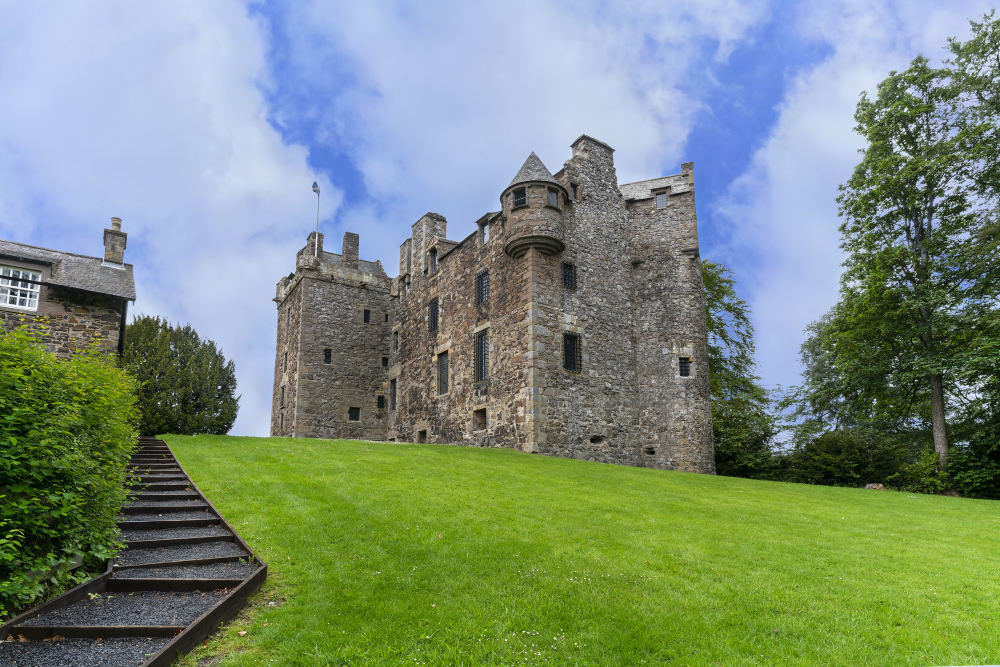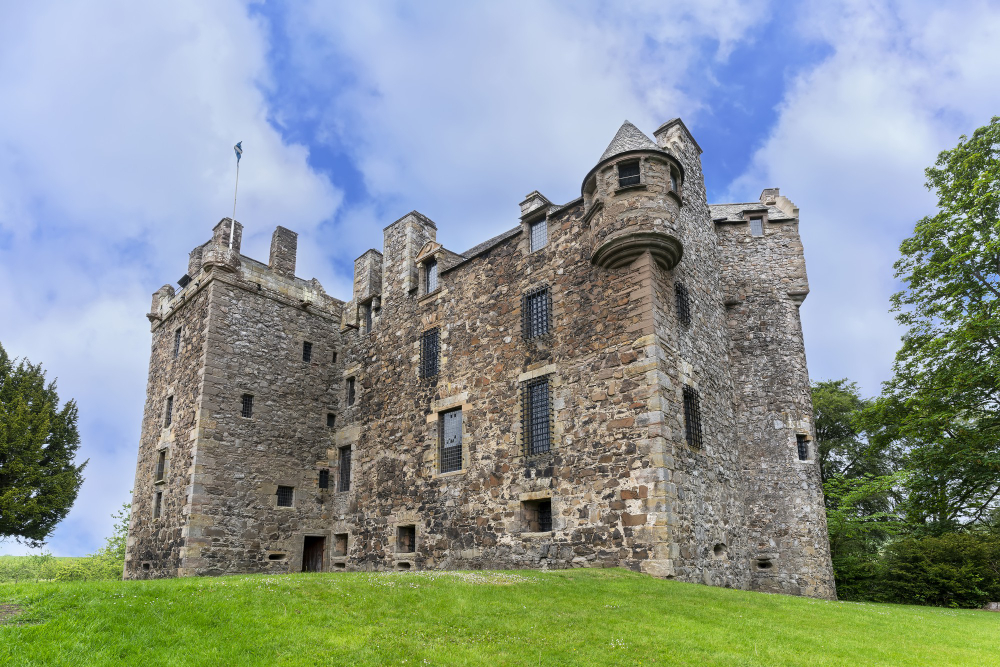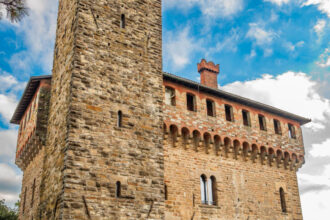

Tucked away on the south bank of the mighty River Tay, some 6.5 kilometres south-east of Perth, lies the venerable Elcho Castle. These impressive castle ruins, with their Z-shaped layout, harbour not only architectural refinements but also stories that transport us to times long past. Since its construction around 1560, it has towered over the landscape, telling tales of Scottish families, architectural innovations and a deep-rooted heritage. But what makes Elcho Castle so special, and what fascinating legends surround this historic site?
The beginnings of a castle: A journey back to the year 1560 – Elcho Castle was built in the mid-16th century, likely to replace an older building on the same site. The period in which it was constructed marks an era of political and social upheaval. Whilst the Scottish Reformation was reshaping the religious landscape and the Renaissance was spreading its cultural influence, a castle emerged there that was more modern than many of its contemporaries. The keep and the surrounding walls were laid out in a Z-shape – a design that served not only as a demonstration of power but also aided defence. The architect ensured that the corner towers occupied strategically valuable positions to repel potential attackers. Despite its military function, however, the castle was equally a symbol of wealth and influence. The builder was a member of the prominent Wemyss family, whose name is inextricably linked to the estate.
The Legacy of the Wemyss Family – To this day, the estate belongs to the Wemyss family, who have carved out a distinguished place for themselves in Scottish society over the centuries. The current holder of the title ‘Earl of Wemyss’ bears the courtesy title ‘Lord Elcho’, a reminder of how close the connection between the family and the castle is. Although Elcho Castle has not been permanently inhabited for more than 200 years, the family has placed great importance on the preservation of the building. It was one of the first examples in Scotland of a historic site preserved solely for reasons of cultural heritage. This early decision has contributed to Elcho Castle now being one of the best-preserved castles of its era.
Architectural marvel: A stroll through the castle – Visitors who pass through the gates of Elcho Castle enter a building that appears both dilapidated and alive. Large parts of the castle are accessible, and although some ceilings in the rooms have collapsed, the charm of the old architecture remains palpable. A particular highlight is the battlement walk along the castle wall. This is accessible at two points and offers a spectacular view of the surrounding countryside. One can almost imagine how guards once patrolled there, keeping watch for threats. The interior of the castle, in turn, gives an impression of what life might have been like in the 16th century – even if the ravages of time are clearly visible.
The mysterious orchard and the dovecote – Not far from the castle walls lies a picturesque orchard that has recently been replanted. Here stand apple and pear trees, a reminder of the region’s agricultural heritage. Historians believe that the original orchard was already part of the castle grounds as early as the 16th century and may have served to provide for the inhabitants. Next to the orchard stands the so-called ‘Doo’cot’ – a beehive-shaped dovecote from the same period. This small structure bears witness to the highly developed agriculture of Renaissance Scotland, when pigeons were kept both as a source of food and for the production of manure. Today, the Doo’cot is a Category A listed building and offers visitors an insight into the estate’s outbuildings.
Myths and Legends: Elcho Castle as a Setting for Stories – Like many historic sites, Elcho Castle is shrouded in legend. One of the best-known stories concerns a ghost said to haunt the castle. It is believed that this ghost is a former resident who met a tragic end whilst defending the castle. Visitors occasionally report strange noises and unexplained apparitions. Another legend tells of a treasure said to be hidden somewhere on the grounds. According to tradition, it is a chest full of gold and jewels that a family member is said to have hidden during a conflict. Although archaeologists have so far been unable to find any evidence for this story, it lends Elcho Castle a mysterious aura that attracts visitors from all over the world.
Protection and Conservation: Elcho Castle Today – Today, Elcho Castle is managed by Historic Scotland, an organisation dedicated to the conservation of historic sites in Scotland. Thanks to their efforts, the castle is open to the public throughout the summer. Visitors can explore the grounds free of charge and immerse themselves in history. Historic Scotland’s commitment has not only helped to save Elcho Castle from decay but has also raised awareness of the importance of such places. The castle is also recognised as a ‘Scheduled Monument’, meaning it is subject to strict heritage protection.
A place steeped in history and mystery – Elcho Castle is more than just a castle ruin – it is a window into the past, a testament to the generations who have shaped this land. Its architecture, stories and legends make it an indispensable part of Scotland’s cultural heritage. Whether you’re exploring the battlements, marvelling at the mysterious orchard or drawing inspiration from the myths – a visit to Elcho Castle promises a journey into the past. The fact that the castle is still associated with the Wemyss family lends it a personal touch. It is not merely a historic building – it is a living part of Scottish history, whose magic draws every visitor deeper into its spell.