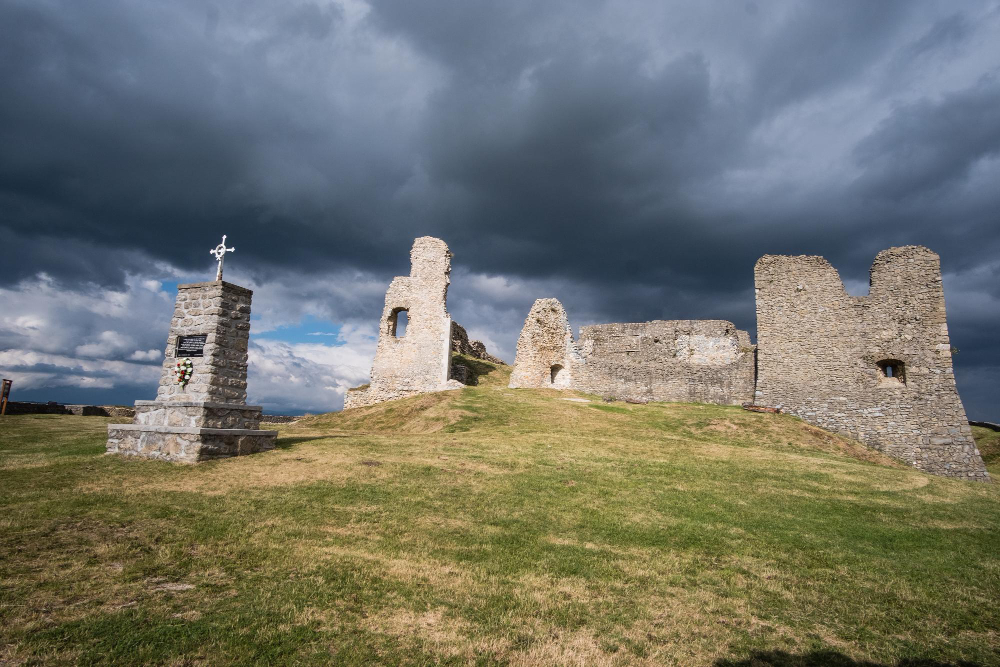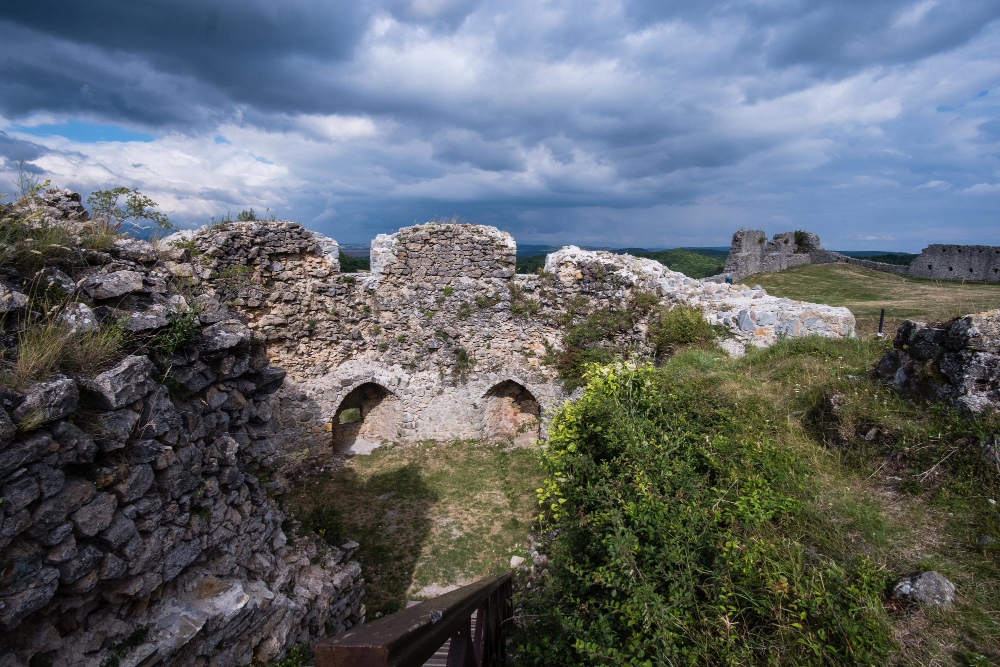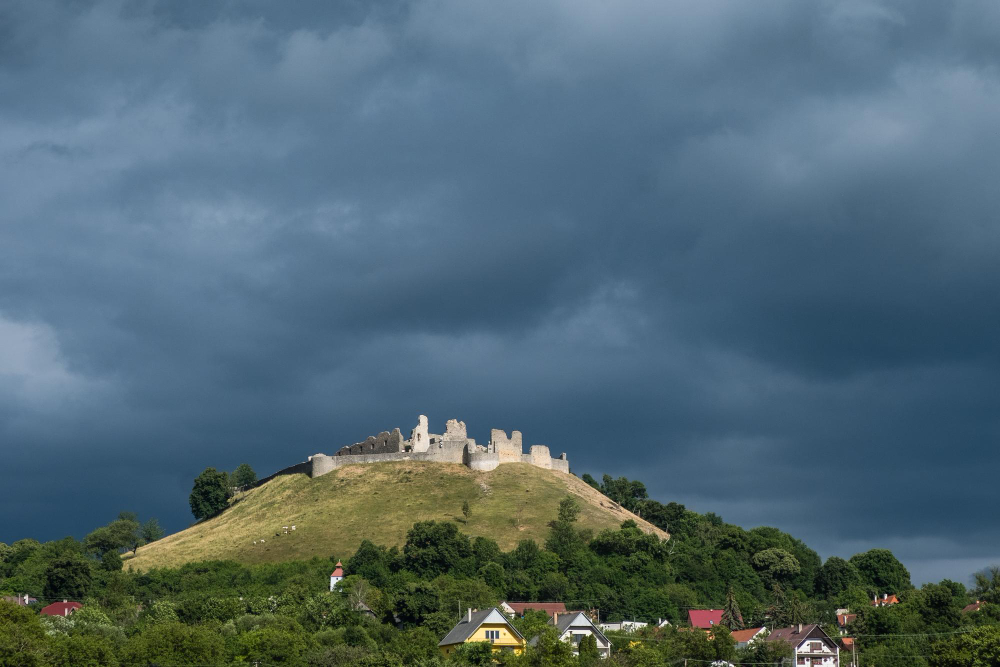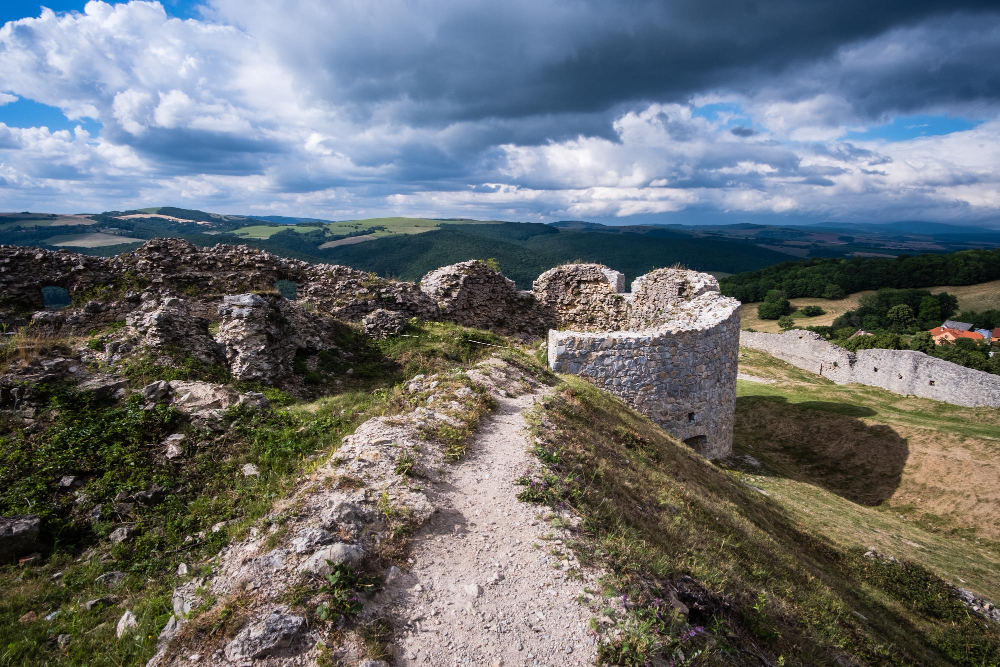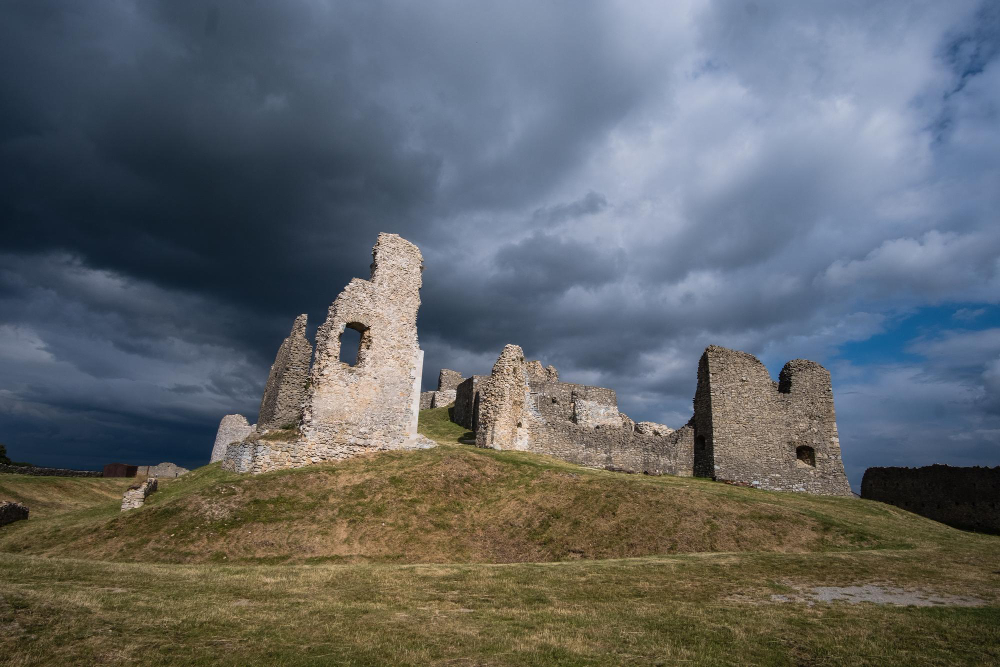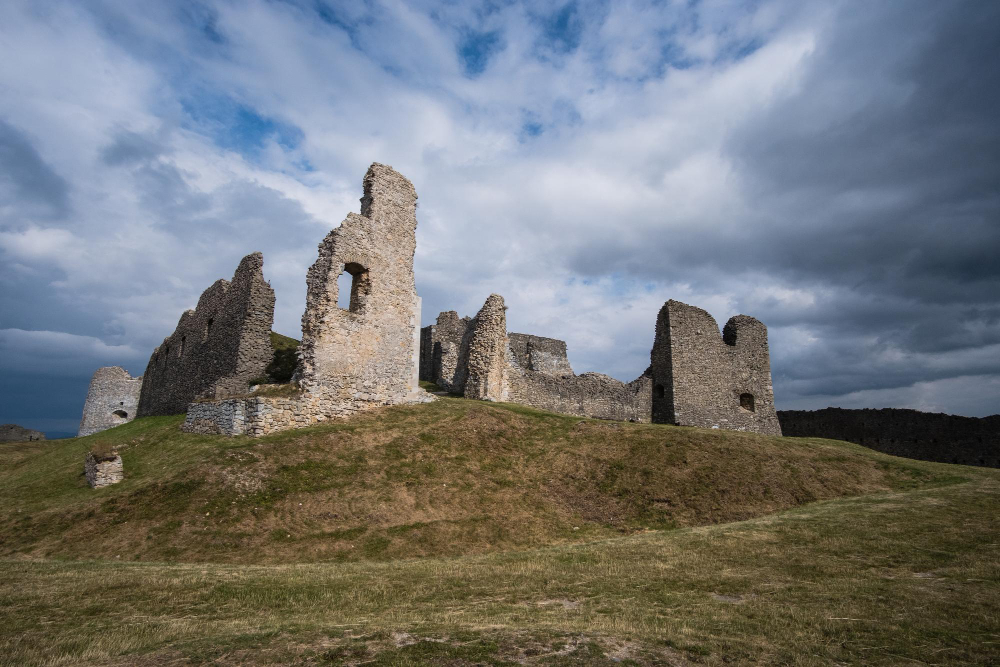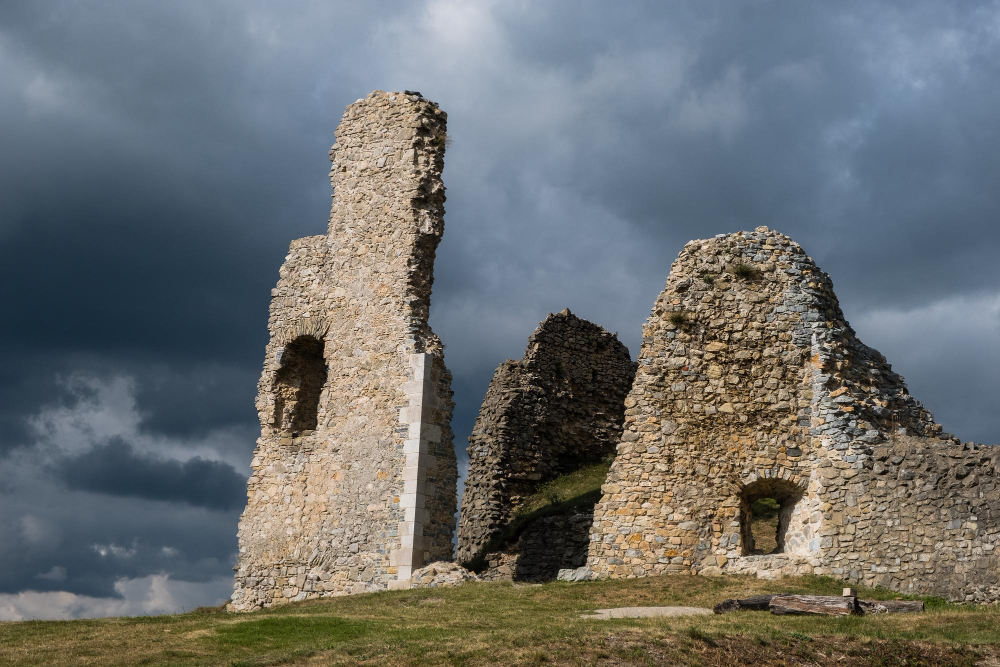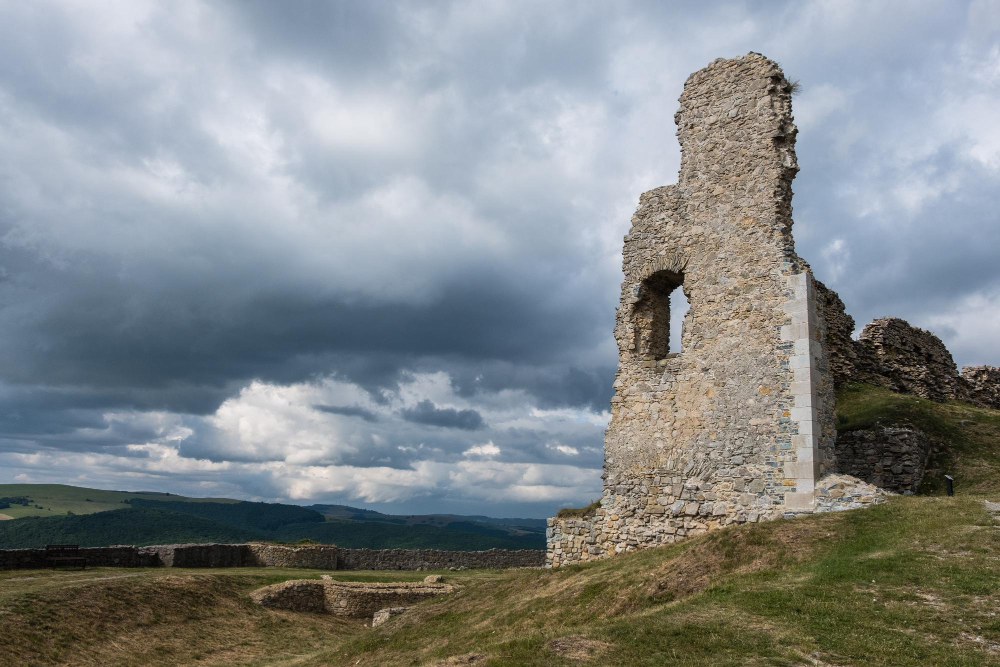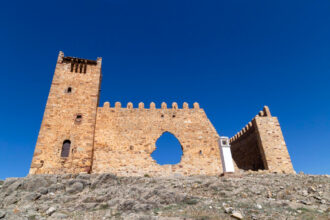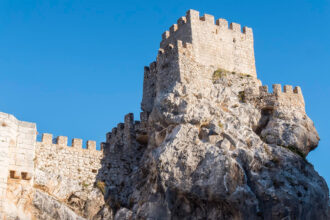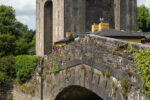

High above the village of Podbranč in the Trnava region of western Slovakia stands a ruin that dominates the landscape even from a great distance. Branč Castle, known in Slovak as Hrad Branč, is situated on a 475-meter-high hill near Senica. From its walls, the view sweeps across the gentle hills and plains of the Záhorie region—but its location was never significant solely for the view. Branč served as a border castle, an administrative center, a military stronghold, and, at times, a place of terror. Today, collapsed walls, deep moats, and restored sections of the fortifications bear witness to more than seven centuries of eventful history.
The castle is one of the oldest surviving castle complexes in Záhorie. It was first mentioned in a document in 1317. However, archaeological and numismatic evidence suggests that its origins date back further: coin finds from the years 1251 to 1261 indicate that the complex was already in existence by the mid-13th century. Master Aba of Hlohovec, a member of an influential noble family in the Kingdom of Hungary—which at the time included the territory of present-day Slovakia—is considered a possible builder.
Guard Posts on the Routes to Moravia – Branč’s location was strategically chosen. The castle was part of a network of fortresses designed to secure trade and military routes between Moravia, western Slovakia, and the mountain passes into the Carpathians. Whoever controlled this hilltop castle not only monitored the immediate surroundings but also key transportation routes to the north and west. In the Middle Ages, such structures were far more than mere defensive fortifications. Branč formed the center of an extensive domain. From here, estates were administered, taxes collected, and justice administered. At the same time, the fortified hilltop offered protection in an era when power struggles between nobles, kings, and regional warlords were a daily occurrence. Even the first decades of the castle’s recorded history reveal just how coveted this location was. In 1297, the Aba family exchanged their holdings—which included the stone castle of Branč—with Master Abrahám Rúfus for other estates. However, the new owner was unable to hold onto the complex for long. In 1309, Matthias III Csák, one of the most powerful magnates of his time, forced him to surrender the castle and his domain. After Csák’s death, Branč temporarily passed to his relative, Master Štefan of Šternberk. The Crown itself also held the castle for a time. Among its owners were King Charles Robert of Anjou and John of Luxembourg. In 1394, Branč was owned by King Sigismund of Luxembourg, who subsequently transferred the castle to Stibor of Stiborice. A significant phase of construction began under his rule.
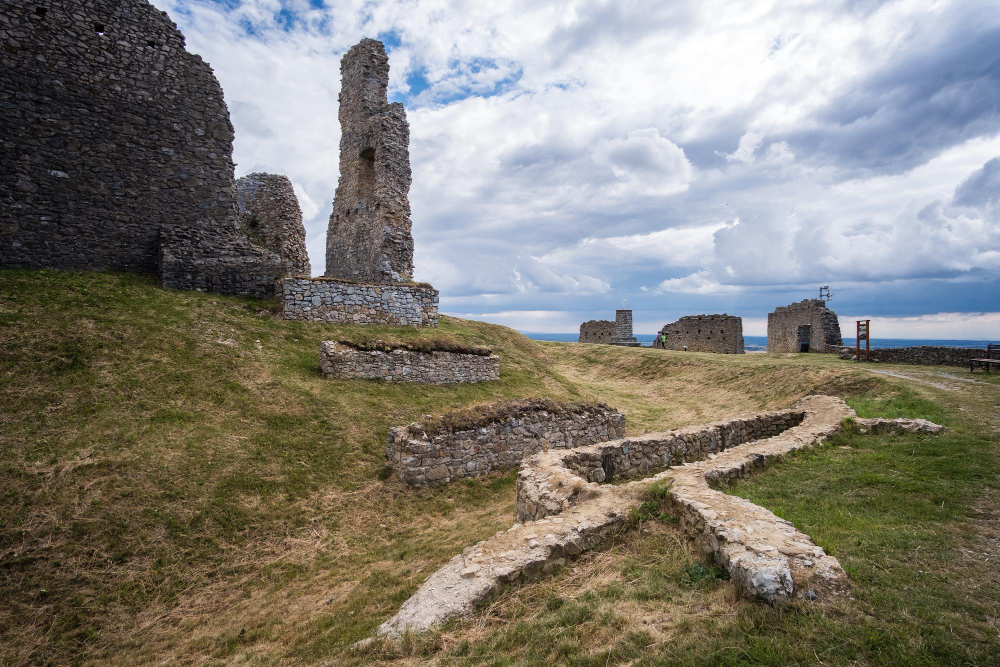
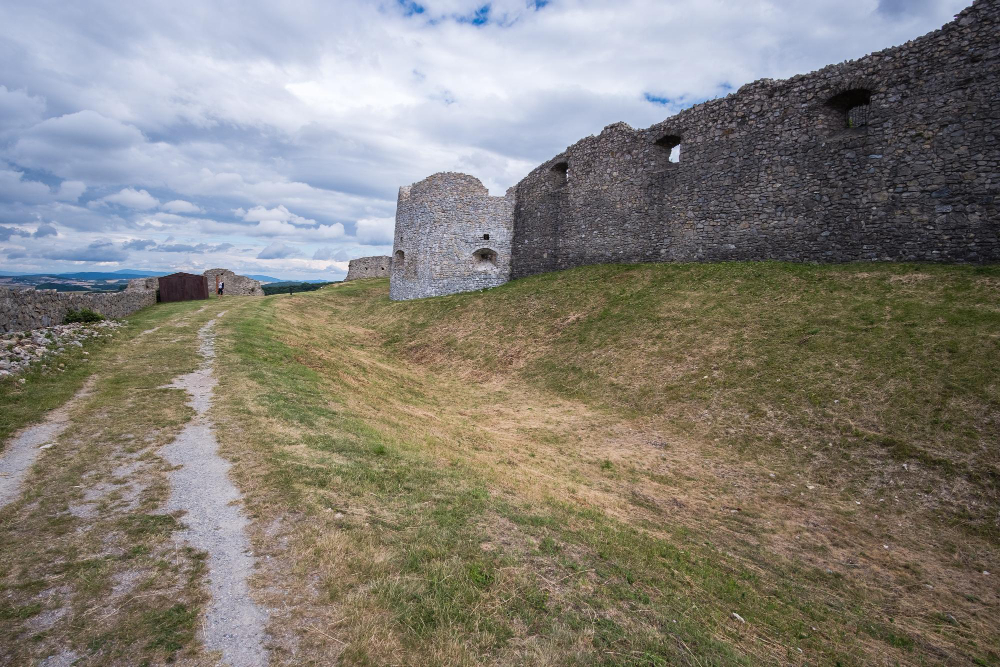
A Gothic Fortress Rises from the Rock – The medieval castle was not built as a single, unified structure, but was expanded, remodeled, and adapted to new military requirements over the course of centuries. The oldest sections were located on the east side of the inner courtyard: a two-room palace building that formed the core of the complex. Under Stibor of Stiborice, the central castle took on a distinctly Gothic character. A palace, a chapel, an attack or defensive tower, and high perimeter walls were built or expanded. The exposed location on the rocky hill was an essential part of the defensive strategy. Natural steep slopes made access difficult, while artificially constructed moats and walls provided additional security for the few vulnerable sides. Today, the ruins are primarily divided into the Lower Castle and the Middle Castle. Between the two lies a strikingly deep, dry moat. It significantly reinforced the natural protective effect of the terrain. Even where the terrain appears relatively flat, attackers once had to cross a moat section approximately 80 meters long—and were exposed to fire from the walls while doing so. The entrance to the Middle Castle was originally located at a corner opposite today’s memorial. The defenders could control the path to the entrance and engage attackers from an elevated position. Inside the complex were courtyards, living quarters, staircases, and service areas. A staircase led from the courtyard to an atrium-like interior and to the individual rooms of the palace. Sources indicate that the residential complex was remarkably large: the castle is said to have had a total of about 40 rooms—15 on the ground floor, 20 on the first floor, and five on another floor. Water was vital for any castle capable of withstanding a siege. There was a well in the western courtyard area of the Lower Castle; an older well was also located in the courtyard of the Middle Castle.
The Lord of the Castle as a Bandit: Pongrác Szentmiklósi – One of the most colorful—but also most notorious—episodes in the castle’s history occurred around 1453. At that time, Pongrác Szentmiklósi took possession of Branč. He is known in historical accounts as a warrior and notorious bandit. From the castle, he undertook raids into Moravia and Austria. The story of this lord of the castle illustrates just how blurred the line between military power, feuding, and outright robbery could be in late-medieval Central Europe. A well-fortified castle was not only a residence but also a military stronghold. Whoever possessed such a structure could control roads, enforce tribute payments, and advance far into neighboring territories with an armed retinue. Branč was particularly well-suited for this purpose due to its location. Today, the ruins stand peacefully in a popular hiking area. In the 15th century, however, the castle was an instrument of power from which conflicts and raids could be launched into neighboring regions.
Nyáry, Mohács, and the 16th-Century Expansion – At the beginning of the 16th century, ownership of the Branč estate was divided. One part belonged to Osvald, lord of the nearby Korlátka Castle. The other part belonged to Eufrozína Pongrácz, who was married to Bernard Nyári. Following the catastrophic defeat of the Hungarian army by the Ottomans at the Battle of Mohács in 1526, their son Ferenc Nyáry moved to his mother’s estate at Branč. Through his marriage to Alžbeta, a granddaughter of Osvald, Ferenc Nyáry consolidated further portions of the estate. His era marked a period during which many castles in the Kingdom of Hungary were rebuilt due to the Ottoman threat and advances in artillery. Branč, too, underwent further fortification improvements. A particularly revealing find documents this architectural history. During archaeological excavations, a decorative stone corbel bearing a coat of arms was discovered. It bears the date 1539 as well as the monogram of František Nyáry and indicates the completion of a reconstruction of the castle. The complex was thus not merely a medieval ruin in the making, but was deliberately modernized once again in the 16th century. Ferenc Nyáry died childless in 1551 and bequeathed his estates to relatives. The last members of the Nyáry family initially continued to live in Branč but built a new manor house in nearby Sobotište. Gradually, their center of life shifted there. This development was typical of many castles in the region: as living standards improved and social expectations changed, high-altitude fortified castles lost significance in favor of more comfortable country estates.
Prison for Protestant Clergy – The castle’s final days as an inhabited manor came during the conflict-ridden second half of the 17th century. During the Thököly Uprising—a rebellion against the Habsburgs—fighting broke out around Branč in 1683. At that time, the complex was administered solely by a castellan, or castle steward. Particularly harrowing is a chapter linked to the religious conflicts of the time. Branč served at times as a place of imprisonment for Protestant clergy who had been sentenced to galley servitude. Historical accounts report that numerous prisoners died in the so-called “pits” at or near the castle. A memorial on the castle grounds commemorates this fate today. Thus, Branč is not merely a testament to feudal power and military architecture. The ruins also serve as a memorial to the persecution of Protestant clergy in the 17th century. It is precisely this connection between architectural history and human suffering that lends the site a special historical depth.
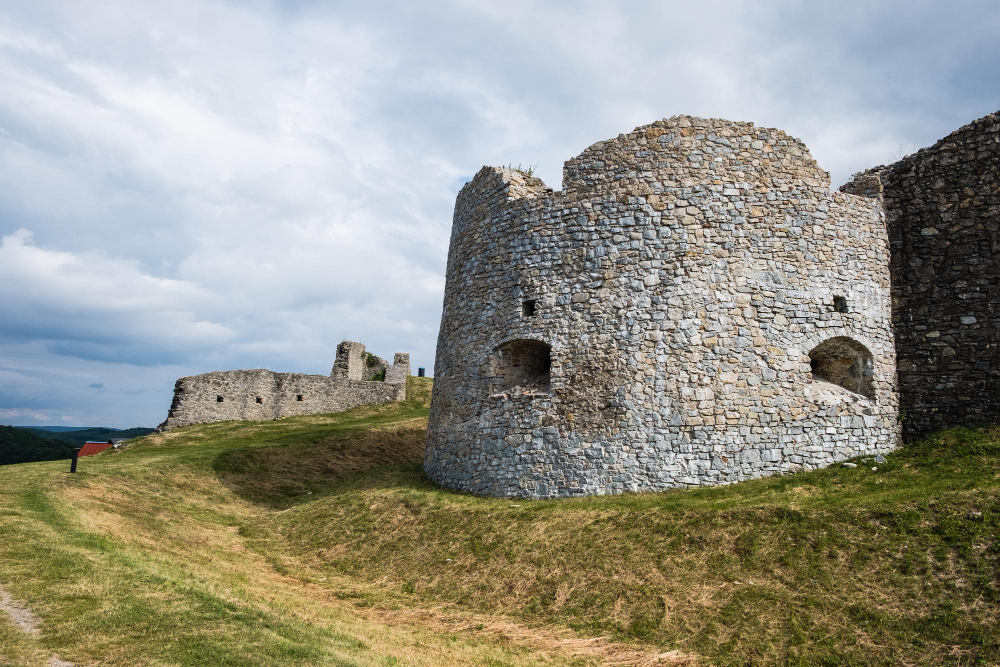
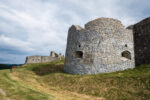
Fire, Decay, and Archaeological Rediscovery – Following the unrest of the late 17th century, Branč was destroyed by fire. By the early 18th century, the structures were already severely damaged. Previous owners apparently had parts of the complex deliberately damaged; at the same time, walls and fortifications fell into disrepair. The castle was finally abandoned and turned into a ruin. The first attempts at historical restoration took place in 1968, but they were never completed. The castle has been the subject of archaeological investigation since 1978. During several excavation campaigns, architectural remains, fragments of windows and doors, and original wooden elements were uncovered. These findings enable researchers to trace the complex development of the complex more accurately. After 1989, investigations and conservation efforts focused on individual areas at risk. Among other things, the particularly endangered side wall of the gate tower in the Inner Castle was stabilized. In 2009, a section of the southern wall of the Upper Castle—which had collapsed as early as 1978—was restored. By 2012, the round cannon bastion at the northeastern corner of the Middle Castle had also been secured. Subsequent research focused on the East Palace, the western wall of the first forecourt, and the West Palace. Branč thus remains a ruin, but not a forgotten one. Every section of wall that has been stabilized and every archaeological investigation adds another detail to the picture of this castle. Anyone who climbs the hill above Podbranč today is not entering a fully reconstructed museum complex. This is precisely what makes the site so compelling: amid the exposed walls, ditches, and remains of former living quarters, it becomes clear how a border fortress has weathered centuries of power, war, religious conflicts, and decay.